

Read the first chapter
The whole of chapter one, free. About 9 min. Turn the pages with the arrows, your keyboard, or a swipe.
Chapter 1
Why 1994 Felt Like a Miracle
A Country Votes Itself Into Being
On 27 April 1994, South Africans stood in queues that often stretched for hours, sometimes through the night, to cast the first vote in which every adult citizen could participate. The remarkable fact was not simply that apartheid had ended. It was that a country built on racial domination had reached a national election without descending into the civil war many had feared.
The ballot carried an extraordinary burden. It was a vote for political equality, but also a verdict on decades of forced removals, banned organisations, police violence and economic exclusion. For many white South Africans, it marked the loss of political control; for millions of black South Africans, it was the first formal recognition of a citizenship the state had long denied.
That is why 1994 felt like a miracle. Yet miracles, in politics as in religion, often conceal the machinery that made them possible. The settlement created a democratic state, but it did not rebuild society from the ground up. Political power changed hands more quickly than land, capital, skills and ownership did.
How could a country achieve one of the most hopeful political transitions of the modern era while carrying so much of its old economic structure into the future?
The Long Road to the Queue
The election was the visible ending of a much longer crisis. By the late 1980s, apartheid had become increasingly difficult to govern and increasingly costly to defend. Internal resistance had spread through townships, workplaces, schools and civic organisations. International sanctions and financial pressure narrowed the government’s room to manoeuvre. The security forces could suppress protests, but they could not create legitimacy.
The African National Congress remained banned, and its leaders were imprisoned or in exile. Yet the organisation’s political presence could not be erased. The release of Nelson Mandela in February 1990 was followed by the unbanning of the ANC and other liberation movements. Those decisions did not produce peace overnight. The early 1990s saw political violence, especially in KwaZulu-Natal and parts of the Reef, where the ANC and Inkatha Freedom Party competed for influence and supporters were killed in township and rural conflicts.
Negotiation therefore took place under pressure from several directions. The government of F. W. de Klerk wanted a controlled transition that protected state continuity and white interests. The ANC wanted majority rule and a democratic constitution. Smaller parties feared being swallowed by a settlement made by the two largest forces. Behind all of them stood an exhausted society, aware that the country could not continue as before but uncertain what would replace it.
The negotiations were not a clean handover. They were a process of bargaining, interruption and recalculation. The Convention for a Democratic South Africa began in 1991, but talks repeatedly stalled. The massacre at Boipatong in 1992, in which residents were killed amid allegations of police complicity, brought the country close to a wider breakdown. The assassination of Chris Hani in April 1993 produced an equally dangerous moment. Hani’s death threatened to ignite mass unrest, yet Mandela’s public address helped contain the immediate crisis.
The election that followed was therefore not the product of trust. It was the product of a shared recognition that the alternatives were worse. Competing political movements accepted rules they did not fully like because the country needed rules that everyone could enter.
That is the first part of the Miracle-and-Tradeoff Lens: political settlements are often secured not by eliminating fear, but by giving fearful groups enough protection to accept change.
The Architecture of the Compromise
The interim Constitution created a bridge between apartheid’s legal order and a future democratic one. It established a government of national unity, protected a wide range of rights and prepared the ground for the final Constitution adopted in 1996. The arrangement allowed the ANC to govern while bringing the National Party and the Inkatha Freedom Party into the executive.
This was a deliberate form of reassurance. The old ruling party did not simply disappear after losing power. White civil servants, judges, managers and security officials remained inside the state. The new government inherited the existing machinery because dismantling it all at once would have risked administrative collapse and possibly renewed violence.
The compromise also extended beyond political institutions. The Truth and Reconciliation Commission, established under the Promotion of National Unity and Reconciliation Act of 1995, offered amnesty to perpetrators who made full disclosure of politically motivated crimes. Its public hearings exposed torture, killings and disappearances, but it was not a conventional criminal court. The country chose disclosure and national repair over a broad programme of prosecutions.
That choice had moral and political consequences. It allowed victims to hear what had happened to relatives whose fates had been hidden. It also left many perpetrators outside prison and many families without material compensation proportionate to their losses. Reconciliation was treated as a condition for national stability, but stability could feel very different depending on which side of the old order one occupied.
The economic settlement was even less visible than the political one. The ANC entered government with a programme of redistribution, the Reconstruction and Development Programme, which promised houses, services, land reform and a more equal economy. In 1996, it adopted the Growth, Employment and Redistribution strategy, placing greater emphasis on fiscal discipline, investment and market confidence.
There were practical reasons for caution. South Africa needed investment, functioning banks, tax revenue and businesses capable of producing goods and jobs. A new government could not simply seize every company or replace every manager without damaging the economy on which public services depended. But caution also meant that ownership patterns changed slowly. The state could legislate political equality more quickly than it could transform accumulated wealth.
A useful comparison is the difference between changing the rules of a game and changing who owns the stadium. In 1994, the rules changed dramatically. The ownership of the stadium - land, mines, finance, industrial assets and established businesses - remained far more resistant.
When Political Freedom Met Economic Inheritance
The first democratic government inherited a society whose geography recorded its history. Townships were generally distant from major employment centres. Former homeland areas had weak infrastructure and limited economic opportunity. White households were more likely to possess property, savings, professional networks and access to quality schools. Black households entered democracy with legal citizenship but vastly unequal starting positions.
This did not mean that nothing changed. The democratic state expanded access to electricity, water, housing, pensions, schools and healthcare. Millions of people gained services that apartheid had either withheld or provided on a racially unequal basis. The Constitution established enforceable rights and independent courts. Parliament became representative of the population rather than a chamber reserved for white citizens.
But improvement and injustice could exist together. A family receiving a formal house in a township might still live far from work, with costly transport and few local jobs. A young person entering a desegregated school system might still inherit the effects of unequal schooling, language barriers and household poverty. Citizenship had been equalised in law while opportunity remained sharply divided in practice.
The surprise is that the most successful part of the transition was also the part that made the unfinished work less visible. Once people could vote, speak freely and challenge the state in court, the new order looked complete from the outside. Yet democratic rights did not automatically transfer productive assets, expertise or economic security.
This matters because it changes the meaning of the “miracle.” The achievement was not that South Africa solved its historical conflicts. It was that political leaders created a framework in which those conflicts could be contested without returning to formal racial rule. The settlement bought time. It did not guarantee what the country would do with that time.
Economic power also shaped the new politics in quieter ways. Businesses could influence policy through investment decisions, lobbying and the threat of capital leaving. Skilled professionals from the old order remained essential to administration and industry. The new state needed competence, but the supply of trained black professionals was still far too small after decades of exclusion. That shortage later created openings for patronage, factionalism and the politicisation of appointments.
The tradeoff was therefore not simply “freedom versus wealth.” It was a chain of linked decisions: preserve capacity to avoid collapse, reassure capital to protect the economy, retain experienced personnel to keep institutions running, and postpone deeper redistribution until the democratic state was stronger. Each decision was understandable. Together, they left the new order carrying an old economic weight.
A Queue, a Family, and a New Citizenship
The voting station at Ohlange High School in Durban carries particular historical meaning. Nelson Mandela cast his ballot there on 27 April 1994, at the site associated with John Langalibalele Dube, the founding president of the ANC. The location connected the first democratic election to an earlier tradition of African political organisation and education.
Across the country, ordinary voters experienced the election less as an abstract constitutional event than as a physical act: standing in line, showing identification, receiving a ballot, marking a party and placing the paper into a box. Many had never before been treated by the state as full political adults. The queue itself became a kind of public evidence. People who had been separated by race, residence and law now waited under the same electoral procedure.
Mandela’s vote at Ohlange symbolised the dignity of the moment, but the voters’ lives also revealed the limits of symbolism. A ballot could abolish political exclusion in an instant; it could not repair a family’s lost land, replace years of poor schooling or move a workplace closer to a township. The queue represented equality at the polling station, not equality in the economy.
That distinction became central to the country’s later disappointment. The promise of 1994 was experienced in moral and constitutional terms, but daily life was measured through jobs, housing, safety, transport and the reliability of public institutions. The distance between those two forms of freedom would widen whenever government failed to convert democratic authority into capable administration.
The people in that queue were not naïve about the difficulty ahead. Many understood that liberation would be gradual and that apartheid’s damage could not be undone by an election. What they could reasonably expect was movement: a state that worked more fairly, an economy that opened more widely and public leaders who treated office as a responsibility rather than a prize.
The settlement created the possibility of that future. It also created the conditions under which failure would be judged more sharply, because the new government now governed in the name of equality.
The Miracle and the Unfinished Inheritance
The transition of 1994 shows that societies can change their political identity faster than they change their material structure. South Africa became a democracy in a legal moment, but it remained an unequal country shaped by the accumulated advantages of apartheid.
That is not a contradiction to be tidied away. It is the central tension of the New South Africa: the same compromise that prevented catastrophe also limited how far the first transformation could reach. Freedom arrived as a shared political fact, while economic freedom remained a contested promise.
A country can be reborn at the ballot box and still carry its former life in its roads, schools, balance sheets and family fortunes. The question left by 1994 was not whether South Africa had changed, but what kind of change its institutions, leaders and citizens would make possible next.
End of chapter one. 34 more chapters and about 32,238 words in the full book.
Swipe or use the arrows to turn the page
What's inside: 35 chapters
- 1. Why 1994 Felt Like a Miracle
- 2. How the Constitution Built Guardrails
- 3. The Growth That Couldn’t Include Everyone
- 4. When the State Became a Prize
- 5. Two Worlds of the Same Crisis
- 6. What Voters Can Still Reclaim
- 7. An electoral shock that no pollster wanted to admit
- 8. What larger mystery is this electoral shock circling?
- 9. A single night that would not add up
- 10. The obvious story everyone tells — and why it feels true
- 11. A paradox on the steps of justice
- 12. The Echoes of Impunity
- 13. An unexpected outcome: personal enrichment as a public wound
- 14. Two distant scenes, one curious echo
- 15. How most people see group voting — and why that is incomplete
- 16. Properganda: When Information Becomes a Currency
- 17. A headline that feels like a promise — and a lie
- 18. The Trojan Horse at Luthuli House
- 19. Comrades at the Gate, Vultures at the Table
- 20. The Architecture of State Capture
- 21. Whispers Behind Closed Doors
- 22. The Great Darkness, the Dry Taps
- 23. The Promise at the Empty Tap
- 24. The Ballot Box Mutiny
- 25. The Arithmetic of Staying
- 26. The Ghosts of 1994
- 27. The Party That Turned Inward
- 28. Beyond the Liberation Dividend
- 29. Ashes or Dawn
- 30. The Second Transition
- 31. The Parties After the Break
- 32. The Future Is Still Contested
- 33. The Future of Belonging
- 34. The Peace That Must Be Renewed
- 35. Chapter 35: The Price of Trust
About this book
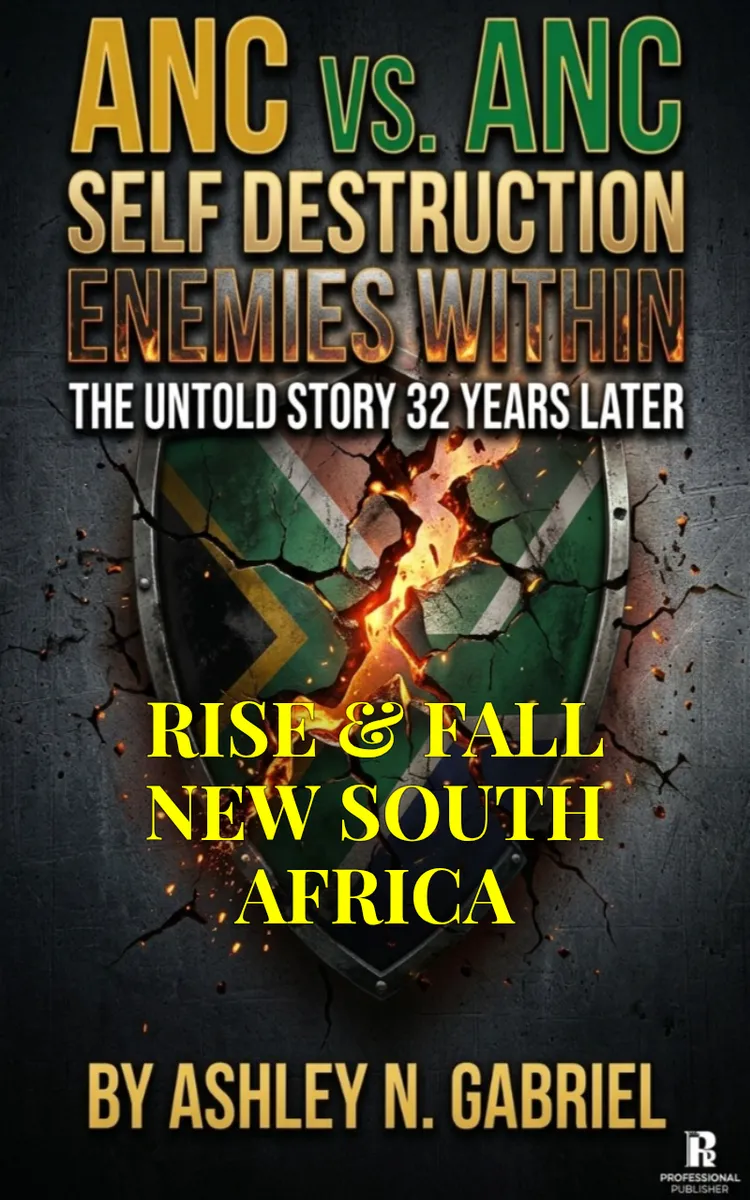
"The Rise And Fall Of The New SA" is a curiosity book by Ashley Noel Gabriel with 35 chapters and approximately 32,238 words. South Africa’s post-apartheid trajectory, institutional decline, inequality, and democratic resilience.
This book was created using Inkfluence AI, an AI-powered book generation platform that helps authors write, design, and publish complete books.
Frequently Asked Questions
What is "The Rise And Fall Of The New SA" about?
South Africa’s post-apartheid trajectory, institutional decline, inequality, and democratic resilience
How many chapters are in "The Rise And Fall Of The New SA"?
The book contains 35 chapters and approximately 32,238 words. Topics covered include Why 1994 Felt Like a Miracle, How the Constitution Built Guardrails, The Growth That Couldn’t Include Everyone, When the State Became a Prize, and more.
Who wrote "The Rise And Fall Of The New SA"?
This book was written by Ashley Noel Gabriel and created using Inkfluence AI, an AI book generation platform that helps authors write, design, and publish books.
Write your own curiosity book with AI
Describe your idea and Inkfluence writes the whole thing. Free to start.
Start writingCreated with Inkfluence AI


