

Read the first chapter
The whole of chapter one, free. About 11 min. Turn the pages with the arrows, your keyboard, or a swipe.
Chapter 1
Pipeline Failure That Wasn’t
The warning light on Stone Rivers’s phone turned red while the snowplow outside the Anchorage freight yard vanished behind a sheet of blowing ice.
He thumbed the message open.
PIPELINE OPERATIONS FAILURE. CRITICAL VALVE ACTUATOR OFFLINE. REPLACEMENT REQUIRED PRUDHOE BAY. IMMEDIATE DISPATCH.
Stone looked past the cracked office window at his tractor, its diesel idling hard beneath a skin of frost. The trailer waited under floodlights with a gray insulated cover cinched over the load. Beyond it, the yard fence rattled in the wind, and the Chugach Mountains had disappeared into the storm.
Routine run, he had been told.
Now the Trans Alaska Pipeline had a dead actuator somewhere north of the Brooks Range, and Stone’s contract had become the only thing standing between his bank account and the end of his marriage.
His phone buzzed again.
CALL OPERATIONS.
He stepped into the cold. Wind drove ice against his cheeks like thrown gravel. At forty-two, after most of his adult life behind the wheel of eighteen-wheelers, he knew the difference between ordinary bad weather and a storm that wanted to put a truck in a ditch. This one had teeth.
He climbed into the cab and slammed the door. The heater coughed warm air against his gloves. He dialed the number.
A man answered on the second ring. “Rivers.”
“Who’s this?”
“Dispatch coordinator. You’ve got the replacement actuator.”
“I was told the load wasn’t leaving until morning.”
“That was before the failure.”
Stone watched the wipers shove slush across the windshield. “What failed?”
“Actuator assembly. North Pump Station Four.”
“That assembly doesn’t just fail.”
A pause settled over the line.
Stone heard keyboard keys clicking in the background. Then the coordinator said, “It did.”
“Was it inspected?”
“Operations says the unit is nonresponsive.”
“That isn’t an answer.”
“It’s the answer on the report.”
Stone leaned forward, forearms on the wheel. “What’s the serial number?”
Another pause. Longer this time.
“You’ll get the paperwork at the gate.”
“I’m asking now.”
“Rivers, the clock is running. Load, fuel, and get north.”
The line went dead.
Stone stared at the phone. The yard lights blurred in the windshield, halos smeared by ice. He had hauled pipe sections, drilling equipment, frozen food, and once a replacement turbine blade that cost more than the house he and his wife had nearly lost. Equipment broke on the North Slope. Pumps seized. Hydraulics froze. Men made mistakes.
But a critical actuator did not simply quit without leaving a trail.
He climbed down and crossed the yard toward the loading office. The door banged against its frame as he entered. A woman in a red parka sat behind a counter, stamping documents into a plastic sleeve. Her hair was tucked beneath a wool cap, and a radio hissed beside her elbow.
“Stone Rivers?” she asked.
“That depends who’s asking.”
“Cargo release.” She slid a packet across the counter. “Sign here.”
He didn’t touch it. “I need the failure report.”
“You need to sign the release.”
“I need to know what I’m hauling.”
“An actuator.”
“For what?”
“Pipeline equipment.”
Stone looked at the packet. The top page carried a familiar company logo and a bold red line: PRIORITY EMERGENCY MOVEMENT.
Underneath, the routing instructions ran south first, then west, then north again.
He tapped the page. “Why does this route go through Fairbanks?”
“Because that’s the route they gave us.”
“The load is already in Anchorage.”
“Then it’ll still go through Fairbanks.”
“That adds hundreds of miles.”
“Not my decision.”
Stone flipped through the pages. The replacement was listed as a hydraulic valve actuator, model number HVA-77, serial number blank. Weight: 2,840 pounds. Dimensions: eight feet long, four feet wide, three feet high.
The packing certificate showed the crate had been sealed at a warehouse in Tacoma two days earlier.
The emergency order had been issued three hours ago.
Stone lifted his eyes. “This was shipped before the failure?”
The woman’s stamp stopped in midair.
“That’s what the date says.”
“Who ordered it?”
“You’re the driver.”
“I’m the one who gets killed if someone put the wrong thing on my trailer.”
Her expression hardened. “Nobody’s trying to kill you.”
“People say that right before they send a truck up the Haul Road with bad information.”
The radio crackled. A voice broke through, sharp and distorted.
“ - flow reduction confirmed at Station Four. Pressure falling on the north segment. Repeat, pressure falling - ”
The woman reached for the radio and turned the volume down.
Stone heard every word anyway.
“Flow reduction?” he said.
“Operations issue.”
“That’s more than a failed actuator.”
“Sign the release.”
He picked up the packet. The paper was cold and slightly damp around the edges. “Who inspected the failed unit?”
“Ask the pipeline people.”
“I’m asking you why the replacement was routed like it was being hidden.”
Her eyes flicked toward the office window.
Only for a second.
Stone noticed.
The door opened behind him. A broad man in a blue company jacket entered carrying a tablet. He had a shaved head, a heavy jaw, and the kind of calm that came from having someone else absorb the consequences.
“Rivers,” he said. “I’m Mason with Northline Logistics.”
“Northline owns the contract?”
“Northline manages the movement.”
“Then tell me why the replacement was ordered before the failure.”
Mason set the tablet on the counter. “You’re looking at procurement time, not failure time.”
“The failure report hasn’t been signed.”
“It doesn’t need to be signed for the pipeline to need a part.”
Stone held up the page. “Serial number’s blank.”
“Packing error.”
“Seal number?”
Mason glanced at the page. “Crate seal is listed on the manifest.”
“It’s not.”
Mason took the packet from him and scanned the sheet. His mouth tightened.
The woman behind the counter said, “It was there this afternoon.”
“Then someone removed it.”
“Or never entered it,” Mason said.
Stone felt the old pressure begin behind his ribs. Not fear. Calculation. A bad load could cost him a truck, a license, or his life. A bad contract could cost him the house and whatever remained of his marriage.
His wife had said it without raising her voice.
One more missed payment, Stone. One more promise that turns into an excuse.
The contract bonus sat in his mind like a locked door. Deliver on time and he could catch up. Miss the deadline and the company could bury him under penalties. His wife could decide there was nothing left to save.
Mason pushed a second document toward him. “There’s an addendum.”
Stone read the first line.
ON-TIME DELIVERY BONUS CONTINGENT UPON ARRIVAL AT PRUDHOE BAY BY 0600 HOURS, FRIDAY.
“Friday?” Stone said. “That’s less than two days.”
“Thirty-six hours.”
“In winter?”
“You know the road.”
“I know the road well enough to know this is stupid.”
“Then don’t take it.”
Mason’s voice carried no challenge. That made it worse.
Stone looked again at the addendum. The bonus was almost enough to clear the overdue mortgage and repair the truck’s transmission. Almost enough to keep his wife from packing the last of her clothes into the blue suitcase she had left beside the bedroom door.
“Who approved this?”
“Operations.”
“Name.”
Mason’s eyes went flat. “You’re not in a position to negotiate.”
“No. I’m in a position to refuse a load that doesn’t have a serial number.”
The radio came alive again.
“Station Four pressure at seventy-two percent. Valve response remains negative. Shut-in protocol initiated.”
The woman behind the counter went still.
Stone turned toward the radio. “They’re shutting down the line.”
Mason snatched up the tablet. “That’s not what they said.”
“That’s exactly what they said.”
“Rivers, the actuator is needed to restore flow.”
“Then why is the replacement already packed and sitting here before the failure?”
Mason’s jaw flexed.
For the first time, Stone saw something break through the man’s calm. Not confusion. Recognition.
Someone had expected this.
Stone set the packet down. “Open the crate.”
Mason stared at him. “Absolutely not.”
“Then I’m not hauling it.”
“You’ll lose the contract.”
“Maybe.”
“And the bonus.”
“Maybe.”
Mason stepped closer. “You think you’re the only driver available?”
“No. I think I’m the only driver standing here asking why your emergency load was staged before the emergency happened.”
The wind struck the building with a deep metallic boom. Somewhere outside, a diesel engine revved and settled into a heavy idle.
Stone took the release form, folded it once, and put it back on the counter.
“Open it,” he said.
The cargo clerk looked at Mason.
Mason looked at the office door.
Then the lights went out.
Darkness swallowed the room. The radio hissed. A generator coughed somewhere behind the building but failed to catch. Stone heard the cargo clerk suck in a breath.
His hand went to the flashlight clipped inside his coat.
“Stay where you are,” Mason said.
Stone clicked the light on.
The beam cut across the counter, the frozen windows, Mason’s face. The man was holding his tablet in one hand and a phone in the other. The screen cast a pale glow over his knuckles.
Outside, a horn blasted once.
Then came the sharp metallic crack of something striking the trailer.
Stone moved.
He hit the office door and shoved through it into the yard. Snow whipped around him. His flashlight beam found the trailer’s rear doors, one of the latch handles hanging open.
The insulated cover snapped violently in the wind.
Stone ran.
A figure in dark clothing moved along the far side of the trailer, low and fast. Stone caught only a shoulder and the flash of a gloved hand before the figure disappeared between two parked rigs.
He reached the trailer and grabbed the open latch.
The doors swung inward.
The crate sat under the cover, strapped to the deck with four heavy chains. One chain had been cut clean through. The broken links glittered on the floor.
Stone climbed inside.
The crate’s wooden lid had been pried up at one corner. Beneath it, the actuator’s steel housing showed through packing foam. A narrow black cable ran from the unit toward the rear bulkhead.
Stone froze.
The cable had not been there when he inspected the load an hour earlier.
He reached for it, then stopped.
A tiny red light blinked near the connector.
“Stone!”
Mason shouted from the office.
Stone backed out of the trailer. “Get away from the building!”
“What?”
“Move!”
A flash erupted beneath the trailer.
The blast was small, but it punched heat through the cold and knocked Stone sideways. A hard pop followed, then the shriek of escaping air. One of the trailer tires collapsed into the snow.
Stone hit the ground shoulder-first. Pain shot down his arm. The flashlight spun away, its beam sweeping across the yard.
Mason stumbled through the office door. “What happened?”
Stone rolled onto one knee and pointed at the trailer. “Someone planted something on the load.”
Mason looked toward the gap between the trucks.
“Where’s the security crew?” Stone demanded.
“Gone.”
“Gone where?”
Mason didn’t answer.
The radio inside the office crackled again, louder now because the door stood open.
“North segment isolation confirmed. Oil flow suspended pending actuator replacement.”
Stone felt the cold settle into his bones.
This wasn’t a part failure. It was a timed shutdown. The damaged chain, the missing seal number, the cable, the tire charge - someone had built the emergency, then arranged for the replacement to die before it reached the pipeline.
Mason’s phone rang.
He answered, listened, and turned pale.
“What?” Stone said.
Mason lowered the phone. “The deadline moved.”
“To when?”
“0600 Friday.”
“That’s the same deadline.”
“No.” Mason looked toward the dark road beyond the yard. “It’s not. They’ve started the pressure bleed. If the actuator isn’t at Station Four by then, they can’t restart without a full system inspection.”
Stone climbed to his feet, his shoulder burning.
“How far is the crate going?”
“Prudhoe first. Then Station Four.”
“That route is insane.”
“It’s the route.”
Stone looked at the severed chain, the ruined tire, and the black cable still blinking inside the crate.
He could walk away. He could call the state police, the pipeline security office, anyone who might care that a national lifeline had been sabotaged in an Anchorage freight yard.
But the contract would be gone before the call ended. So would the bonus. So would the last thin thread holding his marriage together.
He climbed back into the trailer and cut the blinking cable with his pocket knife.
The red light died.
Mason shouted, “What are you doing?”
“Making sure the part survives the yard.”
“You can’t move that load with a damaged trailer.”
Stone dropped from the trailer and opened the tractor door. “Then find me another trailer.”
“It’ll take hours.”
“Find one in minutes.”
Mason caught his arm. “Rivers, if you leave this yard without authorization - ”
Stone looked down at Mason’s hand until the man let go.
“If I stay,” Stone said, “the pipeline stops.”
He climbed into the cab and turned the key. The engine answered with a deep mechanical growl. Headlights cut through the storm, catching snow and fence wire and the empty space where the saboteur had vanished.
His phone rang again.
Stone put it on speaker.
A woman’s voice came through, clipped and urgent. “Stone Rivers?”
“Yes.”
“This is Pipeline Operations. Your load is now under emergency movement authority. You are to depart Anchorage immediately and deliver the replacement actuator to Prudhoe Bay before 0600 Friday.”
“The trailer’s been hit.”
“Can you move?”
Stone looked at the flat tire, the cut chain, and the dark highway beyond the gate.
“I can move.”
“Then move now. Oil flow is already shutting down.”
The call ended.
Stone shifted into gear. Behind him, men ran through the snow toward the trailer. Ahead, the gate rolled open onto the black winter road.
He eased the rig forward, carrying a part someone had tried to destroy before it ever reached the pipeline.
The Haul Road waited north.
End of chapter one. 39 more chapters in the full book.
Swipe or use the arrows to turn the page


What's inside: 40 chapters
- 1. Pipeline Failure That Wasn’t
- 2. The Bonus Contract Turns Hot
- 3. Stone Counts the Load Seals
- 4. Windrowed Ice Blocks the Turnoff
- 5. Stone’s Marriage Gets the Deadline Call
- 6. Trailer Brakes Freeze Mid-Grade
- 7. Mismatched Seal Numbers Point Inland
- 8. A Snowstorm Swallows the Checkpoint
- 9. Stone Finds Maren’s Threat in His Mail
- 10. The GPS Track Goes Dark
- 11. Stone Questions the Mechanic at Fairbanks
- 12. Fuel Line Rupture on the Frozen Run
- 13. The Load Rack Has a Hidden Weakpoint
- 14. Bourne’s Courier Tries to Buy Stone
- 15. Stone Follows the Tracking Device Trail
- 16. The Bridge Load Limit Trap
- 17. Stone Chooses a Dangerous Shortcut
- 18. The Jolt Pops the Reinforcement
- 19. Prudhoe Radio Calls Stone a Liar
- 20. Stone Finds Bourne’s Signature Pattern
- 21. Maren’s Voice Breaks Stone’s Focus
- 22. The Unloading Plan Is Rewritten
- 23. Stone Spots the Wrong Bay Crew
- 24. Cold Storage Alarm Triggers a Full Hold
- 25. Stone’s Hands Shake Over the Evidence
- 26. The Inspection Team Arrives Too Late
- 27. Stone Breaks the Seal Trail Code
- 28. The Storm Hits Prudhoe Bay Hard
- 29. Stone’s Truck Loses Power at Deadline
- 30. The Bonus Contract Looks Dead
- 31. Stone Confronts Bourne’s Proof Anchor
- 32. The Pipeline Cutoff Clock Stops
- 33. Stone Wins the Custody Transfer
- 34. Bourne Maxim’s Plan Collapses
- 35. Bourne’s Courier Tries One Last Move
- 36. Stone Calls Maren, Finally Certain
- 37. The Haul Road Aftermath Settles In
- 38. Bourne Maxim Vanishes Into the Cold
- 39. Stone Receives the Bonus Check
- 40. The Road That Didn’t Break Him
About this book
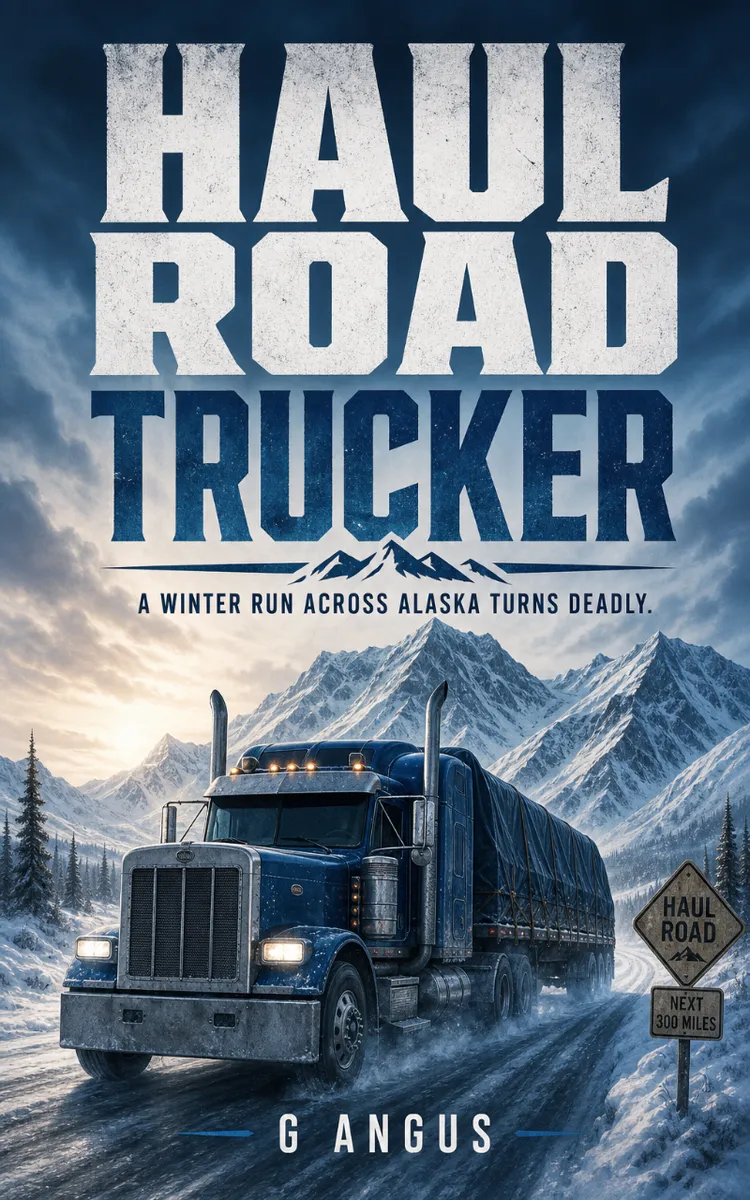
"Haul Road Trucker" is a fiction book by G Angus with 40 chapters and approximately 83,551 words. A truck driver races to deliver a vital part in sabotage..
This book was created using Inkfluence AI, an AI-powered book generation platform that helps authors write, design, and publish complete books. It was made with the AI Novel Writer.
Frequently Asked Questions
What is "Haul Road Trucker" about?
A truck driver races to deliver a vital part in sabotage.
How many chapters are in "Haul Road Trucker"?
The book contains 40 chapters and approximately 83,551 words. Topics covered include Pipeline Failure That Wasn’t, The Bonus Contract Turns Hot, Stone Counts the Load Seals, Windrowed Ice Blocks the Turnoff, and more.
Who wrote "Haul Road Trucker"?
This book was written by G Angus and created using Inkfluence AI, an AI book generation platform that helps authors write, design, and publish books.
How can I create a similar fiction book?
You can create your own fiction book using Inkfluence AI. Describe your idea, choose your style, and the AI writes the full book for you. It's free to start.
Write your own fiction book with AI
Describe your idea and Inkfluence writes the whole thing. Free to start.
Start writingCreated with Inkfluence AI


