
Read the first chapter
The whole of chapter one, free. About 7 min. Turn the pages with the arrows, your keyboard, or a swipe.
Chapter 1
Days 1-6: Recognizing Burnout
The Day Rest Stops Feeling Restful
You answer the message, finish the job, get the children fed, or close the laptop. Then you sit down - and feel nothing. Not relief. Not satisfaction. Just a flat, restless emptiness. Your body is still switched on, but your mind has quietly left the room.
The next morning, small things feel strangely huge. A late payment, a repeated question, a tool left in the wrong place, one more “quick favor.” You snap, then feel guilty. You sleep, but wake as if the night never counted. You keep functioning, yet the parts of you that used to care seem harder to reach. Do you recognise this in yourself?
The Question Beneath Your Exhaustion
What if the problem isn’t that you need to try harder, but that trying harder has become part of what’s wearing you down?
Ordinary stress usually has a clear cause and a natural release. A busy week can leave you tired, but a quiet evening, a decent night’s sleep, or a finished deadline begins to restore you. Burnout is different. The pressure keeps running in the background, even when the immediate task is over. Rest becomes another task you’re failing at.
Burnout often shows up through three connected signs: exhaustion, detachment or cynicism, and a reduced sense of effectiveness. Exhaustion is more than being sleepy. It’s the feeling that your available energy is already spent before the day starts. Detachment can look like numbness, sarcasm, impatience, or avoiding people and tasks you once valued. Reduced effectiveness is the painful sense that your effort no longer produces results you can feel proud of.
Consider the difference between finishing a demanding week and living in a repeating depletion loop. Before, you might have worked late on Thursday, slept longer on Saturday, and felt your interest return by Monday. Now, you work late most nights, use Sunday to catch up, and still begin Monday behind. Your output may look acceptable from the outside, but inside, you’re moving through fog. The issue isn’t a single hard day. It’s that demand has begun to outrun recovery.
This can happen in a business, a household, a classroom, a caring role, or several at once. You don’t need to collapse dramatically for burnout to be real. Sometimes it looks like being reliable while feeling increasingly absent from your own life.
The Burnout Signal Map: How Depletion Keeps Repeating
Use this chain to spot the pattern without blaming yourself:
1. When you face constant demands, unclear expectations, or pressure to keep proving yourself, 2. you feel tense, tired, and unable to switch off, 3. so you push through, postpone rest, say yes again, or numb out with scrolling and busywork, 4. which leads to poorer sleep, more irritability, less patience, and a growing sense that you’re failing.
Then the cycle feeds itself. Because you feel ineffective, you work longer. Because you work longer, you recover less. Because you recover less, ordinary tasks require more effort. Soon, the extra effort becomes proof - at least in your mind - that you must be the problem.
The alternative chain begins with noticing rather than judging:
1. When you spot the first signal - tight shoulders, dread, cynicism, or mental fog, 2. you name the demand and the feeling instead of calling yourself lazy, 3. so you pause long enough to identify what is actually required, what can wait, and what support is missing, 4. which gives you a clearer picture of your limits and interrupts the habit of spending tomorrow’s energy today.
This map doesn’t promise that every pressure disappears. It helps you see where the pressure becomes a pattern. External demands matter: excessive workload, little control, unclear expectations, poor recognition, unfairness, isolation, and conflict between your work and your values can all keep depletion going. Personal patterns can add fuel too. Perfectionism, people-pleasing, guilt, fear of failure, and tying your worth to productivity may convince you to ignore the signals until they become impossible to miss.
Burnout is a signal to investigate, not a verdict on your character.
A Honest Burnout Self-Check
Answer these quickly. Don’t choose the answer that sounds responsible. Choose the one that describes your last two weeks.
1. Energy: On a scale from 1 to 10, how much usable energy do you have when the day begins? A 7-10 suggests some reserve. A 4-6 may point to ongoing strain. A 1-3 means you’re starting each day close to empty.
2. Motivation: On a scale from 1 to 10, how willing are you to begin tasks that normally matter to you? A low score can signal detachment, not laziness - especially if you still care about the outcome but can’t access the drive to start.
3. Irritability: On a scale from 1 to 10, how easily do small problems trigger anger, impatience, or resentment? A higher score often means your system has little spare capacity. The small problem may be real, but it’s landing on an already overloaded body and mind.
4. Sleep and recovery: Yes or no - do you regularly sleep or take time off without feeling restored? A “yes” is an important sign that ordinary rest may no longer be meeting the level of demand. It doesn’t diagnose anything, but it deserves attention.
5. Effectiveness: On a scale from 1 to 10, how strongly do you feel that your effort is producing worthwhile results? A low score may reflect reduced effectiveness, unclear priorities, missing support, or impossible demands - not a lack of ability.
Look for the shape of your answers, not a perfect score. Several low ratings, especially when paired with irritability, poor recovery, detachment, or hopelessness, suggest that your current demands and supports are out of balance. If your distress feels severe, lasts, or affects your safety, relationships, or ability to function, seek support from a qualified health professional. This guide offers educational support; it isn’t a replacement for therapy or medical care.
Now write one sentence: “I first noticed rest was no longer helping when…” Don’t polish it. Include the ordinary detail - the Tuesday morning, the unanswered call, the meal you couldn’t taste, the task you kept rereading. Specific memories reveal patterns better than broad labels.
The Three-Day Burnout Signal Map Challenge
Name the signal before you negotiate with it.
1. Morning rating - Easy For the next three mornings, before checking messages, rate your energy, motivation, and hope from 1 to 10. Write one sentence about what feels heaviest. This takes two minutes. The timing matters because it captures your starting point before the day’s demands blur the picture.
2. Midday pressure scan - Medium Set an alarm for 1:00 p.m. or halfway through your workday. Record the strongest signal: exhaustion, detachment, irritability, or reduced effectiveness. Then write the demand connected to it. Is it workload, lack of control, unclear expectations, conflict, isolation, guilt, perfectionism, or something else? You’re not fixing it yet. You’re locating it.
3. Evening evidence check - Medium For three evenings, ask: “What drained me? What restored me? What do I need tomorrow?” Spend five minutes answering honestly. Compare your notes after the third day. Circle repeated triggers and repeated signs. Those circles are the first draft of your Burnout Signal Map.
You’ll know it’s working when...
• You can name your main burnout signal without immediately judging yourself. - You can connect at least one feeling to a specific demand or personal pattern. - You notice the difference between being tired after effort and staying depleted after rest.
Don’t turn this into another performance test. Missing a day doesn’t erase the information you’ve gathered. The point is not to produce perfect data. It’s to stop treating exhaustion as a personality flaw and start seeing the conditions around it.
Burnout Is Information, Not Failure
Burnout is not a personal failure; it is a signal that your current demands, supports, and recovery habits are out of balance.
• Ordinary stress often eases when the pressure ends; burnout can continue after the task is finished. - Exhaustion, detachment or cynicism, and reduced effectiveness are connected signs - not proof that you’re weak. - External pressures and internal patterns can work together to keep depletion going. - Naming your signals gives you a clearer starting point than forcing yourself to push harder.
You may discover that your exhaustion has a name. You may also discover that the name brings relief - and responsibility. Not the responsibility to blame yourself, but the responsibility to look honestly at what your life has been asking of you, what you’ve been refusing to admit, and where your support has fallen short.
Once you can see the pattern, a deeper question waits: what, exactly, has been creating so much pressure - and which parts can you change?
End of chapter one. 4 more chapters and about 7,730 words in the full book.
Swipe or use the arrows to turn the page
What's inside: 5 chapters
- 1. Days 1-6: Recognizing Burnout
- 2. Days 7-12: Stabilizing Your Energy
- 3. Days 13-18: Rest That Restores
- 4. Days 19-24: Boundaries Without Guilt
- 5. Days 25-30: Sustaining Your Recovery
About this book
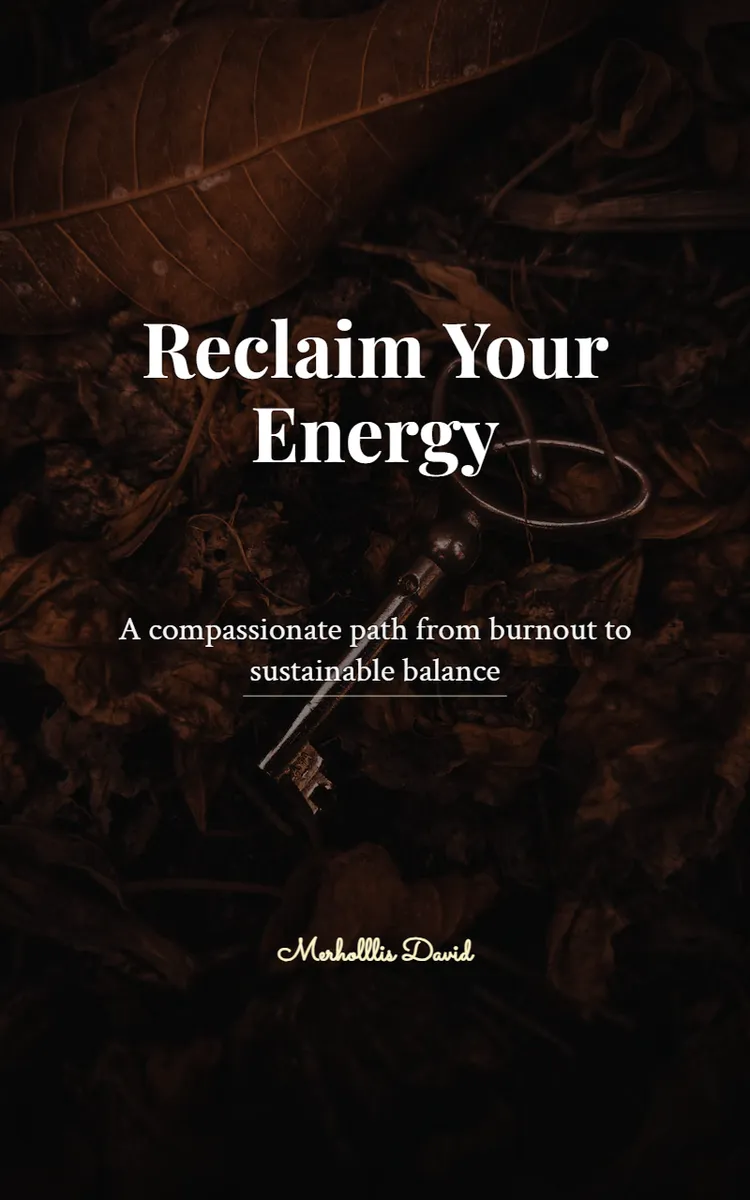
"Reclaim Your Energy" is a self-help book by Merholllis David with 5 chapters and approximately 7,730 words. Recognizing burnout, restoring energy, managing stress, and building sustainable routines.
This book was created using Inkfluence AI, an AI-powered book generation platform that helps authors write, design, and publish complete books. It was made with the AI Self-Help Book Writer.
Frequently Asked Questions
What is "Reclaim Your Energy" about?
Recognizing burnout, restoring energy, managing stress, and building sustainable routines
How many chapters are in "Reclaim Your Energy"?
The book contains 5 chapters and approximately 7,730 words. Topics covered include Days 1-6: Recognizing Burnout, Days 7-12: Stabilizing Your Energy, Days 13-18: Rest That Restores, Days 19-24: Boundaries Without Guilt, and more.
Who wrote "Reclaim Your Energy"?
This book was written by Merholllis David and created using Inkfluence AI, an AI book generation platform that helps authors write, design, and publish books.
How can I create a similar self-help book?
You can create your own self-help book using Inkfluence AI. Describe your idea, choose your style, and the AI writes the full book for you. It's free to start.
Write your own self-help book with AI
Describe your idea and Inkfluence writes the whole thing. Free to start.
Start writingCreated with Inkfluence AI


