

Read the first chapter
The whole of chapter one, free. About 9 min. Turn the pages with the arrows, your keyboard, or a swipe.
Chapter 1
How Seeds Affect Heart Risk
Seed-to-Heart Pathway Map: How Seeds Can Move LDL, Blood Pressure, and Inflammation
“About half of U.S. adults have some form of high blood pressure.” That one fact is enough to make the heart topic feel real - because blood pressure is one of the biggest drivers of heart risk over time. Now add another useful reality: the everyday foods you choose can nudge key pathways that raise or lower that risk, including LDL cholesterol, blood pressure, and inflammation. Different seeds matter because they don’t just add calories; they deliver specific mixes of fiber, healthy fats, plant proteins, minerals, and bioactive compounds that your body uses in different ways.
In this chapter, you’ll learn how seed nutrients influence the main levers behind cardiovascular risk - especially LDL, blood pressure, and inflammation - and how to turn that into a simple routine you can actually stick with. You’ll also get clear “how much, how often, and when to step up” guidance, plus a safety boundary for people who take heart-related medicines.
Who this is for: If you’ve ever looked at a nutrition label and wondered, “Okay, but what does that actually do to my heart?”, this is for you. It’s also for busy people who want a practical seed plan without guesswork - like Daria, 39, an ER nurse who knows how quickly health can change and wants steady, measurable habits she can build on. Key benefits you can expect from this chapter include: - A plain-language map of how seeds affect LDL, blood pressure, and inflammation - A starter seed routine with specific amounts and timelines - Common pitfalls to avoid so you don’t waste effort (or run into side effects)
Takeaway to hold onto: Seeds aren’t magic, but they can be consistent, nutrient-dense tools that support your heart’s risk factors - especially when you match the seed choice and amount to what your body needs.
---
Seed Nutrients and the Heart Levers: LDL, Blood Pressure, and Inflammation
When people say “heart health,” they’re often thinking about one number - like cholesterol. But heart risk is more like a system with multiple dials. Seeds help because their nutrients hit several dials at once. Here’s the simple version of what’s going on, in plain language.
First, think about LDL cholesterol as the “carrying” problem. LDL can pick up and deposit in artery walls, especially when the environment is primed for it. Seeds can help lower LDL risk drivers through soluble fiber and certain fats. Soluble fiber gels in the gut and can bind with bile acids, which nudges your body to use cholesterol to make more bile. Seeds also contribute unsaturated fats (like omega-3 and omega-6 fats depending on the seed), which can support healthier lipid patterns.
Second, consider blood pressure. Blood pressure is influenced by how your blood vessels behave, how much sodium you take in, and how your body manages minerals like magnesium, potassium, and calcium. Many seeds bring along minerals that support normal vessel function and muscle contraction. They also provide arginine-related compounds and other plant bioactives that can support healthier blood vessel signaling. That doesn’t mean seeds “replace” medication - but it does mean they can be part of your daily pressure-management toolkit.
Third, look at inflammation. Inflammation isn’t always bad in the moment - your body uses it to heal. The problem is chronic, low-grade inflammation. Some seed fats (especially ALA, a plant omega-3 found in certain seeds) and antioxidant compounds can help shift the inflammatory balance over time. Seeds also provide polyphenols and other bioactives that support cell protection pathways. In everyday terms: seeds help your body move toward a less inflammatory environment that’s friendlier to artery health.
To keep the cause-and-effect clear, here are the main seed nutrient routes to heart risk:
1. Soluble fiber → LDL support: Fiber binds bile acids and supports healthier cholesterol handling. 2. Minerals (magnesium, potassium, calcium) → blood pressure support: They help normal vessel tone and fluid balance. 3. Healthy fats + antioxidants → inflammation balance: Plant omega-3s and bioactives can calm chronic inflammatory signals. 4. Plant compounds → artery-friendly signaling: Bioactive molecules can support healthier endothelial function (the “lining” of blood vessels).
Ask yourself: When you picture your own heart risk, which dial matters most right now - LDL, blood pressure, or “I feel puffy/sore/tired and I don’t know why”?** This chapter helps you pick seeds based on the dial you’re trying to influence.
Practical takeaway: Seeds influence heart risk by changing the gut-lipid pathway, supporting mineral-driven blood pressure control, and nudging inflammatory balance - not by targeting one single “magic” mechanism.
---
Practical Protocol: A Seed Plan for Measurable LDL, Blood Pressure, and Inflammation Support
Daria, the ER nurse, puts it this way: “In the ER, you learn that small habits matter because emergencies aren’t the only danger. Most of the risk builds quietly.” Her approach to seeds is the same - start simple, give it time, and track what changes.
Below is a protocol you can use whether you’re aiming at LDL, blood pressure, inflammation, or all three. It’s built around a realistic seed serving, a progression that protects your digestion, and a “check-in” rhythm.
Step-by-step seed routine (with amounts and milestones)
Step 1: Start with one seed type for 10-14 days. Choose one seed and use it consistently so you can notice effects (digestion, cravings, how you feel after meals). A solid starting amount is 1 tablespoon per day, mixed into food (yogurt, oatmeal, salads, soups) or ground into a meal. Keep it daily for 14 days.
Step 2: Move to two seed types if you tolerate the first one. On day 15-28, add a second seed type. Your total still stays reasonable: 1 tablespoon of Seed A + 1 tablespoon of Seed B per day. This is a “pathway coverage” step - different seeds lean on different nutrient mixes.
Step 3: Reach a steady “heart-support range” by week 5-6. By week 5 or 6, aim for 2-3 tablespoons total per day (for example: 1 tablespoon in the morning + 1 tablespoon at lunch + 1 teaspoon to 1 tablespoon in the evening if you’re doing well). Don’t jump to the top range quickly - seed fiber can be helpful, but too fast can cause gas or loose stools.
Which seeds to choose (based on the heart lever you care about)
Use this comparison as a guide. You don’t have to memorize every nutrient - just match the seed to the pathway.
| Seed (common use) | Best fit for | How to use it to support the pathway | |---|---|---| | Flaxseed (ground) | LDL support + inflammation balance | Grind and add 1 tablespoon/day to oatmeal/yogurt for the first 2 weeks | | Chia seeds | Blood pressure support + fiber | Use 1 tablespoon/day in water, yogurt, or pudding-style recipes | | Pumpkin seeds (pepitas) | Minerals support (often helpful for blood pressure) | Sprinkle 1 tablespoon/day on salads or roast lightly | | Sesame seeds / tahini | Minerals + plant compounds | 1 tablespoon/day as tahini stirred into sauces or dressings | | Sunflower seeds | Vitamin E and supportive fats | 1 tablespoon/day in salads or blended into a spread |
Daria’s practical tip: She doesn’t buy “seed blends.” She buys single seeds she can rotate, because it’s easier to tell what’s working and what’s upsetting her stomach.
Timing and consistency that work in real life
• Take your seed portion with a meal, not on an empty stomach, especially at the start. - Keep your daily dose within the same window (for example, breakfast + lunch) so it becomes automatic. - If you’re switching from one seed type to another, overlap for 2-3 days rather than replacing everything at once - your gut tends to handle change better that way.
When to seek professional help (don’t wait on these) Seeds are food, but heart-related meds and conditions are real. Get medical advice promptly if you notice: - Unusual bruising or bleeding, black/tarry stools, or vomiting blood (especially if you take blood thinners) - Trouble breathing, facial swelling, or widespread hives after seed intake (possible allergy) - Severe or persistent diarrhea, significant abdominal pain, or dehydration symptoms
Also, if you’re on blood pressure medication or cholesterol medication, check in with your licensed clinician before making big dose jumps - especially if you’re moving toward the higher end of seed intake.
Milestone check-ins (simple and useful): - After 2 weeks: You should feel either “fine” or “better” - and your digestion should be stable. - After 4 weeks: Your meal routine is set. If you want, you can re-check your focus area (more on this below). - After 8-12 weeks: That’s a reasonable window to discuss lab trends (like LDL or other markers your clinician tracks) and symptom changes with your healthcare team.
Practical takeaway: Start at 1 tablespoon/day, progress to 2 tablespoons/day by week 3-4, and aim for 2-3 tablespoons/day by week 5-6 - while keeping seeds in meals and tracking digestion and results over 8-12 weeks.
---
Common Mistakes That Keep Seeds From Helping Your Heart
Seeds can be a great tool, but a few common mistakes make them less effective - or uncomfortable. Here are the ones I see most often, along with what to do instead.
Mistake: Starting too fast (and getting digestion “punished”) Why it happens: People often jump from “occasional seeds” to several tablespoons because they’re excited. But fiber and fats ramp up quickly, and your gut may respond with gas, bloating, or loose stools. That usually leads to quitting before you get any benefit. What to do instead: Stick to 1 tablespoon/day for 10-14 days. If you’re doing well, add the second seed and build to 2 tablespoons/day by week 3-4.
Mistake: Using whole seeds when you need the nutrients to be available Why it happens: Some seeds (especially flaxseed) are harder to digest whole. Whole seeds can pass through with less nutrient availability, so your effort doesn’t translate into the pathway you’re aiming for. What to do instead: For flaxseed, choose ground flax. For chia and pumpkin, whole is usually fine. A simple rule: if a seed is tough, grind it when that seed is your main choice.
Mistake: Treating seeds like a “replacement,” not a “support” Why it happens: People sometimes use seeds as a reason to skip other heart-supporting habits - like reducing highly processed foods, watching sodium-heavy meals, or staying consistent with prescribed meds. Seeds can support risk factors, but they aren’t a substitute for a full plan. What to do instead: Use the seed routine as an add-on to your existing strategy. For Daria, that meant keeping her usual meal structure and swapping in seeds at two meals per day rather than overhauling everything at once.
Practical takeaway: Your best chance of success is the boring plan: start low, prep the seed well (ground when needed), and use seeds as support within your overall heart routine.
---
Closing Thought: Consistency Beats Complexity for Seed-Based Heart Support
Seeds affect heart risk through multiple nutrient pathways - LDL, blood pressure, and inflammation - but the biggest lever you control is consistency. The body tends to respond to steady inputs, not dramatic spikes. When you keep your seed routine simple - one seed to start, two by week three, and a comfortable daily total by week five or six - you give your gut time to adapt and your cardiovascular system time to benefit.
As you move forward in the book, you’ll get even more specific about how to match seed choices to your biggest heart-risk dial and how to build a routine that fits your real schedule - like Daria did in the rhythm of a long shift.
End of chapter one. 8 more chapters in the full book.
Swipe or use the arrows to turn the page

What's inside: 9 chapters
- 1. How Seeds Affect Heart Risk
- 2. Chia, Flax, and Omega-3 Conversion
- 3. Walnuts and Plant Sterols for LDL
- 4. Pumpkin Seeds, Magnesium, and Blood Pressure
- 5. Sesame and Fiber for Metabolic Health
- 6. Portioning Seeds to Avoid Calorie Creep
- 7. Roasted vs Raw Seeds: What Matters
- 8. Building a Seed Plan with Lab Checks
- 9. Practical Bonus Tips & Resources
About this book
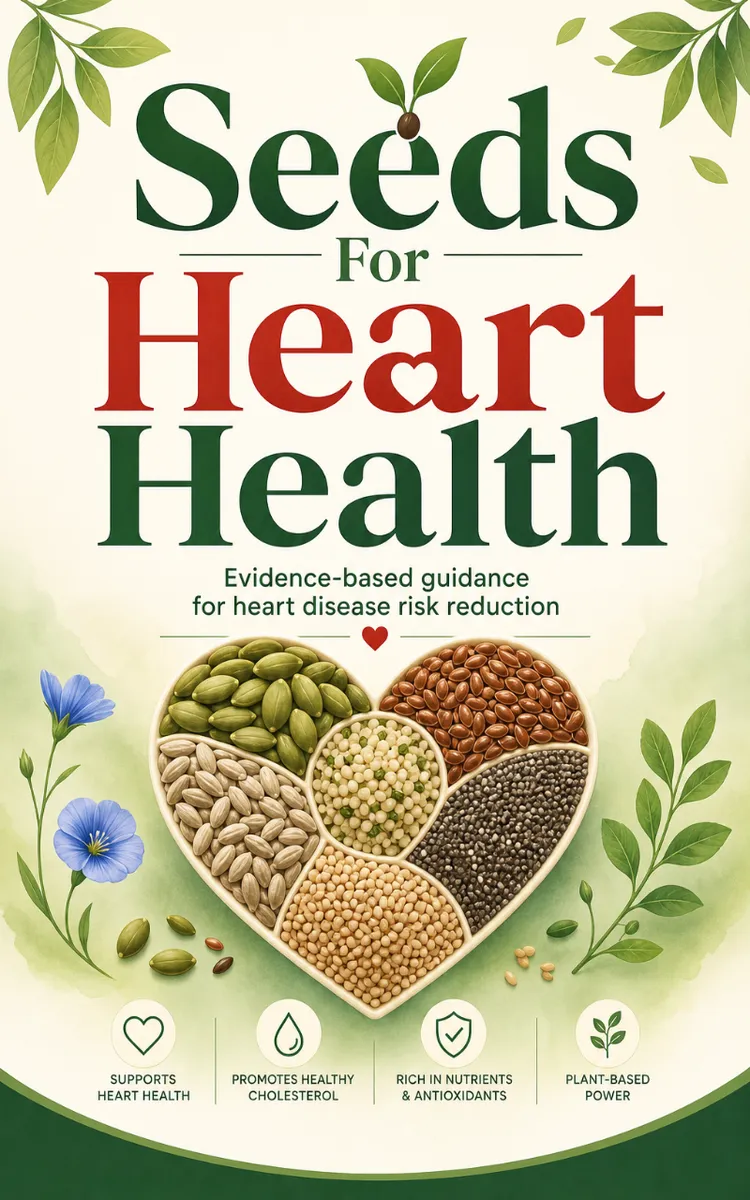
"Seeds For Heart Health" is a health & wellness book by James McCullough with 9 chapters and approximately 15,535 words. Your nutrition might be doing more to your heart than you think, and it may be happening through seed nutrients you are not even aware of. Blood pressure, LDL cholesterol, and inflammation do not change overnight, but the foods you choose can push those pathways in the right direction, or quietly keep them moving the wrong way.
This book was created using Inkfluence AI, an AI-powered book generation platform that helps authors write, design, and publish complete books. It was made with the AI Health Book Generator.
Frequently Asked Questions
What is "Seeds For Heart Health" about?
Your nutrition might be doing more to your heart than you think, and it may be happening through seed nutrients you are not even aware of. Blood pressure, LDL cholesterol, and inflammation do not change overnight, but the foods you choose can push those pathways in the right direction, or quietly keep them moving the wrong way. Seeds are not interchangeable. Each one brings a distinct mix of fiber, healthy fats, minerals, plant proteins, and bioactive compounds that your body uses differently. In Seeds For Heart Health, you will learn how specific seeds affect heart disease risk, what to aim for, how much and how often to use, and the safety boundaries if you take heart-related medicines. Start a seed routine you can actually stick with, with evidence-based guidance that makes sense.
How many chapters are in "Seeds For Heart Health"?
The book contains 9 chapters and approximately 15,535 words. Topics covered include How Seeds Affect Heart Risk, Chia, Flax, and Omega-3 Conversion, Walnuts and Plant Sterols for LDL, Pumpkin Seeds, Magnesium, and Blood Pressure, and more.
Who wrote "Seeds For Heart Health"?
This book was written by James McCullough and created using Inkfluence AI, an AI book generation platform that helps authors write, design, and publish books.
How can I create a similar health & wellness book?
You can create your own health & wellness book using Inkfluence AI. Describe your idea, choose your style, and the AI writes the full book for you. It's free to start.
Write your own health & wellness book with AI
Describe your idea and Inkfluence writes the whole thing. Free to start.
Start writingCreated with Inkfluence AI


