
Read the first chapter
The whole of chapter one, free. About 7 min. Turn the pages with the arrows, your keyboard, or a swipe.
Chapter 1
The Drones Close In
At 1:17 a.m., the streetlamp outside Kigozi Tumuhimbise’s apartment blinked three times and went dark.
He stopped writing.
For seven hours, candlelight had trembled across his desk while he transferred encrypted witness files onto three micro-SD cards. Now the room seemed to contract around the small black rectangles resting beside his thumb. Beyond the shuttered window, a Toyota engine idled in the alley.
Kigozi lifted the first card and pressed it into the hollow beneath his belt buckle. The second disappeared inside the seam of his left boot. He held the third between two fingers.
On the desk lay the records that could bring down the government of Wazalendo or bury him beneath it. Eighty-four million dollars had moved from the Ministry of Finance into Cayman Islands shell companies registered under the name of General Silas Kanyangira’s twenty-two-year-old son. Beside the bank transfers, Kigozi had copied a list of 142 students, trade unionists, and opposition coordinators abducted in six months. Each name carried a date, a last known location, and GPS coordinates leading to clandestine torture sites operated by the Joint Security Command, the CDF Directorate.
The engine outside coughed.
Kigozi slid the third card into the lining of his jacket.
A metal door slammed below.
He extinguished the candle with wet fingers. Wax hardened against his skin. In the darkness, he heard boots enter the building.
Not police boots. These were heavier, deliberate, climbing without haste.
Kigozi crossed to the window and lifted the shutter by a finger’s width. Three white vans sealed the alley. Their Toyota HiAce bodies reflected the weak moonlight. No registration plates. Blackened windows. One van blocked the entrance; another faced the rear drainage canal; the third waited beside the mechanic’s shed, its engine running.
The Drones.
At this hour, between one and four in the morning, they moved through Bwaise, Katwe, and Kasubi, collecting people whose names had become inconvenient. Tonight they had come to his door.
A fist struck the apartment below.
“Open for inspection!”
The voice carried the flat authority of a man accustomed to being obeyed.
Kigozi tucked his notebook into his waistband and looked at the apartment door. His evidence was secure, but the papers remained on the desk: transfers, names, coordinates, photographs of bruised faces. If the officers found them, the cards would not matter. They would know what he had copied, whom he had contacted, and where the trail led.
Another blow shook the building.
“Tumuhimbise! CDF Directorate. Open!”
He grabbed the papers and thrust them into the metal stove. The first page curled. General Silas Kanyangira’s name blackened, then vanished beneath the flame. Smoke scratched his throat.
The lock downstairs splintered.
Kigozi moved to the back wall. His landlord had once complained about a loose panel behind the wardrobe. He had dismissed the warning as ordinary decay. Now he dragged the wardrobe aside. The panel gave with a dry crack, revealing a narrow service shaft that dropped toward the drainage canal.
Below, men shouted.
“Fourth floor!”
“Seal the stairwell!”
Kigozi pulled the panel wider. Cold concrete scraped his palms. The shaft smelled of rust, detergent, and stagnant water. It was barely wide enough for his shoulders.
He looked once at the burning desk.
The apartment door exploded inward.
Kigozi lowered himself into the shaft just as a rifle butt struck the wall above him. Plaster rained across his hair. He held his breath, one hand gripping the concrete ledge, the other pressed against his jacket where the cards rested.
“Search the room!”
A boot entered the apartment.
Kigozi dropped.
He landed in ankle-deep water at the bottom of the shaft. Pain shot through his right foot. Above him, a beam of light cut through the opening, followed by the scrape of men moving furniture.
“Nothing here,” someone said.
“Find him. The Directorate wants him breathing.”
Kigozi bent low and ran.
The drainage canal carried Masaka’s waste beneath the buildings in a narrow black ribbon. Broken bottles glittered along the banks. Water slapped against his trousers as he pushed forward, one hand against the wall. The sound of his breathing seemed loud enough to summon the entire city.
Behind him, a man shouted.
“He’s in the canal!”
A gunshot cracked through the shaft.
Concrete dust struck Kigozi’s cheek. He stumbled, caught himself, and kept moving. The canal narrowed ahead beneath a rusted iron grate. He dropped to his knees and forced his fingers through the bars. They resisted. He twisted until the metal shrieked from its socket.
Another shot struck the water beside him.
Kigozi dragged himself through the opening. His jacket snagged. For one terrible second, the fabric held him while boots splashed closer. He tore free, leaving a strip of cloth on the grate.
He emerged behind a row of shuttered shops, beneath the steep road leading toward Kasubi. Rainwater dripped from the corrugated roofs. Somewhere beyond the darkness, a radio played a hymn through static.
He ran uphill.
His injured foot struck the pavement with every step. He passed a sleeping boda-boda stage, its wooden benches empty, helmets hanging from a nail. At the crest, headlights swept across the road.
Kigozi flattened himself behind a stack of charcoal sacks.
A white van rolled past.
The driver’s window remained black. In the passenger seat, a man held a radio against his mouth.
“Subject has left the building,” the voice crackled. “Repeat, Kigozi Tumuhimbise has vanished.”
The van continued toward the parish road.
Kigozi waited until the engine faded, then rose. His hands shook - not from fear alone, but from the knowledge that the officers had found the apartment empty. They would search every address connected to him. They would question printers, mechanics, clerks, anyone who had once accepted his money or trusted his name.
He limped toward St. Jude Parish.
The church stood behind a low stone wall, its wooden doors closed, its cross pale against the night. Kigozi struck the side gate three times, paused, then struck twice.
No answer.
He tried again.
A bolt shifted.
The door opened a hand’s width. Zawadi Kemigisha looked out, a shawl wrapped around her shoulders, her eyes sharp in the candlelight.
“You came alone?” she whispered.
“Not by choice.”
She opened the gate. Kigozi slipped inside, and she locked it behind him.
The parish courtyard smelled of wet earth and candle smoke. He leaned against the wall, fighting for breath. Water dripped from his trousers onto the stones.
Zawadi looked at the torn jacket. “They followed you?”
“They followed the evidence.”
“That is not an answer.”
“They came to take me.”
Her face hardened. “The Drones?”
“Three vans. They broke into my apartment.”
Zawadi caught his arm. “Are you bleeding?”
“Only where the city tried to hold me.”
“Do not make jokes.”
“I am alive.”
“For now.”
She led him through the vestry. A single candle burned beneath the crucifix. The room contained a wooden table, two chairs, and a radio with its volume turned low. Kigozi removed the micro-SD card from his jacket and placed it on the table.
Zawadi stared at it.
“How many?”
“Three.”
“Where are the others?”
“Hidden.”
“On you?”
He shook his head.
She touched the card but did not pick it up. “What is inside?”
“Everything they have tried to bury. The money. The names. The sites.”
“Whose names?”
“Students. Union organizers. Opposition coordinators. One hundred and forty-two.”
Zawadi’s fingers withdrew.
Kigozi opened his notebook and turned it toward her. The page showed coordinates written in tight columns.
“The Joint Security Command runs the sites,” he said. “The CDF Directorate. General Silas Kanyangira signs the orders, or allows them to be signed. The records connect his office to the transfers.”
Zawadi looked toward the radio.
Static swelled. Then a presenter’s voice emerged, smooth and official.
“Citizens are warned that a dangerous terrorist suspect, Kigozi Tumuhimbise, has escaped lawful detention during an operation in Masaka. The suspect is believed to possess materials intended to incite violence and destabilize the Republic of Wazalendo. Anyone offering shelter or assistance will be treated as an accomplice.”
Zawadi turned the volume down, but the words remained in the room.
Kigozi felt the last door close behind him. His name had been taken from him and returned as a weapon.
“They know,” she said.
“They knew enough to come.”
“No. They know you are gone. That is different.”
Outside, a vehicle slowed on the road.
Both of them froze.
The engine passed the parish wall, then faded toward the lower town.
Zawadi picked up the card. “If this is real, we cannot hide it here.”
“I did not bring it here to hide.”
“Then why?”
“Because I need help.”
Her eyes met his. “From me?”
“From someone who still knows the difference between silence and peace.”
She looked again at the radio. The state presenter was now repeating his name, each time attaching another accusation: terrorist, saboteur, enemy of the people.
Zawadi closed her hand around the card.
“You understand what happens if I help you?”
“Yes.”
“They will come for this parish.”
“Yes.”
“They will come for everyone who has ever spoken to me.”
Kigozi’s injured foot throbbed beneath him. He thought of the men in the canal, the rifle fire, the torn cloth caught on the grate. He thought of the 142 names and the coordinates waiting inside the card.
“Then let them come,” he said. “They have already taught us what their silence costs.”
Zawadi placed the card beneath the crucifix.
The radio crackled again.
“Citizens are instructed to report Kigozi Tumuhimbise immediately. He is armed, dangerous, and wanted for terrorism.”
Kigozi listened to his own name travel through the dark city, carried by the voice of the government that had hunted him. He had reached St. Jude Parish with the evidence intact.
But by dawn, every patrol in Masaka would be searching for a terrorist who had once been an investigator.
End of chapter one. 5 more chapters and about 10,874 words in the full book.
Swipe or use the arrows to turn the page
What's inside: 6 chapters
- 1. The Drones Close In
- 2. The Choice to Publish
- 3. Across the Flooded Quarter
- 4. The Coordinates Beneath Masaka
- 5. Chapter 6
- 6. The Broadcast Goes Dark
About this book
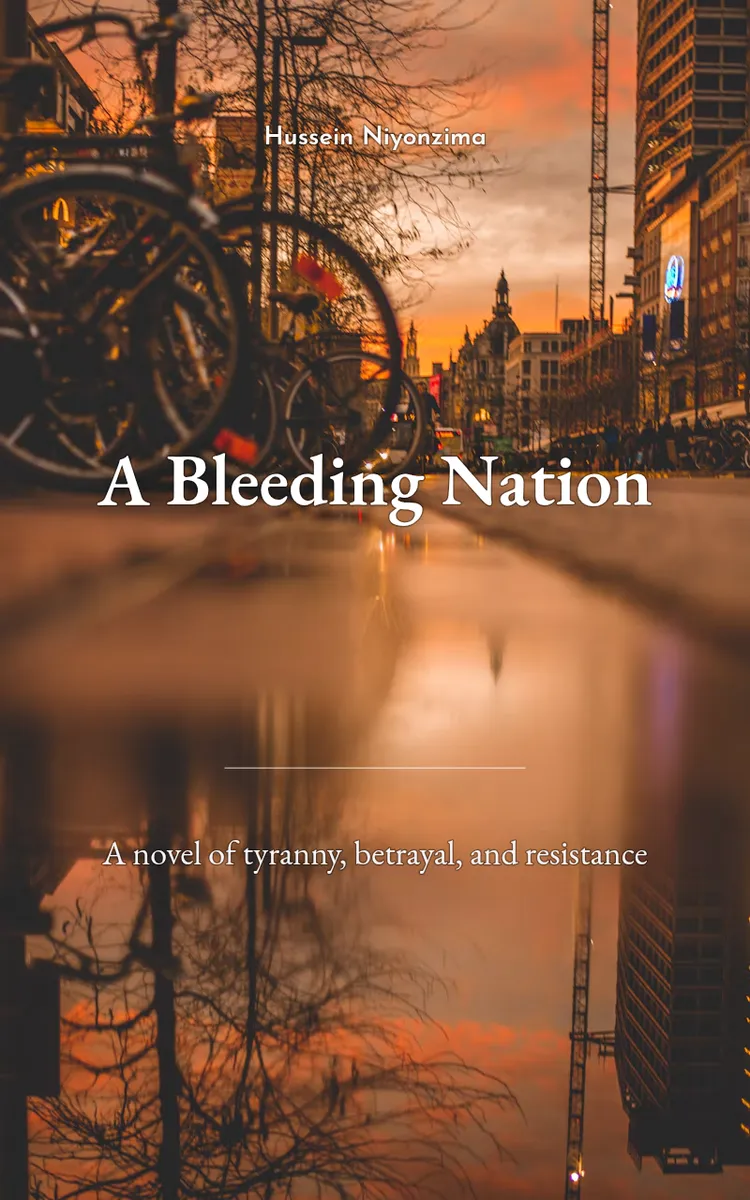
"A Bleeding Nation" is a fiction book by Hussein Niyonzima with 6 chapters and approximately 10,874 words. Political repression, state violence, and resistance in a fictional African republic.
This book was created using Inkfluence AI, an AI-powered book generation platform that helps authors write, design, and publish complete books. It was made with the AI Novel Writer.
Frequently Asked Questions
What is "A Bleeding Nation" about?
Political repression, state violence, and resistance in a fictional African republic
How many chapters are in "A Bleeding Nation"?
The book contains 6 chapters and approximately 10,874 words. Topics covered include The Drones Close In, The Choice to Publish, Across the Flooded Quarter, The Coordinates Beneath Masaka, and more.
Who wrote "A Bleeding Nation"?
This book was written by Hussein Niyonzima and created using Inkfluence AI, an AI book generation platform that helps authors write, design, and publish books.
How can I create a similar fiction book?
You can create your own fiction book using Inkfluence AI. Describe your idea, choose your style, and the AI writes the full book for you. It's free to start.
Write your own fiction book with AI
Describe your idea and Inkfluence writes the whole thing. Free to start.
Start writingCreated with Inkfluence AI


