
Read the first chapter
The whole of chapter one, free. About 7 min. Turn the pages with the arrows, your keyboard, or a swipe.
Chapter 1
Curiosity as a Compass
When Mystery Begins to Point
What question keeps returning, even after you’ve tried to set it aside?
Some questions arrive like interruptions. Others feel different. They stay with you through ordinary tasks: while you’re driving, washing dishes, closing the shop, or answering messages. You may not know whether they’re pointing toward a new responsibility, a needed conversation, or a risk you’ve been avoiding. Still, their persistence deserves attention.
Mystery can feel like a fog, but it can also be a direction marker. The unknown isn’t always asking you to solve everything at once. Sometimes it’s inviting you to notice what matters, test one faithful step, and trust that clarity may come through movement rather than thought alone.
The Compass Curiosity Model helps you do that. It treats curiosity as a compass with four movements: Notice, Name, Test, and Trust. You notice the question. You name what it may be revealing. You test the next responsible step. Then you trust God with what remains beyond your control.
This Chapter Is For You If...
• You keep sensing a question about work, service, relationships, or faith, but you’ve dismissed it as impractical. - You want to distinguish genuine guidance from restless distraction. - You’re ready to take a small, faith-based action without demanding a complete map first. - You need a way to honor mystery while still making grounded decisions.
The shift is simple but meaningful: instead of asking, “How do I eliminate all uncertainty?” you begin asking, “What might this uncertainty be directing me to notice?”
The Compass Curiosity Model
Curiosity becomes a faithful compass when it turns mystery into one honest, tested next step.
Mystery isn’t automatically a sign that you should act. A sudden idea may be nothing more than a passing impulse. A recurring question, however, can deserve prayerful attention - especially when it aligns with your values, serves something beyond your ego, and remains present after the excitement fades.
Consider a small business owner who keeps wondering whether to offer a service for customers who can’t afford the usual rate. The question may create tension. There are bills to pay, and good intentions don’t cover payroll. Curiosity doesn’t require an immediate yes. It might lead to a conversation with a local nonprofit, a limited monthly appointment, or a careful review of the numbers. The mystery becomes direction when the question moves from vague longing to a responsible experiment.
The Compass Curiosity Model keeps faith from becoming either reckless or frozen. Notice the question without rushing to label it. Name the concern, desire, or burden underneath it. Test a step that is small enough to evaluate and meaningful enough to teach you something. Trust the outcome to God without pretending you control every result.
This matters because certainty is often unavailable at the moment a decision becomes important. You may have enough light for the next ten feet, not the whole road. That isn’t failure. It’s an invitation to walk attentively.
In Practice, This Means...
• Writing down recurring questions instead of letting them circle endlessly in your mind. - Checking whether curiosity is connected to service, integrity, and your actual responsibilities. - Choosing a testable action with a clear limit, such as one conversation, one application, or one trial month. - Releasing the demand for immediate proof while reviewing what the step reveals.
Turning Curiosity Into a Daily Practice
Curiosity needs a rhythm, or it can become mental clutter. The following habits give it somewhere useful to go.
1. Morning: record the question. Set aside five minutes before your day fills up. Write one question that has been returning. Keep the wording plain: “Why do I keep thinking about teaching this?” or “What would faithful care look like in this conflict?” Don’t solve it yet. You’re simply practicing Notice.
2. Morning: name the pull beneath it. Add two sentences. What attracts you? What concerns you? If the question is about changing jobs, perhaps the attraction is meaningful work, while the concern is financial stability. Naming both keeps curiosity from becoming either fantasy or fear.
3. Midday: take one information-gathering step. Use ten minutes to learn something concrete. Call someone with relevant experience. Check a cost. Read the instructions for an application. Look at your calendar. Curiosity becomes grounded when it meets facts.
4. Midday: ask the service question. Before acting, ask, “Who could this help, and what responsibility would it create?” This question is especially useful when a new possibility feels exciting. Faithful risks still need good stewardship.
5. Evening: review the evidence. Spend five minutes noting what became clearer, what resistance appeared, and what remains unknown. Don’t judge the day by whether you received a dramatic answer. Judge it by whether you paid attention and acted honestly.
6. Weekly: choose one test. At the end of the week, select one low-risk, meaningful experiment. Give it a time boundary. For example: have two conversations within seven days, volunteer once before committing, or set aside $50 to investigate a training opportunity. A boundary protects curiosity from drifting into endless research.
Prayer can accompany each stage, but it doesn’t need elaborate language. “God, help me notice what matters, name it honestly, and take the next faithful step” is enough to begin.
A Small Step That Makes the Mystery Clearer
Before: A church volunteer kept wondering whether a neglected community garden could become a source of fresh food for nearby families. The thought returned each time she walked past the locked gate. Still, she hesitated. She didn’t know how much work the garden needed, who owned the equipment, or whether anyone would participate.
Action: Rather than announcing a major program, she used the Compass Curiosity Model. She wrote down the question, spoke with the church administrator, and called a local food pantry. Then she invited six neighbors to a Saturday cleanup. She set a clear limit: one morning, no fundraising, and no promise of a full season.
Result: The cleanup revealed both interest and limits. Four people came. The soil needed more work than expected, but the pantry confirmed that fresh herbs would be useful. The next faithful step became visible: start with three raised beds instead of trying to restore the entire garden. Curiosity had not delivered a complete plan. It had delivered enough direction for responsible action.
That distinction matters. The goal isn’t to force every mystery into a neat answer. The goal is to let a sincere question lead you toward better attention, wiser conversations, and an action you can take with integrity.
Questions for the Road Ahead
1. What question has returned at least three times in the past month? Repetition doesn’t prove that a question comes from God, but it does make it worth examining. Write it exactly as it appears, without making it sound more spiritual or more practical than it is.
2. What is this curiosity asking me to notice about my values? A question about changing work may reveal a need for creativity, service, rest, or honesty. The deeper value can guide you even if the original idea changes.
3. Am I seeking guidance, or am I using research to avoid a decision? More information is useful until it becomes a hiding place. If you’ve read twelve articles but haven’t made one phone call, your next step may be contact rather than more reading.
4. What is the smallest responsible experiment I can complete within seven days? Keep it specific. Schedule a conversation, attend one meeting, draft a one-page plan, or test the idea with three people. A small experiment gives mystery a chance to teach you.
5. What outcome am I trying to control, and what would trust look like instead? Trust doesn’t mean ignoring consequences. It means doing your part faithfully while admitting that timing, other people, and final results aren’t fully yours to manage.
These questions aren’t a test you can fail. They’re a way to clear the noise. Honest reflection may show that your curiosity needs patience. It may also show that you’ve been waiting for certainty when a modest act of courage is already available.
Take the Next Faithful Step Today
Set a timer for 20 minutes today. Write down the recurring question you’ve been carrying, name the value and concern beneath it, and choose one responsible action you can complete within the next seven days. Put that action on your calendar before the timer ends.
You will know it worked when the mystery feels less like a cloud you must solve and more like a direction you can explore - one honest step at a time.
You don’t need the whole path to move faithfully. You need enough courage to follow the light you’ve been given, and enough curiosity to notice where it leads.
End of chapter one. 39 more chapters and about 60,623 words in the full book.
Swipe or use the arrows to turn the page
What's inside: 40 chapters
- 1. Curiosity as a Compass
- 2. Choosing Wonder Over Fear
- 3. Faithful Risk Requires Preparation
- 4. The Beginner’s Mindset for Mystery
- 5. Turning Questions Into Prayer
- 6. Building Trust Through Small Steps
- 7. Accepting Unanswered Seasons
- 8. Saying Yes to the Next Right Move
- 9. Practicing Courageful Honesty
- 10. Letting Process Beat Perfect Answers
- 11. Learning to Read Signs Wisely
- 12. Resisting Control When You Can’t Know
- 13. Cultivating Patience With Purpose
- 14. Choosing Integrity Under Uncertainty
- 15. Practicing Grief Without Losing Hope
- 16. Renewing Your Mind for New Paths
- 17. Strengthening Discernment Through Scripture
- 18. Building a Faithful Decision Rhythm
- 19. Learning From Past Leaps
- 20. Letting Community Share the Load
- 21. Handling Doubt Without Worshiping It
- 22. Choosing Humility Over Self-Reliance
- 23. Practicing Courage Through Obedience
- 24. Managing Fear With Breath and Prayer
- 25. Overcoming Procrastination With Clear Intent
- 26. Sustaining Hope With Gratitude Lists
- 27. Learning to Wait Without Withdrawing
- 28. Choosing Patience in Relationships
- 29. Taking Responsibility Without Carrying Guilt
- 30. Refusing Comparison in Your Calling
- 31. Honoring Limits While Pursuing Growth
- 32. Practicing Courageous Consistency
- 33. Reframing Failure as Field Data
- 34. Surrendering Outcomes to God’s Wisdom
- 35. Recognizing When to Pivot
- 36. The Leap of Faith Decision
- 37. Living After the Leap
- 38. Letting Mystery Deepen Your Love
- 39. Celebrating Faithfulness Over Results
- 40. Becoming an Explorer for Life
About this book
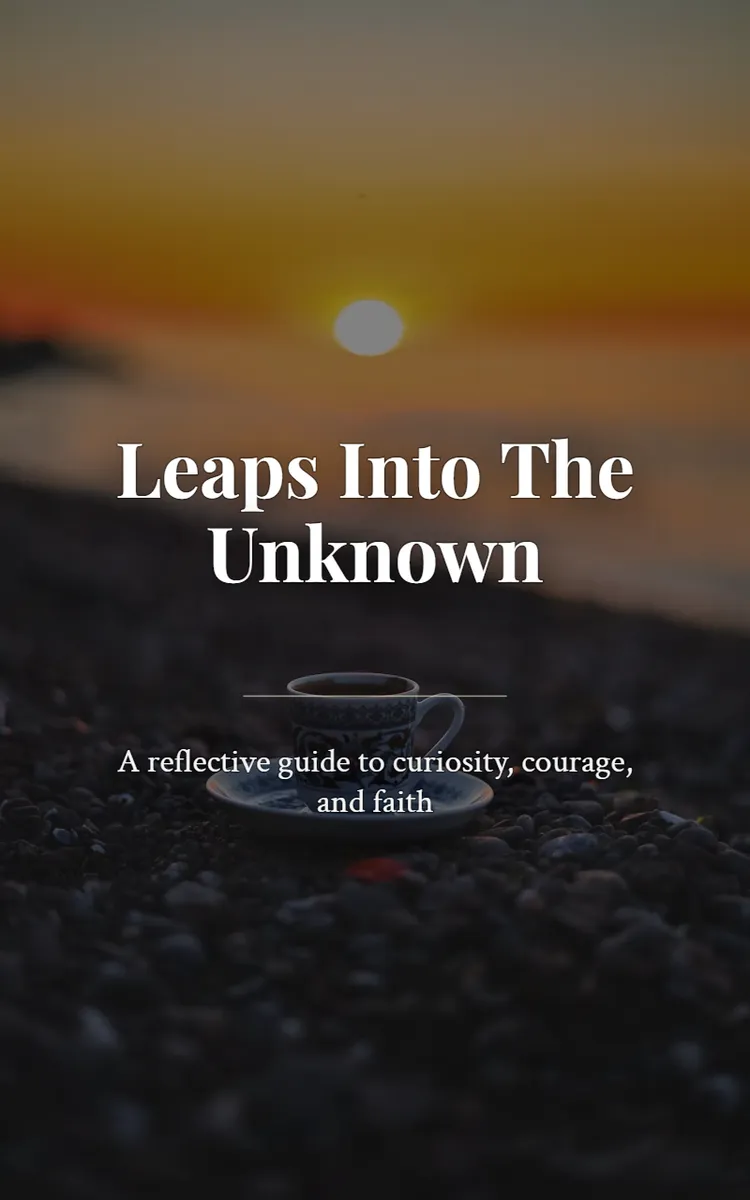
"Leaps Into The Unknown" is a inspirational book by Anonymous with 40 chapters and approximately 60,623 words. Inspiring reflection on mystery, curiosity, and taking faith-based risks.
This book was created using Inkfluence AI, an AI-powered book generation platform that helps authors write, design, and publish complete books. It was made with the AI Inspirational Book Writer.
Frequently Asked Questions
What is "Leaps Into The Unknown" about?
Inspiring reflection on mystery, curiosity, and taking faith-based risks
How many chapters are in "Leaps Into The Unknown"?
The book contains 40 chapters and approximately 60,623 words. Topics covered include Curiosity as a Compass, Choosing Wonder Over Fear, Faithful Risk Requires Preparation, The Beginner’s Mindset for Mystery, and more.
Who wrote "Leaps Into The Unknown"?
This book was written by Anonymous and created using Inkfluence AI, an AI book generation platform that helps authors write, design, and publish books.
How can I create a similar inspirational book?
You can create your own inspirational book using Inkfluence AI. Describe your idea, choose your style, and the AI writes the full book for you. It's free to start.
Write your own inspirational book with AI
Describe your idea and Inkfluence writes the whole thing. Free to start.
Start writingCreated with Inkfluence AI


