
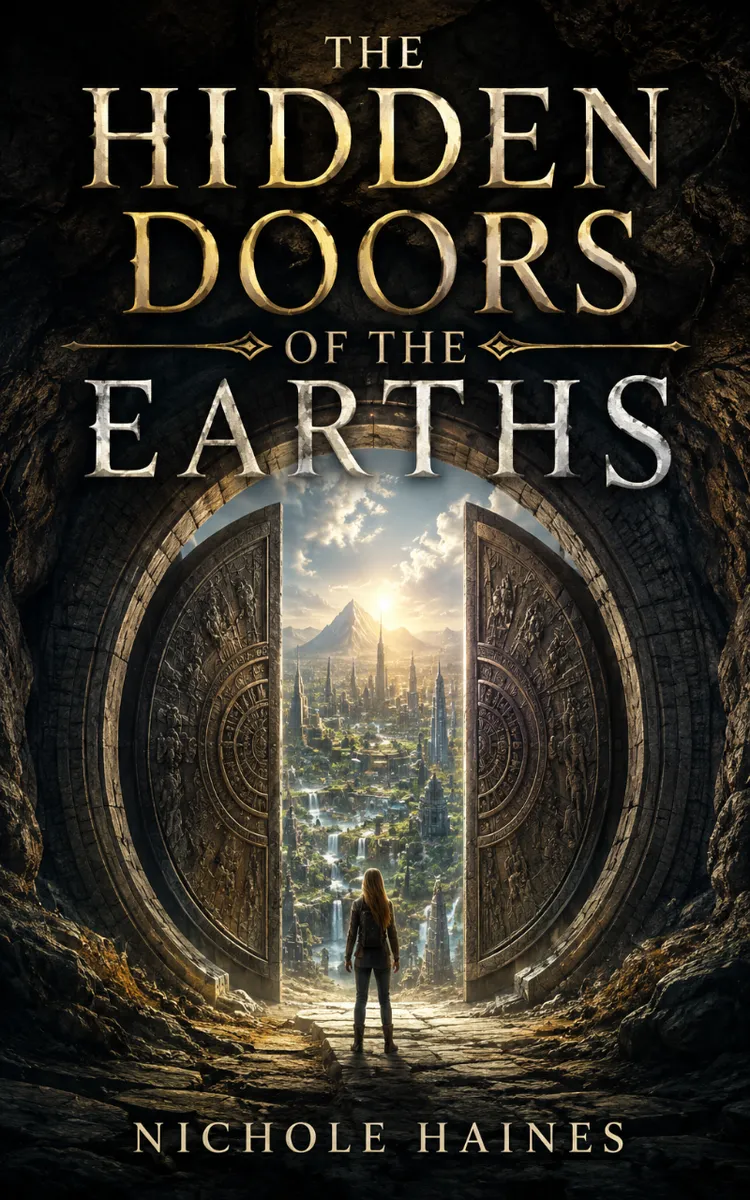

Read the first chapter
The whole of chapter one, free. About 14 min. Turn the pages with the arrows, your keyboard, or a swipe.
Chapter 1
The Door Behind the Floodwall
Water kept time in the flooded underways, slapping the iron ribs of the service tunnel with a steady, bruised rhythm. Mara Kestrel watched the surface for movement that wasn’t her own - every ripple a chance the city’s rumors had turned into something physical. Her flashlight beam jittered through steam and silt, skimming over broken conduits and half-buried signage until it snagged on a smear of darker stone set into the tunnel wall.
Not a patch. Not a repair. A seam.
It ran in a clean vertical line where the concrete should’ve been pocked and uneven, as if someone had cut the wall and then decided not to finish. Mara forced her breathing smaller, colder. The waterline lapped at her boots; each time she shifted, grit rasped under the soles like sandpaper. Somewhere above, the main tracks groaned with the slow settling of flooded infrastructure - an old city complaining in a language of metal and pressure.
The rumor had followed her for days: a hidden door in the underways, a place where the floodwater stopped behaving like water. She’d found the service tunnel by following that rumor through maintenance records that didn’t match the current layout, through a map that kept changing when she looked away. Now the seam stood in front of her, too straight to be accident.
Behind her, the underpass echoed with a sound that didn’t belong to the flood - a measured footstep, then another. Mara didn’t turn right away. She let the beam stay on the seam while she felt for the thing that always came next: the moment the dark decided it had chosen her.
“Still alive?” a voice called out, faintly distorted by distance and water, like it was traveling through a pipe. “That’s… inconvenient.”
Mara’s jaw tightened. She’d been alone in the tunnel long enough to believe the city had swallowed the idea of pursuit. Whoever this was, they’d found her anyway.
She crouched, bracing one hand on slick concrete. Her fingers came away with cold film - mineral slick, not algae. The seam didn’t flex. It didn’t leak. It waited.
“I’m not here to talk,” Mara said, keeping her voice low so it didn’t break the tunnel’s rhythm.
The footstep closer this time, a crunch that suggested boots on something solid above the waterline. “No,” the stranger replied. “You’re here to open it.”
The flashlight beam wavered, then steadied again. Mara reached for the edge of the seam. Her fingertips met a recessed handle disguised as shadow - metal that hadn’t been corroded by the flood. She pulled, expecting resistance, expecting water to spill through a crack.
The seam clicked like a lock forgiving itself.
A panel slid inward with a sound she felt more than heard - an internal pressure shift, the way a door on an old bus used to inhale when someone opened it. Water didn’t rush through. Instead, the tunnel wall made room, and the air on the other side looked wrong. Not dry, not wet. It had the wrong density, as if it belonged to a different weather system.
Mara leaned in despite herself, and the smell hit her first: rain-soaked concrete, sharp and clean, threaded with something faintly metallic and unfamiliar. The tunnel behind her smelled like damp rust. This smelled like open sky.
Her throat tightened. “So it’s real.”
“Of course it is,” the stranger said, closer now, the voice carrying a thin edge of amusement. “People don’t invent doors. They just find them and pretend they didn’t.”
Mara’s goal sharpened into one clean line. Don’t argue. Don’t explain. Walk through before the city decides to swallow the seam again. She shifted her weight, testing the threshold with her boot. The water at her ankles didn’t surge. It didn’t freeze. It simply stopped at the doorway’s line like a boundary drawn in chalk.
She could step through.
She could leave.
Her hands went to the strap of her pack, checking - habit, not hope - that the small items she’d kept dry were still there. A folded street-map she’d stolen from a coastal alternate’s archive, a scrap of chalk-gray paper that never stayed the same color under her lamp, a compact radio that only ever hissed when she turned it on. Proof, tools, and the terrible knowledge that proof never protected you for long.
Behind her, the stranger’s silhouette broke into the flashlight’s spill. He wasn’t tall; he didn’t need to be. He moved like someone who knew how to navigate darkness without trusting it. Water beaded on his clothes in a way that suggested he’d been in this tunnel before and learned how to move without soaking.
“Go on,” he said. “You’ll want to. This is your plan, Mara Kestrel.”
Hearing her name - her full name, spoken with that precise certainty - hit like a slap. She straightened slowly, gun-metal calm she didn’t feel. “You know me.”
“I know pieces,” he corrected, eyes reflecting in the beam. “Enough to know you’re not stupid. Enough to know you’ll run through a door the moment it opens.”
Mara’s mind raced through the identities she’d picked up like shrapnel over the last week. Couriers, analysts, people who swore they worked for someone else, people who wore the same face with different scars. In every version of the story, she’d been running from the flood. In every version, someone else had been running toward her.
“Where’s the rest of it?” she demanded. “Who are you?”
The stranger’s gaze flicked to the doorway. “Not the time.”
“That’s convenient.” Mara stepped backward toward the threshold, keeping her body between him and the open seam. “You said the door is real. That’s it. That’s all I need.”
He laughed once, short and humorless. “It’s not that simple. Doors don’t just open. They decide what they carry.”
The words tightened the air. Mara felt it - felt the seam behind her shifting, like the tunnel wall was reconsidering its decision. The space beyond the doorway trembled with faint distortion, the way heat bends light over asphalt. A sound came from the other side, too: distant traffic, muted by distance and architecture, layered over the underways’ groan.
A city that wasn’t hers.
Mara took a breath that tasted like rain and metal.
Then she moved.
The threshold grabbed her foot - not physically, not like a trapdoor, but like the world had a seam of its own. Her boot sank slightly, as if the ground had different rules. Cold water peeled away from her ankle, replaced by something drier, warmer, the kind of warmth that belonged to sun that hadn’t yet hit concrete. The air changed around her shoulders.
She stepped through.
For a heartbeat, she saw both places at once: the flooded service tunnel with its silt-choked lamps and rusted rails, and the other side where the light looked cleaner, brighter, almost cruel in its clarity. Her flashlight beam cut into the new space and came back with a different color temperature, as if it had traveled through filters she couldn’t name.
Then the door snapped shut behind her with a decisive thunk.
Not a slam. A lock.
Mara spun, yanking her flashlight up to the wall. The seam was gone. The tunnel wall was intact - smooth concrete, no handle, no seam. Only the air was wrong, and the distant sound of traffic was real.
She’d made it.
She’d survived the first crossing.
Her lungs loosened just enough for a shaky laugh. “Okay,” she whispered, because the tunnel didn’t hear whispers; cities did. “Okay. It works.”
The floor beneath her boots was concrete, dry except for a thin film like rain had passed over it without pooling. She stood in a corridor that felt like a maintenance space behind a different subway line. The walls were painted, not stained. A poster was taped near a junction - creased, as if someone had handled it often. The language wasn’t wrong, just… off. Familiar enough to read, unfamiliar enough that her eyes had to work.
She looked down at her pack strap, checking for damage.
Then she heard the sound again: measured footfalls.
Not behind the wall. Not in the tunnel she’d left.
In the corridor with her.
Mara’s spine went rigid. She swung the flashlight beam toward the sound, and at the far end of the corridor, a figure emerged from a doorway-shaped distortion in the air - like reality was holding its breath and finally exhaling. Water didn’t pour through this time. Instead, thin mist rolled out and evaporated instantly in the cleaner light.
The stranger stepped forward as if he belonged there.
His clothes steamed faintly, droplets vanishing before they could fall. His eyes met hers immediately, and the same calm certainty sat behind his face.
“You got here first,” he said.
Mara couldn’t find words fast enough to match the speed at which her fear arrived. “You followed me.”
“I said doors decide what they carry,” he replied. “I didn’t mean the door was going to leave you behind.”
Mara’s hands tightened on her flashlight until the plastic creaked. She tried to orient herself - new corridor, new air, new sounds. Somewhere close, a train clattered through a station. The noise bounced off the walls with a different pitch than the underways she’d known. She was in an Earth that wasn’t hers, and the flood hadn’t drowned her after all.
But she hadn’t escaped pursuit. She’d just outrun it into a different world.
“What did you do?” she demanded.
The stranger’s mouth twitched, not quite a smile. “Nothing you didn’t do. You opened the door. I made sure I was there when it opened.”
Mara took a step back, scanning for an exit she could control. A service hatch sat half-hidden in shadow. A side passage branched off to the left, with a strip of light leaking from its mouth. She could choose one. She could also choose wrong.
She looked at the stranger again. His posture was relaxed in a way that suggested he’d already run this scenario through his head and found the outcome he wanted.
“Where’s your door?” she asked, pointing the flashlight at the air where he’d appeared.
“It’s behind you,” he said.
Mara turned her head sharply, flashlight beam snapping across the wall.
The corridor wall was blank. No seam. No distortion. No handle.
Only a smooth stretch of painted concrete, as if the universe had been edited to remove the evidence.
Her stomach dropped. “It closed.”
“Not just closed,” he said. “It corrected itself.”
Mara swallowed hard. “So I’m trapped.”
“Not trapped.” He took another step, and the floor under his boots made a soft, dry sound. “Cornered, maybe.”
The word landed like a weight. She hadn’t noticed how narrow the corridor felt until he moved closer. The service hatch beside her was too low to reach without crouching, too close to the stranger’s line of sight. The side passage was a gamble - unknown space, unknown rules, unknown whether it led to something she could use.
Mara’s mind flashed to the map in her pack - the one she’d used before, the one that had betrayed her in a different Earth. The paper she’d held up to different light and watched refuse to settle into one truth. It might still help. Or it might be another trap dressed as guidance.
She forced herself to act anyway, because freezing was how people died between worlds.
Mara pivoted toward the side passage, aiming the flashlight beam down its throat. A faint draft touched her face - cooler air, carrying the smell of wet stone and something like electricity. She didn’t wait for permission.
She ran.
Her boots slapped softly on concrete, and her shoulder brushed the wall as she rounded the corner. The corridor narrowed into a maintenance room with pipes overhead and a grated floor drain at its center. The light here flickered - yellow-white bulbs buzzing like insects. Her flashlight beam caught on a painted arrow on the wall: a directional marking that made her skin prickle because it looked like it belonged to her city’s transit system, right down to the thin crack running through the “R.”
She slowed just enough to pull the street-map free, unfolding it with careful hands.
The map responded the way it always did under pressure. Lines shifted. Street names rearranged themselves like they were shuffling cards. The anchor point - a symbol Mara recognized from the coastal Earth - glimmered at the edge of the paper.
She grabbed it with her thumb.
The ink fought her, then steadied into a pattern that made sense for exactly two seconds. A route appeared, leading her deeper into the station infrastructure toward a place marked with the same symbol as the door seam.
She could reach the anchor point again. She could find another crossing - or a way to close whatever had followed her.
A noise behind her snapped her attention.
The stranger had rounded the corner without breaking stride.
Mara spun, map still open in her hand. The paper trembled as if it could feel the pursuit. “How are you keeping up?” she demanded.
He glanced at the map for half a second, as if reading only the shape of it, not the words. “Because you’re not the only one who’s been lost.”
Mara’s throat went tight. “You’re lying.”
“I’m not,” he said. “I’m incomplete.”
Her grip tightened until the map creased along the fold. “What does that even mean?”
He moved closer, slow enough that Mara could still run, fast enough that she couldn’t ignore him. His eyes held hers. “It means there are versions of us that remember the door. Versions that don’t. Versions that open it and disappear. Versions that open it and bring something back.”
Mara felt the corridor’s air change, as if the world leaned toward their conversation. The bulbs overhead buzzed louder. The pipes vibrated with a tremor she felt in her teeth.
Behind him, the far wall shivered.
Not from wind. Not from footsteps.
From instability.
Mara stared, and her blood chilled. The painted concrete rippled like water. A faint seam appeared in the wall’s surface - hairline at first, then widening into a vertical distortion that looked like the earlier door, but unstable, wrong in its proportions.
The door wasn’t just behind her anymore.
It was forming again.
The stranger’s gaze flicked to it, and for the first time his calm cracked into something sharper. “You see it,” he said, voice dropping. “Good. That means it’s reachable.”
Mara’s mind snapped into a single, desperate clarity. If the door was reforming, it meant the multiverse wasn’t a one-way escape. It was a network. Every step she took through one seam could open another elsewhere.
And if he was here - If he was here because he could follow - Then survival wasn’t about getting through. It was about controlling the crossing before it decided to carry him with her again.
Mara shoved the map back into her pack, fingers fumbling because her hands were suddenly too hot. She lunged toward the instability, flashlight cutting a bright line through the rippling wall. The seam darkened, deepening into a gap in reality.
The stranger moved too, stepping between her and the widening door as if he could block it with his body.
“Don’t,” he said, and the word carried urgency now, not amusement.
Mara’s breath caught. “You said it decides what it carries.”
“It does,” he agreed. “And it doesn’t care who wants what.”
The rippling seam widened another inch, and the air pouring out wasn’t rain this time. It smelled like wet metal and burnt insulation, a sharp, sickly tang that made her eyes water. The sound beyond it wasn’t traffic. It was something like distant alarms muffled under water.
Mara’s resolve hardened into action. She grabbed the stranger’s wrist - not gentle, not asking - and yanked him sideways away from the opening.
He stumbled, and his shoulder slammed against the wall. His face flashed with pain he tried to hide, then steadied again into anger.
“You’re trying to trap me,” he said.
“No,” Mara snapped back, breath ragged. “I’m trying to choose.”
The seam flared brighter, the distortion rippling faster, and the corridor’s lights flickered hard enough to throw long shadows across the grated drain. The stranger twisted, trying to regain position. Mara shoved forward, stepping into the widening gap as if she could outrun the door’s decision by being the first body through.
For a split second, the world folded around her. Concrete became liquid light. The smell of wet metal swallowed the rain-metal scent of where she stood. Her ears popped with pressure, and the corridor’s buzzing bulbs became a distant, underwater hum.
She felt the door take her weight.
Then she was through again - stumbling onto a floor that wasn’t dry concrete anymore.
Cold water surged up around her calves, and the familiar slap of floodwater hit her ears like a memory that refused to stay buried. She spun, flashlight beam flaring across flooded rails and broken tiles, the underways of her own city returning with brutal familiarity.
But the seam behind her didn’t vanish.
It stayed open just long enough for someone else to step through.
The stranger staggered out of the distortion with a curse under his breath, water soaking him up to the knees. He looked at Mara - really looked, eyes wide with calculation turning into something like fury.
“Of course,” he muttered. “Of course it brought you back.”
Mara stared at him, water dripping from his sleeves, her chest tight with a realization that landed like a verdict: she’d escaped the flooded tunnel once, crossed into a new Earth, and still hadn’t shaken the person who’d been following her through every door the multiverse offered.
She’d gotten what she wanted.
But the cost had arrived with her, dripping onto the same concrete she’d thought she’d left behind.
The door behind them began to tremble again, the seam tightening as if it was already deciding the next correction.
Mara tightened her grip on the flashlight and forced herself upright in the floodwater, scanning for any sign of a way forward that wasn’t another lock deciding her fate.
Behind her, the stranger straightened, dripping, staring at the narrowing gap like it was a problem he could solve.
Then he looked at her again.
“You opened it,” he said, voice low, almost respectful now. “So open it again. We don’t have long.”
End of chapter one. 41 more chapters and about 116,964 words in the full book.
Swipe or use the arrows to turn the page


What's inside: 42 chapters
- 1. The Door Behind the Floodwall
- 2. A Map That Changes When Read
- 3. Whoever Wears the Same Face
- 4. The Library That Refuses Her
- 5. Mara’s Choice to Lie
- 6. The Door-Signal in Her Teeth
- 7. The Stranger Who Knows Her Name
- 8. Escape Through a Train of Shadows
- 9. The Assistant’s Confession in the Dark
- 10. The Anchor Node Burns the Map
- 11. A Question Hidden in Static
- 12. The Bridge That Only Exists Once
- 13. Forging a Key from Borrowed Memories
- 14. The Previous Mara’s Warning
- 15. The Courier’s Ledger of Earths
- 16. A Storm That Swallows Directions
- 17. Rescuing the Assistant from Chains
- 18. The Containment Room of Mirrors
- 19. The Primary Candidate’s Countdown
- 20. The Door Opens to Her Home
- 21. Her Assistant’s True Motive Revealed
- 22. The Courier’s Raid on the Seam
- 23. Following the Seam’s False Footprints
- 24. The Sealed Room That Breathes
- 25. Choosing Which Earth to Save
- 26. The Second Door’s Uninvited Guests
- 27. A Trail Through Echo-Weather
- 28. The City Built on Borrowed Time
- 29. Breaking the Loop with a Lie
- 30. Mara Loses the Only Proof
- 31. The Last Page in the Ledger
- 32. Returning Through the One-Time Bridge
- 33. Saying Goodbye to a Version
- 34. The Door-Sacrifice Begins
- 35. Infinite Earths Collide at Once
- 36. Mara Remembers the Wrong Earth
- 37. The Assistant Finds Her Again
- 38. The Courier’s Offer of Mercy
- 39. A World Without the Door
- 40. The Door’s Last Whisper Ends
- 41. The Door’s Last Whisper Ends
- 42. The Last Anchor
About this book
"The Hidden Doors of The Earths" is a fiction book by Nichole Haines with 42 chapters and approximately 116,964 words. A hidden door reveals infinite versions of Earth..
This book was created using Inkfluence AI, an AI-powered book generation platform that helps authors write, design, and publish complete books. It was made with the AI Novel Writer.
Frequently Asked Questions
What is "The Hidden Doors of The Earths" about?
A hidden door reveals infinite versions of Earth.
How many chapters are in "The Hidden Doors of The Earths"?
The book contains 42 chapters and approximately 116,964 words. Topics covered include The Door Behind the Floodwall, A Map That Changes When Read, Whoever Wears the Same Face, The Library That Refuses Her, and more.
Who wrote "The Hidden Doors of The Earths"?
This book was written by Nichole Haines and created using Inkfluence AI, an AI book generation platform that helps authors write, design, and publish books.
How can I create a similar fiction book?
You can create your own fiction book using Inkfluence AI. Describe your idea, choose your style, and the AI writes the full book for you. It's free to start.
Write your own fiction book with AI
Describe your idea and Inkfluence writes the whole thing. Free to start.
Start writingCreated with Inkfluence AI


