
Read the first chapter
The whole of chapter one, free. About 6 min. Turn the pages with the arrows, your keyboard, or a swipe.
Chapter 1
Rewriting Your Middle-Manager Identity
When Your Label Walks Into the Meeting Before You Do
The project review was already tense when the department head asked, “What’s your recommendation?”
You knew the answer. You’d reviewed the numbers, spoken with the team, and spotted the risk two weeks earlier. Still, you heard yourself say, “I’m not really the strategic person here. I’m more of an execution manager.” The room moved on. Someone else offered a similar idea five minutes later, with more confidence, and received the credit.
Later, at your desk, the moment replayed. Not because you lacked experience. You’d handled difficult employees, missed deadlines, shifting priorities, and impossible requests from above. But somewhere along the way, a label had settled in: I’m the reliable one, not the leadership one. Labels can sound like facts when you repeat them long enough.
Your old label may be explaining your behavior - but it doesn’t have to define your leadership.
From Limiting Label to Leadership Role
Old Belief: I need to feel confident before I can act like a confident leader.
New Reality: Confidence grows when I repeatedly act from my leadership role, even before the feeling catches up.
A label is a shortcut your mind uses to explain your behavior. “I’m not political.” “I’m bad at conflict.” “I’m the technical person.” “I’m not ready for the next level.” These statements may have started with a real experience. Perhaps a presentation went badly. Maybe a senior leader dismissed your idea. Maybe you were promoted because you were excellent at your individual work and never received a clear picture of what leadership now required.
The problem begins when a temporary experience becomes a permanent identity. You stop asking, “What does this situation require from me?” and start asking, “What would someone like me do?” That question quietly narrows your choices.
A role-based identity gives you a stronger place to stand. It doesn’t ask you to pretend you’re fearless, outgoing, or naturally polished. It asks you to define yourself by the responsibility you’ve accepted. You might say, “I’m a manager who creates clarity,” or “I’m a leader who addresses issues early.” Those statements guide behavior more reliably than “I’m confident” ever could.
Consider the manager who calls herself “terrible at difficult conversations.” When a team member repeatedly misses handoffs, she delays the conversation, rewrites the work herself, and becomes resentful. Her label predicts avoidance. A role-based identity changes the question: “As the manager responsible for clear standards, what conversation is needed?” She can still feel uncomfortable. She simply stops treating discomfort as proof that she should stay silent.
The Identity Upgrade Loop makes this change practical: notice the label, name the role, choose one role-based action, and record the evidence. Each completed action gives your mind something new to believe.
The Identity Upgrade Loop in Real Life
Your mind tends to protect the identity it already knows. If you think of yourself as “the peacekeeper,” speaking directly can feel like becoming a different person. If you see yourself as “the expert who must have the answer,” asking your team for input may feel like weakness. The brain often prefers a familiar limitation to an unfamiliar possibility.
The Identity Upgrade Loop interrupts that pattern. First, you notice the label in the moment it appears. Next, you name the role you want to practice. Then you take one visible action that matches that role. Finally, you capture what happened. This last step matters because your mind needs evidence, not slogans.
You don’t need a dramatic reinvention. A manager who wants to become “a leader who develops people” might stop solving every problem immediately. In a one-on-one, she could ask, “What options have you considered?” and wait through the silence. That small pause is a role-based action. It creates evidence that she can coach instead of rescue.
Signs this pattern is running your life:
1. You introduce yourself through a limitation. You say, “I’m not good with senior stakeholders,” before explaining what you actually contribute.
2. You repeat old evidence as if it predicts the future. One awkward presentation becomes proof that you should avoid presenting.
3. You wait for permission to behave like the role you already hold. You’re officially the manager, yet you keep acting like a highly capable individual contributor.
4. You collect proof of failure and overlook proof of growth. A difficult conversation feels unforgettable, while three clear conversations disappear from memory.
Your identity becomes more flexible when your daily actions give it new evidence.
Questions That Expose the Label Beneath the Behavior
1. What label do you use when you explain why you’re holding back at work? Write the exact words, even if they sound harsh: “I’m not strategic,” “I’m too quiet,” or “I always avoid conflict.” Precision helps you work with the thought instead of letting it operate in the background.
2. When did this label first become convincing? Look for the event, not just the conclusion. Perhaps a senior leader interrupted you once, and you decided your ideas weren’t strong enough. The event was real; the permanent identity may not be.
3. What responsibility does your current role require that the label makes harder? If your label is “I keep the peace,” but your role requires accountability, the gap is clear. You may need to address performance issues earlier, even when you’d rather preserve immediate comfort.
4. What role-based identity would better support the manager you’re becoming? Keep it grounded and behavioral. “I’m a manager who creates clarity” gives you something to do. “I’m exceptional” doesn’t.
5. What is one action that would provide evidence for that identity before the day ends? Send the direct follow-up. State your recommendation in the meeting. Ask an employee to solve the problem rather than solving it for them. Choose an action small enough to complete and meaningful enough to count.
Be honest, but don’t turn honesty into self-attack. The goal isn’t to prove that the old label was foolish. It probably helped you make sense of something. The goal is to decide whether it still deserves authority over your next move.
The Seven-Day Role Evidence Challenge
For the next 7 days, replace one limiting label with one role-based action each workday.
• Day 1: Write down the label that appears most often. Under it, write: “The role I want to practice is…” Choose a clear identity, such as “a manager who addresses issues early.” - Days 2-6: Notice one moment when the old label shows up. Record the situation, the label, and the action your chosen role would take. Complete that action before the workday ends. - Day 7: Review your notes. Circle every piece of evidence that challenges the old label, including small moments such as asking a useful question, setting a boundary, or stating a recommendation. - At the end of each day, finish this sentence: “Today I acted like a manager who…”
Expected difficulty: Medium
You’ll know it’s working when...
• You catch the label before it automatically controls your response. - You take action while still feeling some discomfort. - You describe your behavior using role language instead of personality labels. - You notice evidence of leadership that you previously dismissed. - Someone responds to your clearer behavior with more clarity of their own.
Don’t make the challenge harder by choosing a complete personality overhaul. If you want to become more strategic, you don’t need to transform into the loudest voice in the room. Start by offering one recommendation with the reasoning behind it. If you want to become better at accountability, don’t wait for a major performance crisis. Clarify one expectation today.
The point is not to perform a new identity for seven days. It’s to give yourself repeated proof that your role is larger than the label you’ve been carrying.
You are not required to feel like a different manager before you begin behaving like one.
• Limiting labels turn past experiences into predictions about your future behavior. - A role-based identity connects who you are to the responsibility you’ve accepted. - The Identity Upgrade Loop moves from noticing the label to naming the role, taking action, and recording evidence. - Confidence becomes more believable when your own behavior repeatedly supports it.
The next step is to build on this identity with the choices, boundaries, and leadership habits that make your role visible to others. Your promotion readiness won’t come from sounding like a different person. It will come from consistently acting like the leader your responsibilities already require.
End of chapter one. 9 more chapters in the full book.
Swipe or use the arrows to turn the page


What's inside: 10 chapters
- 1. Rewriting Your Middle-Manager Identity
- 2. Replacing Fixed Beliefs With Growth
- 3. The Promotion Readiness Scorecard
- 4. Turning Urgency Into Weekly Execution
- 5. Delegation Without Losing Control
- 6. Running Clear 1:1s That Produce Results
- 7. Delivering Feedback With the SBI Script
- 8. Building Stakeholder Influence Through Updates
- 9. Resilience After Setbacks
- 10. Purpose-Driven Leadership for Next Level
About this book
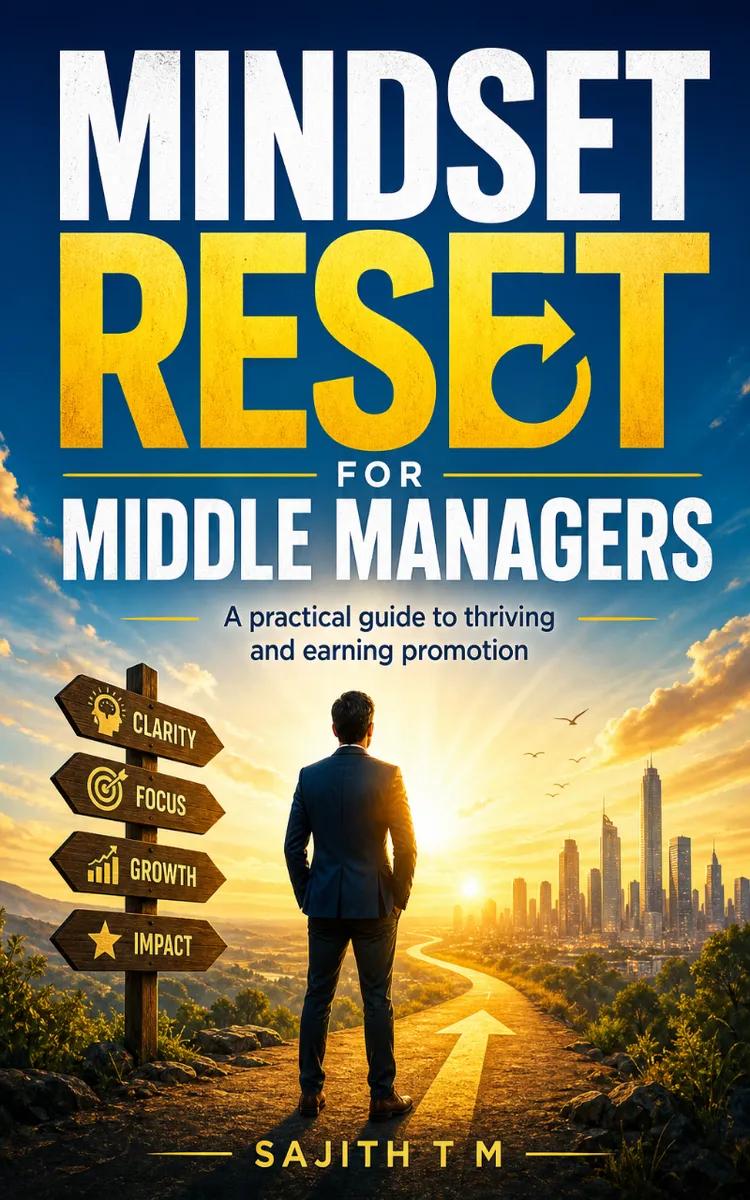
"Mindset Reset For Middle Managers" is a self-help book by Sajith T M with 10 chapters and approximately 15,125 words. Your old identity walks into every meeting before you do. You know the numbers, you’ve handled the hard parts, but the moment someone asks for your recommendation, you hear yourself shrink into a role that sounds safe: “I’m not strategic,” “I’m not political,” “I’m not ready.
This book was created using Inkfluence AI, an AI-powered book generation platform that helps authors write, design, and publish complete books. It was made with the AI Self-Help Book Writer.
Frequently Asked Questions
What is "Mindset Reset For Middle Managers" about?
Your old identity walks into every meeting before you do. You know the numbers, you’ve handled the hard parts, but the moment someone asks for your recommendation, you hear yourself shrink into a role that sounds safe: “I’m not strategic,” “I’m not political,” “I’m not ready.” Then credit goes elsewhere, and the replay starts. Mindset Reset For Middle Managers helps you break the hidden beliefs that quietly steer your choices, your confidence, and your promotion readiness. You will learn how to replace fixed self-talk with growth actions, so your performance becomes visible and credible to the people who decide. If you are ready to lead like the next level is already yours, start here.
How many chapters are in "Mindset Reset For Middle Managers"?
The book contains 10 chapters and approximately 15,125 words. Topics covered include Rewriting Your Middle-Manager Identity, Replacing Fixed Beliefs With Growth, The Promotion Readiness Scorecard, Turning Urgency Into Weekly Execution, and more.
Who wrote "Mindset Reset For Middle Managers"?
This book was written by Sajith T M and created using Inkfluence AI, an AI book generation platform that helps authors write, design, and publish books.
How can I create a similar self-help book?
You can create your own self-help book using Inkfluence AI. Describe your idea, choose your style, and the AI writes the full book for you. It's free to start.
Write your own self-help book with AI
Describe your idea and Inkfluence writes the whole thing. Free to start.
Start writingCreated with Inkfluence AI


