
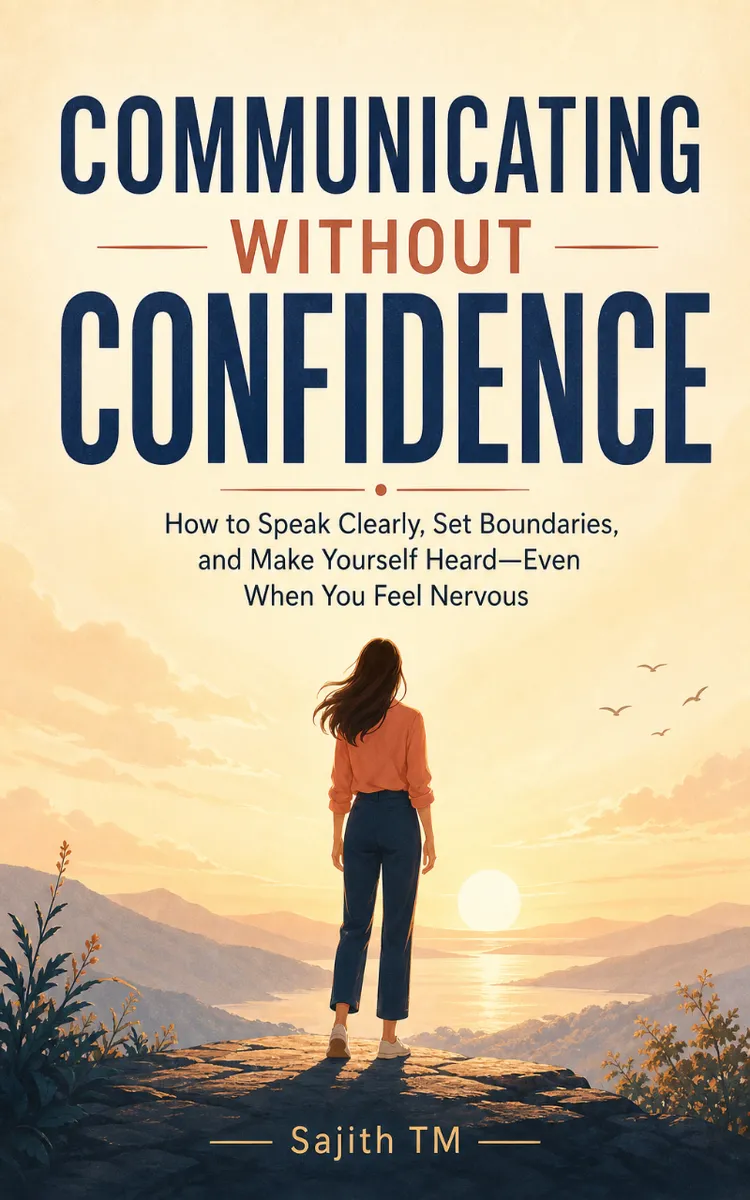
Read the first chapter
The whole of chapter one, free. About 6 min. Turn the pages with the arrows, your keyboard, or a swipe.
Chapter 1
Rewriting Your Confidence Story
The Story You Tell Before You Speak
What do you say to yourself in the few seconds before you speak?
Maybe it’s, “Don’t mess this up.” Maybe it’s, “They’ll notice I’m nervous.” Or perhaps the thought is quieter but just as powerful: “I’m not the kind of person people listen to.” Then someone asks for your opinion in a meeting, a customer wants an explanation, or a group turns toward you - and your mind starts writing the ending before you’ve said a word.
Your body follows the story. Your shoulders tighten. Your voice gets smaller. You rush through the sentence, then replay it later while brushing your teeth. The conversation may have lasted thirty seconds, but your inner critic turns it into a full-length film.
What if your lack of confidence isn’t your identity, but a story you’ve been rehearsing?
From “I’m Not a Speaker” to “I’m Someone Who Speaks Clearly”
Old Belief: Confident speakers are naturally bold, quick, and comfortable, while I’m simply not built that way.
New Reality: Confidence grows when you practice a speaking identity that feels believable, useful, and repeatable.
The old belief makes confidence sound like a permanent personality setting. You either have it, or you don’t. That idea is convenient because it removes the pressure to change - but it also traps you. If “I’m bad at speaking” is who you are, then every awkward pause becomes proof.
The new reality gives you something to work with. You don’t need to become loud, charming, or fearless. You need an identity you can actually live: “I’m someone who takes a moment before answering.” “I explain things simply.” “I can speak even when I feel nervous.” These statements don’t demand a personality transplant. They describe actions.
Picture a gym owner explaining a new membership option to a customer. Under the old story, the conversation might sound like this inside their head: “I hate selling. I’ll sound pushy. They’ll say no.” That story encourages rushed words and an apology for the price. A rewritten identity might be: “I help people choose an option that fits their goals, and I can explain the choices clearly.” The nerves may still show up. But the speaker now has a job to do, not an image to protect.
That difference matters. Confidence isn’t always the feeling that arrives before you speak. Often, it’s the trust you build afterward when you notice, “I said what I meant, even though I was uncomfortable.”
How Your Confidence Story Keeps Taking the Mic
Your confidence narrative is the repeated explanation you use for your speaking behavior. It answers questions like: Why do I stay quiet? Why do I over-explain? Why do I avoid eye contact? Why do I let someone interrupt me?
The story may have started with one embarrassing moment, a harsh comment, or years of being overlooked. Over time, your mind turns an event into a rule. “I stumbled once” becomes “I always stumble.” “Someone laughed” becomes “People will laugh.” Your brain is trying to protect you from another painful moment, so it spots danger early - even when the room is safe.
The problem is that protection can look like limitation. You stop volunteering ideas, soften every request, or hand conversations to people who sound more certain. Then the lack of practice makes speaking feel even harder. The story seems confirmed. That’s the loop you’re here to interrupt.
Signs the Old Story Is Running Your Life
1. You edit yourself before anyone else can. You decide your point is too obvious, too late, or not worth saying. In a team discussion, you may wait for the perfect opening until the topic has moved on.
2. You treat nervousness as evidence of failure. A shaky voice or warm face becomes proof that you shouldn’t be speaking, rather than a normal body response to being noticed.
3. You use permission-seeking language. Phrases such as “This might be stupid,” “I’m probably wrong,” or “Sorry, can I add something?” appear before your actual idea.
4. You replay the conversation but ignore what went well. Your mind zooms in on one pause and skips the fact that the customer understood you, the team considered your suggestion, or you asked a clear question.
Your speaking identity changes when you stop treating old fear as a permanent description of who you are.
Questions That Expose the Story Beneath the Silence
1. What exact sentence appears in your mind just before you speak? Don’t settle for “I feel nervous.” Write the words. It might be, “I need to sound smart,” or “If I disagree, they’ll think I’m difficult.” Naming the sentence makes it easier to question.
2. Whose voice does that sentence sound like? It may come from a former manager, a family member, a teacher, or simply years of comparing yourself with confident people. You don’t need to blame anyone. You’re looking for the source of the rule you’ve been following.
3. What does your current story make you do? Be specific. Does it make you speak too quickly, avoid phone calls, agree when you don’t, or explain simple points for five minutes? A useful answer describes behavior, not character: “I give three reasons when one would do.”
4. What evidence doesn’t fit the story? Think of one recent moment when you communicated better than expected. Maybe you calmly corrected an invoice, asked for help, or told a customer you needed more time. Small evidence counts because identities are built from repeated moments.
5. What speaking identity would help you in the next seven days? Choose something you can demonstrate, not something you have to magically feel. “I’m fearless” is hard to prove. “I speak one clear sentence before adding detail” is practical and visible.
The Seven-Day Confidence Story Rewrite
Challenge: Replace One Speaking Rule
For the next seven days, choose one old confidence sentence and rewrite it into an identity you can practice.
• Write the old sentence at the top of a page. For example: “I’m bad at explaining things.” - Rewrite it as an action-based identity: “I explain one point at a time.” - Each day, use that identity in one real conversation. - Before speaking, take one slow breath and repeat the new sentence silently. - Afterward, record three details: what you said, what happened, and what your old story predicted incorrectly. - Keep each entry under two minutes. The goal is repetition, not a beautifully decorated journal.
Difficulty: Medium
You’ll know it’s working when…
• You catch the old story before it fully takes over. - You pause instead of rushing to prove yourself. - Your new identity feels more believable than it did on day one. - You collect at least three examples of speaking while nervous. - You judge the conversation by clarity, not by whether you felt perfectly calm.
Don’t choose the biggest speaking challenge in your life for this exercise. Start with a manageable moment: asking a colleague a direct question, explaining a price, sharing one opinion, or leaving a clear voicemail. Your brain needs usable evidence. A tiny successful action is more helpful than a grand promise you avoid.
Some days, the old story will be louder. That doesn’t mean the rewrite failed. It means the old path is well worn. You’re building another path through practice. The aim isn’t to erase nervousness. It’s to stop allowing nervousness to introduce you.
Your Voice Can Become Evidence
Your confidence story is not a verdict; it’s a draft you revise through the way you speak today.
• You learned to separate a nervous feeling from a fixed identity. - You identified how your old confidence narrative affects your speaking behavior. - You replaced personality labels with practical, action-based speaking identities. - You began gathering real evidence through a seven-day Confidence Story Rewrite.
The next step is to give that new identity something solid to stand on. When you know what you mean, who you’re speaking to, and what you want the conversation to achieve, confidence has less work to do. Your voice doesn’t need to perform a new personality. It needs a clear direction.
End of chapter one. 9 more chapters and about 14,024 words in the full book.
Swipe or use the arrows to turn the page
What's inside: 10 chapters
- 1. Rewriting Your Confidence Story
- 2. Defusing Catastrophic Self-Talk
- 3. Replacing Perfectionism With Clear Intent
- 4. Using the 3-Point Message Ladder
- 5. Asking Questions That Build Trust
- 6. Saying What You Mean With Soft Starts
- 7. Setting Boundaries Without Guilt
- 8. Handling Pushback With the Reset Loop
- 9. Practicing Courageous Micro-Shares
- 10. Aligning Your Voice With Purpose
About this book
"Communicating Without Confidence" is a self-help book by Sajith TM with 10 chapters and approximately 14,024 words. You can learn to communicate clearly even when confidence is missing. This book shows you how to change the thoughts that hijack your delivery, so your words come out calmer, cleaner, and more convincing.
This book was created using Inkfluence AI, an AI-powered book generation platform that helps authors write, design, and publish complete books. It was made with the AI Self-Help Book Writer.
Frequently Asked Questions
What is "Communicating Without Confidence" about?
You can learn to communicate clearly even when confidence is missing. This book shows you how to change the thoughts that hijack your delivery, so your words come out calmer, cleaner, and more convincing. You will rewrite your confidence story, defuse the worst case mental spiral, and use the Thought-to-Voice Brake to regain control in real time. You will replace perfectionism with clear intent, so your messages land when someone is waiting. You will craft Intent-First Messages that make your purpose impossible to miss, and you will build repeatable speaking habits that feel like you. By the time you finish, you will have practical strategies you can use immediately to help clients and communicate with confidence that grows.
How many chapters are in "Communicating Without Confidence"?
The book contains 10 chapters and approximately 14,024 words. Topics covered include Rewriting Your Confidence Story, Defusing Catastrophic Self-Talk, Replacing Perfectionism With Clear Intent, Using the 3-Point Message Ladder, and more.
Who wrote "Communicating Without Confidence"?
This book was written by Sajith TM and created using Inkfluence AI, an AI book generation platform that helps authors write, design, and publish books.
How can I create a similar self-help book?
You can create your own self-help book using Inkfluence AI. Describe your idea, choose your style, and the AI writes the full book for you. It's free to start.
Write your own self-help book with AI
Describe your idea and Inkfluence writes the whole thing. Free to start.
Start writingCreated with Inkfluence AI


