
Read the first chapter
The whole of chapter one, free. About 7 min. Turn the pages with the arrows, your keyboard, or a swipe.
Chapter 1
Choosing Happiness as Identity
When Happiness Is Always Waiting for Later
Nadia, 34, had a customer success job that looked fine from the outside. She paid her bills, answered messages, helped clients solve problems, and usually kept her promises. Still, her happiness seemed to depend on whatever came next.
She’d feel better when the difficult account renewed. When work slowed down. When she finally took a proper holiday. When her partner was less stressed. When she had more money, more energy, or fewer unanswered messages glowing on her phone.
One Tuesday evening, Nadia closed her laptop after handling a customer complaint that wasn’t even her fault. She stood in the kitchen, reheating dinner, and caught herself thinking, “I’ll be happy when this week is over.” Then she paused. She’d said the same thing the week before.
What if happiness isn’t something you find after life gets easier, but something you practice while life is still happening?
The Shift From Waiting to Choosing
Old Belief: I need a good reason to be happy.
New Reality: Happiness can be part of who I am, even when my circumstances aren’t perfect.
This doesn’t mean pretending everything is wonderful. Nadia still had hard customers, tired evenings, and bills to manage. Choosing happiness didn’t require her to smile through frustration or deny that some days were genuinely painful. It meant she stopped making happiness wait for permission from the outside world.
Most of us are taught to treat happiness like a reward. Finish the project, then relax. Reach the goal, then celebrate. Fix the relationship, then feel peaceful. The problem is that life keeps producing new problems. If happiness only arrives after everything is settled, it may never get much time in your schedule.
The Identity-First Happiness Loop begins with a different question. Not, “What would make me happy right now?” but, “What would a person who practices happiness do with this moment?” That question gives you somewhere to stand.
For Nadia, the answer wasn’t to ignore the complaint or force excitement about reheated dinner. It was to take ten minutes before responding to another message, eat without her phone, and notice one part of the day that had gone well. She also sent a voice note to a friend instead of disappearing into work. None of these actions changed her workload. They changed the way she showed up inside it.
That’s the important distinction. Circumstances influence your mood, but they don’t have to own your identity. You can be disappointed and still be someone who practices happiness. You can be worried and still make room for warmth. You can have a bad afternoon without turning it into a bad life.
How the Identity-First Happiness Loop Works
The loop is simple: identity shapes action, action creates evidence, and evidence strengthens identity.
When you tell yourself, “I’m someone who practices happiness,” you begin looking for small actions that match that identity. You might step outside before your next call, speak kindly to yourself after a mistake, or enjoy your morning coffee instead of treating it as fuel to rush past. Those actions create evidence: “I really did choose a better response.” Over time, that evidence makes the identity feel more believable.
The reverse loop works too. If you repeatedly say, “I can’t be happy until this is fixed,” you train yourself to scan for what’s wrong. Every delay becomes proof. Every inconvenience reinforces the belief that happiness belongs somewhere in the future.
Here are signs this pattern is running your life:
1. You keep moving the happiness finish line. You felt sure you’d relax after payday, but payday arrived and another concern took its place.
2. Good moments feel suspiciously temporary. Instead of enjoying a peaceful evening, you wait for the next problem to interrupt it.
3. You treat ordinary pleasure as something you must earn. A walk, a laugh, or a quiet lunch feels irresponsible unless every task is complete.
4. You describe yourself through your current struggle. You don’t simply say, “Work is difficult right now.” You say, “I’m miserable,” as if the difficulty has become your permanent identity.
Happiness becomes more dependable when you practice it as an identity, not postpone it as a reward.
The goal isn’t to feel cheerful every minute. That would be exhausting and unrealistic. The goal is to become familiar with returning to happiness. You notice when you’ve drifted into waiting. You choose one small action that reflects the person you want to be. Then you repeat the process.
Think of it like brushing your teeth. You don’t do it once and declare the job finished forever. You return to it because care works through repetition. Happiness works that way too.
Questions for the Life You’re Living Now
1. What condition have you secretly placed in front of your happiness? Finish the sentence: “I’ll let myself feel happy when…” Be honest. Maybe your answer is “when I have more money,” “when my family calms down,” or “when I feel confident.” Naming the condition helps you see how long you’ve been waiting.
2. Where did you experience a small moment of happiness recently, even though life wasn’t perfect? It could be a funny message, a good meal, clean sheets, or five quiet minutes in the car. The point isn’t to find a dramatic memory. It’s to notice that happiness already appears inside unfinished days.
3. What would someone who identifies as a happiness practitioner do during your next difficult moment? Nadia might pause before replying to an angry customer. You might take three slow breaths, ask for help, or refuse to punish yourself for being human. Choose an action you could actually take, not one that sounds impressive.
4. Which daily habit currently tells your brain that happiness must wait? Perhaps you check work messages before getting out of bed, skip lunch until everything is done, or spend every evening replaying what went wrong. Identify one habit and replace it with a two-minute act of deliberate enjoyment.
5. What evidence could you create today that you are already becoming this person? Keep it visible and specific. “I’ll take a ten-minute walk at 3 p.m.” is stronger than “I’ll be happier.” Your identity grows from what you repeatedly do, especially when no one else notices.
Don’t rush these answers. The most useful response may not sound polished. “I’m tired of waiting for a life that never has problems” is a powerful place to begin.
The Seven-Day Happiness Identity Challenge
Challenge: Collect Evidence That You Choose Happiness
For the next seven days, practice one deliberate happiness action before the day ends. Choose something small enough to do on a difficult day.
• Each morning, write: “Today, I am someone who practices happiness by…” - Complete one action that matches the sentence. Examples include taking a phone-free lunch, playing one favorite song, enjoying tea without multitasking, calling a trusted person, or spending ten minutes outside. - When something goes wrong, name the feeling without making it your identity: “I’m frustrated right now, and I’m still someone who can choose my next response.” - At night, record one piece of evidence that you practiced happiness. Write one sentence only. - On the seventh day, read all seven entries and notice which actions felt natural, forced, or surprisingly effective.
Expected difficulty: Medium
You’ll know it’s working when:
• You stop waiting for a perfect mood before taking a positive action. - You catch yourself saying, “I can have a good moment even with this problem.” - Small pleasures feel less like distractions and more like part of a well-lived day. - A difficult moment ends without defining the entire day. - You begin using the phrase “I’m someone who practices happiness” as a reminder, not a performance.
Some days, your action will feel meaningful. Other days, it may feel almost silly. That’s fine. You’re not trying to create a dramatic emotional transformation in one week. You’re teaching your mind that happiness is allowed to exist alongside effort, disappointment, and uncertainty.
The Person You Practice Becoming
You don’t need a reason to begin practicing happiness; the practice becomes the reason you trust yourself to find it.
• Waiting for perfect circumstances makes happiness fragile and constantly delayed. - Choosing happiness as an identity doesn’t deny pain; it gives you a steady response within pain. - The Identity-First Happiness Loop grows through repeated evidence: identity shapes action, action strengthens identity. - Small, deliberate moments of enjoyment can train you to stop treating happiness as something you must earn.
Nadia didn’t solve her workload in seven days. She didn’t become cheerful on command. What changed was more useful: she stopped handing every emotion and every good moment over to circumstances. She began to see happiness as something she could return to, one ordinary choice at a time.
That is where consistent happiness starts - not with a perfect life, but with a new answer to the question, “Who am I being today?”
End of chapter one. 5 more chapters in the full book.
Swipe or use the arrows to turn the page


What's inside: 6 chapters
- 1. Choosing Happiness as Identity
- 2. Rewriting Beliefs That Block Joy
- 3. Building a Daily Happiness Habit
- 4. Communicating Needs Without Killing Peace
- 5. Resilience That Keeps Happiness Alive
- 6. Chapter 6
About this book
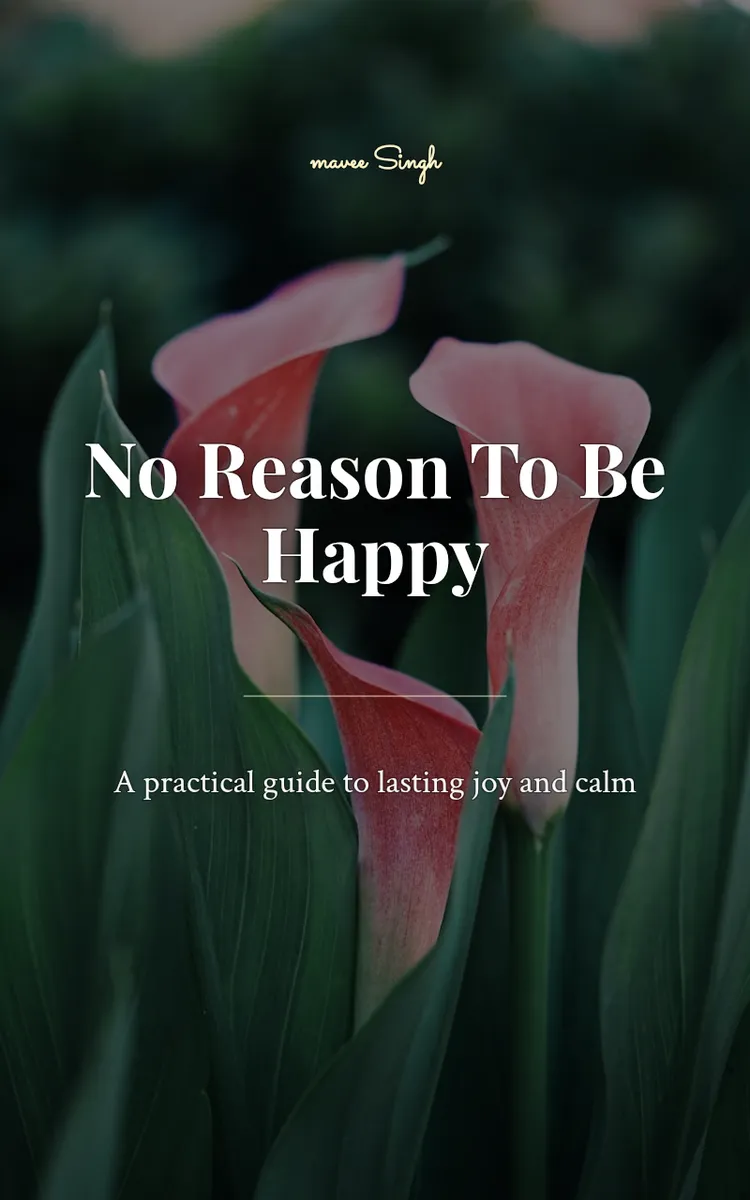
"No Reason To Be Happy" is a self-help book by mavee Singh with 6 chapters and approximately 7,872 words. Building consistent happiness despite life’s ups and downs.
This book was created using Inkfluence AI, an AI-powered book generation platform that helps authors write, design, and publish complete books. It was made with the AI Self-Help Book Writer.
Frequently Asked Questions
What is "No Reason To Be Happy" about?
Building consistent happiness despite life’s ups and downs
How many chapters are in "No Reason To Be Happy"?
The book contains 6 chapters and approximately 7,872 words. Topics covered include Choosing Happiness as Identity, Rewriting Beliefs That Block Joy, Building a Daily Happiness Habit, Communicating Needs Without Killing Peace, and more.
Who wrote "No Reason To Be Happy"?
This book was written by mavee Singh and created using Inkfluence AI, an AI book generation platform that helps authors write, design, and publish books.
How can I create a similar self-help book?
You can create your own self-help book using Inkfluence AI. Describe your idea, choose your style, and the AI writes the full book for you. It's free to start.
Write your own self-help book with AI
Describe your idea and Inkfluence writes the whole thing. Free to start.
Start writingCreated with Inkfluence AI


