
Read the first chapter
The whole of chapter one, free. About 8 min. Turn the pages with the arrows, your keyboard, or a swipe.
Chapter 1
October 26, 2006: The Night Everything Broke
The phone went dark in my hand, and the farmhouse seemed to grow larger around me.
I was alone at Lillie’s farmhouse in Franklin, Kentucky, with the October air pressing cold against the windows and the familiar rooms no longer feeling familiar. The refrigerator hummed in the kitchen. Somewhere outside, leaves scraped across the porch. Those ordinary sounds should have comforted me. Instead, they seemed connected to something I could not see.
The voices had already been getting worse. When the phone died, they became harder to separate from the radio and television. I had been hearing messages in ordinary programs, in the pauses between songs, and in words that seemed aimed directly at me. I believed the television and radio were sending coded warnings. I believed people were communicating about me without saying my name.
I was not thinking clearly enough to question those beliefs.
I had always struggled in unfamiliar places and around people. When I arrived at the University of Kentucky in the fall of 2003, I carried my isolation with me. I was an introvert to the point of becoming almost invisible. I did not know how to ask for help, and I did not trust myself enough to believe I deserved it. By the end of that fall, I had dropped out. I went on carrying the shame of that decision, telling myself I should have been stronger.
By October 2006, I had started working at Toyota Motor Manufacturing in Georgetown, Kentucky. From the outside, getting a job and trying to move forward might have looked like progress. Inside, I was coming apart. My mind had become a place I could not safely live in. Fear followed me from room to room, and every attempt to find an explanation seemed to create another threat.
At the farmhouse, I moved from one room to another, trying to find a way to settle myself. The floor felt hard beneath my shoes. The air smelled faintly of old wood, dust, and the food that had been prepared earlier. I looked at the dead phone again as if the screen might suddenly light up.
I needed to reach someone.
The problem was that I could not decide whom to call, and I had already experienced too many failures trying to connect with family. Jennifer, Lillie, Brody, Alyssa, Carson, Jessica, and Louis were names tied to my life, but that did not mean I knew how to reach them in that moment. People could care about you and still not understand what was happening inside your mind. Calls could go unanswered. Messages could be missed. Explanations could sound unbelievable, even when they were the only truth you had.
I had not built a dependable way to ask for help. That failure became dangerous when I needed help most.
The voices intensified. They seemed to come from the television, from the radio, and from inside my own thoughts at the same time. I could not find a quiet place because the quiet itself felt threatening. I changed rooms, but the fear came with me. I tried to reason with myself, but reason was losing its grip.
I remember feeling trapped by the farmhouse. It had been a place connected to family and memory, but that night it became a maze. Every doorway led to another room filled with the same fear. The walls did not change, yet my understanding of them did. I was no longer simply alone. I felt watched, targeted, and pushed toward a decision I was not strong enough to resist.
Looking back, I can see how far my thinking had collapsed. At the time, I did not see illness. I saw danger. I did not see hallucinations. I saw messages. I did not see that my brain was turning ordinary sounds into threats. I believed the threats were real, and that belief controlled my actions.
I do not describe this to make the night more dramatic. It was already devastating without exaggeration. The truth is frightening enough: I was a grown man in a familiar house, surrounded by objects I knew, and I could not trust what I heard or believed. I needed emergency help, but the illness made help feel dangerous.
The crisis moved from fear into action. I was no longer only trying to understand the voices. I was trying to survive what I thought they meant. Somewhere in that confusion, I suffered injuries that nearly ended my life. The stabbing was not a story I planned or a moment I understood clearly. It was part of a mental collapse that placed my life in immediate danger.
The physical pain cut through some of the confusion. I remember the shock of it, the weakness that followed, and the awareness that something had gone terribly wrong. The room, the floor, and the air around me became sharply real for a moment. I could feel the seriousness of my injuries even though my thoughts remained disorganized.
I needed someone to come.
When help finally became involved, I was not calm or cooperative. Fear had convinced me that the people around me were part of the danger. My combativeness was not courage. It was terror wearing the appearance of anger. I resisted because I believed resistance was the only way to protect myself.
There were attempts to control the situation, but my mind interpreted them through paranoia. I did not understand that people were trying to keep me alive. I understood restraint as another threat. I fought against what was happening while my body was already weakened by the injuries.
The aftermath was confusing and painful. I was restrained, and I was transferred for emergency care. I had wanted to escape the farmhouse and the voices, and in one sense I got what I wanted: I was no longer alone in that room. Help had reached me. But help arrived through force and fear because I had become too sick to accept it willingly.
That was the cost.
At Franklin Hospital, I was sedated. The medication quieted my body, but it did not immediately end the crisis in my mind. Sleep did not erase the beliefs that had taken over. The voices and fear continued into the next facility, following me beyond the farmhouse and into emergency treatment.
I had imagined that reaching a hospital would make everything instantly clear. It did not. A hospital could treat my injuries, monitor my body, and give me medication, but it could not immediately rebuild my trust. I was still frightened. I was still confused. I still believed parts of what my illness was telling me.
The people caring for me saw a patient in crisis. I saw people I did not know, in a place I did not understand, making decisions about my body and my future. That difference between what was happening and what I believed was happening became one of the hardest parts of the entire experience.
I now understand that my family’s contact failures were not proof that nobody cared. They were evidence of how unprepared we all were for a crisis of that size. Mental illness had already isolated me, and my inability to communicate made the isolation worse. I had not learned how to say, “I am losing touch with reality.” The people around me had not been given the information or tools to recognize what was happening before it became an emergency.
That does not erase the pain of being unreachable. It does not erase the consequences. It does help me understand that the night was bigger than one person’s weakness. It involved illness, fear, silence, confusion, and a family trying to respond after the situation had already become dangerous.
I was not saved because I suddenly became strong. I was saved because, even in my worst condition, other people took action when I could not. The transfer to emergency care became the first part of a longer path that eventually led me to Vanderbilt Hospital. At that point, I did not recognize the transfer as an answer to prayer. I only knew that I was being moved again, sedated and injured, while the fear continued to press against my thoughts.
But I remained alive.
That fact matters to me now. I was not yet hopeful. I was not yet healed. I was not yet able to explain the truth. Still, my life had not ended at the farmhouse. The night had broken my sense of safety, damaged my body, and exposed how completely my mind had turned against me, but it had not taken away every possibility.
Years later, as a father of three children, an author, and a business owner, I have had to look directly at the man I was that night. I cannot pretend he handled everything perfectly. I cannot pretend I understood addiction, mental illness, or treatment the way I do now. I can say that he was suffering, and suffering had narrowed his world until survival became almost impossible.
My recovery would eventually include counseling and Suboxone treatment. After eight years clean, I remain on Suboxone because I know my history and I know the danger of assuming I am beyond relapse. Some people may not understand that decision. I understand it as part of staying alive and protecting the life I worked to rebuild. Recovery has never been about proving that I can suffer without support. It has been about accepting the support that keeps me moving toward my children, my family, and the person I am still becoming.
At Franklin Hospital, sedation carried me away from the farmhouse, but it did not carry the illness away. The crisis continued into the next facility, where I would have to face the fear, the injuries, and the truth I had been unable to speak.
I had reached help, but I had not yet learned how to let help reach me.
End of chapter one. 14 more chapters and about 27,918 words in the full book.
Swipe or use the arrows to turn the page
What's inside: 15 chapters
- 1. October 26, 2006: The Night Everything Broke
- 2. Franklin Hospital to Vanderbilt Miracle
- 3. Telling the Doctors the Full Story
- 4. The Chest Tube Removal Hurt Worse
- 5. Western State Hospital Bipolar Diagnosis
- 6. Eastern State’s Daily Therapy Schedule
- 7. Thanksgiving 2006 Homecoming Alienation
- 8. Bond, Charges, and NAMI Help
- 9. Court Battles for Brody’s Visits
- 10. Suboxone Start and the First Clean Year
- 11. Eight Years Clean: Staying on Suboxone
- 12. Taxi Work Becomes My Recovery Anchor
- 13. Prednisone, Benzo History, and Hard Choices
- 14. Parenting Three Kids Without Losing Myself
- 15. Stronger Than the Storm II: Legacy Plan
About this book
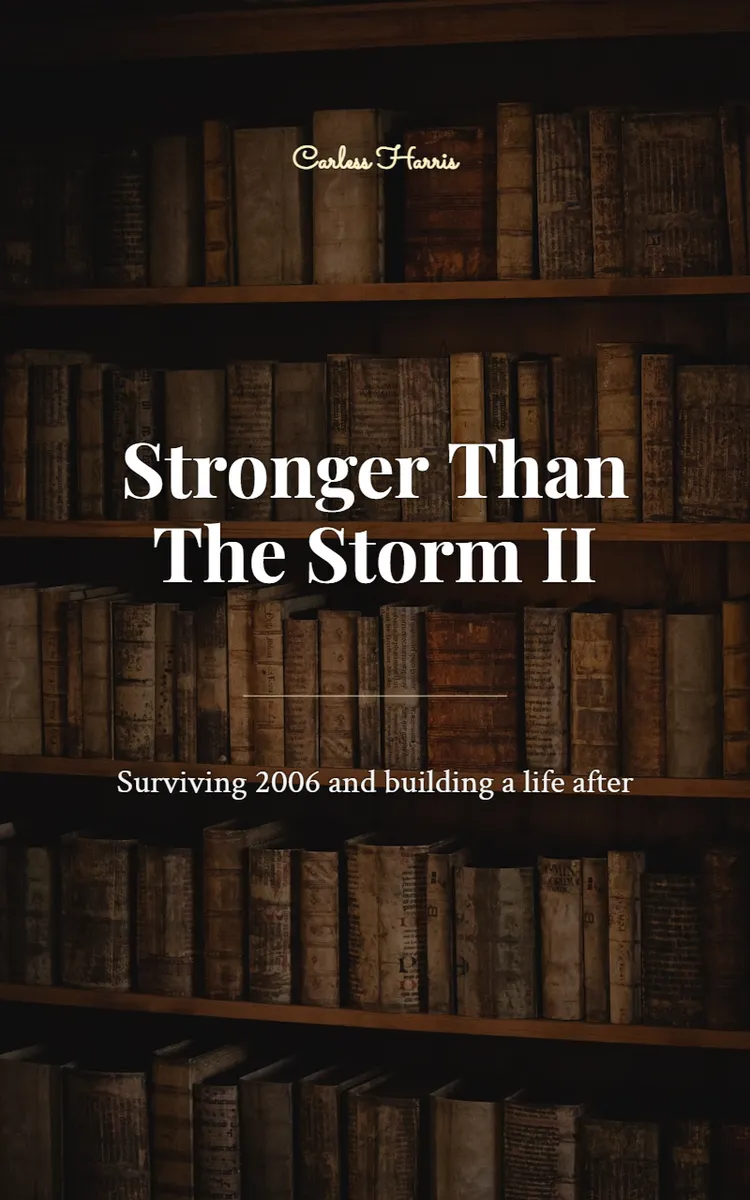
"Stronger Than The Storm II" is a biography book by Carless Harris with 15 chapters and approximately 27,918 words. A man’s 2006 suicide attempt, recovery, and resilience.
This book was created using Inkfluence AI, an AI-powered book generation platform that helps authors write, design, and publish complete books. It was made with the AI Biography Writer.
Frequently Asked Questions
What is "Stronger Than The Storm II" about?
A man’s 2006 suicide attempt, recovery, and resilience
How many chapters are in "Stronger Than The Storm II"?
The book contains 15 chapters and approximately 27,918 words. Topics covered include October 26, 2006: The Night Everything Broke, Franklin Hospital to Vanderbilt Miracle, Telling the Doctors the Full Story, The Chest Tube Removal Hurt Worse, and more.
Who wrote "Stronger Than The Storm II"?
This book was written by Carless Harris and created using Inkfluence AI, an AI book generation platform that helps authors write, design, and publish books.
How can I create a similar biography book?
You can create your own biography book using Inkfluence AI. Describe your idea, choose your style, and the AI writes the full book for you. It's free to start.
Write your own biography book with AI
Describe your idea and Inkfluence writes the whole thing. Free to start.
Start writingCreated with Inkfluence AI


