
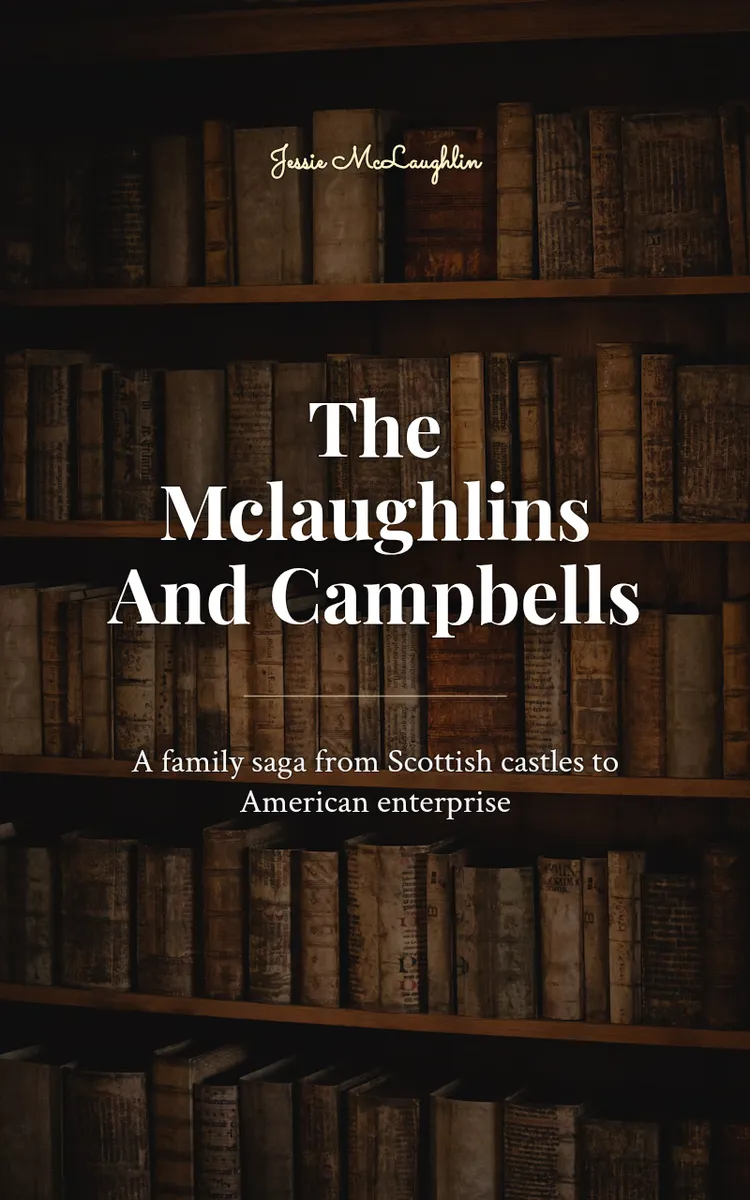
Read the first chapter
The whole of chapter one, free. About 9 min. Turn the pages with the arrows, your keyboard, or a swipe.
Chapter 1
The Castle Ledger
Rain struck the castle windows hard enough to blur the hills beyond them. Ewan McLaughlin paused beneath the stone archway, one hand on the cold iron latch, while the last of the daylight faded over the threatened estate.
He was young enough to be dismissed as a boy by older men and old enough to understand what their silence meant. The estate’s future had become uncertain. Notices had arrived, questions had been raised, and the family record offered no clear answer. For years, an older rumor had passed quietly through the McLaughlin household: somewhere in the past, a Campbell marriage had joined the two families. If the rumor was true, it might connect their claims to the land. If it was false, the estate stood with little protection.
Ewan had come to the castle archive because the records were due to be removed before the week ended. No one had told him directly why. His father had only said that the papers would be safer elsewhere, and that was enough to make Ewan distrust the arrangement. A record moved from a known room to an unknown place was not lost, but it could become nearly as difficult to find.
He pushed the door open. The hinges gave a long, low groan.
Inside, the castle smelled of wet wool, old smoke, and stone chilled by centuries of weather. Wind moved through the passageways, carrying the faint rattle of loose shutters. Ewan lifted the lamp he had brought and stepped into the archive wing.
The corridor was unfamiliar. He had visited the castle before, but never beyond the rooms used for family gatherings. Here, the walls narrowed, and the floor dipped beneath his boots. A row of faded portraits watched from the darkness, their painted faces dulled by dust. He kept one hand against the wall as he walked, feeling for the turn described in the brief note he had found among his family’s papers.
“Third passage after the old chapel,” he murmured.
His voice seemed too small for the corridor.
At the third passage, he turned left and found a locked door.
The key ring in his pocket held three keys. The first did not fit. The second entered the lock but would not turn. The third turned halfway, then stopped with a hard click.
Ewan leaned close to the door. Beyond it, he heard nothing but the rain.
He tried again, pressing his shoulder against the wood. The lock resisted. His fingers slipped on the cold metal, and the lamp flame shook, throwing restless light across the panels.
“Come on,” he said.
The door did not move.
He stepped back and looked along the passage. A narrow stairway rose beside the wall, almost hidden behind a hanging cloth. The archive might have been reached by another route. He lifted the cloth and found a steep staircase winding upward into darkness.
The stair smelled of damp lime and old timber. Water dripped somewhere above him. Ewan held the lamp close to the wall and climbed, counting the steps until the staircase ended at a small landing. A second door stood there, its lower edge swollen from damp.
This one opened.
Beyond it lay a room filled with shelves. The shelves leaned under the weight of parchment bundles, account books, rolled maps, and wooden boxes marked with dates. Dust softened every surface. The lamp light reached only a few feet, leaving the far end of the archive in shadow.
Ewan entered carefully and closed the door behind him. The storm became quieter, though the rain still struck the narrow windows. He could hear the lamp wick crackling and the soft scrape of his sleeve against the shelves.
His goal was simple: find the marriage record before the documents were removed. The obstacle was the archive itself, which had been arranged for people who already knew its paths. Every shelf seemed to contain another family name, another date, another branch of the past. The McLaughlin papers were not together. The Campbell papers were not together. Some had been catalogued by property, others by year, and several boxes bore labels so faded that the ink had become a brown blur.
Ewan set the lamp on a table and opened the first box.
Inside were estate accounts. He turned the pages quickly, scanning names and sums. Grain, repairs, rents, horses, roofing slate. The figures belonged to another time, but the land was the same land. The boundary stones, the river fields, and the wooded slope appeared in the notes as carefully as they did on the survey maps.
A floorboard creaked behind him.
Ewan turned.
Nothing moved. The door remained shut. Wind pressed against the window, making the glass tremble in its frame.
He waited, then looked back at the box. His unease was not fear of a person. It was the feeling of being late, of arriving after a decision had already been made. The records might be removed while he searched, or a page might be taken from a book before he ever reached it.
He opened another box.
This one contained correspondence. The paper was brittle, and the seals had broken long ago. One letter referred to a Campbell holding, but the name appeared only in a list of tenants. Another mentioned a marriage between families from neighboring lands, though the names had been lost where the fold had torn.
Ewan read the fragment twice.
The rumor had always sounded too simple. Someone had married a Campbell, people said, and the connection had been remembered only in pieces. Yet a marriage alone did not prove a right to land. The date mattered. The names mattered. The witnesses mattered. Without those details, the story could be dismissed as family pride.
He moved farther into the room.
At the rear stood a narrow cabinet with a brass plate. The plate was marked with a single word: Marriages.
The key to the cabinet was not on the ring. Ewan tried the handle, but it held firm. He searched the table drawers, then the ledges beneath the windows. He found a broken quill, a length of twine, and a small brass button. Nothing opened the cabinet.
He crouched and examined the lock. The wood around it was scratched, as if others had tried to force it. He placed both hands on the handle and pulled. The cabinet shifted slightly from the wall.
Behind it, a loose stone showed in the plaster.
Ewan set down the lamp and worked his fingers into the gap. The stone came free with a shower of grit. Behind it lay a narrow recess containing a ring of old keys.
He chose the longest key. It entered the cabinet lock and turned.
The doors opened with a dry wooden crack.
Inside were three ledgers, each bound in dark leather. The middle one carried no label. Its spine had split, and a strip of faded green cloth held it together. Ewan lifted it with both hands. Dust rose from the cover and caught in his throat.
He carried the ledger to the table.
The first pages listed marriages in a neat, formal hand. Dates ran down the margins. Beside them were names, residences, and the names of witnesses. Ewan turned slowly, afraid that haste would damage the paper.
The McLaughlin name appeared several times. So did Campbell.
He bent closer.
There it was: a marriage between a McLaughlin and a Campbell, recorded in a year that placed the union within the line of inheritance now under question. The entry gave the family names, the parish, and two witnesses. For a moment, the room seemed steadier than it had been. The rumor had not been empty. It had survived because something real lay beneath it.
Ewan placed his finger beside the entry without touching the ink.
“This is it,” he said.
The words were quiet, but they carried more weight than he expected. The marriage was not merely an old connection. It could make the Campbell blood tie a practical matter of land and survival. It could give both families grounds to resist the claim against the estate.
He turned the page to read the continuation.
The paper tore.
Ewan froze.
A section near the lower edge had already been damaged. The missing portion included the line beneath the marriage entry. Part of one witness’s name remained, but the rest had been torn away. The next page was stained by water, and the ink had spread into a dark gray cloud.
He lifted the ledger toward the lamp. The damaged edge was old, not fresh. Someone had not simply neglected the record; the missing part had been separated from it. The marriage could be identified, but the evidence was incomplete.
A knock sounded at the outer door.
Ewan closed the ledger.
Another knock followed, firmer than the first.
He did not answer. He moved the lamp away from the table and stood beside the cabinet, listening. The storm covered smaller sounds, but the knock had come from inside the archive wing. Whoever was there had reached the room by the locked passage or the hidden stair.
“Is someone there?” a voice called.
Ewan recognized no one.
He looked at the ledger in his hands. Leaving it behind meant losing the strongest proof he had found. Taking it meant removing a family record that did not belong to him alone. He thought of the estate, of the papers being moved, and of the years in which the McLaughlin and Campbell connection had been treated as little more than a story.
The handle turned.
Ewan slipped the ledger beneath his coat. It pressed against his ribs, stiff and cold through the cloth.
The door opened a fraction, then stopped against the table he had placed behind it. A narrow line of corridor light entered the room.
“Open the door,” the voice said.
Ewan backed toward the stair. He did not know whether the speaker meant to protect the archive or prevent him from finding what it contained. Either way, the cost of being discovered was clear. The record might be taken from him before he could show it to anyone.
He lifted the lamp and moved through the rear doorway. The staircase waited beyond, steep and wet with drafts. He descended carefully, keeping one hand on the wall and the other over the ledger.
At the bottom, he found the passage blocked by a fallen beam. The storm had forced part of the ceiling down, scattering plaster across the floor. For several seconds he stood without moving. Then he lowered the lamp, found a narrow gap beside the wall, and turned his shoulders to pass through it.
His coat caught on a splinter. He pulled free, leaving a small tear in the sleeve. On the other side, the air felt warmer. He crossed the chapel passage and reached the main hall, where rainwater had blown beneath the doors and spread across the flagstones.
A servant’s lamp burned near the entrance. No one stood beside it.
Ewan crossed the hall and pushed outside.
The rain struck his face. He held the ledger beneath his coat and hurried down the path toward the estate house, his boots sinking into the wet ground. Behind him, the castle windows glowed faintly through the storm. The archive remained closed, and the damaged record remained unresolved.
Yet he was no longer shut out of the family history.
Looking back, Ewan understood that the discovery changed more than the legal question surrounding the estate. Before that night, the Campbell connection had belonged to rumor, repeated because families often preserved what they could not prove. In his hands, the marriage ledger made the connection visible. It placed McLaughlin and Campbell in the same line of record, bound by marriage and blood, but it also showed how easily a claim could be weakened by one missing witness or one damaged page.
The proof was real, but it was not complete.
That uncertainty became part of the inheritance. Ewan had found the record he needed, yet the torn page left the claim exposed. The ledger gave him a beginning, not a final answer. To secure the estate, he would have to learn who the missing witness had been and why that part of the entry was gone.
For the first time, the future of the McLaughlin estate rested not only on what the family remembered, but on what Ewan could recover.
End of chapter one. 39 more chapters and about 100,170 words in the full book.
Swipe or use the arrows to turn the page


What's inside: 40 chapters
- 1. The Castle Ledger
- 2. The Campbell Wedding Pact
- 3. Tracing the Missing Witness
- 4. The Pass to Inverness
- 5. Choosing the Alliance
- 6. The Estate Seizure
- 7. A Shipbound Family Tree
- 8. Departure from Greenock
- 9. The Crossing’s Hard Choice
- 10. Quarantine at New York
- 11. Finding the New York Cousin
- 12. Tenement Winter
- 13. Work Beyond the Castle
- 14. The Warehouse Fire
- 15. The Campbell Address
- 16. The Uptown Walk
- 17. A Name for the Future
- 18. The Failed Cart Venture
- 19. The Canal Road Contract
- 20. The Ledger’s Hidden Clause
- 21. The Cost of Partnership
- 22. The Cargo That Sank
- 23. Who Signed the Advance
- 24. The Mill Town Detour
- 25. The Campbell Reserve
- 26. The Credit Freeze
- 27. The Rail Yard Opportunity
- 28. The Mountain Grade
- 29. A Repair Shop Stake
- 30. The Shop’s First Failure
- 31. The Missing Parts Account
- 32. The Investor’s Locked Yard
- 33. The Price of Control
- 34. The Settlement Records
- 35. The Joint Settlement
- 36. Rules for the Repair Firm
- 37. The Railway Workshop
- 38. The Next Generation’s Ledger
- 39. The American Corporation Bid
- 40. From Castle Record to Boardroom
About this book
"The Mclaughlins And Campbells" is a biography book by Jessie McLaughlin with 40 chapters and approximately 100,170 words. The intertwined histories of the McLaughlin and Campbell families.
This book was created using Inkfluence AI, an AI-powered book generation platform that helps authors write, design, and publish complete books. It was made with the AI Biography Writer.
Frequently Asked Questions
What is "The Mclaughlins And Campbells" about?
The intertwined histories of the McLaughlin and Campbell families
How many chapters are in "The Mclaughlins And Campbells"?
The book contains 40 chapters and approximately 100,170 words. Topics covered include The Castle Ledger, The Campbell Wedding Pact, Tracing the Missing Witness, The Pass to Inverness, and more.
Who wrote "The Mclaughlins And Campbells"?
This book was written by Jessie McLaughlin and created using Inkfluence AI, an AI book generation platform that helps authors write, design, and publish books.
How can I create a similar biography book?
You can create your own biography book using Inkfluence AI. Describe your idea, choose your style, and the AI writes the full book for you. It's free to start.
Write your own biography book with AI
Describe your idea and Inkfluence writes the whole thing. Free to start.
Start writingCreated with Inkfluence AI


