
Read the first chapter
The whole of chapter one, free. About 10 min. Turn the pages with the arrows, your keyboard, or a swipe.
Chapter 1
Who Gets to Name Black History?
The Question Behind the Record
Who gets to decide whether a Black event becomes history, folklore, or silence?
A courthouse ledger can preserve a land sale while omitting the intimidation that forced it. A school textbook can devote pages to a presidential speech and a sentence to the Black organizers who made that speech politically possible. A museum can display a famous photograph while leaving visitors unsure who selected it, who paid for its preservation, and what neighboring images were never collected.
The record is not the past itself. It is the surviving result of choices made by clerks, teachers, editors, archivists, politicians, families, and institutions. Those choices do not always amount to a secret plot. Sometimes they reflect racism, sometimes professional habit, sometimes political strategy, and sometimes the simple fact that powerful institutions are better equipped to preserve their own version of events.
That is why arguments about the rewriting of Black history are rarely arguments about facts alone. They are arguments about custody: who holds the documents, who explains them, and which memories receive public space.
When the archive is selective, how much of the past can later generations mistake for the whole truth?
The Memory Gatekeeping Map
A useful way to examine these disputes is the Memory Gatekeeping Map. It follows a historical claim through three connected places: the archive, the classroom, and public memory. Each place has a different kind of authority. Archives determine what can be consulted. Classrooms determine what is taught as essential. Public memory determines what is repeated through monuments, holidays, museums, speeches, and popular culture.
The first gate is often the archive. Archives are not neutral warehouses in which every surviving document waits patiently for discovery. They are shaped by collecting policies, funding, storage space, cataloging systems, and legal ownership. A plantation owner’s business papers may survive because a family preserved them, while the testimony of enslaved workers may survive only in fragments gathered by someone else. Government records can be extensive and still reveal more about how officials described Black people than about how Black people understood their own lives.
The Freedmen’s Bureau, established after the Civil War, generated records about labor contracts, schools, marriages, medical care, and disputes. These documents are invaluable, but they were produced largely by federal officials and local agents. They show Black communities negotiating with institutions that had power over them. They do not automatically provide an unfiltered view of Black life. Reading them requires attention to the form itself: who wrote the report, who was its audience, and what kinds of behavior officials considered worth recording.
The second gate is the classroom. What reaches students depends on state standards, textbook adoption, teacher preparation, available time, and the political climate surrounding schools. A textbook may describe Reconstruction as a period of disorder and corruption, echoing interpretations popularized after the late nineteenth century, or it may emphasize Black political participation, institution building, and the violent campaigns that destroyed Reconstruction governments. Both versions can mention the same dates while producing entirely different meanings.
The third gate is public memory. Monuments and commemorations do not merely preserve history; they organize attention. A courthouse statue, a named highway, or a state holiday tells the public which people deserve recognition and what story should accompany them. The United Daughters of the Confederacy, founded in 1894, played a major role in promoting Confederate memorials and influencing textbook language. Their work did not erase every account of slavery or Black resistance, but it helped make one interpretation physically and culturally familiar: the Confederacy as a cause of honor rather than a government created to protect slavery.
These gates reinforce one another. A limited archive makes a thin classroom lesson easier to write. A classroom lesson makes a monument seem self-explanatory. The monument then appears to confirm the lesson. The Memory Gatekeeping Map matters because it shows how omission can become authority without requiring every participant to coordinate consciously.
How Political Interpretations Enter the Record
The year 1890 sits near a major change in the political treatment of Black history. Reconstruction had ended, federal protection had weakened, and Southern states were building systems of segregation and disfranchisement. At the same time, historians and public officials were producing explanations for what had happened after emancipation. Those explanations often presented Black political participation as evidence of incompetence rather than as a democratic achievement threatened by organized violence.
The Dunning School, associated with historian William A. Dunning and scholars influenced by his interpretation, treated Reconstruction governments as corrupt and portrayed white Southern resistance as a reaction to misrule. Black officeholders were frequently described through racist stereotypes, while the role of white paramilitary violence received less attention. This interpretation was not simply a scholarly opinion sitting on a library shelf. It entered classrooms, public ceremonies, films, and political language.
The 1915 film The Birth of a Nation offered one of the most influential popular versions of that story. It depicted the Ku Klux Klan as rescuers and Black political power as a threat. The film reached large audiences and was screened at the White House during Woodrow Wilson’s presidency. Its influence illustrates a crucial point: public memory is shaped not only by historians but also by technologies of circulation. A moving image, repeated across theaters, can make an interpretation feel like eyewitness truth.
Marxist, socialist, and Communist writers later challenged parts of the dominant account, especially by emphasizing labor, class conflict, imperialism, and economic power. During the twentieth century, Communist organizers and associated intellectuals also drew attention to racial violence and the conditions of Black workers. Their interventions sometimes opened subjects that mainstream historians had neglected. They also carried political assumptions of their own, and their accounts could place class struggle above other forms of Black political thought.
The Democratic Party’s role changed across time and cannot be reduced to a single uninterrupted position. In the late nineteenth and early twentieth centuries, white Democrats in the South were central to segregation, disfranchisement, and the defense of the racial order. Later, especially during the New Deal and the civil rights era, national Democrats became associated with reform, federal programs, and civil rights legislation, while many Black voters shifted toward the party. That transition affected public memory. A party that had once been deeply tied to Jim Crow could later present itself as the principal vehicle of racial progress.
This is where political rewriting becomes difficult to identify. A movement may recover forgotten evidence while also arranging that evidence to support its preferred theory. A party may change its policies while narrating its earlier record more gently. Neither process makes every claim false. It means that interpretation must be tested against documents, chronology, and the voices of people whose lives are being described.
A surprising fact follows: the same historical event can be “rewritten” by opposing political movements without either side inventing the event itself. The conflict often concerns emphasis - class or race, national policy or local resistance, leadership or grassroots organizing, reform or coercion. What changes is the path through the evidence.
That reframes the problem. Rewriting is not limited to deleting a name from a textbook. It can also mean placing a familiar fact inside a new moral structure, so that emancipation appears mainly as a labor transition, civil rights mainly as a party achievement, or Black resistance mainly as a response to outside ideologies. The question becomes not only “What was omitted?” but “What explanation was made to seem natural?”
The Classroom as a Sorting Machine
School history is shaped by compression. Years of conflict must fit into a limited number of pages and class periods. Compression is unavoidable, but it is never innocent. The subjects that receive space become the subjects students remember as central.
Consider Reconstruction. A lesson focused on presidential leadership may center Abraham Lincoln, Andrew Johnson, and Ulysses S. Grant. A lesson focused on Black political agency may begin with the constitutional amendments, Black conventions, schools, churches, newspapers, and elected officials that emerged after emancipation. A lesson focused on white resistance may foreground the Ku Klux Klan Acts, racial terror, economic coercion, and the eventual withdrawal of federal protection. These are not three unrelated histories. They are three arrangements of attention.
Textbooks also inherit language. Terms such as “carpetbagger,” “scalawag,” and “Black Republican” once carried the assumptions of writers who wanted Reconstruction to appear illegitimate. Even when later editions revise the interpretation, older phrases can survive in captions, chapter titles, or teachers’ notes. A label compresses an argument into a word. Once repeated long enough, the argument can disappear while the label remains.
Black communities developed their own historical institutions partly because formal education and public culture were unreliable custodians. Black colleges, churches, women’s clubs, newspapers, veterans’ organizations, and local historical societies preserved speeches, minutes, photographs, family papers, and oral accounts. The work of Carter G. Woodson, who founded the Association for the Study of Negro Life and History in 1915, responded directly to the absence and distortion of Black history in schools and public scholarship. Negro History Week, established in 1926, created a public structure for circulating material that mainstream institutions often neglected.
Woodson’s project also reveals a tension inside recovery. Once a community must establish a separate institution to preserve its history, that institution becomes responsible for choosing what to highlight. It may emphasize achievement in response to racist denial; another generation may emphasize conflict, labor, gender, or political disagreement. Preservation is necessary, but preservation always involves selection.
The most revealing classroom question may therefore be a quiet one: Which people appear as historical actors rather than as subjects of policy? Black Americans are often present in lessons about slavery, segregation, or discrimination but absent from lessons about diplomacy, economics, science, military organization, and political theory. Their suffering is recorded more readily than their strategy.
A Street, a School, and a Missing Archive
The life of Septima Clark shows how public memory can mismeasure historical importance. Born in Charleston, South Carolina, in 1898, Clark became a teacher, civil rights organizer, and major force behind citizenship education. South Carolina’s law barred Black teachers from teaching in public schools before 1920, so Clark first taught on Johns Island, where she worked with children and families in a segregated system that denied Black educators equal status.
Clark later joined the Highlander Folk School in Tennessee and helped develop citizenship schools. These schools taught adults to read materials connected to voting and public life, including registration forms and constitutional language. The work was practical, but its significance was larger than literacy instruction. It treated political participation as a skill that communities could build collectively despite legal barriers and intimidation.
Citizenship schools became associated with the broader civil rights movement, but Clark’s name has often occupied less public space than the names of nationally recognized male leaders. The imbalance is not evidence that one person secretly removed her from history. It shows how public memory favors certain forms of leadership: the famous speech, the courtroom victory, the televised march. The slower work of teaching adults, training local leaders, and creating durable networks is harder to dramatize and easier to lose.
Clark’s story also exposes the relationship between archive and classroom. If an institution preserves organizational minutes, lesson materials, correspondence, and local testimony, later historians can reconstruct the infrastructure of a movement. If those records remain scattered in private homes or uncataloged collections, the movement may be remembered through its most visible spokespeople rather than its builders. The missing archive does not prove that the work was unimportant. It explains why importance can become difficult to see.
Public memory often mistakes visibility for scale. A person whose photograph appears in newspapers may be remembered more easily than hundreds of people who made the work possible away from cameras. That is not merely a problem of fairness. It changes the historical explanation, making movements appear to arise from exceptional individuals instead of organized communities.
What the Gates Reveal
The archive, the classroom, and public memory do not simply reflect the past; they manufacture the conditions under which the past can be recognized. Their influence is strongest when it becomes invisible - when a familiar textbook, monument, or documentary feels like the natural shape of history rather than one arrangement among many.
Human beings prefer coherent stories, and institutions reward coherence. A complicated past, filled with competing motives and unfinished arguments, is easier to teach when it has heroes, villains, turning points, and a clear political inheritance. Black history has repeatedly been narrowed by that desire for simplicity: first through racist exclusion, later sometimes through partisan recovery that treats one ideology as the key to every event.
The result is not a past that has vanished, but a past whose surviving pieces have been arranged into different pictures. Somewhere in the gap between what was preserved, what was taught, and what was commemorated lies the question that keeps history unsettled: what other meanings are waiting in the records no one thought to save?
End of chapter one. 39 more chapters and about 70,951 words in the full book.
Swipe or use the arrows to turn the page


What's inside: 40 chapters
- 1. Who Gets to Name Black History?
- 2. The 1890s Turn in Historical Writing
- 3. How Reconstruction Became a Cautionary Tale
- 4. The Dunning School’s Lasting Footprint
- 5. When Lost Cause Memory Went National
- 6. The Archive’s Missing Voices
- 7. Textbooks That Taught a Narrow Past
- 8. The Politics of the Word “Rewritten”
- 9. What Marxist History Actually Claims
- 10. Socialism’s Appeal to Black Organizers
- 11. Communist Organizing and Race Politics
- 12. The Scottsboro Case as a Test
- 13. Du Bois’s Changing Political Vocabulary
- 14. The Harlem Renaissance’s Many Histories
- 15. Labor History Beyond Class Alone
- 16. The New Deal’s Racial Record
- 17. Democrats Before the Civil Rights Era
- 18. The Dixiecrat Breakaway Explained
- 19. Civil Rights Laws and Party Change
- 20. How Political Coalitions Shape Memory
- 21. The Civil Rights Movement’s Competing Stories
- 22. King Beyond the Simplified Quote
- 23. Malcolm X and the Uses of Reinvention
- 24. Black Conservatism Left Out of Frame
- 25. Black Nationalism Beyond Party Labels
- 26. The FBI’s Role in Public Memory
- 27. Universities, Grants, and Historical Agendas
- 28. Museums Choose What Visitors See
- 29. Monuments Turn Interpretation into Stone
- 30. Film’s Shortcut to Historical Certainty
- 31. The Internet’s Fast-Moving History Claims
- 32. Primary Sources Can Mislead Too
- 33. When Statistics Hide Their Categories
- 34. The Difference Between Omission and Conspiracy
- 35. How Historians Correct Earlier Accounts
- 36. The Politics of School Curriculum
- 37. Teaching Disagreement Without False Balance
- 38. Building a More Complete Black History
- 39. Questions Every Political History Must Answer
- 40. The Past Belongs to the Evidence
About this book
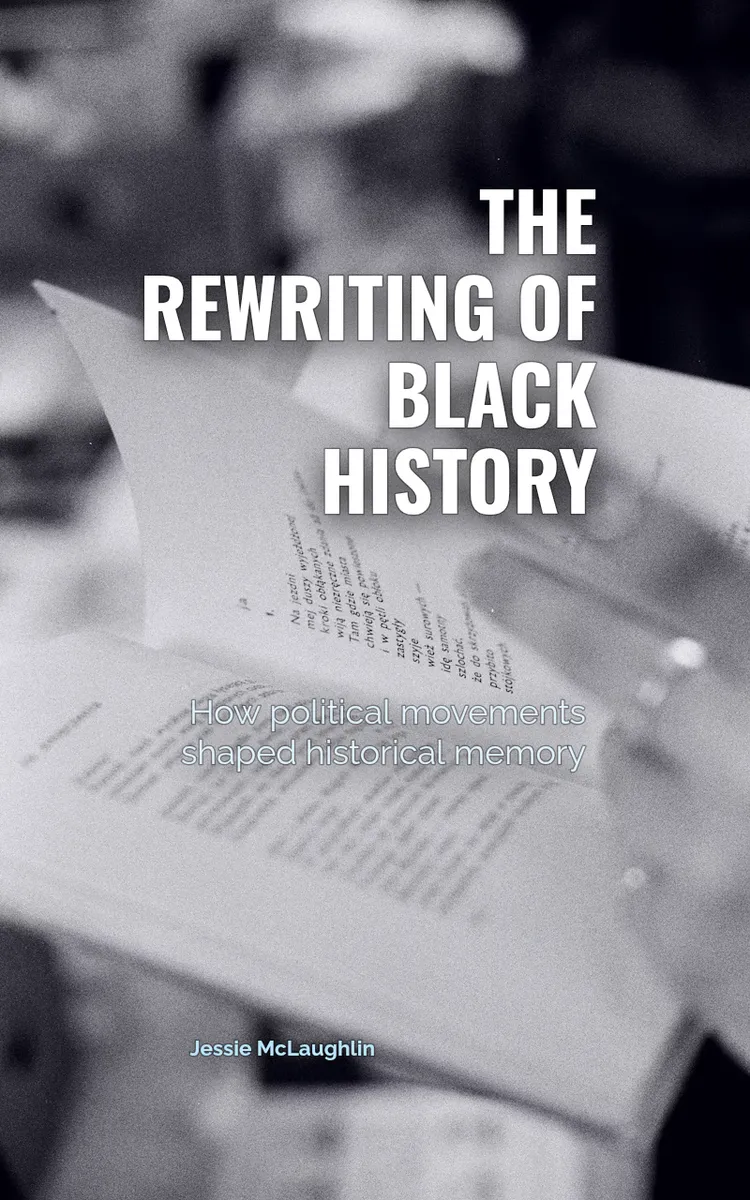
"The Rewriting Of Black History" is a nonfiction book by Jessie McLaughlin with 40 chapters and approximately 70,951 words. Claims about political movements reshaping Black history since 1890.
This book was created using Inkfluence AI, an AI-powered book generation platform that helps authors write, design, and publish complete books.
Frequently Asked Questions
What is "The Rewriting Of Black History" about?
Claims about political movements reshaping Black history since 1890
How many chapters are in "The Rewriting Of Black History"?
The book contains 40 chapters and approximately 70,951 words. Topics covered include Who Gets to Name Black History?, The 1890s Turn in Historical Writing, How Reconstruction Became a Cautionary Tale, The Dunning School’s Lasting Footprint, and more.
Who wrote "The Rewriting Of Black History"?
This book was written by Jessie McLaughlin and created using Inkfluence AI, an AI book generation platform that helps authors write, design, and publish books.
Write your own nonfiction book with AI
Describe your idea and Inkfluence writes the whole thing. Free to start.
Start writingCreated with Inkfluence AI


