
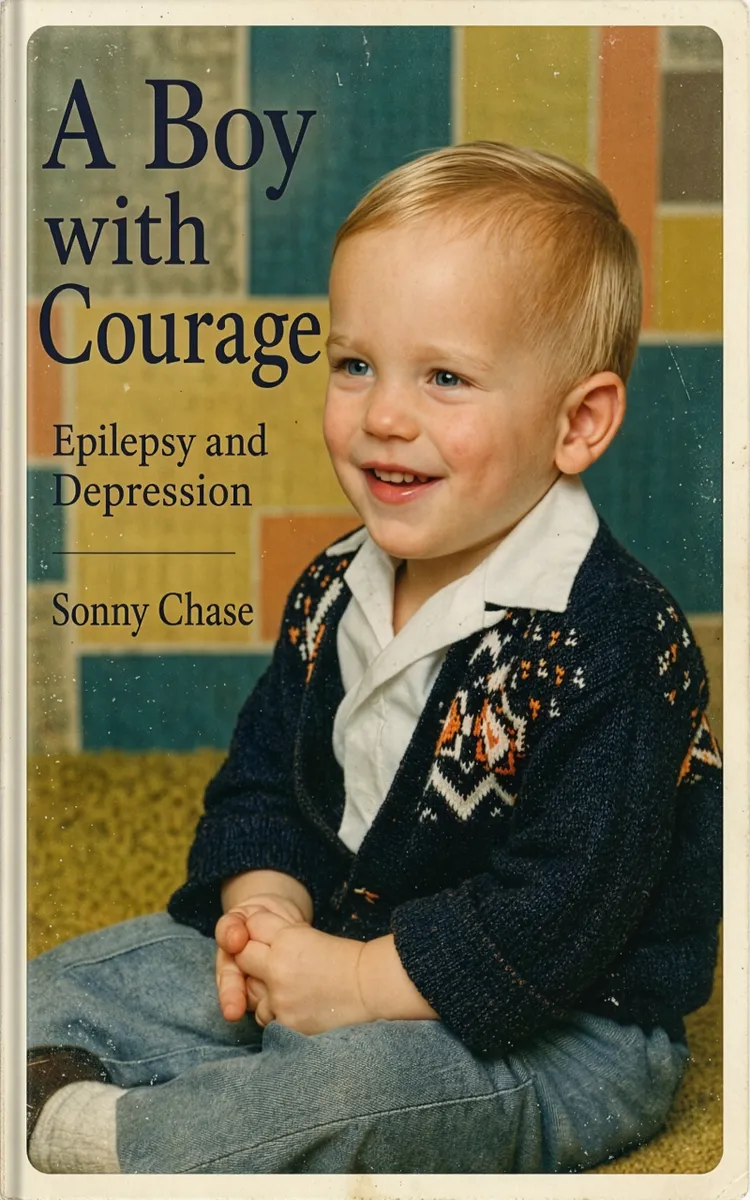

Read the first chapter
The whole of chapter one, free. About 5 min. Turn the pages with the arrows, your keyboard, or a swipe.
Chapter 1
Beginning of It All
In 1967, I came into the world in Coon Rapids, Minnesota, a suburban town situated on the banks of the Mississippi River, a mere 20 miles north of the bustling Twin Cities. My arrival was two months premature, and I weighed a mere 4.5 pounds. The doctors decided to keep me in the hospital for an extra couple of weeks to ensure I gained enough weight before my parents could take me home with them.
Apart from my early arrival, the first 14 months of my life were quiet. However, everything changed on Christmas in 1968. My father, Danny, was sipping coffee with his bandmate and close friend, Ray. Meanwhile, I stayed at home with my mom — whose given name is Lynnette but everyone calls her “Nettie.”
My mother told me she had taken care of me earlier that day when I was sick with a high fever. Since we didn’t have a thermometer, we couldn’t measure exactly how high my temperature was. As teenage parents, they struggled to make ends meet with only my 19-year-old father’s income while my mom was still in high school. Despite the lack of resources, my mother did her best to cool me down by using cold, damp washcloths on my head and face.
Finally, feeling both exhausted and satisfied that she had reduced my temperature, she rocked me to sleep and laid me down into my crib before crawling into her own bed to get some much-needed rest. Two hours later she awoke to the sound of the Christmas tree toppling over. This is strange, she thought. I had begun walking at the age of six months, so she had leaned the tree up against the wall of the trailer house in order to prevent me from getting into trouble with it.
As she walked past my crib to check on the tree, she discovered what had to be a new mother’s nightmare: her baby boy’s helpless little body lying in the crib, trembling, with his eyes rolling into the back of his head. It turned out I was having convulsions and had shaken my crib hard enough to bump the wall, causing the tree to fall over. My mom has always said that the sound of that tree falling saved my life. Had I laid there convulsing much longer, it could have caused irreversible brain damage — or it could have killed me.
Making matters worse, it was close to midnight. My parents did not have a telephone back then, and my father had their only vehicle. My mother was stuck in the trailer park with me until my father came home, which was, thank goodness, just a few minutes later. With my tiny body still twitching in her arms, my mother waited by the door until my father walked in. She told him they needed to rush me to the hospital as quickly as possible. Together they sped off to the hospital. By this time, my poor 17-year-old mother was panicking.
Upon arriving at the hospital, I was still twitching in my mother’s arms. She told the doctors and nurses she had found me convulsing and that I had had a fever all day, and they immediately took me from my mother’s arms and rushed me into a separate room. The nurse told my mother she was just going to check my temperature. Then shortly thereafter, the nurse returned to inform my mother that they had given me an injection of Phenobarbital, a strong barbiturate commonly used to treat seizures, and, decades earlier, anxiety.
My mother, young and drained of energy, was overwhelmed with fear, isolation, and confusion. She felt betrayed that the doctors didn’t give her a say on whether I would receive the drug. To make matters worse, the medical staff informed her that after being given the injection, my little body went limp and on one side became unresponsive. The doctors couldn’t determine if it was a side effect of the Phenobarbital, or if it was a result of the convulsion itself. Years later, our family physician told my mother that because my body was still twitching during the injection, it was likely that the needle had hit a nerve. He stated that he would never inject a convulsing baby like they did. Later that evening, they performed a spinal tap — also called a lumbar puncture — to test for bacterial meningitis since I had been experiencing convulsions and a high fever. Thankfully, the results were negative. The doctors decided to admit me and monitor me for a week. My parents were devastated to leave without me once again, just as they had to after my premature birth.
It wasn’t until four months later that I experienced my first official seizure. Unfortunately, my mother was not present at the time, so there wasn’t much being done about it back then. The incident took place on a hot summer day at my grandmother’s house. My Great grandmother informed my mother that I had a peculiar look on my face and that I seemed to be shaking, but when she asked if I was feeling cold, I didn’t respond until minute later. As my mother puts it, “This marked the start of everything.”
I was nine years old, there was an evening my mother and I stayed up all night playing games, watching television, my mother did whatever she could to make it until morning. My doctors were going to do an EEG — which stands for electroencephalogram — measures and records the electrical activity in my brain. The test involves attaching special sensors, known as electrodes, to small plates that are placed on my head and connected to a large computer. Despite the results showing no focal abnormalities, signs of seizures were still present through my behavior. Whenever a seizure occurs, I would again tell my mom that I was feeling cold. Being so young at the time, it was the only way for me to explain something that was happening to my body. My seizures were classified as focal, also known as partial or localized seizures. They initially only affected one hemisphere of my brain.
In an attempt to control them, neurologists prescribed the medication Dilantin — the first of many medications I would try. To counteract the swelling of my gums caused by Dilantin, I had to take folic acid supplements. It took nine years of tests and doctor visits before I was finally diagnosed with epilepsy. However, even after starting medications, my personality and memory began to change — something that my parents and teachers noticed. Despite these challenges, I still managed to have a fun childhood playing with friends in my neighborhood.
CHAPTER TWO
End of chapter one. 8 more chapters and about 11,273 words in the full book.
Swipe or use the arrows to turn the page
What's inside: 9 chapters
- 1. Beginning of It All
- 2. The 1970s
- 3. Beginning of Adulthood
- 4. Close Calls
- 5. A Devastating Three Months
- 6. Made a Decision
- 7. Here We Go
- 8. Making Our Way Home
- 9. Making a Difference — Decisions
About this book
"A Boy With Courage Epilepsy and Depression" is a biography book by Sonny Chase with 9 chapters and approximately 11,273 words. It covers key insights and practical takeaways on the topic.
This book was created using Inkfluence AI, an AI-powered book generation platform that helps authors write, design, and publish complete books. It was made with the AI Biography Writer.
Frequently Asked Questions
What is "A Boy With Courage Epilepsy and Depression" about?
"A Boy With Courage Epilepsy and Depression" is a biography book by Sonny Chase covering key insights and practical takeaways on the topic.
How many chapters are in "A Boy With Courage Epilepsy and Depression"?
The book contains 9 chapters and approximately 11,273 words. Topics covered include Beginning of It All, The 1970s, Beginning of Adulthood, Close Calls, and more.
Who wrote "A Boy With Courage Epilepsy and Depression"?
This book was written by Sonny Chase and created using Inkfluence AI, an AI book generation platform that helps authors write, design, and publish books.
How can I create a similar biography book?
You can create your own biography book using Inkfluence AI. Describe your idea, choose your style, and the AI writes the full book for you. It's free to start.
Write your own biography book with AI
Describe your idea and Inkfluence writes the whole thing. Free to start.
Start writingCreated with Inkfluence AI


