
Read the first chapter
The whole of chapter one, free. About 8 min. Turn the pages with the arrows, your keyboard, or a swipe.
Chapter 1
The $900-Per-Week Goal Map
Why $900 a Week Needs a Map
What would change if every $900 you brought home each week had a job before you spent it? Without a clear plan, that money can disappear through rent, fuel, groceries, takeout, automatic payments, and small purchases that feel harmless one at a time. A retirement goal then stays stuck as a wish because today’s bills keep taking every dollar.
The $900 Trail Map turns weekly income into a path you can check and adjust. It does not assume a perfect income, a large emergency fund, or a high-paying office job. It gives each week a target, separates today’s needs from tomorrow’s retirement, and sets deadlines you can see on a calendar. After you set it up, you will know how much money must cover regular life, how much must move toward retirement, and what spending must shrink to keep the plan alive.
The point is not to pretend that every week looks the same. Overtime, slow work, repairs, and seasonal bills can change your cash flow. The point is to give the $900 a default route so you make deliberate choices instead of wondering where it went.
Build the $900 Trail Map
Start with the amount you can reliably work with. For this plan, the weekly target is $900. If your paycheck arrives every two weeks, divide the deposit into two weekly amounts on paper. If your income changes, use the lowest normal week as your starting point and treat extra money separately. That keeps one good week from creating bills you cannot handle during a slow week.
Use these steps to build the map:
1. Mark the weekly starting line. Write $900 at the top of a page or spreadsheet. This is the money your plan must direct before you spend it. If taxes or payroll deductions already come out, use the amount that actually reaches your account.
2. Protect the weekly living amount. List housing, utilities, food, transportation, insurance, and required payments. Convert monthly bills into weekly amounts by multiplying the monthly bill by 12 and dividing by 52. A $1,200 monthly rent becomes about $277 per week. Set that amount aside each payday so the next rent payment does not surprise you.
3. Set the retirement transfer. Choose a fixed amount that moves automatically on payday. Start with an amount you can repeat during an ordinary week, not an amount that only works when nothing goes wrong. A $100 weekly transfer gives the plan a clear retirement target while leaving $800 for current needs and other goals.
4. Create a repair-and-shock buffer. Set aside money for tires, tools, medical bills, home repairs, and other costs that do not arrive every week. A $50 weekly buffer grows to $2,600 over a year if you leave it alone. This protects the retirement transfer when the water heater fails or the truck needs work.
5. Give the remaining money a limit. After living costs, retirement, and the buffer, assign the rest to groceries, fuel, personal spending, and planned extras. When that amount reaches zero, stop spending in those categories until the next weekly reset.
The map works because it moves retirement money before casual spending. If you wait until Sunday night to save what remains, spending usually claims the money first. An automatic transfer creates a firm boundary. Check your retirement account rules and employer plan details before choosing an account, especially if your workplace offers a contribution match. The account choice matters, but the weekly habit matters first.
Write the targets where you will see them. A simple table keeps the plan concrete:
| Weekly route | Example amount | |---|---:| | Starting income | $900 | | Retirement transfer | $100 | | Repair-and-shock buffer | $50 | | Regular living costs | $600 | | Flexible spending | $150 |
These figures form an example map, not a promise that every household can use the same split. Your rent, debt, fuel, and family needs may push the living-cost line higher. If your required costs exceed the available money, do not hide the problem by skipping retirement without a review. First cut or renegotiate a bill, cancel unused subscriptions, reduce flexible spending, and look for a cheaper version of a regular expense. The goal stays visible even when the first version needs adjustment.
Set timelines that match the weekly transfer. At $100 per week, you direct $5,200 toward retirement over a year before any investment growth. Over five years, the same weekly habit directs $26,000. Over a decade, it directs $52,000. These are deposits, not guaranteed account balances. Investment values can rise or fall, and fees can reduce results. Still, the timeline shows why a repeatable weekly amount beats waiting for a large windfall.
A Working Route From Payday to Ten Years
Use this scenario as a model for your own numbers. Assume the weekly take-home amount is $900, housing and required household costs total $600 per week, and the goal is to begin a retirement habit without borrowing for ordinary expenses.
1. On payday, move $100 to retirement. Schedule the transfer for the same day the $900 arrives. The expected outcome is a retirement deposit every week instead of an end-of-month guess.
2. Move $50 into the repair-and-shock buffer. Keep this money in a separate savings account so it does not mix with spending cash. After four weeks, the balance should reach $200. After one year, it should reach $2,600 if no emergency uses it.
3. Reserve $600 for regular living costs. Break that amount into the bills you listed. For example, reserve $277 for rent, $75 for utilities and phone, $100 for groceries, $80 for fuel, and $68 for insurance or required payments. Replace these example amounts with your actual bills.
4. Keep $150 for flexible spending. Use it for household items, meals away from home, clothing, or other choices that do not belong in the required-cost list. Divide it into $75 for the first half of the week and $75 for the second half if you tend to spend quickly.
5. Review the route every Sunday. Compare planned amounts with actual spending. If groceries ran $20 over, record the reason and take $20 from next week’s flexible spending. Do not quietly pull it from retirement. The expected outcome is a visible correction instead of a broken plan.
6. Set a 30-day checkpoint. After four weeks, confirm that the transfers happened, required bills stayed covered, and the flexible limit matched real life. If the map failed because fuel cost more than expected, adjust the fuel line and cut a lower-priority category. If it failed because of unplanned online purchases, remove saved card details and add a 24-hour waiting rule for nonessential items.
7. Set a one-year checkpoint. Confirm the retirement deposits, buffer balance, and total spending. At $100 per week, the retirement deposits should total $5,200 for the year. If you missed weeks, write down why and choose a catch-up amount only if your regular bills can handle it.
8. Set a ten-year target. Keep the $100 weekly transfer as the base route. Ten years of deposits would total $52,000 before investment gains or losses. If your income rises, direct part of each raise toward retirement instead of rebuilding your spending around the full increase.
The map becomes stronger when you use separate accounts or clearly labeled savings buckets. One account can hold bill money, another can hold the repair-and-shock buffer, and the retirement account can receive its transfer automatically. Separation reduces the chance that grocery money gets mistaken for rent money or that retirement savings gets spent on a weekend purchase.
Quick checklist
• Write $900 as the weekly starting amount. - List every required bill and convert monthly costs to weekly amounts. - Schedule the retirement transfer on payday. - Set up a separate repair-and-shock buffer. - Give flexible spending a hard weekly limit. - Review actual spending every Sunday. - Check progress after 30 days and one year. - Keep the ten-year deposit target visible. - Send part of every raise toward the retirement route.
Common Breakdowns and the Fix
The retirement amount is too large for real life
A big transfer can look impressive on paper and still force you to use a credit card for groceries or fuel. That creates a false win: the retirement account grows while expensive debt grows beside it.
Do this: Start with a weekly amount you can repeat after covering required costs. Test it for 30 days, then raise it when your bills and buffer can support the increase.
Not this: Promise a large monthly deposit, miss it twice, and decide that retirement saving does not work.
The map treats irregular bills as surprises
Vehicle registration, work equipment, school costs, and annual insurance payments do not disappear because they arrive less often. If you leave them off the weekly route, they will raid the retirement transfer when they come due.
Do this: Add each irregular bill to a yearly list, divide its amount by 52, and place that weekly amount in the buffer or a separate sinking fund. A $520 annual bill needs $10 per week set aside.
Not this: Wait for the bill, then call the retirement money available because the expense was predictable.
The $900 number hides an income problem
Some weeks may bring less than $900 because of weather, fewer shifts, illness, or a slow season. If your plan requires $900 every week, a short week can push you into missed bills or new debt.
Do this: Build the core route around your lowest normal weekly income. On a $750 week, cover required costs first, make a smaller retirement transfer if necessary, and pause flexible spending. On a $1,050 week, send the extra $300 according to a written rule: refill the buffer, catch up a missed retirement deposit, or cover a known annual bill.
Not this: Spend the extra during strong weeks and borrow during weak weeks.
The $900 Trail Map gives your money a direction before the week gets noisy. Keep the targets visible, check them weekly, and adjust the route without abandoning the destination. Retirement savings grow from the deposits you protect repeatedly, and every protected dollar makes the next bill, repair, and future goal easier to handle.
End of chapter one. 24 more chapters and about 40,501 words in the full book.
Swipe or use the arrows to turn the page


What's inside: 25 chapters
- 1. The $900-Per-Week Goal Map
- 2. Your Bills: Know Every Number
- 3. The Middle-Class Budget Baseline
- 4. 50/30/20 Without the Fantasy
- 5. The Spending Habit Audit
- 6. Subscription Cull With the 3-Strike Rule
- 7. Couponing That Works for Groceries
- 8. Discount Stacking Without Overspending
- 9. Bills Negotiation Scripts That Get Results
- 10. Insurance Premium Cuts You Can Do
- 11. Phone and Internet Plans: Downgrade Smart
- 12. Energy Bills: Stop the Waste Fast
- 13. Food Budgeting With a Weekly Cap
- 14. Meal Prep on a Work Schedule
- 15. Eating Out: The $X Rule
- 16. Transportation Costs: Fix the Big Leaks
- 17. Debt Payoff Order for Real Life
- 18. Emergency Fund: The 3-Bucket Start
- 19. Sinking Funds for Irregular Bills
- 20. The No-Spend Day That Builds Momentum
- 21. Automation: Pay Yourself First
- 22. Cash Envelopes for Spending Control
- 23. Budget Checkups: Weekly and Monthly
- 24. The “When You Slip” Recovery Plan
- 25. Turn Savings Into Retirement in Ten Years
About this book
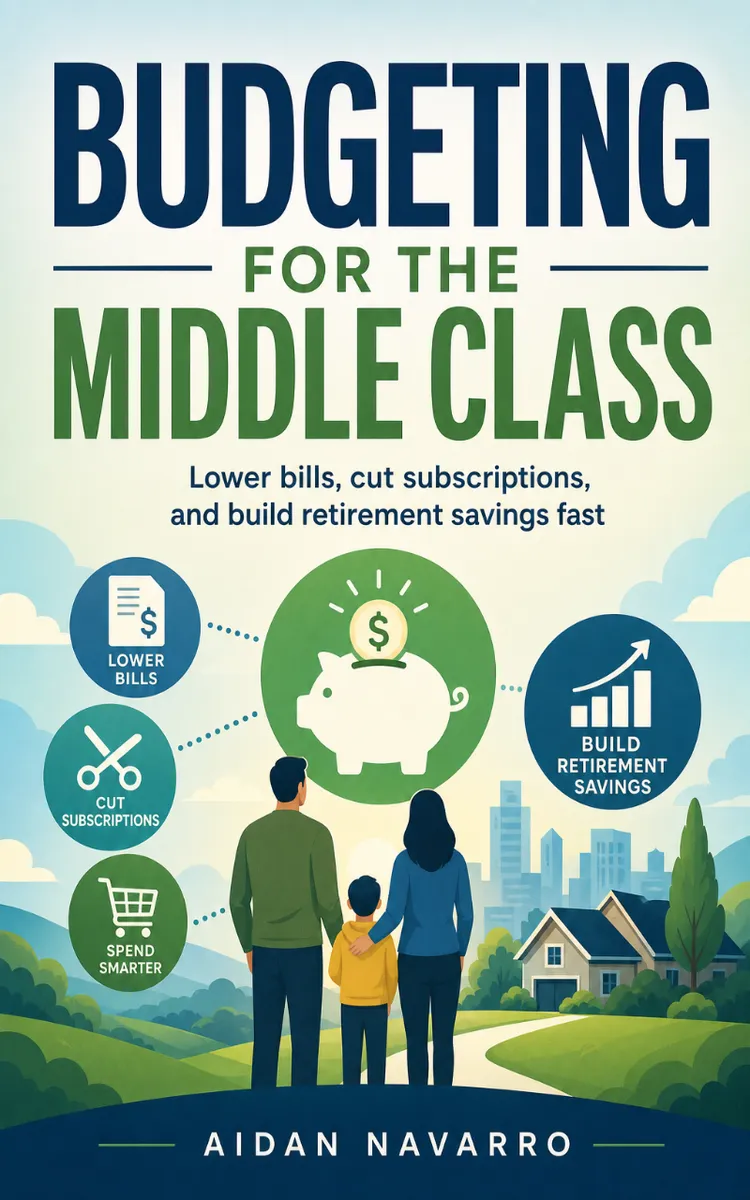
"Budgeting For The Middle Class" is a finance book by Aidan Navarro with 25 chapters and approximately 40,501 words. What if every dollar you bring home each week had a job before you spend it? Without a map, middle-class money vanishes into rent, fuel, groceries, takeout, autopay, and the small charges that quietly stack up. Then retirement stays a wish, because today’s bills keep taking every dollar.
This book was created using Inkfluence AI, an AI-powered book generation platform that helps authors write, design, and publish complete books. It was made with the AI Ebook Generator.
Frequently Asked Questions
What is "Budgeting For The Middle Class" about?
What if every dollar you bring home each week had a job before you spend it? Without a map, middle-class money vanishes into rent, fuel, groceries, takeout, autopay, and the small charges that quietly stack up. Then retirement stays a wish, because today’s bills keep taking every dollar. The $900 Trail Map turns weekly income into a path you can check, adjust, and protect. You will separate needs from tomorrow’s retirement, set deadlines you can see on a calendar, and build a budget that works even when your income or expenses wobble. Start with what you reliably earn, inventory every bill, and use clear rules to stop guessing and start saving. Read this now and build your plan before the next paycheck disappears.
How many chapters are in "Budgeting For The Middle Class"?
The book contains 25 chapters and approximately 40,501 words. Topics covered include The $900-Per-Week Goal Map, Your Bills: Know Every Number, The Middle-Class Budget Baseline, 50/30/20 Without the Fantasy, and more.
Who wrote "Budgeting For The Middle Class"?
This book was written by Aidan Navarro and created using Inkfluence AI, an AI book generation platform that helps authors write, design, and publish books.
How can I create a similar finance book?
You can create your own finance book using Inkfluence AI. Describe your idea, choose your style, and the AI writes the full book for you. It's free to start.
Write your own finance book with AI
Describe your idea and Inkfluence writes the whole thing. Free to start.
Start writingCreated with Inkfluence AI


