
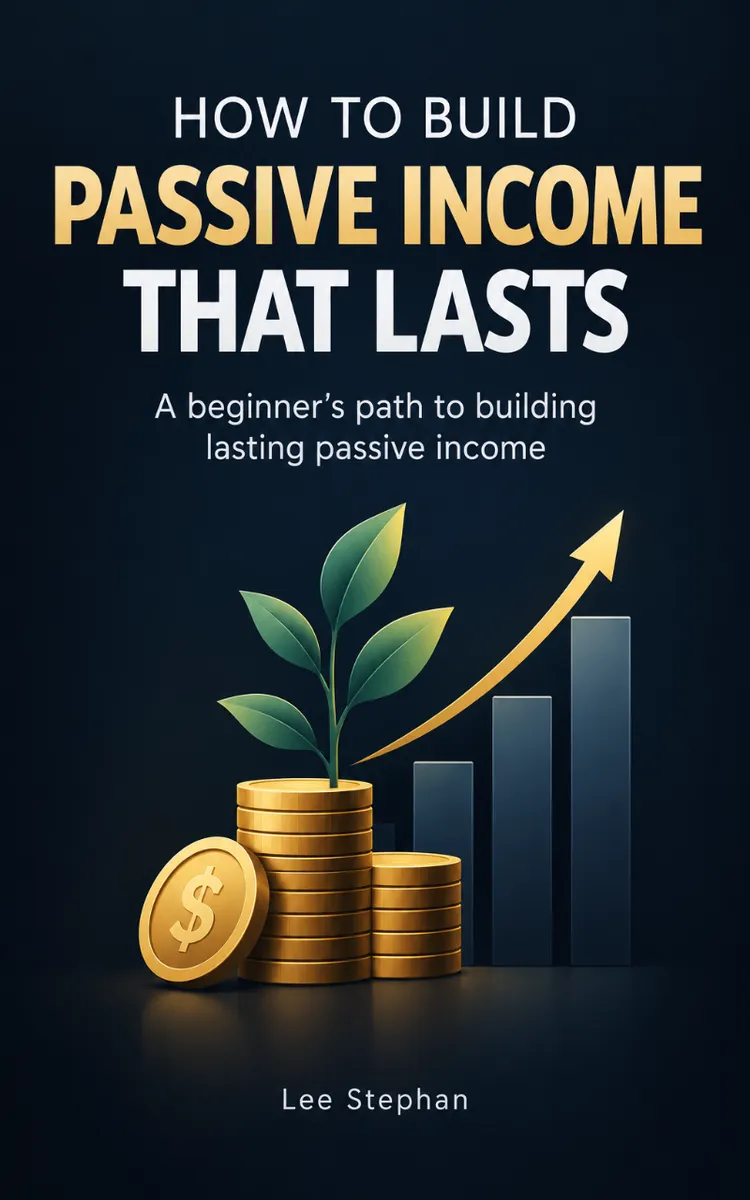

Read the first chapter
The whole of chapter one, free. About 13 min. Turn the pages with the arrows, your keyboard, or a swipe.
Chapter 1
Don't Overthink It - Building Your First Income-Producing Asset
Start With an Asset You Can Actually Carry
A good friend of mine once told me he wanted “passive income,” but his first idea required $40,000, a storefront, and staff he could not yet afford. His strongest opportunity sat much closer: he already knew which questions potential customers asked repeatedly. He turned that knowledge into a paid guide and a simple referral page. The first version of this guide cost less than $300 and took two weekends to create.
That is the point of a first income-producing asset. You do not need to begin with the most impressive business. You need an asset that matches your skills, available time, and starting capital closely enough to survive the learning period. An asset earns beyond the hour you spend creating or delivering it. It might be a digital guide, a recorded course, a rental tool, a niche website, a licensing package, or a small piece of equipment that others pay to use.
The wrong choice creates another job with extra expenses. The right choice gives you something you can improve, sell repeatedly, rent out, or license without starting from zero each time. By the end of this section, you will know how to measure your resources, compare possible assets, and select one that fits your real life rather than your wishful thinking.
Use the Seed Asset Method
The Seed Asset Method helps you choose a small asset with room to grow. A seed asset starts narrow, uses resources you already control, and proves demand before you invest heavily. You will assess three resources: skill, time, and capital. Then you will match them to a buyer’s problem.
Begin with an honest inventory. Write down the work people already ask you to do, the tools or knowledge you already own, and the hours you can protect each week. Do not count every hour outside your job. Count the hours you can use consistently for three months. If you can spare four hours on Saturday and one hour on two evenings, record six hours, not an optimistic fifteen.
Use these steps:
• List sellable skills. Write five tasks you can perform better than a beginner. Include trade skills, writing, teaching, organizing, repair, design, sales, cooking, bookkeeping, or equipment operation. A sellable skill solves a problem someone will pay to avoid.
• Measure dependable time. Review your calendar for the next twelve weeks. Mark the hours you can protect without harming your job, family duties, or health. Your time limit determines the asset’s required simplicity.
• Calculate available capital. Include cash you can risk without touching rent, debt payments, emergency savings, or essential bills. If you have $1,200 available, do not choose an asset that needs $1,200 before its first customer.
• Find repeated demand. Ask current customers, coworkers, local businesses, or online groups what they repeatedly need help with. Look for the same question appearing several times. Repeated demand gives your asset a better starting point than a clever idea with no buyer.
• Choose a small paid test. Build the smallest useful version and set a deadline. A $49 checklist, a $15 monthly rental, or a $99 recorded workshop can reveal more than months of planning.
• Set a reinvestment rule. Decide in advance how you will use early revenue. You might put the first $500 toward better recording equipment, advertising, inventory, or software. A rule prevents you from spending the money before the asset proves itself.
Match the asset to the strongest combination of resources. If you have strong knowledge but little money, choose a digital product, paid template, short course, or licensing package. If you have capital but limited time, consider equipment rental, a vending location, or a managed storage arrangement, but include maintenance and oversight in your time estimate. If you have both time and practical skill, build a repeatable service package that another person can eventually deliver, or create a training product that answers the questions you already solve.
The asset must also pass a simple earnings test. Estimate the first-year revenue, direct costs, and your setup hours. Suppose a $79 guide could sell to 40 buyers. That produces $3,160 in sales. Subtract $260 for software, payment fees, editing, and promotion, leaving $2,900 before taxes. If you spend 35 hours creating and launching it, the first-year return equals about $83 per setup hour. Later sales may require only customer support and occasional updates. The calculation does not guarantee success, but it shows whether the idea can move beyond hourly pay.
A useful asset has a clear owner, a clear buyer, and a clear delivery method. You should be able to answer three questions in one sentence each: What does the asset help someone do? Who pays for it? How does the buyer receive the benefit without requiring your full personal attention every time? If you cannot answer those questions, narrow the idea before you spend money.
Build and Test One Small Asset
Consider a practical example: a gym owner knows how to set up safe strength-training programs for people with only 30 minutes at home. She has six hours per week, $900 available, and regular questions from members who travel for work. A full online coaching business would require constant personal feedback. A better seed asset could combine a downloadable four-week program, short demonstration videos, and a $12 monthly access plan for updates.
She can apply the method in this order:
• Define the buyer and result. She chooses busy adults who want a simple home routine and states the result clearly: four weeks of guided workouts using adjustable dumbbells and a resistance band.
• Set the spending limit. She reserves $450 for a microphone, lighting, editing help, and a basic sales page. She keeps the remaining $450 for refunds, testing small advertisements, or fixing delivery problems.
• Create the first version. During two weeks, she records 20 short videos, writes the schedule, adds safety notes, and loads the files into a simple digital product platform. She avoids building a custom mobile application because the first buyers do not need one.
• Test with real buyers. She offers 15 early copies at $39 to existing members and former members. The lower launch price rewards useful feedback while proving whether people will pay.
• Measure the result. If all 15 copies sell, revenue reaches $585. After $450 in setup costs, she has $135 before taxes and a list of specific questions from buyers. If only two people buy, she interviews those buyers and the nonbuyers before spending more.
• Improve the delivery. She turns repeated questions into clearer instructions, adds a printable calendar, and records one replacement video where people struggled. She then raises the regular price to $59 and tracks sales, refunds, support time, and customer completion.
• Reduce her personal involvement. She schedules one monthly group question session instead of answering the same questions individually. She writes answers into a support page and adds them to the product. The asset becomes easier to sell without requiring a new private appointment for every customer.
The expected outcome is not instant freedom. The first target is proof: paying customers, manageable support, and a positive path after direct costs. If 40 customers buy at $59, sales reach $2,360. If platform fees, refunds, and updates total $360, the remaining $2,000 can fund better promotion or a second related product. The owner now has evidence, customer language, and a delivery system instead of only an idea.
Use a simple spreadsheet to record the test. Create columns for date, buyer, price, payment fee, refund, support minutes, and source of the sale. Review it each Sunday. Your goal is to learn whether the asset earns more with each improvement, not to hide weak results behind optimistic projections.
Quick checklist
• Write five skills people already ask you to use.
• Mark the hours you can protect for twelve weeks.
• Set a cash limit that excludes essential money.
• Identify one repeated customer problem.
• Choose an asset that delivers the same basic result repeatedly.
• Build a paid version within 14 to 30 days.
• Sell to a small group before making a large investment.
• Track revenue, direct costs, support time, refunds, and repeat sales.
• Improve the asset from repeated questions, not guesses.
• Reinvest only after the first test shows real demand.
Avoid Expensive Misalignment
Choosing an asset that needs skills you do not have
A person with strong repair skills may choose to build a complicated software product because it sounds scalable. That choice adds learning time, development costs, and technical risk before the person tests the customer problem.
Do this: Start with the skill that already produces trusted results. Turn a repeated repair diagnosis into a guide, inspection checklist, training video, or rental package.
Not this: Spend months learning an unrelated technical field before asking whether buyers want the solution.
If the asset requires a new skill, hire only for the narrowest task you cannot complete yourself. Keep ownership of the customer problem, offer, and quality standard.
Confusing revenue with income
A $5,000 sales month does not mean you earned $5,000. Payment fees, materials, advertising, refunds, storage, repairs, and taxes reduce what remains. A rental asset can look profitable until you count transport and downtime. A digital product can look free to deliver until customer support takes ten hours each week.
Do this: Record every direct cost and your support time from the first sale. Set aside money for taxes according to your local rules and speak with a qualified tax professional when the asset grows.
Not this: Judge the asset by sales screenshots or gross revenue alone.
Your first asset should show a surplus after direct costs and a declining need for your personal hours. If sales rise while support time rises at the same speed, you have built a service, not yet an income-producing asset. Improve the instructions, add boundaries, or change the delivery model.
Starting too large
People often spend their entire budget on inventory, branding, equipment, or a custom website before they test demand. A large launch creates pressure to defend the original idea, even when buyers show little interest.
Do this: Set a minimum test. For example, sell 10 copies, secure three rental bookings, or collect five paid deposits before expanding.
Not this: Buy a year of supplies because the per-unit price looks cheaper.
A small test protects your capital and gives you useful information. When buyers pay, finish the product, and ask for the next version, expansion becomes a decision supported by evidence. When they do not, you can change direction without carrying a large pile of unused costs.
Your first income-producing asset does not need to impress anyone. It needs to fit your actual skill, calendar, and cash, then solve one problem repeatedly. Start with a seed you can plant now, measure what grows, and reinvest only where the evidence points. That discipline turns ordinary know-how into an asset that can keep working after the original hour has ended.
Why your first income-producing asset must earn while you sleep
You want money that arrives without trading every hour for a dollar. The fastest way to get there is to build one asset that creates recurring value for other people without requiring you to show up every time. That single asset solves three common problems: it converts your existing skill into repeatable cash, it forces you to test demand before you spend much, and it teaches you how to protect time while you grow income. After you finish this section, you’ll be able to pick one small, testable asset that matches your real-life hours, budget, and skills - then run a low-cost experiment that proves whether it can produce passive income.
The secret is not a clever product idea; it’s choosing something you can deliver once and sell or rent many times. If you already fix pipes, teach fitness, design logos, or run a small shop, you can turn what you do into a product - a downloadable guide, a recorded workshop, a rental item, or a license agreement - that pays you again and again. You’ll walk away knowing how to measure time and money, build a minimal version, and decide whether to scale or stop without losing much cash. You’ve got this - the first asset should fit your real life, not your fantasy.
The core technique: build a small, testable passive income asset
The technique I use and teach is simple: pick the smallest useful version of an asset you can create, sell it to real buyers fast, and keep improving only when the money and feedback justify more work. Follow these components:
• Inventory your sellable skills.
• Write five things you already do better than a beginner. Example: "I create simple bookkeeping spreadsheets for local tradespeople." Use these to pick asset ideas.
• Count dependable hours for three months.
• Schedule the real hours you can protect every week. If you can reliably spare six hours, plan an asset that requires 20-30 setup hours, not 100.
• Set a hard cash cap for testing.
• Only use money you can risk. If you can spare $500, commit no more than half to initial creation and half to fixes or ads.
• Build the smallest paid version in 14-30 days.
• Create a $15-$99 offering that delivers a clear outcome. Example: a $39 checklist plus three short videos that solve a repeated problem.
• Sell to a small audience and measure.
• Aim for 10-40 buyers. Track gross sales, payment fees, refunds, support minutes, and source of sale in a simple spreadsheet.
• Reinvest by rule.
• Decide up front: first $500 goes to marketing, next $500 to product improvement. That prevents impulse spending.
These steps turn vague hopes into measurable tests. If people pay and support time drops per sale, you’ve built passive income. If not, you learned fast without wasting much.
A realistic scenario: a carpenter builds a downloadable maintenance guide
Step 1: Inventory - the carpenter lists five repeated requests: "how to stop a squeaky door," "seal a deck," "repair loose stair treads," "choose outdoor screws," "simple tool list." He has 8 dependable hours per week and $600 to risk.
Step 2: Pick a seed asset - he chooses a deck maintenance guide: a 20-page PDF + five short how-to videos, priced at $49.
Step 3: Build in 21 days - record videos using a $120 lapel mic and free editing software, create the PDF in a template, host on a simple digital storefront that charges $1 + platform fees per sale.
Step 4: Test with 25 buyers - he emails past clients and posts locally. If 25 buy at $49, gross = $1,225. Subtract $225 for fees and equipment, net ≈ $1,000 before taxes.
Step 5: Measure support time - track time answering questions. If support averages 10 minutes per buyer (4+ hours total), he can convert frequent questions into an FAQ and cut support to 30 minutes for the next 25 buyers.
Quick checklist
• List five repeatable skills or questions.
• Block dependable hours for 3 months.
• Set a cash cap and stick to it.
• Create a minimally viable paid product in 14-30 days.
• Sell to 10-40 people and track sales + support time.
• Reinvest early revenue according to a pre-set rule.
Common mistakes and fixes
Building the wrong format
Choosing a flashy app when buyers want a simple checklist wastes time and money.
Do this: Match format to buyer need - sell a PDF or short videos if buyers want quick answers.
Not this: Buy custom software or inventory before you prove demand.
Counting gross sales as profit
Gross revenue hides fees, refunds, and your support time.
Do this: Track direct costs, platform fees, refunds, and support minutes from the first sale. Set aside money for taxes.
Not this: Celebrate a sales screenshot without checking how many hours you spent supporting buyers.
Testing with the wrong audience
Selling to strangers before you test close, known customers leads to misleading results.
Do this: Offer the first run to past customers, friends, or a local group who know your work.
Not this: Spend ad dollars to find cold traffic before you have a refined offer and support answers.
Finish by choosing one small asset you can deliver quickly. Build it, sell it to a handful of real buyers, and track the numbers. If the results improve with small changes and your personal hours don’t rise as sales grow, you’ve started real passive income. Keep the test simple, stay honest with theIf the test fails, treat the result like a map, not a verdict. Talk to nonbuyers, tighten the promise, or change the delivery format. Often a clearer headline, one replacement video, or a prepaid deposit option turns a weak test into a repeatable sale. You’ve already lowered risk by building small - now use customer feedback to make smarter choices. Remember: passive income starts with a product that truly reduces someone’s problem without calling you every time. Take the next honest step, and you’ll have something that can grow while you sleep. You’ve got this.
End of chapter one. 4 more chapters and about 10,292 words in the full book.
Swipe or use the arrows to turn the page
What's inside: 5 chapters
- 1. Don't Overthink It - Building Your First Income-Producing Asset
- 2. Creating Digital Products That Actually Sell
- 3. Build the Cash - Investing for Reliable Cash Flow
- 4. Don't Make It Hard - Automating Operations Without Losing Quality
- 5. Avoid the Pitfalls - Scaling and Protecting Multiple Income Streams
About this book
"How to Build Passive Income That Lasts" is a finance book by Lee Stephan with 5 chapters and approximately 10,292 words. How to Build Passive Income That Lasts shows you how to choose an income-producing asset that fits your skills, time, and starting capital. Use learned methods to compare ideas, then turn useful knowledge into a product that solves one clear problem.
This book was created using Inkfluence AI, an AI-powered book generation platform that helps authors write, design, and publish complete books. It was made with the AI Ebook Generator.
Frequently Asked Questions
What is "How to Build Passive Income That Lasts" about?
How to Build Passive Income That Lasts shows you how to choose an income-producing asset that fits your skills, time, and starting capital. Use learned methods to compare ideas, then turn useful knowledge into a product that solves one clear problem. When you’re ready to invest, the included Cash-Flow Ladder helps you match money to its job instead of chasing something out of your reach. This is a ground-up approach to building assets you can improve, sell repeatedly, rent out, or license. Apply the techniques that allow you to start with something small enough to build now, and give you room to grow into a long-term financial success.
How many chapters are in "How to Build Passive Income That Lasts"?
The book contains 5 chapters and approximately 10,292 words. Topics covered include Don't Overthink It - Building Your First Income-Producing Asset, Creating Digital Products That Actually Sell, Build the Cash - Investing for Reliable Cash Flow, Don't Make It Hard - Automating Operations Without Losing Quality, and more.
Who wrote "How to Build Passive Income That Lasts"?
This book was written by Lee Stephan and created using Inkfluence AI, an AI book generation platform that helps authors write, design, and publish books.
How can I create a similar finance book?
You can create your own finance book using Inkfluence AI. Describe your idea, choose your style, and the AI writes the full book for you. It's free to start.
Write your own finance book with AI
Describe your idea and Inkfluence writes the whole thing. Free to start.
Start writingCreated with Inkfluence AI


