
Read the first chapter
The whole of chapter one, free. About 7 min. Turn the pages with the arrows, your keyboard, or a swipe.
Chapter 1
Motivation Is a Liar (Sometimes)
The Day Motivation Disappears
> “I’ll do it when I feel ready.”
That sentence sounds harmless. Sometimes it even feels wise. You say it on Monday morning while looking at the unopened spreadsheet. You say it after work when your running shoes are beside the door. You say it on Sunday night, staring at the laundry, the course you meant to finish, or the bank account you promised to review.
Then the day gets busy. Your energy drops. Someone needs something. Your phone offers a much easier task. By evening, you haven’t done the thing, and now you’re carrying two weights: the task itself and the irritation of avoiding it.
The frustrating part is that you weren’t confused. You knew what needed doing. You may even have felt genuinely motivated yesterday. Yesterday, the plan was clear. Today, the plan is still clear - but your desire to act has vanished. Do you recognise that pattern in yourself?
The Question Behind the Missing Motivation
What if motivation isn’t supposed to carry the task?
Most of us quietly treat motivation like a dependable employee. We expect it to show up at the right time, bring energy, make the first step feel appealing, and stay until the job is finished. When it doesn’t, we assume something is wrong with us.
Motivation is persuasive because it feels like information. When you feel excited about exercising, your brain presents exercise as manageable. When you feel interested in learning a new skill, the difficult parts seem worth tolerating. When you feel inspired to sort out your finances, opening the banking app doesn’t seem quite so unpleasant.
But feelings change faster than responsibilities do. Motivation is influenced by sleep, stress, hunger, recent disappointment, the weather, an awkward email, and whether you’ve already spent an hour making tiny decisions. It can be useful, but it isn’t stable enough to be your main plan.
Take a simple example. Before-and-after motivation might look like this:
Before, you wait for the right mood to train. On a good morning, you exercise for forty minutes. On an ordinary morning, you negotiate with yourself until the available time disappears. The workout depends on how you feel before it begins.
After, you decide that at 6:30 a.m., you’ll put on your shoes and walk for ten minutes. If you feel energetic, you can continue. If not, ten minutes still counts. The task no longer asks motivation to approve it. Your decision has already been made.
That shift may sound small. It’s not. You’re moving trust from a temporary feeling to a repeatable arrangement. The goal isn’t to become a person who always feels driven. It’s to become a person who can begin without requiring a special internal weather forecast.
How Motivation Talks You Out of Action
Here’s the usual chain:
1. When you face a task that feels boring, uncertain, or uncomfortable, you wait for motivation to appear. 2. You feel resistance and interpret it as a sign that now isn’t the right time. 3. So you postpone the task and choose something that gives quicker relief, such as checking messages or doing an easier job. 4. Which leads to guilt, a larger task, and even more resistance the next time you face it.
Notice the trick in step two. Resistance gets treated as evidence. You don’t simply feel uncomfortable; you conclude that action should wait. The feeling becomes a verdict.
Now compare it with the alternative chain:
1. When you face a task that feels boring, uncertain, or uncomfortable, you use a pre-decided starting action. 2. You feel resistance, but recognise it as a normal part of beginning. 3. So you do the smallest useful version, such as writing one paragraph, walking around the block, or opening the bill and reading the amount. 4. Which leads to evidence that action is possible, less emotional drama around the task, and a stronger chance of continuing tomorrow.
This is where the Motivation Reliability Test helps. Before trusting motivation, ask: Has this feeling helped me start this task consistently before, including on ordinary days? If the answer is no, don’t insult the feeling. Just don’t hand it the keys.
A feeling can explain your hesitation without earning the right to decide your next move.
The Motivation Reliability Test
Use these questions honestly. There are no gold stars for giving yourself a flattering answer.
1. On a scale from 1 to 10, how often does waiting for motivation lead to the result you actually want? A high score suggests motivation has some practical value for this task. A low score shows that waiting has become a polished form of postponement.
2. On a scale from 1 to 10, how difficult is the first two minutes of this task? If the number is high, the task may be too vague, too large, or emotionally loaded. You probably don’t need more motivation; you need a clearer entry point.
3. Yes or no: Have you completed this task before without feeling motivated at the start? A yes proves the feeling isn’t a requirement. A no doesn’t mean you can’t do it; it means you need to test a smaller starting action.
4. On a scale from 1 to 10, how much does the task improve once you begin? A high score means the main problem is likely starting. A low score may point to a task that needs changing, scheduling, support, or a more honest look at why you’re avoiding it.
Here’s a simple interpretation guide. If your ratings show that waiting rarely works, the decision is straightforward: stop using motivation as the gatekeeper. If starting feels harder than continuing, focus on the first two minutes. If the task never improves after you begin, don’t keep blaming yourself for a badly designed plan.
The test isn’t there to prove that you’re lazy. It’s there to separate a useful signal from an unreliable promise. Motivation may visit. Your routine needs to work whether it does or not.
A Three-Step Test You Can Start Today
Build one motivation-proof start
Choose one task you’ve been waiting to feel ready for. Keep it specific. “Get healthier” is too broad. “Walk after lunch” works. “Fix my finances” is a cloud. “Open the credit-card statement at 7:00 p.m.” gives you somewhere to stand.
1. Name the first visible action. Write down the smallest action that changes the situation: put on walking shoes, open the document, place the bill on the desk, or set out the study materials. Do this now. Difficulty: Easy.
2. Schedule a ten-minute appointment with the task. Choose a time within the next twenty-four hours. Set one alarm labelled with the action, not a vague instruction. At the scheduled time, begin for ten minutes. You may continue, but you don’t have to. Difficulty: Medium.
3. Record the result without judging your mood. Write three quick notes: whether you started, how long you continued, and how motivated you felt before beginning. The point is to collect evidence. You’re testing reliability, not trying to produce a perfect day. Difficulty: Medium.
You’ll know it’s working when:
• You begin before feeling fully ready. - The first step feels less mysterious because it’s already defined. - You stop describing motivation as the thing that decides whether the task happens.
If you miss the appointment, don’t turn the miss into a character assessment. Reschedule it within the next day and make the starting action smaller. A failed ten-minute plan teaches you more than a grand plan you never test.
Trust the Arrangement, Not the Mood
Motivation is helpful, but it’s a poor appointment keeper. It can give you a burst of energy, help you enjoy progress, or make a difficult goal feel meaningful. Let it help when it shows up. Just don’t build your life around its attendance.
The more dependable approach is to make action easier to begin and less dependent on a daily debate:
• Motivation can start the conversation, but a clear routine makes the decision. - Resistance is a feeling, not a reliable instruction. - The first useful action should be small enough to begin on an ordinary day. - The Motivation Reliability Test turns vague frustration into evidence you can use.
You don’t need to feel eager before every important action. You need a starting point that still makes sense when the day has been long, your inbox is crowded, and your inner cheerleader has taken the afternoon off.
So when the familiar thought arrives - I’ll do it when I feel motivated - try a better question: What is the smallest step I can take while feeling exactly as I feel right now? That question doesn’t demand a personality transplant. It simply gives you a way forward.
End of chapter one. 9 more chapters in the full book.
Swipe or use the arrows to turn the page


What's inside: 10 chapters
- 1. Motivation Is a Liar (Sometimes)
- 2. Turn Goals Into Identity Promises
- 3. Build a Two-Minute Starting Habit
- 4. Design Your Environment for Follow-Through
- 5. Use Implementation Intentions for Busy Days
- 6. Practice Discipline Without Feeling Punished
- 7. Stop Missing Days With a Minimum Standard
- 8. Make Consistency Measurable and Simple
- 9. Handle Resistance With the Next-Right Step
- 10. Build a Life System That Keeps Working
About this book
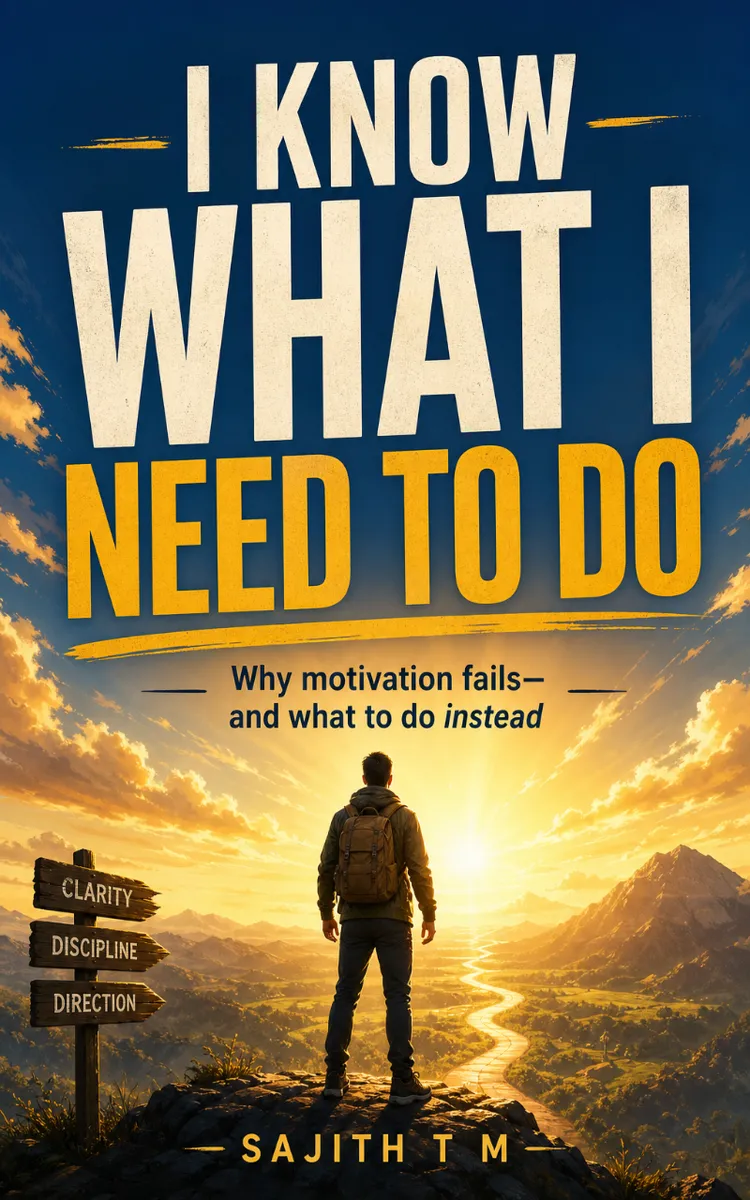
"I Know What I Need To Do" is a self-help book by Sajith T M with 10 chapters and approximately 14,962 words. Motivation disappears the moment your day gets real. You know exactly what to do, you even felt ready yesterday, then the plan stays clear while your desire to act vanishes.
This book was created using Inkfluence AI, an AI-powered book generation platform that helps authors write, design, and publish complete books. It was made with the AI Self-Help Book Writer.
Frequently Asked Questions
What is "I Know What I Need To Do" about?
Motivation disappears the moment your day gets real. You know exactly what to do, you even felt ready yesterday, then the plan stays clear while your desire to act vanishes. By evening, you are carrying the task and the irritation of avoiding it. This book challenges the lie that motivation is supposed to carry your goals. You will stop outsourcing follow-through to mood, energy, or “the right time,” and start building discipline that works when motivation does not. Through practical tools, identity shifts, and a two-minute starting habit, you will turn goals into actions you can repeat. If you want consistency, not another pep talk, read this now.
How many chapters are in "I Know What I Need To Do"?
The book contains 10 chapters and approximately 14,962 words. Topics covered include Motivation Is a Liar (Sometimes), Turn Goals Into Identity Promises, Build a Two-Minute Starting Habit, Design Your Environment for Follow-Through, and more.
Who wrote "I Know What I Need To Do"?
This book was written by Sajith T M and created using Inkfluence AI, an AI book generation platform that helps authors write, design, and publish books.
How can I create a similar self-help book?
You can create your own self-help book using Inkfluence AI. Describe your idea, choose your style, and the AI writes the full book for you. It's free to start.
Write your own self-help book with AI
Describe your idea and Inkfluence writes the whole thing. Free to start.
Start writingCreated with Inkfluence AI


