
Read the first chapter
The whole of chapter one, free. About 12 min. Turn the pages with the arrows, your keyboard, or a swipe.
Chapter 1
The Body in the Switchbacks
The last of the stormwater ran down the trailhead sign in silver threads when Mara Kestrel heard someone shouting above the trees.
She killed the engine and sat with both hands on the wheel. Rain ticked against the windshield, though the storm had passed. Beyond the parking turnout, the switchback trail climbed through dark spruce toward Alder Ridge, its lower stones shining like wet bone.
“Help!” a voice called. “Somebody get up here!”
Mara was out of the car before she could think better of it.
The trail began behind a rusted chain, where a sign warned hikers about washouts and falling rock. Mud sucked at her boots as she climbed. Water rushed beside the path in a narrow ditch, carrying pine needles and bits of orange bark. Above, another voice broke through the trees.
“Don’t move him!”
“I’m not moving him!”
Mara rounded the first bend and saw two hikers pressed against the uphill wall. One was a young man in a blue rain shell, his face gray beneath a yellow climbing helmet. The other, a woman with a red pack, stood barefoot in one boot while the other dangled from her hand.
Between them, the trail dropped away.
A body lay on the lower switchback, half on the path and half among the wet brush. The man’s jacket was black with rain. One arm pointed downslope, fingers curled around nothing. His head rested at an angle that made Mara stop.
The woman in the red pack saw her first. “You have a phone?”
Mara’s hand went to her pocket. “Yes.”
“Call emergency services.”
The young man turned sharply. “Wait.”
The word landed harder than the rain.
Mara looked at him. “What?”
He glanced toward the body, then up the trail. “We need to know if he’s alive.”
“You just said not to move him.”
“I said you shouldn’t move him.”
The woman’s mouth tightened. “Eli.”
“What?” His eyes flicked back to the trees. “We don’t know what happened.”
Mara stepped closer to the edge. The dead man’s boots were planted on the lower trail, but his torso lay twisted in the brush. There was no blood on the rocks beneath him. A dark mark showed at the base of his skull, partly hidden by wet hair.
She had come to hike Alder Ridge before the clouds closed in again. Three hours up, an hour at the overlook, then back to the car before dark. Her pack held water, a granola bar, and a camera she had promised herself she would use for something other than work. That small plan now seemed absurdly delicate.
“Give me your phone,” the woman said.
Mara pulled it out. The screen lit, then flashed No Service.
“Damn it.”
“There’s a signal at the next bend,” Eli said. “Maybe.”
“Maybe?”
“It comes and goes.”
The woman snatched her own phone from a pocket and raised it toward the sky. “Nothing.”
A low rumble moved through the mountain. Not thunder. Rockfall, somewhere above them. The sound rolled between the trees and faded.
Mara looked at the body again. “Who is he?”
Neither answered.
“Did either of you see him fall?”
Eli’s jaw worked. “We heard something.”
“That’s not what I asked.”
The woman in the red pack crouched near the body without touching it. “He was already down when we came around the bend.”
“Then why are you arguing?”
“Because he may not have fallen,” Eli said.
The woman looked up at him. “You don’t know that.”
“I know what I saw.”
Mara’s attention sharpened. “What did you see?”
Eli stared at her, and in that pause she heard it again: shouting, farther up the switchbacks. A man’s voice, carried thinly through the wet trees.
“Get away from him!”
The three of them turned.
A figure moved between the spruce trunks above, dark jacket, gray cap. He was running downhill. Mara saw one hand catch a branch, saw him glance toward the body, then toward them. For one clear second, his face showed beneath the cap.
Then he disappeared around the bend.
“Hey!” Eli shouted. “Stop!”
He started after him.
Mara caught his sleeve. “Don’t.”
Eli jerked free. “That was him.”
“Who?”
“The man who was with the victim.”
The woman rose. “You said you didn’t see anyone.”
“I said I heard something.”
“You said we were first here.”
“I was trying to keep you from panicking.”
“You’re doing a terrible job.”
Mara looked toward the bend. The mud held several sets of prints, softened by runoff. One set led down toward the body. Another crossed the trail and vanished into the brush. The runner’s boots had left sharp, fresh impressions in the wet clay.
“What did he do?” Mara asked.
Eli’s face had gone pale again. “He pushed him.”
The woman shook her head. “You didn’t see that.”
“I saw them fighting.”
“When?”
“Before you came.”
“Then why didn’t you say so?”
Eli looked at Mara. “Because he might still be close.”
A branch snapped above them.
This time all three flinched.
Mara backed toward the uphill wall. The trail was too narrow for comfort, the drop below slick with mud and broken stone. The storm had changed the mountain. Water poured across the path in clear sheets. Every route out seemed to angle past the body, past the bend where the stranger had vanished, or upward into the trees.
Her phone showed one bar.
She dialed emergency services.
The call connected, broke, then connected again.
“Emergency services,” a woman’s voice said, faint and metallic.
“My name is Mara Kestrel. I’m on the switchback trail above Alder Ridge. There’s an injured hiker - ”
“He’s dead,” Eli said.
Mara looked at him.
The dispatcher’s voice crackled. “Ma’am, repeat your location.”
“There’s a man who may be dead. We need rescue and law enforcement. The trail is unstable, and someone left the scene.”
“Who left?”
Mara turned toward the bend.
Eli stepped close. “Don’t say that.”
The woman in the red pack stared at him. “Why not?”
“Because you don’t know what you saw.”
“I saw a man running.”
“You saw a shape.”
“I saw his face.”
Mara pressed the phone tighter to her ear. “A man in a dark jacket and gray cap ran uphill. One of the witnesses says he was with the victim.”
The dispatcher asked for the trail marker. Mara found the sign nailed to a spruce: ALDER RIDGE LOOP, LOWER SWITCHBACK, 1.8 MILES TO NORTH OVERLOOK.
She read it aloud.
“Stay on the line,” the dispatcher said. “Do not approach the suspect. Can you safely move to the trailhead?”
Mara looked down the path. The body lay between them and the road.
“Not without passing the victim.”
“Do not disturb the scene. Rescue is being dispatched from the ranger station.”
A sharp whistle cut through the trees.
The woman in the red pack spun around. “That came from above.”
Eli grabbed Mara’s arm. “We have to go.”
“Go where?”
“Down.”
“That’s where the body is.”
“Then around it.”
He pulled her toward the outer edge of the trail. Gravel slid beneath his boots and rattled down the slope. Mara planted herself against the uphill bank.
“Let go.”
He did, but not before his fingers tightened.
The woman stepped between them. “Nobody moves until help arrives.”
“You want to wait here for the man who pushed him?” Eli said.
“If he pushed him, tell the dispatcher.”
Eli’s expression shifted. Fear remained, but something harder moved beneath it. “You don’t understand.”
“No,” Mara said. “You’re not explaining.”
For a moment, the only sound was water striking leaves.
Then Mara noticed the dead man’s right hand.
It was clenched around a strip of blue fabric.
Not torn from his own jacket. The cloth was brighter, almost electric against the mud, and a thin metal button was caught in its threads.
She crouched without touching him.
Eli swore under his breath.
The woman whispered, “What is it?”
Mara lifted her phone and took a photograph. The flash whitened the trees.
“Why did you do that?” Eli demanded.
“To remember what I saw.”
“You’re making this worse.”
“How?”
His eyes fixed on the blue fabric. “Because now everyone’s going to decide it means something.”
“Does it?”
He didn’t answer.
The dispatcher’s voice came through the phone. “Ma’am, are you still there?”
“Yes.”
“Can you confirm breathing or a pulse?”
Mara looked at the body. The rain had gathered in the hollow of his cheek. His skin was waxy, his lips blue.
“I can’t find either.”
“Do not touch him.”
“I haven’t.”
A distant engine groaned somewhere below, then faded. The rescue team would need time. The trailhead was nearly two miles from the nearest paved road, and the storm had probably washed out part of the access track.
The woman in the red pack sank against the uphill wall. “I’m Lena Ortiz.”
Mara looked at her.
“If they ask,” Lena said. “That’s my name. I didn’t touch him. I came up from the lower trail with Eli. We heard shouting.”
Eli gave a humorless laugh. “You want to rehearse now?”
“I want the truth to sound the same twice.”
Mara kept her phone raised. “And you?”
“Eli Mercer.”
“What exactly did you hear?”
Eli looked toward the body. “A man said, ‘You should have left it alone.’”
The words seemed to settle over the trail.
Mara felt the wet cold through her jeans. “Who said it?”
“I don’t know.”
“You said you saw them fighting.”
“I saw one man shove the other.”
“Then you do know.”
His gaze met hers. “I saw a shoulder. A hand. That’s all.”
Lena stared at him. “You told me he pushed him.”
“I said it looked like he pushed him.”
“No. You said - ”
“Enough,” Mara snapped.
Both of them fell quiet.
A rescue whistle sounded below. This one was closer.
Mara glanced once more at the runner’s tracks. The prints crossed the mud beside the body, then returned to the upper trail. Whoever had run had not slipped. He had moved quickly and deliberately, avoiding the slickest stones.
The dispatcher asked, “Ma’am, can you identify the victim?”
“No.”
“Any identification on him?”
Mara edged closer, careful not to step where the mud was undisturbed. A leather wallet protruded from the man’s jacket pocket. She could see a corner of a card but not the name.
“I see a wallet.”
“Do not remove it.”
“I won’t.”
Eli took a step toward her. “Mara, right?”
She looked at him. “How do you know my name?”
“You said it to the dispatcher.”
“Did I?”
His face closed.
Lena noticed it too. “You’ve been listening.”
“I’ve been standing here.”
The first rescuer appeared around the lower bend in a red helmet and yellow shell, followed by another carrying a medical bag. Behind them came a broad-shouldered man in a green sheriff’s jacket, moving with the careful impatience of someone accustomed to difficult ground.
“Everyone stay where you are,” the sheriff called.
The rescuer reached the body and knelt. He checked for a pulse, shone a light into the dead man’s eyes, then looked up.
“Confirmed deceased.”
The words were quiet, but they changed the trail. Until then, Mara had been guarding a possibility. Now there was only a body and the people around it.
The sheriff approached. “Who called it in?”
Mara raised her hand.
He looked at her phone, then at the other two. “Name?”
“Mara Kestrel.”
“Where were you when you found him?”
“Coming up from the trailhead. I heard shouting.”
“What kind of shouting?”
“A man telling someone to get away from him. Then I saw a runner above us.”
The sheriff’s eyes moved to Eli. “You?”
“Eli Mercer.”
“You were here first?”
“No,” Eli said.
Lena spoke at once. “We came together.”
“Did you see anyone leave?”
Eli hesitated.
Mara said, “He did.”
The sheriff looked at her. “He did?”
“A man in a dark jacket and gray cap. He ran uphill after we reached the body.”
“Did you see his face?”
“Yes.”
“Describe him.”
“Forties, maybe. Lean. Dark hair. He had a scar near his left eyebrow.”
Eli shook his head. “That’s not what she said before.”
Mara turned. “What?”
“You said you only saw his back.”
The sheriff’s attention returned to her. “Which is it?”
“I saw his face when he looked down at us.”
“For how long?”
“Long enough.”
“Could you identify him?”
“I could identify the jacket.”
The sheriff crouched near the body, careful not to touch anything. “There’s another hiker on this trail today. Name’s Nolan Vance. Blue shell, gray cap. We’ve had complaints about him harassing people near the ridge.”
Mara stared at the sheriff. “The man I saw wore a dark jacket.”
“Blue can look dark in this weather.”
“He was running uphill.”
“So was Nolan.”
“Did you see him?”
The sheriff stood. “Not yet.”
Lena folded her arms. “You’re saying Nolan killed him?”
“I’m saying Nolan is the first person we’ll look for.”
“You haven’t even asked who the dead man is,” Mara said.
The sheriff’s mouth tightened. “We’ll get there.”
Mara pointed toward the body without crossing the trail. “There’s blue fabric in his hand. A button. He may have grabbed the attacker.”
The sheriff looked at the strip, then at her. “You took a picture?”
“Yes.”
“Why?”
“Because nobody else was doing it.”
A silence opened between them.
The sheriff held out his hand. “Give me the phone.”
Mara didn’t move. “The dispatcher has the call.”
“And I’m asking for the photograph.”
“You can take it from the evidence team.”
His expression hardened. “Ms. Kestrel, this is now a crime scene. You’ll do what I tell you.”
“If it’s a crime scene, why are you already naming someone?”
“Because I know this mountain and the people who use it.”
“You know one hiker has a reputation. That isn’t evidence.”
The sheriff took a step closer. “You arrived after the fall. You were frightened, the weather was bad, and you saw a figure at a distance. Your account is not as solid as you think.”
Mara felt the phone warm against her palm. Behind the sheriff, Eli lowered his gaze. Lena watched Mara with an expression that was not quite gratitude.
The sheriff continued, “Nolan Vance was seen heading toward the upper switchbacks. If he ran, it was because he knew what he’d done.”
“No,” Mara said. “He ran because someone was chasing him.”
“Who?”
“I don’t know.”
“Exactly.”
The rescue crew began covering the body. Yellow tape appeared between the spruce trunks, bright as warning paint.
Mara looked past it, toward the bend where the runner had vanished. Rainwater slid over the tracks, blurring the edges one drop at a time.
She had wanted a hike. A clear trail, a view of the ridge, an afternoon that belonged only to her.
Now the sheriff was asking her to surrender the one thing she had seen clearly.
“I’m telling you what happened,” she said.
He held her gaze. “You’re telling me what you think happened.”
Below them, another whistle sounded. From above came a faint crack of stone.
Mara closed her fingers around the phone.
The sheriff turned toward the upper trail. “Find Nolan Vance,” he called to one of the deputies. “He’s our suspect.”
Mara watched the deputy climb into the trees.
On her screen, the photograph of the dead man’s hand remained open. The blue fabric, the metal button, the mud untouched around it.
The sheriff had dismissed her account before anyone had examined the evidence.
Mara slipped the phone into her pocket and looked up the switchbacks.
Somewhere beyond the rain-dark spruce, the man she had seen was still moving through the mountain.
End of chapter one. 14 more chapters and about 32,208 words in the full book.
Swipe or use the arrows to turn the page


What's inside: 15 chapters
- 1. The Body in the Switchbacks
- 2. A Missing Map from Alder Ridge Lodge
- 3. The Stamped Route That Lies
- 4. Stormgate Cuts Off the Trail
- 5. Mara Chooses to Trust Jonah Pike
- 6. The Sheriff’s Rope Gets Replaced
- 7. Granite Hollow’s Hidden Footprints
- 8. A Cabin Alibi Cracks Wide Open
- 9. The Framed Guide’s Letter
- 10. The Search Party Turns Against Mara
- 11. Mara Watches the Evidence Sink
- 12. The Wind Reveals the Murder Route
- 13. The Overhang Confession in the Snow
- 14. Jonah Pike Returns with the Missing Key
- 15. The Mountain Keeps Its Final Secret
About this book
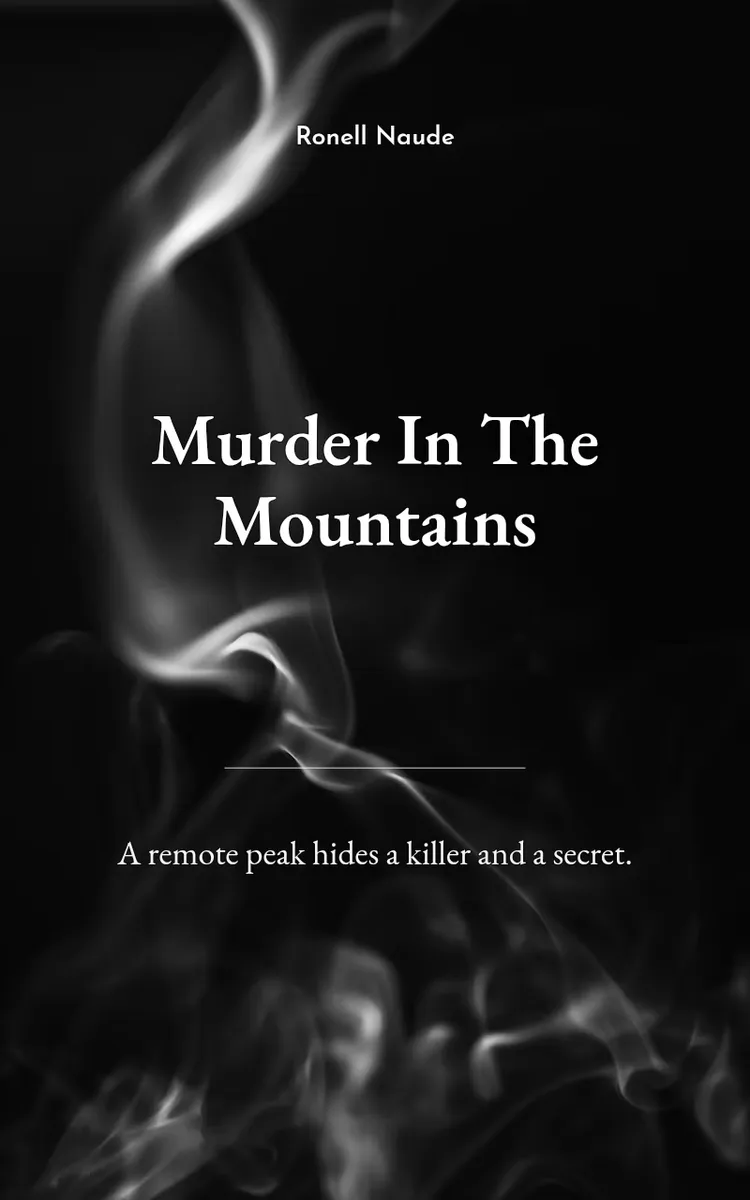
"Murder In The Mountains" is a fiction book by Ronell Naude with 15 chapters and approximately 32,208 words. A murder mystery set in a mountainous wilderness.
This book was created using Inkfluence AI, an AI-powered book generation platform that helps authors write, design, and publish complete books. It was made with the AI Novel Writer.
Frequently Asked Questions
What is "Murder In The Mountains" about?
A murder mystery set in a mountainous wilderness
How many chapters are in "Murder In The Mountains"?
The book contains 15 chapters and approximately 32,208 words. Topics covered include The Body in the Switchbacks, A Missing Map from Alder Ridge Lodge, The Stamped Route That Lies, Stormgate Cuts Off the Trail, and more.
Who wrote "Murder In The Mountains"?
This book was written by Ronell Naude and created using Inkfluence AI, an AI book generation platform that helps authors write, design, and publish books.
How can I create a similar fiction book?
You can create your own fiction book using Inkfluence AI. Describe your idea, choose your style, and the AI writes the full book for you. It's free to start.
Write your own fiction book with AI
Describe your idea and Inkfluence writes the whole thing. Free to start.
Start writingCreated with Inkfluence AI


