

Read the first chapter
The whole of chapter one, free. About 9 min. Turn the pages with the arrows, your keyboard, or a swipe.
Chapter 1
The Farm Jess Can’t Save
The auction notice was pinned beneath the kitchen clock, its corners lifting whenever the stove breathed heat into the room.
Jess McLellen reached for it, but Christine slapped her hand over the paper first.
“Don’t,” she said.
The clock ticked above them. Outside, a loose strip of tin knocked against the barn roof, again and again, like someone asking to be let in. Jess stood with his coat still on, mud drying along the cuffs. He had spent the morning walking the fields and finding more stones than green shoots.
“I need to look at it,” he said.
“You’ve looked at it all week.”
“I need to know the date.”
Christine’s fingers tightened on the notice. “Friday.”
Jess glanced toward the calendar. “That’s three days.”
“I can count.”
At the table, fourteen-year-old James stopped scratching his pencil across his schoolbook. Mary, ten, sat beside him with both hands wrapped around a cup of milk. She watched her parents without drinking.
Jess pulled out a chair and sat. The wood groaned beneath him. On the table lay the feed bill, the grocer’s account, and a letter from the bank folded twice along the same crease. He had kept the letter unopened for two days, though he knew what it said. A man did not need to read a foreclosure notice to understand the weight of it.
Christine lifted the auction paper and held it against her chest.
“They’ll take the team first,” Jess said. “Then the cultivator. If there’s anything left after that, they’ll put a price on the house.”
“Stop.”
“I’m telling you what’s coming.”
“You’re telling the children.”
James lowered his eyes. Mary set down her cup. A pale ring of milk remained on the table.
Jess looked at them and felt the words turn sour in his mouth. The children had heard enough already: the bank man’s boots on the porch, Christine whispering after dark, the silence that fell whenever a bill arrived.
“I’m sorry,” he said.
Christine’s face softened for only a moment. Then she turned toward the stove and lifted the lid. A thin flame trembled beneath the iron pot.
“There’s enough beans for supper,” she said. “Not enough for tomorrow.”
Jess rose. “I’ll go to Harlan’s.”
“Harlan won’t lend you more.”
“I’ll ask.”
“He already told you.”
Jess grabbed his cap from the peg. “Then I’ll ask someone else.”
“Who?”
He had no answer. The question struck harder than the bank letter. He stood with his hand on the door latch while the kitchen held its breath around him.
James spoke without looking up. “What about Alaska?”
Christine turned sharply. “James.”
“What about it?” Jess asked.
James pushed his schoolbook aside. “The notice at school. The New Deal is looking for farming families. They’re sending them to Palmer. Alaska.”
Mary’s eyes widened. “Is that where the gold is?”
“No,” James said. “It says land.”
Christine laughed once, but there was no humor in it. “Land. That’s what we need. As if land grows food by itself.”
James reached into his satchel and drew out a folded newspaper clipping. The edges were worn from being opened too often.
Jess took it. The print was small and crowded, but one line stood clear: two hundred three farming families would be chosen to relocate to Palmer, Alaska. Each family would receive a forty-acre plot of land to farm.
“Where did you get this?” Jess asked.
“Mr. Bell let me cut it out.”
“You’ve been carrying it around?”
James nodded. “I wanted to show you.”
Christine took the clipping from Jess. Her eyes moved across the words. She read the number twice.
“Alaska,” she said. “We don’t know anyone there.”
“We don’t know anyone here who can help us,” Jess answered.
The room went still.
Christine placed the clipping on the table as if it might stain the wood. “You mean to take us away from this farm?”
Jess looked past her to the window. Beyond the glass, the fields lay brown beneath a hard gray sky. The farmhouse needed shingles. The barn door leaned crooked on one hinge. Near the fence, the old apple tree had lost a limb during the last storm, and its broken end pointed toward the house.
“This farm is already being taken from us,” he said.
“That doesn’t make Alaska a home.”
“No. But forty acres could.”
“Forty acres of what?”
“Land.”
“Frozen land, perhaps. Wilderness. Bears. No church, no school, no neighbors.” Christine’s voice rose with each word. “You read one newspaper clipping and think we can carry our whole life across the country in a wagon?”
Jess folded the clipping along its old crease. “The notice says families will be helped.”
“The notice says what it needs to say to get desperate people to sign up.”
James leaned forward. “It says the government will provide transportation.”
“James, enough.”
“But if we lose the farm - ”
“Enough.”
Mary reached for her brother’s sleeve. He stopped.
Jess sat again. The chair felt smaller than it had before. He wanted something concrete, something he could put his hands on and trust: a paid bill, a full grain bin, a deed safe from the bank. Instead he had a newspaper clipping and a deadline.
Christine gathered the papers from the table and stacked them with care. “We stay,” she said.
“Stay and do what?”
“Work.”
“I’ve worked until my hands split.”
“So have I.”
“I know.”
Her eyes flashed. “Do you? You go out before dawn, and when the sun goes down you come in angry at the ground. I wash the mud from your clothes. I stretch flour. I keep the children from asking whether we’ll still be here next month. Don’t tell me you’re the only one working.”
Jess dropped his gaze. The stove popped. Mary flinched, and Christine reached behind her to touch the girl’s shoulder.
“I’m not saying that,” Jess said.
“You’re saying Alaska will fix us.”
“I’m saying this place won’t.”
For a moment, only the tin on the barn roof answered.
James picked up the clipping. “Could we apply and decide later?”
Christine looked at him. “It isn’t a library book.”
“We don’t have to go just because we apply.”
Jess turned toward his son. That was the first sensible thing anyone had said since the notice appeared.
Christine shook her head. “An application costs more than paper.”
“What does it cost?” Jess asked.
“Hope.”
The word settled between them.
Jess remembered the bank letter in his pocket. He took it out and laid it beside the clipping. The envelope had softened at the corners from being carried. He opened it with his thumb and placed the page on the table.
Christine read the first line. Her mouth tightened.
James looked away. Mary pressed closer to him.
“The payment is due Friday,” Jess said. “If I miss it, the auction goes forward.”
Christine’s eyes stayed on the letter. “How much?”
Jess named the amount.
She closed her eyes. “We don’t have it.”
“No.”
“Could you sell the cow?”
“She wouldn’t cover half.”
“The wagon?”
“We need it.”
“Then borrow.”
“From whom?”
She had no answer this time.
Jess reached for the application form. He had brought it home from the county office that afternoon, folded inside his coat. The paper was clean and stiff, unlike everything else in the kitchen. At the top, in dark type, were the words Palmer, Alaska.
He spread it flat.
Christine did not touch it. “You’ve already decided.”
“I’ve decided to apply.”
“That’s the same thing.”
“No. It gives us a chance.”
“It gives a stranger in an office the right to decide whether our family belongs somewhere we’ve never seen.”
“A stranger in a bank office is deciding whether we belong here.”
Christine stared at him. Her anger seemed to falter, leaving something more frightened beneath it.
Mary spoke softly. “Would we take our beds?”
Jess turned toward her. “I don’t know.”
“Our dishes?”
“I don’t know.”
“Would there be trees?”
“Probably.”
“Would there be snow?”
“More than here, I expect.”
Mary considered that. “Could we have a dog?”
Christine let out a tired breath. “Mary.”
The girl lowered her head, but James smiled faintly.
Jess took up the pen. The nib scratched when he tested it on the margin. His hand shook once, then steadied.
Christine caught his wrist.
“If you sign,” she said, “you cannot pretend this is only a piece of paper.”
“I know.”
“You cannot promise the children a better life.”
“I won’t.”
“You cannot promise me I’ll like it.”
“No.”
Her grip loosened, but she did not let go. “Then what can you promise?”
Jess looked at the farm through the window. The fields were poor, but he knew every rise and furrow. He knew where spring water gathered and where the soil turned black beneath the weeds. Leaving felt like tearing out a root with his bare hands.
“I can promise I’ll try to keep us together,” he said.
Christine’s eyes shone. She looked toward James and Mary, then at the bank letter.
“Fill it out,” she said.
Jess bent over the form.
His name came first: Jess McLellen. He wrote Christine beneath it, then James, age fourteen, and Mary, age ten. The ink pooled at the end of each letter. When he reached the line asking why the family wished to relocate, he stopped.
The truth would not fit neatly in the space provided.
He wrote, “To farm and provide for my family.”
Christine watched the words appear. “That sounds respectable.”
“It’s true.”
“Not all of it.”
“No.”
He signed at the bottom. Then he pushed the form toward her.
Christine did not pick up the pen.
Jess waited.
At last she sat beside him. Her shoulder touched his. The warmth of it steadied him more than any promise on the page.
“If we go,” she said, “we go together.”
“That’s the plan.”
“And if the land is no good?”
“We’ll find out.”
“If they put us in a tent?”
Jess looked again at the line about Palmer. “Then we’ll live in a tent until we can build something better.”
Christine gave him a sharp look. “You say that as if it will be simple.”
“I don’t think it will be simple.”
She took the pen.
Her signature came slowly, each letter pressed deep into the paper. When she finished, she left the pen on the table and folded her hands in her lap.
James leaned over to see. Mary rose on her knees.
“Does that mean we’re going?” James asked.
Jess folded the application, careful not to crease the signatures.
“It means we’ve applied.”
Christine looked at him. “And if they choose us?”
The question carried the whole house inside it - the stove, the beds, the worn table, the fields beyond the window, the years they had spent making a life from stubborn soil.
Jess placed the application inside his coat.
“Then we’ll decide,” he said.
But even as he spoke, he knew the decision had already begun. The farm remained beneath the gray Michigan sky, and the bank letter still waited on the table. Yet in his pocket, beside the notice of all they might lose, lay a signed promise of forty acres in a place none of them had seen.
Christine rose to clear the cups. Her hand paused on Mary’s empty one.
“Alaska,” she whispered, as though testing the word for weight.
Outside, the tin struck the barn roof again.
This time, Jess heard it as a warning.
End of chapter one. 39 more chapters in the full book.
Swipe or use the arrows to turn the page


What's inside: 40 chapters
- 1. The Farm Jess Can’t Save
- 2. Christine’s Refusal, Then Agreement
- 3. James Reads the Palmer Notice
- 4. The Letter That Changes Everything
- 5. Packing a Life into a Tent
- 6. The Train North With No Turning Back
- 7. Asking Where the 40 Acres Begin
- 8. First Sight of the Tent City
- 9. Jess Builds a Home From Canvas
- 10. The First Seed Order Goes Missing
- 11. Christine Finds a Neighbor’s Kindness
- 12. James Learns the Alaska Soil Truth
- 13. A Spring Storm Tears the Tent
- 14. Christine’s Anger Finds a Target
- 15. Mary Gets Sick, Then Holds On
- 16. The First Harvest That Isn’t Enough
- 17. James Joins the Work Parties
- 18. Winter Locks the Tent City Tight
- 19. Spring Plans for the Second Year
- 20. A Rumor of Measles Spreads
- 21. Christine Refuses to Let Mary Wander
- 22. Mary’s Fever Breaks the Family
- 23. Christine’s Grief Turns to Rage
- 24. James Buries Mary in Palmer Soil
- 25. The Winter After Loss Hits Hard
- 26. Christine Finally Breaks the Silence
- 27. A Seed Trade That Saves Next Spring
- 28. James Learns to Share His Burden
- 29. Christine’s Hands Return to the Furrows
- 30. The Frost Kills the New Growth
- 31. Asking the Clinic for Better Answers
- 32. Fuel Runs Out Before the Next Planting
- 33. Christine Chooses Hope Over Anger
- 34. A Message About Land Rights
- 35. The Third-Year Crop Takes Hold
- 36. A Family That Doesn’t Break
- 37. Leaving the Tent Behind, Slowly
- 38. James Writes Mary’s Name Forward
- 39. The Colony Remembers Their Work
- 40. Descendants Still Farm Palmer
About this book
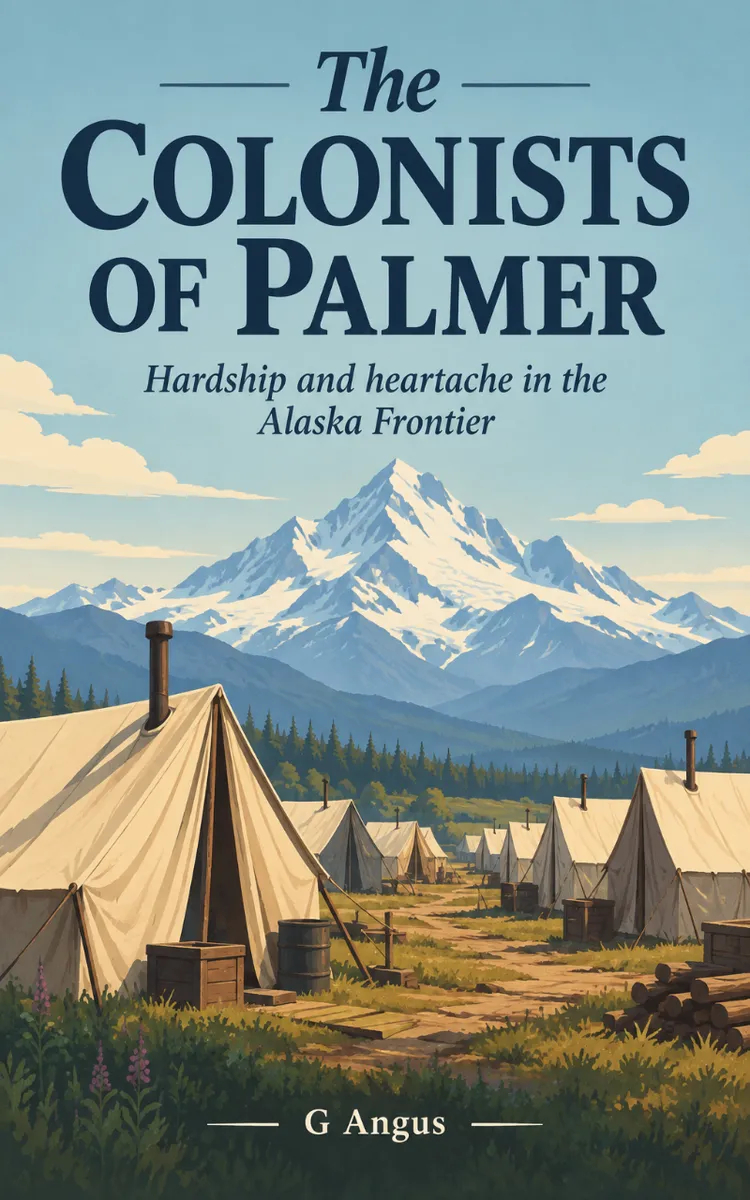
"The Colonists Of Palmer" is a fiction book by G Angus with 40 chapters and approximately 91,274 words. A Michigan family relocates to Palmer, Alaska in 1937.
This book was created using Inkfluence AI, an AI-powered book generation platform that helps authors write, design, and publish complete books. It was made with the AI Novel Writer.
Frequently Asked Questions
What is "The Colonists Of Palmer" about?
A Michigan family relocates to Palmer, Alaska in 1937
How many chapters are in "The Colonists Of Palmer"?
The book contains 40 chapters and approximately 91,274 words. Topics covered include The Farm Jess Can’t Save, Christine’s Refusal, Then Agreement, James Reads the Palmer Notice, The Letter That Changes Everything, and more.
Who wrote "The Colonists Of Palmer"?
This book was written by G Angus and created using Inkfluence AI, an AI book generation platform that helps authors write, design, and publish books.
How can I create a similar fiction book?
You can create your own fiction book using Inkfluence AI. Describe your idea, choose your style, and the AI writes the full book for you. It's free to start.
Write your own fiction book with AI
Describe your idea and Inkfluence writes the whole thing. Free to start.
Start writingCreated with Inkfluence AI


