

Read the first chapter
The whole of chapter one, free. About 6 min. Turn the pages with the arrows, your keyboard, or a swipe.
Chapter 1
Separate Your Worth from Workplace Power
When Approval Becomes the Weather
At 9:14 on Monday morning, your manager walks past without saying hello. By 9:20, you’re rereading Friday’s email, wondering whether the short reply meant you missed something. At 10:05, they praise someone else’s contribution in a meeting, and your shoulders tighten before you’ve even spoken.
Nothing concrete has happened. Still, your focus is gone. You’re monitoring a face, a tone, a delayed response. Your workday has quietly become a search for evidence that you’re safe, valued, and still in good standing.
That’s exhausting - and it gives someone else’s shifting mood far too much control over your sense of self.
Your manager’s opinion can affect your work, but it does not get to define your worth.
The Shift from Borrowed Worth to Inner Ground
Old Belief: If my manager approves of me, I’m doing well. If their opinion changes, something must be wrong with me.
New Reality: Feedback is information about my work in a specific moment. It is not a final verdict on my ability, character, or value.
This shift matters because workplace power can make ordinary reactions feel like personal judgments. A manager controls assignments, reviews, access, and sometimes your next opportunity. Your nervous system notices that imbalance. It starts treating their approval like a form of protection.
But approval is unstable. A manager may be distracted, under pressure, inconsistent, or simply poor at communicating. Their praise can be generous on Tuesday and absent on Thursday. If your identity rises and falls with those changes, you’ll spend more energy reading the room than doing your job.
The Inner Anchor Model gives you somewhere steadier to stand. It has three parts: your values, your evidence, and your chosen response. Your values answer, “How do I want to work?” Your evidence answers, “What do I actually know?” Your chosen response answers, “What will I do next, regardless of the emotional weather?”
Suppose your manager says, “This needs more thought,” in front of your team. The old pattern turns that sentence into, “I’m not respected. I’m failing.” The Inner Anchor pauses. Your values might be care and accuracy. Your evidence might be that the draft met the brief but needed clearer financial detail. Your response could be, “I’ll ask which section needs more depth and confirm the deadline.”
You haven’t ignored the feedback. You’ve refused to turn one comment into an identity crisis.
Recognising When Their Opinion Has Moved Inside Your Head
A grounded sense of self doesn’t mean you stop caring about your work or become impossible to influence. It means you can receive input without handing over the steering wheel.
The pattern usually shows up in small, familiar ways. You may notice it before you have language for it. Watch for these signs:
1. You replay neutral interactions for hours. A brief message such as “Please revise this” becomes a detailed investigation into your standing. You search punctuation for clues because uncertainty feels harder to tolerate than criticism.
2. You change your position before anyone asks you to. You soften a sound recommendation, agree with a weak plan, or stay silent in a meeting because disagreement feels like danger rather than professional judgment.
3. You treat praise as proof and silence as rejection. A compliment lifts you for the day. A missed acknowledgment drops you just as quickly. Your confidence depends on signals you don’t control.
4. You can list your manager’s reactions more easily than your own standards. You know what earns a smile, a quick reply, or public approval. You’re less clear about the quality of work you want to be known for.
The Inner Anchor Model puts your identity back in your hands.
Start with your values, check the evidence, and choose a response that matches the professional you want to be - not the mood your manager happens to be carrying.
Think of a tradesperson whose supervisor suddenly starts checking every detail. The old belief says, “They must think I’m incompetent.” The Inner Anchor asks different questions: Have the requirements changed? Is there a real error to correct? What standard do I want my work to meet? That person can accept a useful correction while calmly asking for clear expectations.
This is not about pretending power differences don’t exist. Your manager’s decisions may have real consequences. The point is to respond strategically instead of emotionally outsourcing your identity. You can protect your position without shrinking yourself to keep someone pleased.
Questions That Return You to Yourself
1. What do I believe my manager’s approval proves about me? Maybe it seems to prove that you’re competent, secure, or deserving of opportunity. Name the connection clearly; once it’s visible, you can question whether one person should carry that much authority over your identity.
2. Which values do I want my work to show, even when nobody praises it? Choose two or three, such as reliability, honesty, precision, or courage. A grounded sense of self grows when your daily choices match those values without requiring an audience.
3. What is the actual evidence behind my fear right now? Separate facts from interpretation. “My manager hasn’t replied since yesterday” is evidence. “They’ve decided I’m useless” is a conclusion, not a fact.
4. Where have I agreed too quickly because I wanted to stay in good standing? Look for a recent meeting, email, or handover. An honest answer might be, “I accepted an impossible deadline instead of explaining what would need to move.”
5. What would I say if I trusted my work could be reviewed without my whole identity being reviewed? You might ask, “Which outcome matters most here?” or say, “I can complete that by Friday, or I can deliver a partial version tomorrow. Which is more useful?”
These questions aren’t designed to make you fearless. They help you become accurate. Accuracy is powerful when your mind has started filling gaps with rejection.
The Seven-Day Inner Anchor Practice
Challenge: Seven Days of Evidence Before Interpretation
For the next seven days, keep a small note on your phone or a sheet beside your keyboard. Each time your manager’s tone, silence, praise, or criticism affects your self-worth, pause and record three lines:
• What happened: Write only what a camera could capture. - What I told myself it meant: Name the story, even if it sounds dramatic. - My anchored response: Identify the relevant value, the available evidence, and your next professional action.
Then complete one small act that reflects your own standard. Send the clear follow-up. Ask for the missing detail. Keep your reasonable boundary. Finish the task carefully, even if nobody comments on it.
Expected difficulty: Medium
You’ll know it’s working when:
• You recover your focus faster after a tense interaction. - You ask for clarification instead of guessing what your manager thinks. - You can receive correction without adding a personal insult to it. - You make at least one work decision based on your values rather than approval. - Your notes contain more observable facts and fewer predictions about rejection.
The practice may feel awkward at first. You’re interrupting a well-rehearsed habit: scanning upward for permission to feel okay. Give the pause enough time to work. A few steady seconds can stop a passing mood from becoming your entire day.
Stand on What Is Yours
Your worth is not a performance review, a manager’s mood, or a place on the organisational chart.
You’ve learned to:
• Separate useful feedback from the story that you are fundamentally failing. - Use the Inner Anchor Model: values, evidence, and chosen response. - Notice when approval has become the measure of your identity. - Build steadiness through seven days of recording facts before interpretation.
You can care about your reputation without constantly managing someone else’s emotions. You can respect authority without making authority your mirror. And you can respond to a manager’s changing opinion with clear judgment instead of a changing sense of self.
That inner steadiness gives you a stronger starting point for everything that follows: protecting your energy, speaking plainly, and standing your ground without becoming hardened by the storm.
End of chapter one. 9 more chapters and about 14,880 words in the full book.
Swipe or use the arrows to turn the page

What's inside: 10 chapters
- 1. Separate Your Worth from Workplace Power
- 2. Stop Absorbing Other People’s Emotions
- 3. Read Difficult Behavior Without Taking It Personally
- 4. Define the Boundary Before You Need It
- 5. Say No Without Overexplaining
- 6. Call Out Behavior with Calm Precision
- 7. Hold Your Ground in Unequal Power Dynamics
- 8. Stay Steady When Conflict Escalates
- 9. Protect Your Energy Across the Workday
- 10. Build a Career That Honors Your Limits
About this book
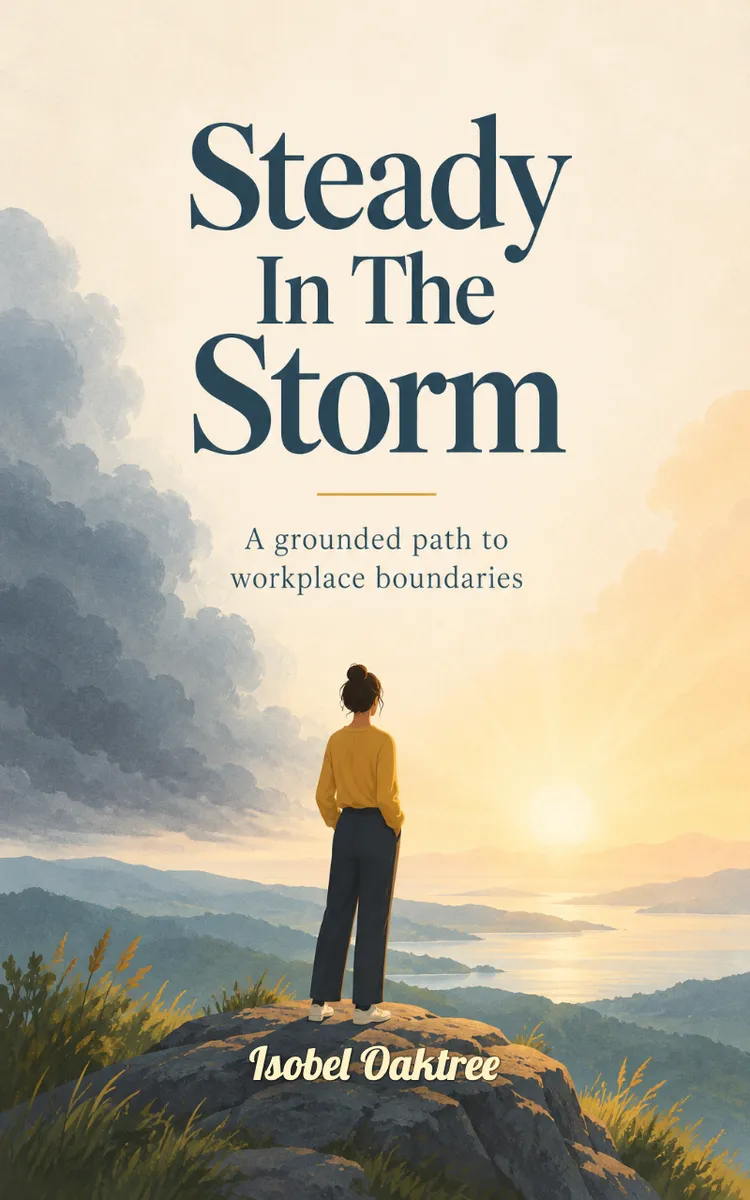
"Steady In The Storm" is a self-help book by Isobel Oaktree with 10 chapters and approximately 14,880 words. Setting workplace boundaries and staying composed around difficult personalities and power imbalances.
This book was created using Inkfluence AI, an AI-powered book generation platform that helps authors write, design, and publish complete books. It was made with the AI Self-Help Book Writer.
Frequently Asked Questions
What is "Steady In The Storm" about?
Setting workplace boundaries and staying composed around difficult personalities and power imbalances
How many chapters are in "Steady In The Storm"?
The book contains 10 chapters and approximately 14,880 words. Topics covered include Separate Your Worth from Workplace Power, Stop Absorbing Other People’s Emotions, Read Difficult Behavior Without Taking It Personally, Define the Boundary Before You Need It, and more.
Who wrote "Steady In The Storm"?
This book was written by Isobel Oaktree and created using Inkfluence AI, an AI book generation platform that helps authors write, design, and publish books.
How can I create a similar self-help book?
You can create your own self-help book using Inkfluence AI. Describe your idea, choose your style, and the AI writes the full book for you. It's free to start.
Write your own self-help book with AI
Describe your idea and Inkfluence writes the whole thing. Free to start.
Start writingCreated with Inkfluence AI


