

Read the first chapter
The whole of chapter one, free. About 7 min. Turn the pages with the arrows, your keyboard, or a swipe.
Chapter 1
Choosing Glasses for Short Cocktails
Why the Short-Serve Glass Match Matters
A guest orders an Old Fashioned, and the bartender reaches for a tall glass. The drink still contains whiskey, bitters, sugar, and ice, but the large empty space makes the small serving look lost. A rocks glass would give the drink the right depth, keep the ice close, and make each sip feel balanced. Choosing the correct glass changes more than appearance: it affects temperature, aroma, dilution, and how easily the guest drinks.
Short cocktails usually fall into two serving groups. A rocks glass handles neat spirits, drinks served over ice, and muddled cocktails. A coupe handles chilled drinks served without ice, often called “up” drinks. The difference rests on the drink’s final condition. Ask yourself: Should the guest see and use ice, or should the drink arrive cold but clear of ice?
The Short-Serve Glass Match gives you a simple way to decide. By the end, you will know how to select the glass, prepare it, transfer the drink without losing its temperature, and check whether the final serve looks and drinks correctly. You will also understand why a Negroni belongs in a rocks glass while a Manhattan belongs in a coupe.
The Short-Serve Glass Match
Start by identifying the drink’s service style rather than its name. A recipe may contain similar spirits and still need a different glass because the finishing method changes. Use the following three-part match:
• Choose a rocks glass for ice or muddling.
A rocks glass, also called an Old Fashioned or lowball glass, has a short, wide body and a stable base. Use it when the drink stays over ice, when the recipe includes muddled ingredients, or when you serve a spirit neat. Its broad opening gives the guest access to the aroma, while its heavy base supports large cubes and muddled fruit.
• Choose a coupe for a chilled drink without ice.
A coupe has a stem and a rounded bowl. Shake or stir the drink with ice, strain that ice out, and serve the cold liquid in the coupe. The stem lets the guest hold the glass without warming the drink with a palm around the bowl.
• Match the glass size to the finished volume.
A short drink should not disappear in a large bowl. For a drink that finishes around 3 ounces, use a rocks glass that leaves room for ice or a coupe that holds the liquid without a wide, empty gap. The correct size keeps the drink looking intentional and helps preserve its temperature.
Use a rocks glass for an Old Fashioned, Negroni, and Whiskey Sour when the recipe calls for ice. Build an Old Fashioned over one large cube so the drink cools slowly and dilutes steadily. Serve a Negroni over fresh ice because the drink needs the cube to remain cold as the guest sips. Serve a Whiskey Sour in a rocks glass when you want to show its foam and provide room for fresh ice.
Muddled cocktails also need the sturdy shape of a rocks glass. A muddled drink contains ingredients pressed directly in the serving glass, such as sugar, citrus, mint, or fruit. The thick base gives you a firm surface for the muddler, and the wide opening gives you room to add ice without crushing the garnish against the rim. Muddle gently enough to release juice and aroma without shredding mint or forcing bitter oils from citrus peel.
Use a coupe for a Manhattan or Daiquiri served up. Stir a Manhattan with ice until chilled, then strain it into a cold coupe. Shake a Daiquiri with ice, strain it, and serve it without ice. The stem keeps warm fingers away from the bowl, while the rounded shape supports the drink’s aroma. A Gibson, sometimes spelled Gillette in older recipe references, also suits a coupe when you serve it chilled and strained.
A practical check helps when a recipe gives no glass instruction: look at the final ice. If the drink reaches the guest with ice, choose the rocks glass. If you remove the ice before serving, choose the coupe. If you muddle in the serving glass, choose the rocks glass unless the recipe specifically directs another vessel. The glass follows the drink’s service, not the bartender’s habit.
Applying the Match at the Bar
Consider a service order for a Negroni and a Daiquiri. The Negroni needs ice in the final glass; the Daiquiri needs chilling but no ice at service. Follow these steps:
• Prepare the glasses.
Place one rocks glass and one coupe on a clean bar mat. Fill the rocks glass with ice for 30 seconds, then discard the meltwater. Chill the coupe with ice and water, or place it in a refrigerator for several minutes. The cold glass slows warming after you finish the drink.
• Build the Negroni.
Add 1 ounce gin, 1 ounce sweet vermouth, and 1 ounce bitter aperitif to a mixing glass with ice. Stir for about 20 seconds. Stirring chills and dilutes the drink without adding air. Strain it over one fresh large cube in the rocks glass. Add an expressed orange peel; squeeze the peel over the surface to release its oils, then place it on the rim or in the drink.
• Prepare the Daiquiri.
Add 2 ounces white rum, 1 ounce fresh lime juice, and ¾ ounce simple syrup to a shaker with ice. Shake firmly for 10-12 seconds. Shaking chills the drink, blends the ingredients, and adds a small amount of dilution. Empty the temporary ice from the coupe, then double-strain the drink into the glass to remove small ice chips and pulp.
• Check the finished serves.
The Negroni should sit low in the rocks glass with the cube visible and the orange aroma noticeable. The Daiquiri should fill the lower part of the coupe without ice floating on top. Both drinks should feel cold when you touch the stem or base, not warm around the bowl.
• Serve promptly.
Deliver the Negroni before the large cube melts too far and the Daiquiri before the chilled coupe loses its edge. A correctly matched glass cannot prevent a long delay from warming or diluting the drink.
Quick checklist
• Is the drink served with ice? Use a rocks glass.
• Did you muddle ingredients in the serving vessel? Use a rocks glass.
• Is the drink chilled, strained, and served without ice? Use a coupe.
• Does the glass fit the final volume without excessive empty space?
• Did you chill the glass before pouring?
• Did you add fresh service ice instead of reusing shaker ice?
• Does the garnish support the drink’s aroma and style?
• Can the guest hold the glass without warming the liquid?
The expected result is easy to judge: the rocks drink stays cold over its fresh cube, and the coupe drink arrives cold, clear, and free of loose ice. If either drink looks diluted, warm, or undersized, check the glass choice and the preparation sequence before changing the recipe.
Mistakes That Change the Serve
Using a coupe for a drink that needs ice
A coupe may look elegant, but it cannot replace the function of a rocks glass when the recipe depends on a large cube. A Negroni served in a coupe warms more quickly and loses the slow dilution that shapes each sip. The guest also has no stable ice to keep the drink cold.
Do this: Stir the Negroni with ice, then strain it over one fresh large cube in a rocks glass.
Not this: Strain it into a coupe simply because the drink contains no juice.
Pouring a shaken drink into a warm coupe
A warm coupe pulls heat into a drink immediately. A Daiquiri may leave the shaker cold but arrive merely cool if the glass sat at room temperature during preparation.
Do this: Chill the coupe with ice and water while you measure and shake, then empty it just before straining.
Not this: Leave the empty coupe on the bar and expect the shaker to keep the drink cold.
Overfilling a rocks glass
A rocks glass needs room for ice, garnish, and comfortable sipping. Filling it to the rim with liquid and small cubes makes the drink splash, warms the guest’s hand against the bowl, and speeds dilution.
Do this: Pour the drink first, then add one large cube or enough fresh ice to leave a small gap below the rim.
Not this: Pack the glass with crushed ice when the recipe calls for one large cube.
Muddling too aggressively
Hard muddling can tear mint, pulverize fruit seeds, and pull harsh bitterness from citrus peel. The rocks glass gives you a firm base, but that does not mean you need force.
Do this: Press and twist gently until the ingredients release their juice and aroma.
Not this: Pound repeatedly until the herbs turn dark and the fruit becomes a pulp.
A rocks glass keeps ice, strength, and muddled ingredients under control. A coupe protects the cold, clear finish of a drink served up. Match the glass to what the guest receives, and short cocktails will arrive with the temperature, aroma, and balance the recipe intended. That decision forms the foundation for every other glass choice behind the bar.
End of chapter one. 5 more chapters in the full book.
Swipe or use the arrows to turn the page

Tonic And Twist Bartending Exam

Tonic And Twist Bartending School: Final Exam

Tonic And Twist Bartending School
What's inside: 6 chapters
- 1. Choosing Glasses for Short Cocktails
- 2. Serving Tall, Refreshing Drinks
- 3. Specialty Glasses for Cocktails and Spirits
- 4. Matching Beer Styles to Glassware
- 5. Chapter 6
- 6. Selecting Glasses for Red and White Wine
About this book
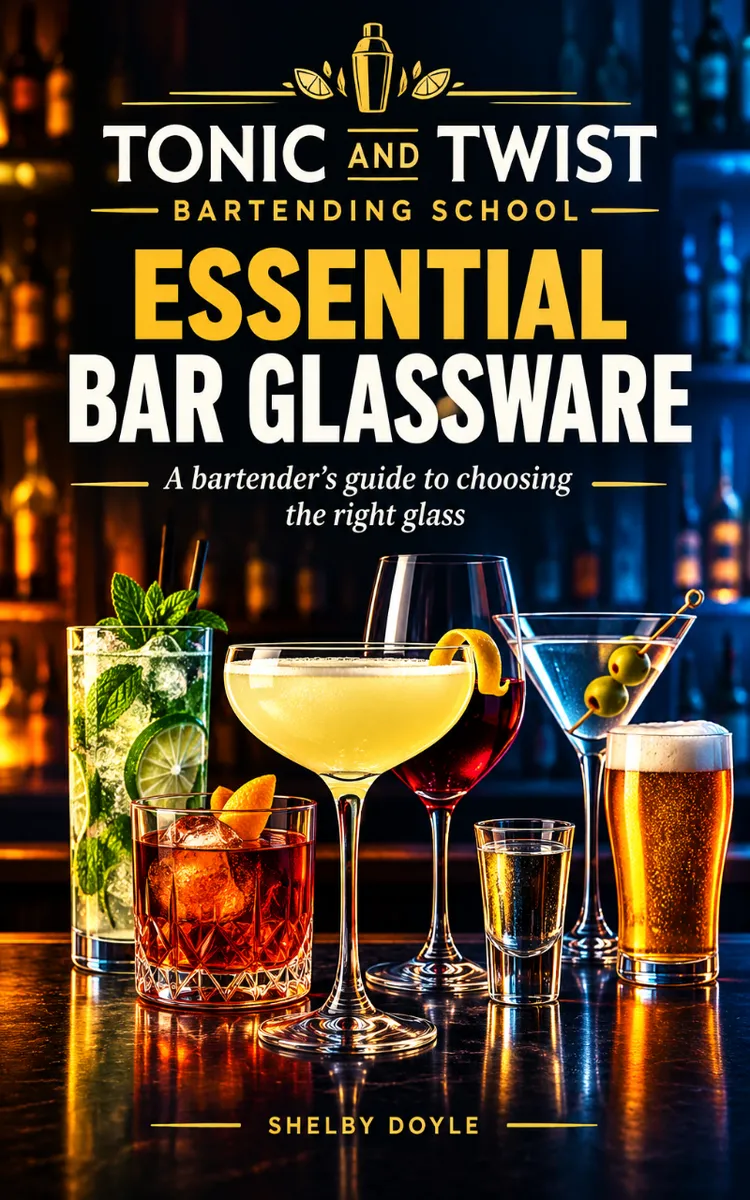
"Essential Bar Glassware" is a how-to guide book by Shelby Doyle with 6 chapters and approximately 8,142 words. Bar, beer, and wine glass types, their features, and best uses.
This book was created using Inkfluence AI, an AI-powered book generation platform that helps authors write, design, and publish complete books. It was made with the AI Ebook Generator.
Frequently Asked Questions
What is "Essential Bar Glassware" about?
Bar, beer, and wine glass types, their features, and best uses
How many chapters are in "Essential Bar Glassware"?
The book contains 6 chapters and approximately 8,142 words. Topics covered include Choosing Glasses for Short Cocktails, Serving Tall, Refreshing Drinks, Specialty Glasses for Cocktails and Spirits, Matching Beer Styles to Glassware, and more.
Who wrote "Essential Bar Glassware"?
This book was written by Shelby Doyle and created using Inkfluence AI, an AI book generation platform that helps authors write, design, and publish books.
How can I create a similar how-to guide book?
You can create your own how-to guide book using Inkfluence AI. Describe your idea, choose your style, and the AI writes the full book for you. It's free to start.
Write your own how-to guide book with AI
Describe your idea and Inkfluence writes the whole thing. Free to start.
Start writingCreated with Inkfluence AI


