

Read the first chapter
The whole of chapter one, free. About 9 min. Turn the pages with the arrows, your keyboard, or a swipe.
Chapter 1
The Price Tag on a Vote
When a Donation Becomes a Door
In 2010, Citizens United v. Federal Election Commission transformed the legal landscape of American elections by allowing corporations and unions to spend independently to influence campaigns. The ruling did not permit companies to hand out unlimited checks directly to candidates, but it helped create a political marketplace in which wealthy interests could spend vast sums shaping the choices placed before voters.
That distinction matters. A voter may still cast the final ballot, yet the menu of candidates, messages, and issues has often been filtered long before Election Day. Campaign money does not simply buy advertisements. It helps determine who can afford to run, who receives serious attention, who gains access to decisionmakers, and whose concerns remain outside the room.
The central mystery is not whether wealthy donors control every vote. It is how private money can influence public choice without ever appearing on the ballot.
When voters choose among candidates, who chooses the choices?
The Ladder from Check to Access
Campaign finance is often described as a contest of spending. That description is accurate but incomplete. Money enters politics through a chain of conversions: private wealth becomes a donation; a donation becomes visibility, visibility becomes credibility, and credibility can become access. The Access-for-Cash Ladder names this progression.
At the first rung, money pays for the basic machinery of a campaign: staff, offices, travel, legal advice, polling, digital systems, and advertising. A candidate without those resources may possess experience or popular ideas but remain nearly invisible. A candidate with them can introduce a name to millions of voters before opponents have raised enough to respond.
The second rung is attention. Donors do not merely fund messages; they help determine which messages circulate. A television advertisement can make a candidate appear familiar. A well-targeted online campaign can place a carefully worded issue in front of selected groups. Fundraising itself also creates news. A candidate who reports a large haul is treated as viable, and viability attracts more donors, endorsements, staff, and coverage.
The third rung is access. Large donors may receive invitations to private receptions, policy briefings, small-group meetings, or calls with elected officials. None of these exchanges necessarily involve corruption. A business owner explaining how a proposed regulation affects payroll may be offering useful information. The imbalance appears when hundreds of such conversations are available to wealthy contributors while ordinary constituents struggle to obtain a reply.
At the top of the ladder sits influence over political survival. Officials know which networks helped elect them, and which donors may support a future campaign. They also know that a well-funded challenger can turn an ordinary disagreement into an expensive fight. Money does not need to dictate every vote to shape the boundaries of acceptable behavior.
A campaign contribution is therefore less like purchasing a single product than buying a place near the counter where products are discussed.
The ladder operates before voters make their final decision. By then, the most important financial choices may already have been made which candidates can hire experienced organizers, which campaigns can withstand attacks, and which voices are introduced as serious alternatives.
From Party Machines to Super PACs
The political use of money is not new. In nineteenth-century American cities, party organizations exchanged jobs, contracts, and services for loyalty. Political machines such as Tammany Hall (Formed in 1786 also known as the Society of St. Tammany or the Columbian Order was a powerful American political organization that serves as he main local machine of the Democratic Party in New York City and New York State for nearly a century and half) built durable networks by connecting public resources to private relationships. The methods were often crude, but the underlying principle was familiar: access flowed through organized money and influence.
Reformers later sought to weaken these arrangements through civil-service rules, disclosure requirements, primary elections, and limits on corporate contributions. The reforms did not remove wealth from politics. They changed their routes. As parties became more professional and campaigns more dependent on media, fundraising became central to political organizations.
The modern campaign is an expensive technical operation. Candidates need compliance lawyers to interpret election rules, consultants to shape messages, data firms to identify likely supporters, and fundraisers to maintain a steady stream of contributions. A person with no political network may be legally free to run but practically unable to compete.
The ballot is public; the audition for the ballot is often private.
That audition has expanded beyond traditional campaign committees. Political action committees, or PACs, allow groups to raise and spend money for political purposes under specific legal rules. Super PACs, created after court decisions including Citizens United and SpeechNow.org v. FEC, may raise unlimited sums from individuals, corporations, unions, and other groups for independent political spending, so long as they do not coordinate directly with candidates.
The legal separation between campaigns and outside groups can look tidy on paper. In practice, people move between campaigns, consulting firms, advocacy organizations, and donor networks. A former campaign official may understand a candidate’s strategy, preferred language, and target voters, even when formal coordination is prohibited. The result is a system in which money can travel through several organizations while maintaining a common political purpose.
History is less a story of money entering politics than of money learning to move around barriers.
The Candidate Market
A political campaign resembles a business in one important respect: it must attract investment before it can demonstrate success. Yet the investors are not neutral. They often seek candidates whose positions already fit their interests, or whose ambitions suggest that access will become valuable later.
This creates a market for candidates. Donors look for people who can win, but also for people who understand their concerns, share their priorities, or belong to networks where relationships can be maintained. Candidates, meanwhile, learn to present themselves in ways that appeal to financial supporters without alienating the broader electorate.
The pressure is especially strong in early stages, when a candidate must prove viability. A campaign that raises money quickly can hire staff and gain coverage. A campaign that raises slowly may be judged unsuccessful before most voters have heard its ideas. Fundraising becomes a test that candidates must pass before they are treated as legitimate contenders.
That test favors people who already possess connections. A sitting officeholder, prominent lawyer, business executive, or well-connected activist may have access to donors who can provide the first wave of money. Someone from a less affluent community may have deep local knowledge but no invitation to the rooms where large checks are discussed.
The effect is not always ideological. Wealth can narrow the field even when donors disagree with one another. Candidates who cannot raise enough money may disappear, while those who are skilled at fundraising remain. Voters then encounter a smaller and more polished set of options, giving the appearance of free choice within a field shaped by financial selection.
Campaigns also change their language according to the audience. A candidate may speak about wages, housing, or public services at a rally, then discuss regulation, tax policy, or procurement with donors in a private setting. These positions need not directly contradict one another. The difference lies in which problems receive detail, urgency, and sustained attention.
The Access-for-Cash Ladder thus reaches beyond contributions. It influences which candidates are considered credible, which subjects receive expert treatment, and which relationships become politically durable.
The Counterintuitive Power of Small Donors
The surprising fact is that large donors do not always need to purchase a candidate’s explicit loyalty. Their greater power may come from helping create the conditions under which certain candidates are possible at all.
That reframes from the usual question. Instead of asking whether a donor received a specific favor, it is often more revealing to ask which candidates could build a campaign, survive scrutiny, and reach voters because a donor network supported them. Influence can operate through selection long before it appears as a policy decision.
Small-donor fundraising complicates this picture. Digital platforms have allowed campaigns to collect modest contributions from large numbers of people, sometimes producing substantial totals without dependence on a handful of wealthy backers. Small donors can signal broad enthusiasm and give candidates room to challenge established party preferences.
Yet small-dollar systems do not automatically erase inequality. Online fundraising requires compelling messages, constant communication, and professional digital operations. Campaigns still need early money to hire the people who build those systems. A movement may become broad only after a narrow group of early supporters makes it visible.
The paradox is that democratic energy can be genuine while the path to visibility remains unequal. A candidate may eventually attract thousands of ordinary contributors, but the first doors may have opened through wealthy individuals, party networks, or established institutions.
The Donor Who Became a Political Geography
The 2012 presidential race offered a clear view of how private wealth could shape public choice. Mitt Romney had spent years building a national political network and fundraising operation before becoming the Republican nominee. His campaign competed within a system where major donors, party organizations, business networks, and outside groups all helped determine which candidates could sustain a national contest.
Romney’s rival Newt Gingrich demonstrated another feature of the system. The super PAC supporting Gingrich received major financial backing from casino owner Sheldon Adelson and his wife, Miriam. That support helped keep Gingrich’s campaign politically viable after his own fundraising and campaign organization had weakened. The money did not guarantee victory, but it extended his presence in the race and kept his message before voters.
The episode made visible in a process that usually remains hidden. A donor’s decision could affect not only advertising levels but the length of a candidate’s candidacy. By extending a campaign, outside spending gave voters more time to encounter one contender and more opportunity for that contender to shape the debate.
The same pattern appears at local and state levels, where a single wealthy donor can matter even more because the political arena is smaller. A contribution that would be one entry among many in a national contest may dominate a mayoral, legislative, or judicial race. Candidates who lack comparable backing may find themselves unable to answer attacks or communicate with voters.
A donation therefore changes political geography. It determines which names appear on screens, which voices of travel across a district, and which candidates remain present long enough to be judged.
The Quiet Redesign of Choice
Democracy is commonly pictured as a moment in a polling place: a citizen reads a list of names and marks one. Campaign finance reveals the much longer process behind that moment. Political choice is shaped in donor meetings, fundraising calls, party gatherings, consulting offices, and advertising markets months or years before a ballot is printed.
This does not mean voters are puppets, or that every election outcome is purchased. Voters reject heavily funded candidates; grassroots campaigns sometimes overcome established networks, and donors often disagree about what money can accomplish. But the unequal distribution of political resources still changes the contest. It gives some candidates repeated chances to speak while others struggle to be heard once.
Human beings naturally treat familiarity as information. A candidate seen repeatedly can feel more credible, even when the repetition was purchased rather than earned through public service. The campaign system turns financial capacity into a kind of political presence, and presence can be mistaken for public support.
Private wealth does not need to abolish elections to weaken democracy. It only needs to influence who stands before the electorate, which arguments receive amplification, and which relationships become routine. The ballot remains in the voter’s hand, but the path leading to that ballot may have been paved by people who could afford to build it.
A democracy can preserve the ritual of choice while narrowing the range of choices that seem possible. The unsettling question is not whether money is spoken. It is why, in a system built on equal votes, some voices are given to the microphone long before the public is invited to listen.
End of chapter one. 11 more chapters and about 17,261 words in the full book.
Swipe or use the arrows to turn the page


What's inside: 12 chapters
- 1. The Price Tag on a Vote
- 2. Lobbyists Write the Fine Print
- 3. When Newsrooms Depend on Billionaires
- 4. The Revolving Door Keeps Spinning
- 5. Tax Havens, Empty Treasuries
- 6. The Courts That Money Can Reach
- 7. Why Inequality Breeds Political Silence
- 8. Holding the Line: Practical Steps to Rebuild Influence
- 9. Democracy’s Wealth-Breaking Tools
- 10. The Rules Beneath the Rules
- 11. The Power of the Exception
- 12. Chapter 12 Reclaim The Republic
About this book
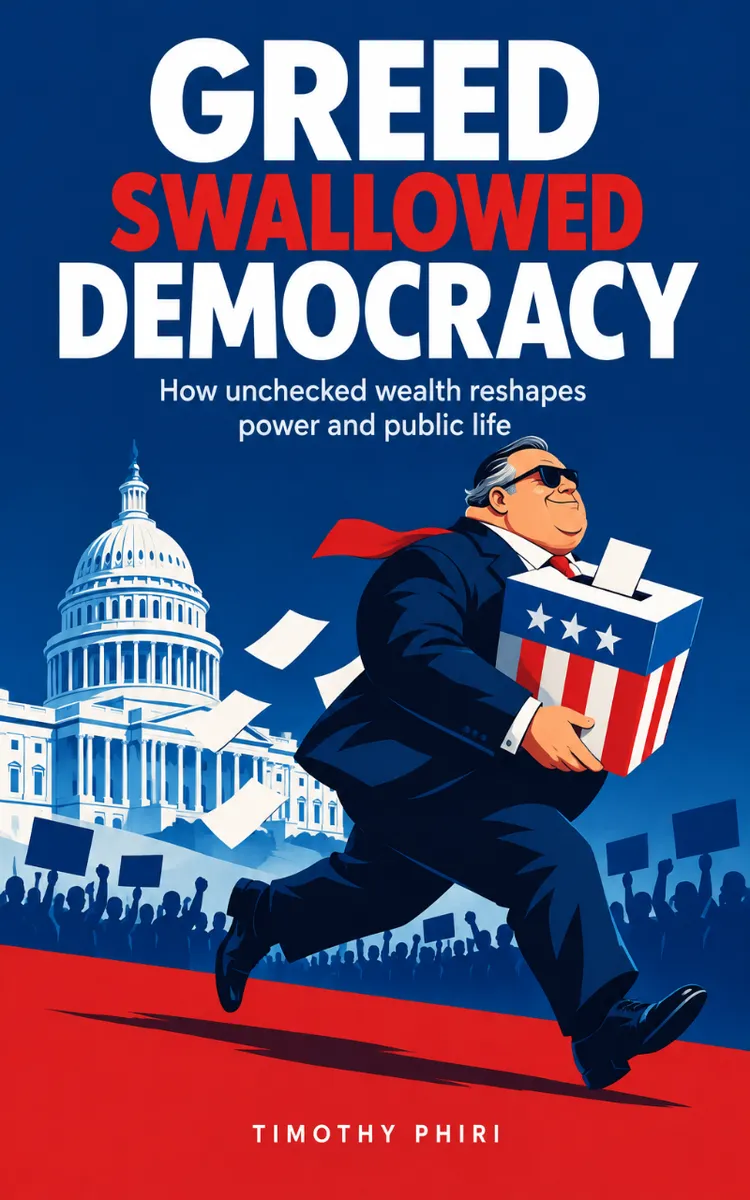
"Greed Swallowed Democracy" is a curiosity book by Timothy Phiri with 12 chapters and approximately 17,261 words. How greed and concentrated wealth undermine democratic institutions and public life.
This book was created using Inkfluence AI, an AI-powered book generation platform that helps authors write, design, and publish complete books.
Frequently Asked Questions
What is "Greed Swallowed Democracy" about?
How greed and concentrated wealth undermine democratic institutions and public life
How many chapters are in "Greed Swallowed Democracy"?
The book contains 12 chapters and approximately 17,261 words. Topics covered include The Price Tag on a Vote, Lobbyists Write the Fine Print, When Newsrooms Depend on Billionaires, The Revolving Door Keeps Spinning, and more.
Who wrote "Greed Swallowed Democracy"?
This book was written by Timothy Phiri and created using Inkfluence AI, an AI book generation platform that helps authors write, design, and publish books.
Write your own curiosity book with AI
Describe your idea and Inkfluence writes the whole thing. Free to start.
Start writingCreated with Inkfluence AI


