

Read the first chapter
The whole of chapter one, free. About 7 min. Turn the pages with the arrows, your keyboard, or a swipe.
Chapter 1
The Black Sky of 2027
A Compass Beneath the Dark Vault
In 1930, at the height of the Great Depression, American astrologer Evangelos S. Protopapas published forecasts that sought to read the economic crisis through the movements of the planets. He was not alone: for centuries, in courts, ports, and newspapers, astrology has surfaced when societies pass through periods of uncertainty. What is striking is not that the stars explained those crises, but that people needed to turn disorder into a story they could read.
Within this almanac, 2027 emerges as a year of somber, transformative atmosphere. Darkness does not signify inevitable misfortune or a sentence written in the stars. It is a cultural image: night as a space for perception, the eclipse as an interruption of habit, the celestial vault as a mirror in which each reader recognizes their own fears, desires, and contradictions.
The Compass of the Dark Vault offers a way to travel this terrain without confusing symbol with fact. Its directions promise no certainties; they point to moods, tensions, and possibilities for interpretation. The predictions that follow belong to astrology’s cultural, symbolic, artistic, and recreational sphere for adults. They do not replace medical, psychological, legal, or financial expertise, nor do they claim to dictate professional decisions.
What do we really see when we look up at a sky that seems to keep silent?
The Night as Humanity’s Archive
Long before printed horoscopes, communities observed the sky to keep track of time. In Mesopotamia, scribes recorded eclipses, planetary appearances, and seasonal changes on clay tablets. Those records did not clearly separate astronomy, religion, agriculture, and government: the firmament was at once calendar, omen, and political archive.
Western astrology inherited part of that ancient custom of relating celestial rhythms to human experience. In the Hellenistic world, especially from the second century before our era, the practice of casting individual birth charts took hold. Birth ceased to be merely a family event and came to be viewed as a symbolic arrangement of the sky.
Over time, that way of seeing changed. Medieval astrology coexisted with the medicine of its day; Renaissance astrology circulated through courts and universities; the modern press made it part of everyday reading. The newspaper horoscope reduced complex systems to a few lines, but preserved something essential: the sense that life could be read through correspondences.
Contemporary science clearly distinguishes astronomy from astrology. The former studies physical objects and phenomena through observation, mathematical models, and repeatable tests. The latter uses planets, signs, and cycles as a symbolic language. This difference does not erase astrology’s cultural interest; it defines its nature. A birth chart does not measure personality like a clinical instrument, just as a novel does not claim to function as a census.
2027 enters this book as a surface for reading. The so-called black sky is not a physical color of the firmament, but a composition of images: thresholds, shadows, partial revelations, and forces that seem to act beneath the surface. Its value lies in interpretation, not obedience.
The Calendar, the Symbol, and Everyday Life
Almanacs began as practical tools. For centuries, they offered the phases of the Moon, harvest dates, religious festivals, tides, and advice for organizing the year. The modern astrological almanac preserves that temporal structure, but adds another layer: it turns January, February, or November into distinct scenes within an annual narrative.
This division into months matters because the human mind readily thinks in cycles. A whole year can feel abstract; twelve fragments make it easier to recognize shifts in tone. Readers see January as an entrance, March as a place of movement, August as a warmer chamber, or November as a corridor of shadows. The point is not to prove that each month has a measurable energy, but to offer a rhythm for contemplation.
A prediction, in this sense, works like a framed mirror. The mirror reflects the observer’s features; the frame decides what falls inside and what remains outside. When someone reads a warning about relationships, vocation, money, or vitality, they are not receiving a photograph of the future. They encounter a set of images they can connect to conversations, decisions, memories, or present conflicts.
This is where the Compass of the Dark Vault takes on its particular meaning. It does not push readers toward a single answer. It helps them find their bearings among four recurring landscapes: bonds that draw people together or wear thin, work that demands attention, material resources, and the reserve of energy with which each person moves through their days. The compass does not turn these realms into destiny; it gathers them beneath a single symbolic vault.
It also explains why this almanac includes thirteen signs. The twelve traditional signs belong to a long astrological convention; Ophiuchus, placed between November 29 and December 17 within the framework of this work, introduces an additional figure: the serpent, symbolic healing, hidden knowledge, and the tension between what is shown and what remains concealed. Its presence does not automatically correct the tradition or make it scientific. It expands the calendar’s cultural play and raises a question about who decides the boundaries of a system.
When the Sky Seems Personal
There is a familiar paradox: the more general a description is, the more easily it can feel intimate. Psychology has studied this effect, associated with the so-called Forer effect, whereby many people recognize broad, favorable statements as their own, even when they were written for a general audience. The phenomenon does not prove that every astrological experience is empty; it does remind us that a sense of precision can arise from the way we interpret a text.
The surprise lies elsewhere: a prediction can be culturally meaningful precisely because it lacks scientific precision. Its ambiguity allows different generations, professions, and temperaments to find different connections. The same passage about a closed door might evoke a relationship for one person, a job for another, and a period of silence for someone else.
That changes the central question. Instead of asking whether a paragraph can predict a specific event, it is worth noticing what kind of attention it awakens. Symbolic astrology need not compete with a work calendar or a medical consultation to serve a narrative purpose. It operates like an ancient language that lets us speak about uncertainty without pretending uncertainty has disappeared.
The danger arises when a symbol becomes a command. A horoscope read as a sentence can narrow the freedom of the person consulting it; read as a cultural mirror, it remains open. That is why the pages of 2027 should be read by adults able to distinguish a suggestive image from a verifiable claim.
A City That Consults the Stars
Today, astrology coexists with screens, apps, and social media. In cities such as Buenos Aires, Mexico City, Madrid, and Bogotá, astrological consultations appear alongside bookstores, cafés, podcasts, and digital publications. The phenomenon does not belong only to a past of ancient observatories: it adapts to urban schedules, mobile phones, and brief conversations.
In Buenos Aires, for example, bookstores in Palermo and San Telmo have for years maintained sections devoted to tarot, astrology, and esoteric traditions. There, one can find ephemerides, birth charts, sign guides, and historical works. The scene does not prove that planets govern human behavior. It shows something more concrete: that many people still seek languages for talking about identity, relationships, and the future in an age saturated with data.
An almanac reader might consult a prediction over breakfast, share it in conversation, or return to it months later, when an image takes on a different meaning. The use is cultural and recreational, but that does not make it trivial. Calendars have accompanied wars, harvests, migrations, weddings, and mourning; they have shaped domestic memory and the collective imagination.
In this context, the book’s Gothic tone is not an ornamental disguise. The aesthetic of shadows reminds us that every reading of the future begins in the face of the unknown. Candles, corridors, dark ink, and constellations do not replace facts: they surround them with an atmosphere that can make visible the unease normally hidden beneath routine.
What the Darkness Lets Us Glimpse
Astrology survives not because it has dispelled mystery, but because it has given it successive forms: tablets, charts, almanacs, newspaper columns, and glowing screens. Each era changes the instrument; the need to relate external time to inner life remains.
Here, 2027 appears as symbolic territory, not a celestial tribunal. Its signs and months offer images for thinking about relationships, vocation, fortune, and energy without turning any of those images into a sentence. The night does not answer for us; it merely reveals how many questions we were already carrying in silence.
Beneath the black vault, the future retains its strangest quality: it has not yet happened, but it can already alter our imagination. And perhaps it is that anticipated shadow that makes the ancient habit of looking up so persistent.
End of chapter one. 13 more chapters and about 24,298 words in the full book.
Swipe or use the arrows to turn the page


What's inside: 14 chapters
- 1. The Black Sky of 2027
- 2. Aries: the price of the first step
- 3. Taurus: What the Shadow Cannot Buy
- 4. Gemini: Two Voices Beneath the Moon
- 5. Cancer: tides behind the door
- 6. Leo: The Crown Put to the Test
- 7. Virgo: The Order of Hidden Things
- 8. Libra: balance comes at a cost
- 9. Scorpio: Descending Without Losing Yourself
- 10. Sagittarius: Maps for an Escape
- 11. Capricorn: building in the face of winter
- 12. Aquarius: Signs from the Unlikely
- 13. Pisces: The Border of Dreams
- 14. Ophiuchus and the Table of Bonds
About this book
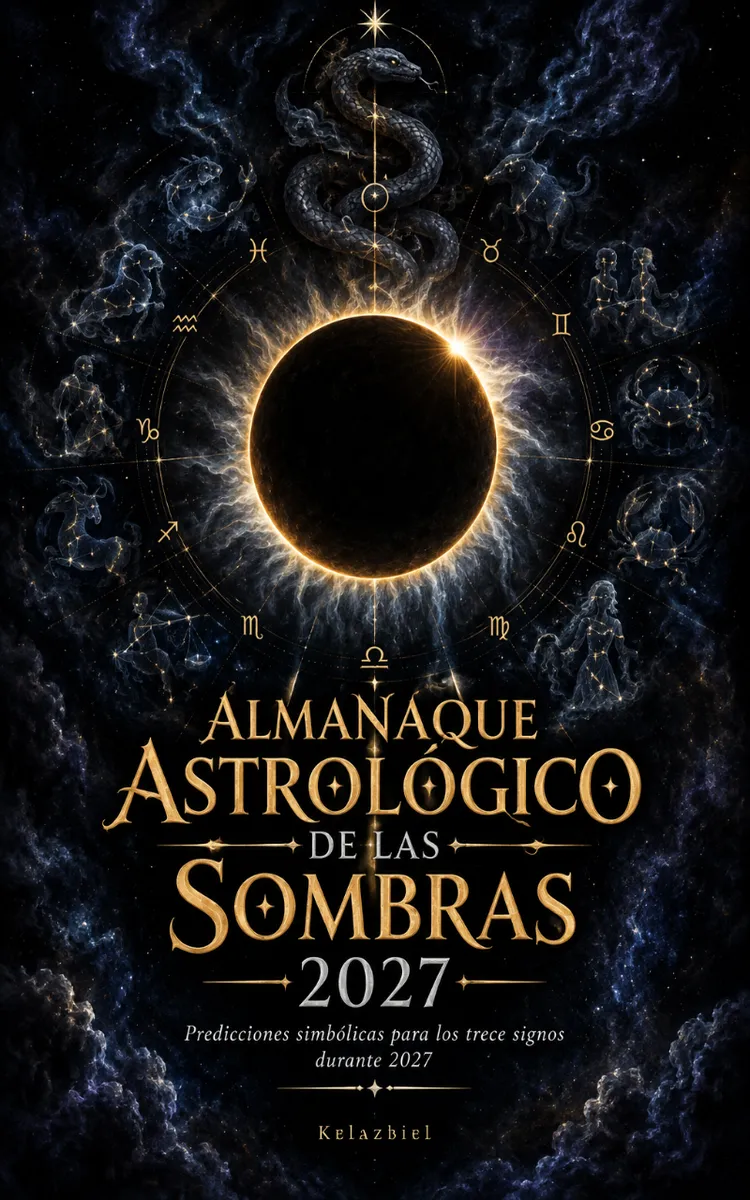
"Astrological Almanac of the Shadows 2027" is a curiosity book by Kelazbiel with 14 chapters and approximately 24,298 words. Monthly astrological predictions and compatibility for thirteen zodiac signs.
This book was created using Inkfluence AI, an AI-powered book generation platform that helps authors write, design, and publish complete books.
Frequently Asked Questions
What is "Astrological Almanac of the Shadows 2027" about?
Monthly astrological predictions and compatibility for thirteen zodiac signs
How many chapters are in "Astrological Almanac of the Shadows 2027"?
The book contains 14 chapters and approximately 24,298 words. Topics covered include The Black Sky of 2027, Aries: the price of the first step, Taurus: What the Shadow Cannot Buy, Gemini: Two Voices Beneath the Moon, and more.
Who wrote "Astrological Almanac of the Shadows 2027"?
This book was written by Kelazbiel and created using Inkfluence AI, an AI book generation platform that helps authors write, design, and publish books.
Write your own curiosity book with AI
Describe your idea and Inkfluence writes the whole thing. Free to start.
Start writingCreated with Inkfluence AI


