
Read the first chapter
The whole of chapter one, free. About 12 min. Turn the pages with the arrows, your keyboard, or a swipe.
Chapter 1
A Door in the Grief
The loose floorboard in the upstairs corridor clicked beneath Elias Ward’s heel, though he had not stepped on it in years.
He stopped with one hand against the wallpaper, listening. The house answered in its usual language: the refrigerator’s tired shudder below, a pipe ticking inside the wall, rain combing the windows with thin, patient fingers. Nothing else moved. Nothing else had moved for forty-three days.
On the landing, the clock still showed 2:17.
It had stopped there the morning the hospital called.
Elias looked toward the bedroom at the end of the corridor, where the door remained closed because opening it required a kind of courage he had not yet found. Then he crouched and pressed the floorboard again.
Click.
A small sound. An ordinary sound. Yet the wood gave beneath him as if something below had shifted to make room.
He pulled up the board.
Dust powdered his fingers. Beneath it lay not darkness, but a brass key.
Elias stared at it. The key was narrow and old-fashioned, with a bow shaped like an open eye. It rested on a square of blue cloth, and stitched into the cloth, in white thread, was his daughter’s name.
Mara.
His breath caught so sharply it hurt.
“No,” he said.
The word fell into the corridor and seemed to wait.
He had spent the morning avoiding Mara’s room, the afternoon avoiding the telephone, and the evening avoiding the simple fact that grief had made every room in the house into a question. He had not showered. He had not eaten. He had walked from one end of the house to the other, touching nothing, as if the furniture might accuse him of continuing.
Now the house had placed her name beneath his foot.
Elias picked up the key. It was cold enough to sting.
Behind him, somewhere downstairs, a door creaked.
He turned.
The front door stood open.
Rain silvered the threshold. The porch light swung gently though there was no wind.
Elias closed his hand around the key and went down.
The front door had always stuck in damp weather. Mara used to shoulder it open, laughing when the swollen wood resisted her. She had been twelve the last time, all elbows and wet hair, carrying a paper bag of groceries against her chest.
“Stand back,” she had told him. “The door respects confidence.”
Now it opened at the lightest touch.
The rain had stopped. Across the street, the houses were dark, their windows reflecting a sky without stars. Elias stepped onto the porch. The key warmed in his palm.
A sound came from inside the house.
Not a voice. Pages turning.
He went back in.
The sound led him upstairs, past the stopped clock, toward the narrow closet beside Mara’s bedroom. It was the closet where his mother had kept winter coats, where Elias had hidden as a child during thunderstorms. Its door had been painted over so many times that the hinges looked buried.
He pulled it open.
The closet was empty except for a cardboard box of Christmas lights and a single red mitten.
The pages turned again.
Elias moved the box. Dust rose, catching in his throat. Behind the hanging rail, the wall was covered in faded wallpaper patterned with small green leaves. He ran his fingers over it and felt a seam.
A door had been painted into the wall.
Its outline was almost invisible, but there: a tall rectangle, the shape of a door without a handle. In the center waited a brass keyhole.
Elias stood very still.
The key in his hand trembled.
He inserted it. The lock turned with a soft, pleased sigh.
The painted door swung inward.
Beyond it was a staircase descending through a darkness that did not belong to the house. Warm gold light gathered far below. The air carried the scent of paper, cedar, and something faintly sweet, like the biscuits Mara used to burn in the oven.
Elias gripped the doorframe.
“This isn’t real.”
A voice answered from below.
“Real is a poor door.”
He flinched and nearly fell backward.
At the bottom of the stairs stood a woman in a gray coat, though Elias could not tell how she had arrived there. Her hair was white and cut bluntly at her jaw. She held a lantern whose flame burned blue. Her face was neither young nor old; it seemed to change whenever he tried to settle on it.
“Who are you?” Elias asked.
“The person who opens what has been shut.”
“Where does this go?”
“Down.”
“That isn’t an answer.”
“It is the first one.”
He should have left. He knew this with the plain certainty of a man standing beside a cliff. Yet the stairs waited, and the blue lantern painted a path through the dark.
Elias looked toward Mara’s bedroom.
The door remained closed.
“What is this place?”
The woman lifted the lantern. Behind her, the darkness brightened, revealing shelves - rows and rows of them, rising beyond sight. Books filled every shelf. Some were bound in leather, some in cloth, some in materials Elias could not name. Their spines bore names, dates, and symbols that shifted when he looked directly at them.
“The library,” she said.
“Whose library?”
“All of them.”
The phrase entered him like a splinter.
He descended.
The stairs were narrow and uneven. The walls pressed close, though now and then a window appeared, showing scenes that vanished before he could understand them: a boy flying a red kite over a field; a woman in a wedding dress standing alone beneath an elm; a crowded kitchen where someone who looked like Elias was laughing with his mouth open.
He stopped at that last window.
The man inside had his face, but not his sorrow. He was older by perhaps ten years. A little girl sat on his shoulders, her hands tangled in his hair.
Mara.
Elias reached for the glass.
The scene disappeared.
“Wait.”
The woman continued downward.
“Was that her?”
“You saw what you saw.”
“Was she alive?”
“In that life.”
Elias caught up with her. “What does that mean?”
“It means a life is not a promise.”
“Then why show me?”
“I didn’t.”
They reached the bottom.
The library opened around him.
It was larger than any building he had known, though its ceiling was hidden beneath drifting clouds of dust and candle smoke. Ladders rolled along brass rails. Staircases curled into balconies, then folded back on themselves. Books moved quietly through the air, carried by no hands. Somewhere far away, a bell chimed once, and every shelf leaned toward the sound.
Elias could not move.
The woman set her lantern on a desk. “You wanted to know why it appeared.”
“Yes.”
“It appeared because you asked.”
“I didn’t ask for this.”
“You asked every night.”
His mouth went dry. “I never said anything.”
“Words are not the only way to knock.”
She walked to a shelf near the desk and drew out a book.
It was bound in blue cloth.
Mara’s name was stitched across the cover.
Elias took one step toward it, then stopped.
“No.”
The woman held the book out.
“No,” he repeated. “Put it back.”
“This is the life you came for.”
“I came to understand.”
“You cannot understand without entering.”
“I’m not reading that.”
The woman’s expression softened, which frightened him more than anger would have.
“Why?”
“Because it will be false.”
“Perhaps.”
“Because it will give me something to lose.”
“You have already lost something.”
Elias turned away. The library seemed to tilt. Along the nearest shelf, hundreds of books bore his name.
Elias Ward.
Elias Ward.
Elias Ward.
Some were thin as pamphlets. Others were thick enough to break a wrist. One had a cover made of yellow raincoat material. Another appeared to be bound in the wood of a kitchen table. Every possible life, he thought. Every road not taken, every door left unopened.
The woman placed Mara’s book on the desk.
“Read.”
“I can’t.”
“You can.”
“I won’t.”
“Then the library remains closed to you.”
He laughed once, without humor. “It’s already open.”
“No. You are standing in its entrance.”
The blue lantern flickered. The shelves drew farther away, and the floor beneath Elias’s shoes became transparent. Below it he saw the corridor of his house, the stopped clock, the closet, the red mitten.
A threshold.
He backed away from the desk.
“What happens if I leave?”
“You return to the life you have been living.”
“And if I read?”
“You may see the life that might have been.”
“And Mara?”
The woman did not answer.
Elias looked at the blue book. Its cover had been worn smooth where a child’s hands might have held it. He remembered Mara at six, refusing to sleep unless he read the same story twice. He remembered her at sixteen, slamming her bedroom door because he had asked where she was going. He remembered the last morning: her coat half-buttoned, one shoelace undone, a question he had answered without looking up from his phone.
He had spent forty-three days refusing to remember the sound of her voice because memory made the house unbearable.
Now the library had remembered for him.
“What is the condition?” he asked.
The woman’s eyes settled on him.
“There is always a condition.”
“What is it?”
“To read the life, you must give up the memory that brought you here.”
His fingers curled.
“What does that mean?”
“You may keep the life,” she said. “Or you may keep the memory. Not both.”
“What memory?”
“The one you cannot bear to lose.”
Elias looked at Mara’s name.
The room seemed to narrow around it.
“You mean I forget her?”
“No.”
“You mean I forget what she looked like?”
“No.”
“Her voice?”
“No.”
“Then what?”
The woman leaned closer. Her eyes were gray, and in them Elias saw a thousand closed doors.
“The memory you use to prove she was yours.”
He could not breathe.
The library’s bells began to ring, one after another, from distant balconies. Books opened along the shelves. Pages fluttered in a wind that touched only paper.
Elias reached for the volume.
The woman caught his wrist.
“Once you begin, you cannot stop at the part that comforts you.”
He looked at her hand, then at the book.
“What part will comfort me?”
“You will know her.”
“I know her.”
“You know the life you shared.”
The woman released him.
Elias opened the book.
The first page was blank. Then ink rose through the paper in dark, wet lines.
Elias Ward was late to the hospital because Mara had forgotten her blue scarf.
He recoiled.
The sentence changed.
Elias Ward was not at the hospital because he had answered the phone.
It changed again.
Elias Ward had never married. Elias Ward had married someone else. Elias Ward had become a teacher. Elias Ward had left the city. Elias Ward had stayed.
The pages turned by themselves, racing through possibilities until one stopped.
In this life, Mara was twenty-seven.
She stood in a kitchen painted yellow, her hair tied loosely at her neck. A kettle whistled behind her. She turned toward the doorway.
“Dad?”
The voice came from the page.
Elias gripped the book so hard its corners cut his palms.
Mara smiled. Not the hospital smile, not the photograph smile. This was the smile she gave when she knew she had won an argument but was waiting for him to discover it.
“You’re staring,” she said.
Elias bent over the page.
“I’m here,” he whispered.
Mara’s eyes shifted, as though she could see him through the ink.
“No,” she said. “You’re looking.”
The kitchen trembled.
“What does that mean?”
“You always confuse the two.”
“I’m sorry.”
Her smile faded.
The book grew warm beneath his hands.
“I thought if I found the right life,” Elias said, “I could fix it.”
“You can’t fix a life by choosing another one.”
“Then why show me?”
“Because you’re still trying to leave.”
Behind Mara, the kettle screamed.
Elias reached toward the page. His fingertip touched her cheek.
The paper was warm.
“Tell me what happened,” he said.
Mara looked past him, toward something beyond the book.
“You know what happened.”
“I need you to tell me.”
“No. You need me to absolve you.”
The words struck with the force of a door slammed shut.
Elias pulled his hand back.
The woman stood beside him now. “Read further.”
“I don’t want this.”
“You wanted her alive.”
“In this life she is.”
“In this life, yes.”
Mara turned from the kettle. “Dad, listen to me.”
Elias bent close.
“If you keep this life,” she said, “you lose the morning.”
“What morning?”
“The last one.”
His chest tightened.
“You mean I’ll forget it?”
“You’ll forget the way you failed me.”
The library fell silent.
For a moment, Elias saw the morning clearly: Mara in the doorway, one shoelace loose, blue scarf hanging from her pocket. He had been looking at his phone. She had said, “Dad, can I ask you something?”
He had answered, “Not now.”
Then she had left.
The memory had become a blade he turned in himself each night.
The book offered him a life where she lived, where he could hear her voice and stand in her yellow kitchen, where regret might become an object set down and forgotten.
But the condition waited beneath the page.
He would have to surrender the morning. The last moment in which Mara had needed something from him. The last moment in which he had been her father and had failed.
Elias closed the book.
Mara vanished.
“No,” he said.
The woman watched him. “You may leave.”
He looked at the cover. “If I refuse, does the library disappear?”
“It will close.”
“And if I accept?”
“It will open.”
“To what?”
“To every life you have not lived.”
Elias wiped his palms on his coat. Blood marked the blue cloth of the book.
He thought of the house above, holding its silence like a grudge. He thought of the morning he had refused to remember and the daughter who had carried it away with her.
Then he placed his hand on the cover again.
“I’ll read,” he said.
The woman nodded.
“But I won’t give you the morning.”
“Then you will give something else.”
“What?”
The book opened beneath his hand.
On the first page, new words appeared.
To enter, Elias Ward must surrender the memory of being loved by Mara before she was lost.
Elias stared at the sentence.
The library doors opened somewhere behind him, though he had not seen any doors before. A wind moved through the aisles, lifting his coat and turning the pages of every book bearing his name.
He could no longer remember Mara’s face at six.
He could remember her yellow kitchen. Her loose hair. Her voice.
But the small hand that had once curled around his finger was gone from him.
Elias made a sound that seemed to come from the floor.
The woman stepped aside.
“Now,” she said.
The threshold waited.
Elias crossed it, carrying the book, while behind him the library began to rearrange itself around the shape of his grief.
End of chapter one. 7 more chapters in the full book.
Swipe or use the arrows to turn the page

What's inside: 8 chapters
- 1. A Door in the Grief
- 2. Reading the Book That Answers
- 3. Shelves That Rearrange by Choice
- 4. The Librarian of Unmade Decisions
- 5. A Map Written in Margins
- 6. When the Ink Won’t Forgive
- 7. Choosing the Version That Stays
- 8. The Life He Writes Back Into
About this book
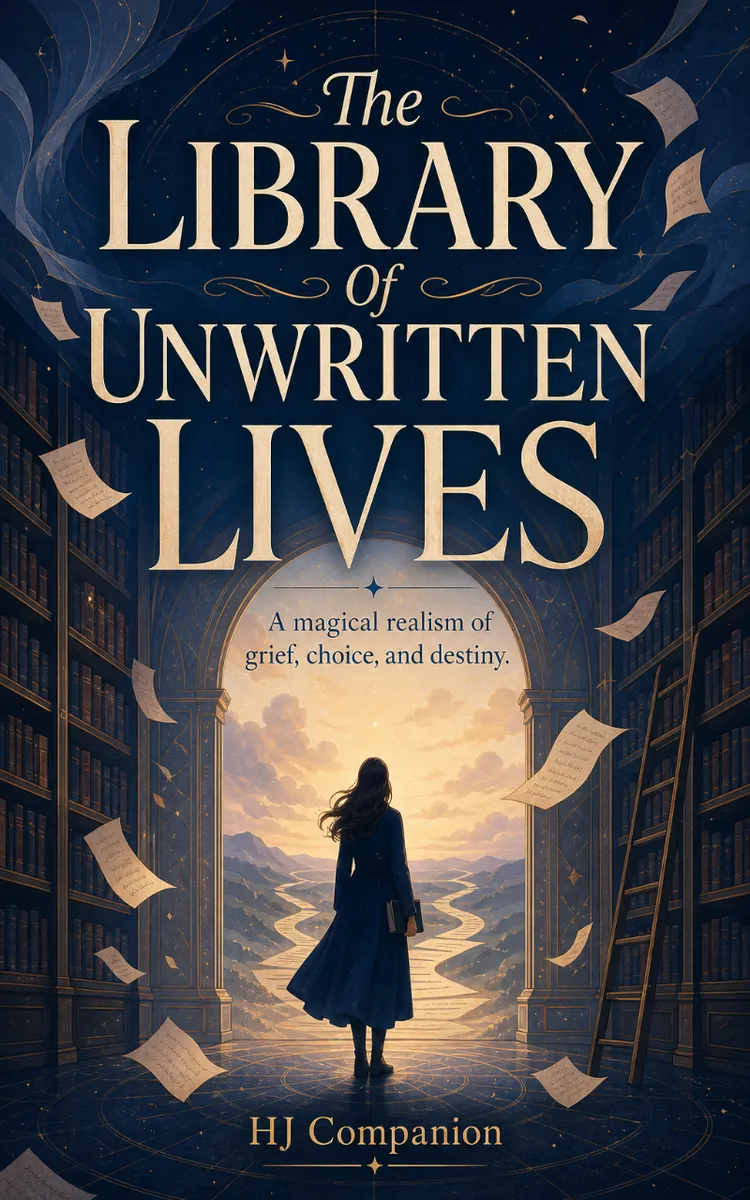
"The Library Of Unwritten Lives" is a fiction book by HJ Companion with 8 chapters and approximately 17,022 words. A grieving father discovers books of alternate lives..
This book was created using Inkfluence AI, an AI-powered book generation platform that helps authors write, design, and publish complete books. It was made with the AI Novel Writer.
Frequently Asked Questions
What is "The Library Of Unwritten Lives" about?
A grieving father discovers books of alternate lives.
How many chapters are in "The Library Of Unwritten Lives"?
The book contains 8 chapters and approximately 17,022 words. Topics covered include A Door in the Grief, Reading the Book That Answers, Shelves That Rearrange by Choice, The Librarian of Unmade Decisions, and more.
Who wrote "The Library Of Unwritten Lives"?
This book was written by HJ Companion and created using Inkfluence AI, an AI book generation platform that helps authors write, design, and publish books.
How can I create a similar fiction book?
You can create your own fiction book using Inkfluence AI. Describe your idea, choose your style, and the AI writes the full book for you. It's free to start.
Write your own fiction book with AI
Describe your idea and Inkfluence writes the whole thing. Free to start.
Start writingCreated with Inkfluence AI


