
Read the first chapter
The whole of chapter one, free. About 7 min. Turn the pages with the arrows, your keyboard, or a swipe.
Chapter 1
Reset Your Brain Fog Signals
Core Idea: Track Brain Fog Patterns, Then Pick One 18-Day Focus Brain fog doesn’t show up randomly. It usually comes with signals - certain foods, sleep patterns, stress moments, hormone shifts, and even your “default” daily routine. When you track what’s happening around the fog, you stop treating it like a mystery monster. You start treating it like a repeating pattern you can work with.
Here’s the simple structure for this chapter: you’ll (1) log a few brain fog moments, (2) look for your most common “triggers or conditions,” and (3) choose one focus for the next 18 days. That focus isn’t your whole life plan. It’s one lever you’ll pull consistently, so you can actually see what helps.
Key takeaway: You’ll reduce brain fog faster by tracking patterns you can measure, then committing to one 18-day focus instead of trying everything at once.
To make it easy, use these steps: 1. Capture 5-7 brain fog moments (when it starts, how it feels, and what was happening right before). 2. Spot repeating conditions (common time of day, sleep, meals, stress level, screen time, movement, etc.). 3. Choose one “18-day focus” based on the pattern that shows up most and feels doable. 4. Commit to one measurable action tied to your focus (so you’ll know if it’s working).
Your Turn (quick setup): Grab your Brain Fog Planner for Women 40+ and open to a fresh page for “Pattern Signals.” If you don’t have that exact page name yet, use the next blank section - just keep your notes together so you can compare them.
---
Guided Practice: Pattern Signals Log + Your 18-Day Focus Pick Time required: 15-25 minutes Materials needed: your Brain Fog Planner for Women 40+, a pen, and a timer (optional, but helpful if you tend to “just keep going”)
You’re going to do two things: log patterns from your recent reality, and pick one focus for the next 18 days. No guessing required - you’ll use your own data.
Step-by-step instructions 1. Choose your log window. Write the dates you’ll cover (example: “Last 7 days”). If you’re starting today, use “today + the last 6 days.” 2. Pick 5-7 moments when your brain fog showed up. They can be big (“couldn’t think straight”) or annoying-small (“lost my train of thought”). - Write “Moment #1” through “Moment #7.” 3. For each moment, fill in these exact fields (keep it short - your goal is patterns, not poetry): - Time of day: (morning / midday / afternoon / evening / late night) - Fog rating (0-10): circle a number - What I was doing right before: (example: “answering emails,” “driving,” “cooking,” “scrolling,” “after lunch”) - Sleep last night (hours): (estimate is fine) - Water today so far (rough): “low / medium / high” - Food timing: “on time / late / skipped” (or “snack after 3+ hours”) - Stress level right then (0-10): circle a number - Movement in last 4 hours: “none / some / yes” 4. Circle your top 2 repeating conditions. Look across your moments and circle the two things that show up most often (for example: “after lunch,” “sleep under 6 hours,” “high stress,” “no movement,” “late meals,” “screen-heavy time”). 5. Pick your one 18-day focus using this rule: Choose the condition you can influence the easiest and that appears in your top circles. Write it as a clear target like: - “Reduce afternoon fog by improving lunch timing” or - “Lower fog after high-stress moments by adding a 10-minute reset” or - “Help morning fog by getting 7+ hours sleep consistently.” 6. Write one measurable action for those 18 days. Keep it simple and countable. Examples: - “No more than 4 hours without eating (snack counts).” - “10-minute walk within 4 hours before dinner.” - “Drink 2 full glasses of water by 12 PM.” - “Do a 90-second breathing reset after stressful tasks (3 times/day).” 7. Set your start date and write it clearly: “I start on: ________.”
Completed example (so you can copy the format) > Pattern Signals Log (Example) > Window: last 7 days > > Moment #1: Midday • Fog 7/10 • emails • sleep 5.5 hrs • Water: low • Food: late • Stress 8/10 • Movement: none > Moment #2: Afternoon • Fog 6/10 • driving kids • sleep 6 hrs • Water: low • Food: on time • Stress 7/10 • Movement: none > Moment #3: Midday • Fog 8/10 • computer work • sleep 5 hrs • Water: medium • Food: late • Stress 6/10 • Movement: some > Moment #4: Afternoon • Fog 6/10 • cooking • sleep 6.5 hrs • Water: low • Food: late • Stress 5/10 • Movement: none > Moment #5: Evening • Fog 5/10 • scrolling • sleep 5.5 hrs • Water: medium • Food: on time • Stress 6/10 • Movement: none > > Top repeating circles: Water low (4/5+) and Food late (3/5+) > > 18-day focus: “Reduce afternoon fog by improving lunch timing and hydration.” > Measurable action: “By 12 PM, drink 2 full glasses of water, and don’t go more than 4 hours without eating (snack counts).” > Start date: ________
Your Turn: Fill your log now. Use your Planner page and write 5-7 moments. When you’re done, underline your top 2 repeating conditions.
---
Real-World Application: Spot the Pattern in Everyday Life (and Know What “Working” Looks Like) Now that you’ve picked your focus, the next job is to apply it to real days - the kind where laundry exists and your brain is already doing 14 things at once. The trick is to look for the same signals you logged, then watch for a specific outcome.
If your pattern is late meals, you might notice fog hits harder “between lunch and dinner,” especially when you’re busy or distracted (like work calls, running errands, or cooking while talking to someone). Your expected outcome for the next 18 days: the fog rating drops at those times, or the “fog start” happens later. You’re not aiming for perfection. You’re aiming for fewer moments where you feel suddenly scrambled without warning.
If your pattern is low water, you might see fog creep in after you’ve been at your desk for hours, or after you’ve had coffee and forgot to drink anything else. Your expected outcome: fewer “mental static” moments after midday, and clearer thinking when you sit down to do one task (like paying a bill, writing a grocery list, or reading a paragraph without rereading it).
If your pattern is high stress + no movement, you’ll often feel fog right after a stressful task (emails, conflict, appointment waiting) and it doesn’t lift until you move or reset. Your expected outcome: after your measurable action (like a 10-minute walk within 4 hours of dinner or a 90-second reset after stressful tasks), you should notice either lower stress ratings or a faster “fog recovery” (you get your focus back sooner).
Apply It (use these scenarios): 1. Think about your next busy stretch. Where does it usually hit - morning, after lunch, or late afternoon? Write one sentence: “Most of my fog hits when ______.” 2. Connect that to your focus. If your focus is hydration + lunch timing, what’s your next “test moment”? Write: “My next test day is ____ (tomorrow / next workday / Saturday).” 3. Decide the outcome you’ll track. Write one measurable sign you’ll watch for: “I’ll know it’s working if my fog rating is ____ or if the fog starts ______ later.”
---
Reflect and Plan: Lock In Your Next 18 Days (Without Overthinking It) You’ve now got your pattern signals and your one 18-day focus. The goal of reflection here isn’t to spiral. It’s to make your focus stick and keep you from switching tracks when life gets loud.
Reflect: Use the prompts below. Answer in your own words, then use the lines for handwritten notes.
1) What are my top 2 repeating conditions behind my brain fog (from my log), and which one did I choose for my 18-day focus? ________________________________________________________________________________ ______________________________________________________________________________ ________________________________________________________________________________
2) What measurable action did I pick, exactly - and what will I do when I miss a day? (Write your “reset rule.”) ________________________________________________________________________________ ______________________________________________________________________________ ________________________________________________________________________________
3) In the next 7 days, what specific moment will I watch most closely to see if my focus is working? ________________________________________________________________________________ ______________________________________________________________________________ ________________________________________________________________________________
Your Turn (final lock-in): Write your 18-day focus sentence exactly as you’ll keep it on your Planner. “I’m focusing on: ________________________________________________ for the next 18 days.”
When you track patterns and choose one focus, you turn brain fog from “random bad luck” into “data.” And once it’s data, you can change it - one repeatable action at a time.
End of chapter one. 4 more chapters in the full book.
Swipe or use the arrows to turn the page
What's inside: 5 chapters
- 1. Reset Your Brain Fog Signals
- 2. Build a 10-Minute Morning Reset
- 3. Use Single-Tasking for Focus
- 4. Set Boundaries Without Guilt
- 5. Plan Your Clarity Week Ahead
About this book
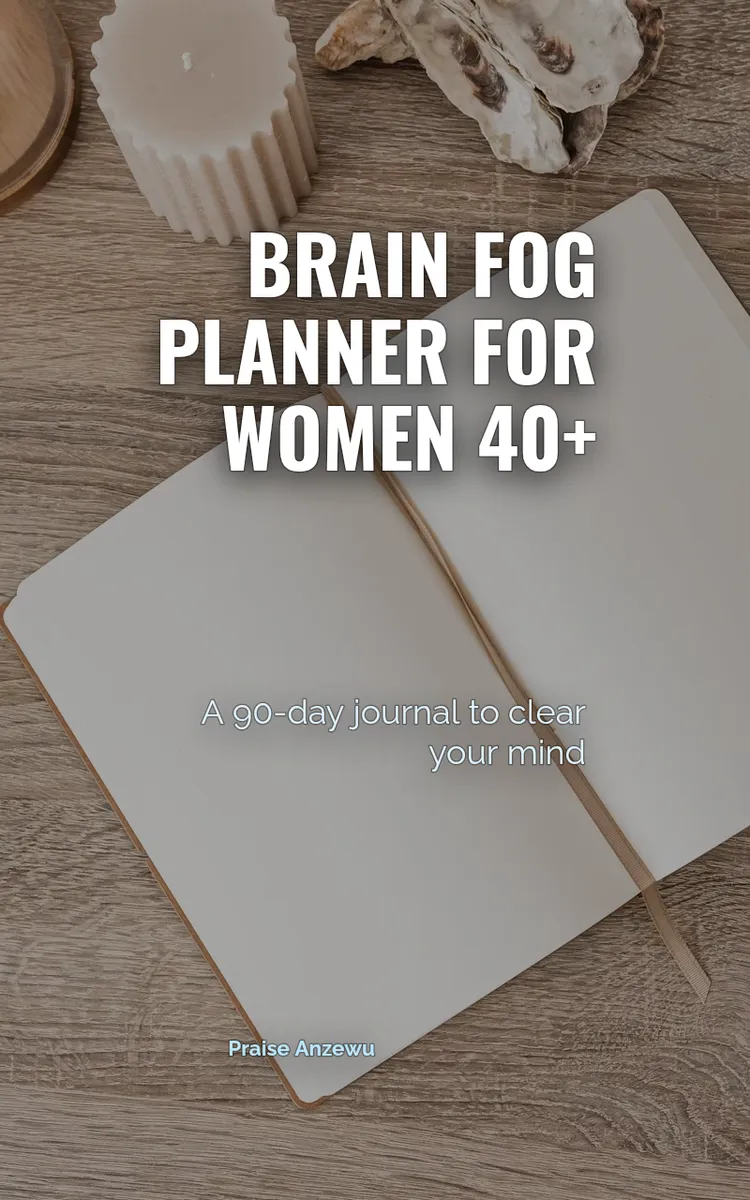
"Brain Fog Planner For Women 40+" is a workbook by Praise Anzewu with 5 chapters and approximately 7,061 words. 90-day journal for women 40+ managing brain fog.
This book was created using Inkfluence AI, an AI-powered book generation platform that helps authors write, design, and publish complete books. It was made with the Workbook Generator.
Frequently Asked Questions
What is "Brain Fog Planner For Women 40+" about?
90-day journal for women 40+ managing brain fog
How many chapters are in "Brain Fog Planner For Women 40+"?
The book contains 5 chapters and approximately 7,061 words. Topics covered include Reset Your Brain Fog Signals, Build a 10-Minute Morning Reset, Use Single-Tasking for Focus, Set Boundaries Without Guilt, and more.
Who wrote "Brain Fog Planner For Women 40+"?
This book was written by Praise Anzewu and created using Inkfluence AI, an AI book generation platform that helps authors write, design, and publish books.
How can I create a similar workbook?
You can create your own workbook using Inkfluence AI. Describe your idea, choose your style, and the AI writes the full book for you. It's free to start.
Write your own workbook with AI
Describe your idea and Inkfluence writes the whole thing. Free to start.
Start writingCreated with Inkfluence AI


