

Read the first chapter
The whole of chapter one, free. About 5 min. Turn the pages with the arrows, your keyboard, or a swipe.
Chapter 1
MODULE 1 SHOTS & VACCINES
SHOTS & VACCINES
A Personality-Aligned Guide to Helping Children Feel Safe, Capable, and Confident
"The goal is not to help children avoid fear. The goal is to help children discover they can handle fear."
Understanding Why Shots Matter So Much to Children
Many adults underestimate the emotional impact of vaccinations.
After all, the procedure itself often lasts less than five seconds.
From an adult perspective, the experience seems minor.
From a child's perspective, however, a shot can feel enormous.
Children may spend:
• days worrying
• hours anticipating
• weeks remembering
The emotional experience surrounding a vaccination is often much larger than the physical experience itself.
That is why understanding how children process fear matters.
The Five Layers of Shot Anxiety
Most children are not afraid of only one thing.
Their anxiety usually contains multiple layers.
Layer 1: Fear of Pain
This is the most obvious concern.
Questions children commonly ask include:
• Will it hurt?
• How much will it hurt?
• How long will it hurt?
• Is it worse than last time?
For some children, pain is the primary concern.
For many others, it is only a small piece of a much larger fear.
Layer 2: Fear of the Unknown
Children often fear uncertainty more than discomfort.
Common worries include:
• When exactly will it happen?
• What happens after?
• What if something unexpected occurs?
• What if the nurse does something different?
This fear is especially strong in children who crave predictability.
Layer 3: Fear of Losing Control
Children rarely choose:
• the appointment
• the vaccine
• the location
• the timing
The experience can feel imposed upon them.
For children who value independence, loss of control can feel more distressing than the injection itself.
Layer 4: Fear Created by Imagination
Some children imagine:
• giant needles
• unbearable pain
• complications
• disasters
These children are not being dramatic.
They are using the same imagination that helps them create stories, solve problems, and dream.
Unfortunately, imagination can also magnify fear.
Layer 5: Fear of Embarrassment
This layer surprises many parents.
Children often wonder:
• What if I cry?
• What if people watch?
• What if I scream?
• What if my parent is disappointed?
Sometimes fear of embarrassment exceeds fear of pain.
How Personality Changes Everything
Two children can receive the same vaccine from the same nurse on the same day.
One walks out smiling.
The other remembers the experience for months.
Why?
Because children don't experience the procedure.
They experience their interpretation of the procedure.
Personality shapes that interpretation.
Information-Focused Children
These children reduce fear through understanding.
When uncertainty increases, anxiety increases.
When clarity increases, anxiety decreases.
Typical Questions
• What happens first?
• Then what?
• How long does it take?
• What does the needle look like?
What They Need Most
Predictability.
Parent Script
"We'll check in."
"Then we'll sit in the waiting room."
"The nurse will call us."
"She'll clean your arm."
"You'll feel a quick pinch."
"Then you'll get a bandage."
"The entire shot takes only a few seconds."
Notice that this script gives information without overwhelming detail.
Connection-Focused Children
These children regulate emotions through relationships.
They ask an internal question:
"Am I safe, and am I supported?"
Typical Questions
• Will you stay with me?
• Can I sit on your lap?
• What if I get scared?
What They Need Most
Connection.
Parent Script
"I'll be with you before, during, and after."
"You don't have to do this alone."
"If you're scared, I'll still stay with you."
"Nothing about my love changes because you're nervous."
The message is simple:
You're not alone.
Sensory-Focused Children
These children notice everything.
The smell of alcohol wipes.
The temperature of the room.
The texture of the exam table.
The sound of packaging being opened.
Typical Questions
• What will it feel like?
• Will it be cold?
• Will the room be loud?
What They Need Most
Sensory preparation.
Parent Script
"The alcohol wipe will feel cool."
"You'll feel pressure from my hand."
"Then you'll feel a quick pinch."
"After that, the sensation starts fading almost immediately."
Specific sensory descriptions build trust.
Imagination-Focused Children
These children understand the world through meaning.
Facts do not calm them nearly as much as purpose.
Typical Questions
• Why do I need this?
• What does it do?
• Is it helping my body?
What They Need Most
Purpose.
Parent Script
"This vaccine helps your immune system learn how to protect you."
"It's like teaching your body what to do if certain germs show up."
"This helps your body stay healthy in the future."
Purpose often creates courage.
How Early Should Parents Tell Children?
One of the most common questions parents ask is:
"When should I tell my child about the shot?"
The answer depends partly on personality.
Information-Focused Children
Prefer advance notice.
They need time to process.
A few days ahead often works best.
Connection-Focused Children
Need enough notice to discuss feelings but not enough time to build anxiety.
Usually 1–3 days is appropriate.
Sensory-Focused Children
Benefit from preparation that focuses on sensations rather than anticipation.
Avoid repeatedly revisiting the topic.
Imagination-Focused Children
Need enough time to develop understanding but not enough time to build elaborate fearful scenarios.
Moderate notice often works best.
The Parent's Emotional Influence
One of the strongest predictors of a child's stress level is not the procedure.
It's the adult's emotional state.
Children constantly scan adults for information.
If you appear:
• terrified
• frantic
• apologetic
• guilty
Children assume there must be danger.
When adults appear:
• calm
• confident
• supportive
• predictable
Children feel safer.
This does not mean pretending.
It means becoming the anchor.
The Vaccination Day Plan
Before Leaving Home
Review the plan once.
Not ten times.
One calm review is enough.
Say:
"Today is vaccine day."
"We have a plan."
"We'll handle it together."
Then move on with the day.
In the Car
Avoid excessive discussion.
Allow normal conversation.
This prevents the shot from becoming the center of the child's world.
In the Waiting Room
The waiting room is where anxiety often peaks.
The procedure still hasn't happened.
Children have time to imagine.
Use personality-specific support:
Information-Focused
Review the sequence.
Connection-Focused
Stay physically close.
Sensory-Focused
Reduce stimulation.
Imagination-Focused
Use positive visualization.
End of chapter one. 11 more chapters and about 13,864 words in the full book.
Swipe or use the arrows to turn the page

The Home Personality Test™

The 16 Baseball Minds: How Personality Shapes High School & College Players

Retirement by Personality: 16 Paths to a Fulfilling Life
What's inside: 12 chapters
- 1. MODULE 1 SHOTS & VACCINES
- 2. MODULE 2 Blood Draws
- 3. MODULE 3 IV Placement
- 4. IV Care Checklist
- 5. MODULE 4 Emergency Room & Urgent Care Visits
- 6. MODULE 5 Hospital Stays
- 7. MODULE 6 Recovery at Home
- 8. MODULE 7 Medical Anxiety
- 9. MODULE 8 Medical Trauma
- 10. MODULE 9 Building Resilience Through Medical Experiences
- 11. MODULE 10 Advocacy
- 12. A Personal Note from the Author
About this book
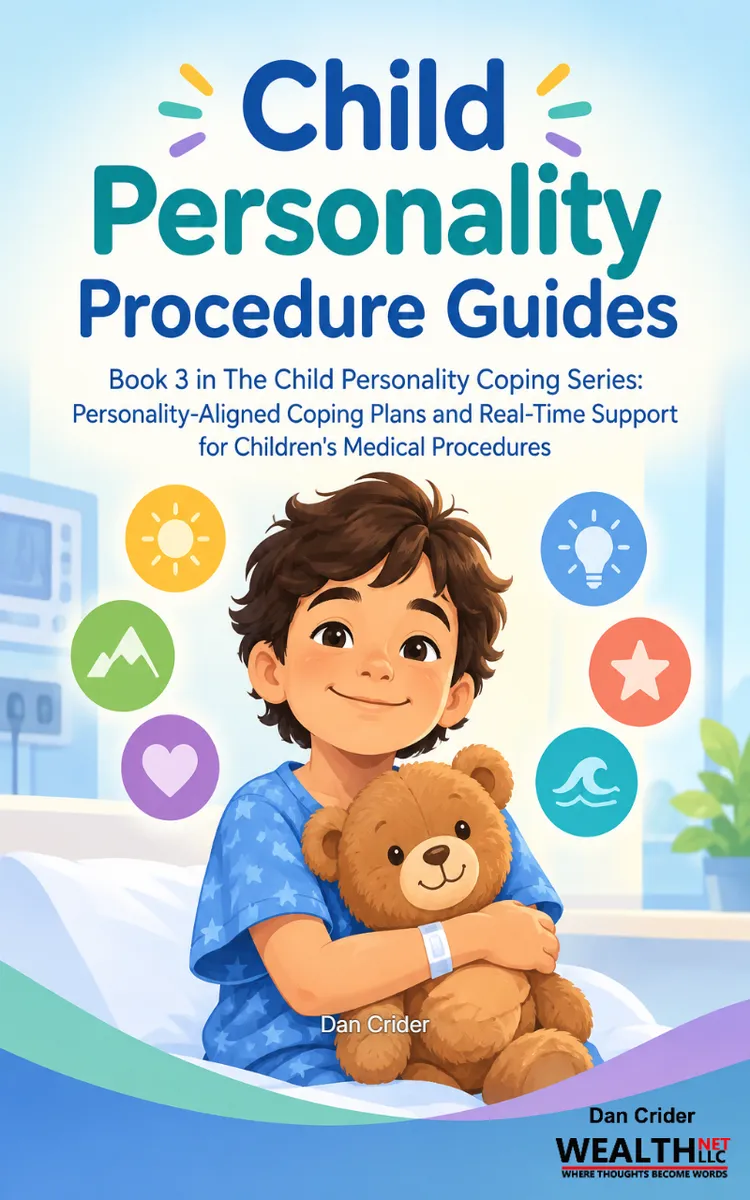
"Child Personality Procedure Guides" is a general book by Dan Crider with 12 chapters and approximately 13,864 words. It covers key insights and practical takeaways on the topic.
This book was created using Inkfluence AI, an AI-powered book generation platform that helps authors write, design, and publish complete books.
Frequently Asked Questions
What is "Child Personality Procedure Guides" about?
"Child Personality Procedure Guides" is a general book by Dan Crider covering key insights and practical takeaways on the topic.
How many chapters are in "Child Personality Procedure Guides"?
The book contains 12 chapters and approximately 13,864 words. Topics covered include MODULE 1 SHOTS & VACCINES, MODULE 2 Blood Draws, MODULE 3 IV Placement, IV Care Checklist, and more.
Who wrote "Child Personality Procedure Guides"?
This book was written by Dan Crider and created using Inkfluence AI, an AI book generation platform that helps authors write, design, and publish books.
Write your own book with AI
Describe your idea and Inkfluence writes the whole thing. Free to start.
Start writingCreated with Inkfluence AI


