
Read the first chapter
The whole of chapter one, free. About 9 min. Turn the pages with the arrows, your keyboard, or a swipe.
Chapter 1
Why the Grand Line Feels Like Myth
When Maps Become Myths
In 1845, the British ship Erebus and its companion Terror disappeared while searching for the Northwest Passage through the Canadian Arctic. Their crews carried accurate nineteenth-century instruments, yet the landscape defeated ordinary navigation: sea became ice, landmarks vanished, and familiar routes dissolved into rumor. The expedition entered history not simply as a failed voyage, but as a legend shaped by an unreachable passage.
That transformation is familiar to readers of One Piece. The Grand Line is a route on a map, but it behaves like a story told by people who have never seen all of it. Its islands do not merely sit at different coordinates; they obey different climates, histories, technologies, and rules of survival. Names such as Laugh Tale, Joy Boy, and the Void Century sound less like labels than fragments preserved from an older age.
The series makes these devices feel believable because real cultures have always built knowledge in the same way. Impossible places, famous names, and spoken rumors do not weaken a world when they are surrounded by practical details. They give the world depth. The Mythic Familiarity Lens examines that process: how the strange becomes credible when it is attached to things humans already recognize - navigation, memory, trade, fear, and the imperfect passing of stories from one person to another.
What makes a fictional world feel true: the accuracy of its map, or the human reasons people disagree about what the map contains?
The Grand Line and the Geography of the Impossible
The first mythmaking device is geography that refuses to behave. In many traditional stories, distant places are not merely far away; they are separated from ordinary experience by some special condition. Greek poets placed the Hesperides at the western edge of the known world, where golden apples grew under divine protection. Medieval European maps marked regions inhabited by monstrous peoples, often at the margins where reliable reports ended. Irish legend placed the Isle of Tír na nÓg beyond ordinary seas, reachable only through unusual travel and impossible to understand by normal measures of time.
These places were not random inventions. They grew from the structure of old maps. A map’s blank spaces invited explanation, and explanation often arrived as story. Before satellite imagery and global positioning systems, a coastline could be known in one harbor and unknown in the next. A sailor might have dependable information about one island, a warning about another, and only a name for a third. The result was a geography made from different grades of certainty.
The Grand Line uses this older logic while adding a scientific-looking layer. Its climate changes abruptly. Islands can possess distinct weather systems, and the sea itself becomes difficult to navigate because ordinary compasses fail. The Log Pose gives the setting a practical instrument for an otherwise impossible route. It does not remove mystery; it gives mystery a mechanism.
That distinction matters. A world feels less believable when its wonders appear without friction. In One Piece, reaching an island requires time, supplies, navigation, repairs, and knowledge of local hazards. Even the most extravagant locations are connected to ordinary problems: food, shelter, illness, government, and transport. The impossible geography is therefore anchored by realistic consequences.
The same pattern appears in historical exploration. The Northwest Passage was not one fixed route waiting to be discovered. It was a collection of channels through the Arctic archipelago, many of them blocked by seasonal ice and difficult to distinguish from one another. European powers spent centuries searching for it because the idea was geographically plausible but practically elusive. A passage could exist on a map and remain unreachable in reality.
One surprising fact follows from this history: the most convincing impossible places are usually built around real navigational difficulties. A frozen sea, a shifting desert, a mountain range, or a dangerous current can produce more durable legends than a purely supernatural barrier. Reality supplies the resistance that makes the myth feel earned.
Names That Outlive Their Owners
A second device is the legendary name. In One Piece, a name can carry more force than a weapon. Gol D. Roger becomes “Gold Roger” through public distortion. Joy Boy survives across centuries as a half-understood figure. Nika moves between ancient belief, suppressed history, and political fear. These names do not provide complete information. They provide pressure. Characters react to them before the reader knows exactly why.
Real history is full of names that developed in the same way. Prester John, a supposedly powerful Christian ruler somewhere in Asia or Africa, appeared in European reports during the Middle Ages. European monarchs and explorers treated the story as a possible political opportunity, even though the kingdom was never located. The name functioned as a container for hope, strategy, and misunderstanding.
A name can travel farther than a person because it is easier to remember than a biography. It can also change shape as it crosses languages. The historical figure known in English as Genghis Khan was called Chinggis Khaan in Mongolian traditions; the name passed through different writing systems and political contexts before reaching modern readers. Each version preserved something while altering something else.
This is why the titles in One Piece feel older than the current plot. “Pirate King” is not simply a job description. It is a public title shaped by newspapers, governments, admirers, and enemies. “World Government” sounds administrative, but its authority depends on controlling which names and events can be spoken openly. The struggle over history is therefore also a struggle over vocabulary.
Oral cultures make this process especially visible. In West Africa, griots preserved genealogies, political histories, praise poems, and accounts of rulers through performance. Their work was not a mechanical recording of the past. It involved memory, authority, context, and audience. A story’s survival depended partly on who was trusted to tell it and who wanted to hear it.
The same principle explains why rumors in One Piece are so powerful. A rumor is not merely information with low accuracy. It is information moving through a social network without a single controlling editor. It reveals what people fear, desire, or are forbidden to know.
Rumor as a Form of Navigation
Long before charts became standardized, sailors navigated through a mixture of observation and inherited knowledge. Polynesian navigators read swells, stars, birds, clouds, and the behavior of sea life. Their knowledge was precise, but much of it was transmitted through teaching, memory, and practice rather than written maps. A route could be real even when outsiders could not understand the system used to describe it.
The Vikings’ knowledge of the North Atlantic offers another example. Medieval Norse sailors used landmarks, winds, currents, birds, and seasonal conditions to travel between Iceland, Greenland, and North America. The Icelandic sagas preserve accounts of these voyages, but the stories combine geography with family conflict, moral judgment, and literary shaping. The existence of a real journey does not prevent it from becoming legend.
One Piece treats rumor in a similarly layered way. Information about the Grand Line travels through bounty posters, newspapers, pirate crews, royal courts, Marines, and ordinary civilians. Each group receives a partial version. A government announcement may be official but incomplete. A tavern story may be inaccurate but preserve an important emotional truth. A forbidden inscription may be factually precise while remaining unreadable to nearly everyone.
This produces a useful reversal: rumor is not the opposite of a map; it is one of the ways a map exists for people who cannot see the whole world. A person who has never visited an island still forms a working picture of it from names, warnings, prices, songs, and secondhand accounts. That picture may be wrong in detail while remaining powerful enough to shape behavior.
The detail that makes One Piece’s rumors convincing is their uneven distribution. Some characters know too little. Others know one crucial fact but misunderstand its importance. Governments conceal information not because secrecy is abstractly evil, but because controlling a story can protect a political order. The Void Century is compelling for this reason: its absence behaves like evidence. The silence around it becomes part of the historical record.
The Unexpected Logic of Believable Myths
The counterintuitive finding is that myths become more credible when they contain contradictions. A perfectly consistent legend often feels manufactured; a living tradition carries rival versions, missing names, altered motives, and arguments over what happened.
That changes how the Grand Line should be understood. Its mysteries do not depend only on hidden answers. They depend on the visible traces left by disagreement. The world feels inhabited because people interpret the same past differently, and those interpretations affect laws, alliances, religion, and violence.
Historical traditions show why. The story of King Arthur survives through Welsh, French, English, and later literary versions that disagree about his origins, court, enemies, and final fate. The contradictions did not destroy the legend. They allowed different communities to claim it and reshape it for their own purposes.
One Piece builds this same tension into its major names. Joy Boy is remembered as a person, a promise, a failure, and a symbol. Nika appears in forms that connect folklore, enslavement, resistance, and suppressed history. The uncertainty surrounding these figures is not empty space waiting for an explanation. It is the social life of a myth.
The Passage That Became a Legend
The search for the Northwest Passage provides a concrete parallel to the Grand Line’s unreachable destination. European sailors began pursuing the route seriously in the late fifteenth century, after Atlantic voyages raised the possibility of reaching Asia by sailing west. Expeditions led by figures such as John Cabot, Martin Frobisher, and Henry Hudson explored parts of the North Atlantic and Arctic, but no simple route appeared.
In 1845, Sir John Franklin’s expedition entered the Arctic with the ships Erebus and Terror. Both vessels became trapped in ice near King William Island. Franklin died, and the surviving crew eventually abandoned the ships. Search expeditions followed, collecting clues from Inuit testimony, written notes, abandoned equipment, and the landscape itself. The truth emerged gradually, through fragments that had to be interpreted across cultural and geographic boundaries.
The passage existed, but not in the form European maps had promised. It was a network of dangerous waterways whose usefulness depended on ice, weather, ships, and timing. The myth grew because the destination was both real and resistant to ordinary access. It gained legendary force not from being imaginary, but from repeatedly defeating confident explanations.
That is the condition of Laugh Tale and the wider Grand Line. A destination becomes mythic when many people know its name, few know its location, and each generation adds meaning to the gap. The route is not only a line across the sea. It is a chain of testimony, censorship, ambition, and error.
The World Hidden Inside a Rumor
One Piece feels mythic because it does not separate geography from memory. Its islands are strange, but their strangeness is organized by navigation. Its legendary names are grand, but they survive through ordinary acts of speech. Its rumors are unreliable, yet they influence governments and reshape lives.
Human beings have always filled the edges of knowledge with stories. Sometimes those stories preserve a route; sometimes they conceal a crime; sometimes they turn a dead person into a symbol larger than any life could contain. The Grand Line feels real because its myths behave like ours: partial, contested, useful, and never entirely under anyone’s control.
A map can show where the sea is. Only a story can explain why people keep sailing toward the place marked beyond it.
End of chapter one. 12 more chapters and about 23,309 words in the full book.
Swipe or use the arrows to turn the page

What's inside: 13 chapters
- 1. Why the Grand Line Feels Like Myth
- 2. The Sun God Behind Luffy’s Freedom
- 3. When the World Was Flooded
- 4. The Lost Century’s Real-World Shadows
- 5. Poneglyphs as Stones That Remember
- 6. The Ancient Weapons’ Mythic Names
- 7. Sky Islands and Heavenward Kingdoms
- 8. Giants at the Edge of the Map
- 9. The Sea’s Monsters and Its Gods
- 10. Pirates Between History and Legend
- 11. Revolutionaries Who Challenge Heaven
- 12. Inherited Will Across Generations
- 13. What the One Piece Myth Says About Us
About this book
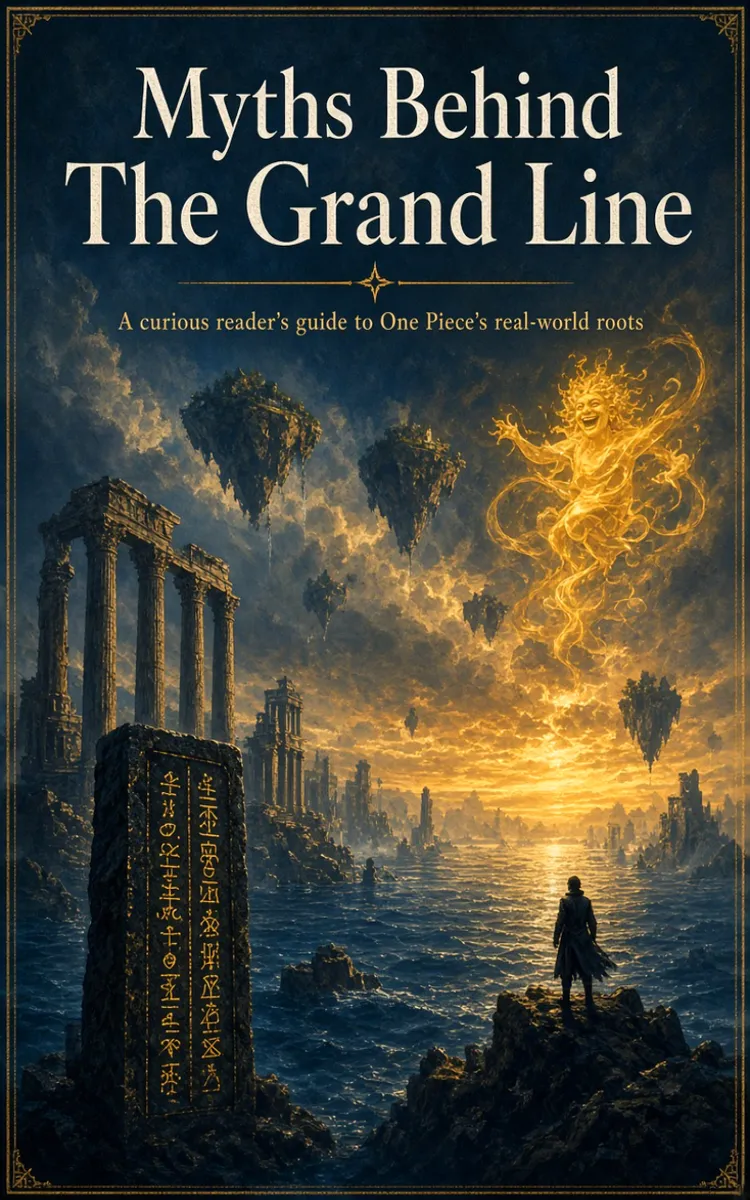
"Myths Behind The Grand Line" is a curiosity book by The Dingo with 13 chapters and approximately 23,309 words. Real-world myths, legends, and historical events reflected in One Piece.
This book was created using Inkfluence AI, an AI-powered book generation platform that helps authors write, design, and publish complete books.
Frequently Asked Questions
What is "Myths Behind The Grand Line" about?
Real-world myths, legends, and historical events reflected in One Piece
How many chapters are in "Myths Behind The Grand Line"?
The book contains 13 chapters and approximately 23,309 words. Topics covered include Why the Grand Line Feels Like Myth, The Sun God Behind Luffy’s Freedom, When the World Was Flooded, The Lost Century’s Real-World Shadows, and more.
Who wrote "Myths Behind The Grand Line"?
This book was written by The Dingo and created using Inkfluence AI, an AI book generation platform that helps authors write, design, and publish books.
Write your own curiosity book with AI
Describe your idea and Inkfluence writes the whole thing. Free to start.
Start writingCreated with Inkfluence AI


