
Read the first chapter
The whole of chapter one, free. About 7 min. Turn the pages with the arrows, your keyboard, or a swipe.
Chapter 1
The Investing Ego You Carry
The Price of Looking Smart
In 1720, Isaac Newton bought shares in the South Sea Company, watched the price rise, and sold with a profit. Then the price kept climbing. Newton bought back in at a much higher price and lost heavily when the bubble burst. He later said he could calculate the motions of heavenly bodies, but not the madness of people.
The important detail is not that Newton made a bad forecast. It is that his identity became involved. A brilliant man could tolerate missing an opportunity less easily than he could tolerate a loss. The decision looked like analysis, but pride had quietly joined the trade.
Your identity enters investing through small doors. You buy a company because it matches your beliefs. You refuse to sell because selling would admit that your original judgment failed. You choose an investment that sounds sophisticated because you want to see yourself as sophisticated. You call these decisions rational because the ego rarely announces itself as ego.
The Ego-Account Ledger helps you separate the financial reason for a decision from the identity reason hiding underneath it. After using it, you can spot when pride, reputation, or self-image has taken control before those forces turn an ordinary investment into an expensive personal argument.
The Ego-Account Ledger
An investment decision usually carries two accounts. The first account holds the financial case: expected return, risk, time horizon, cash needs, and alternatives. The second holds the emotional bill: what the decision says about you, what it helps you prove, and what embarrassment you want to avoid. The Ego-Account Ledger makes both accounts visible.
Write the financial case and the identity case separately. Do not trust yourself to keep them distinct in your head. A person who owns shares in a company may say, “The business has strong cash flow.” That may be true. The same person may also think, “I understand this industry better than most people.” That second thought can make new evidence feel like a personal insult.
Use these four entries before you buy, sell, or hold:
1. Financial reason. Write the plain reason for the decision. Name the business condition you expect, the time you can stay invested, and the loss you can withstand. If you cannot explain the decision without mentioning your intelligence, taste, or reputation, you have not yet written the financial reason.
2. Identity reward. Record what the decision lets you believe about yourself. Perhaps you become the disciplined investor, the contrarian, the person who “saw it early,” or the person who understands an industry others ignore. Naming the reward reduces its power because pride works best in the dark.
3. Identity threat. Write what would feel embarrassing or painful if the decision failed. You may fear admitting that a friend’s criticism was correct, selling after a public prediction, or abandoning an investment connected to your career. This entry matters because people often accept larger financial losses to avoid a smaller blow to their self-image.
4. Exit test. Define the fact that would make you change your mind. Use a business condition, valuation limit, cash requirement, or time boundary. Do not write “when I feel less confident.” Confidence often grows after a loss because the ego wants to defend itself.
Consider a tradesperson who owns shares in a tool manufacturer. The company’s products helped build his business, so the investment feels like loyalty as well as ownership. If the company loses market share, he may dismiss the warning because selling feels like rejecting the tools that helped him earn a living. The ledger separates gratitude from valuation. He can respect the product and still decide that the shares no longer deserve his money.
This process also exposes status purchases disguised as investments. A complicated fund, a private deal, or a large position in a fashionable company may offer little financial advantage while offering a strong identity reward. The question is not whether the investment looks impressive. The question is whether you would still buy it if nobody else could see the decision.
Applying the Ledger Before a Concentrated Investment
Consider a realistic decision: you have $30,000 available for long-term investing and want to place $12,000 into a company connected to your trade. You know its products, follow its management, and believe the market underestimates its future. You also mentioned the idea at a family gathering, where several people questioned it. Your pride now has two reasons to defend the purchase: proving your analysis and proving the company’s critics wrong.
Work through the decision in this order:
1. Write the financial case in five lines. State the company’s expected business improvement, the price you consider reasonable, the holding period, and the conditions that would weaken the thesis. Expected outcome: you should explain the purchase without using words such as “smart,” “obvious,” or “everyone else is missing it.”
2. Record the identity reward. Write: “If this works, I will feel like…” Complete the sentence honestly. You might write, “I will feel like the person who understands my industry better than professional investors.” Expected outcome: you see the emotional profit sitting beside the possible financial profit.
3. Record the identity threat. Write: “If this fails, I will fear that…” You might write, “I will look careless in front of my family.” Expected outcome: you recognize why you may hold too long after the facts change.
4. Set the position limit before buying. Decide whether $12,000 still makes sense if the shares fall by 40 percent and remain weak for two years. If that loss would force you to sell at the worst moment, reduce the position. Expected outcome: the amount reflects your ability to stay calm, not your desire to make the decision feel important.
5. Create the exit test. For example: review the investment every six months; sell if the company loses its main distribution advantage, carries debt you did not expect, or fails to meet your stated business goal by a set date. Expected outcome: you judge the investment against prior rules instead of inventing new reasons to defend it.
6. Ask the invisible-audience question. “Would I make the same decision if no one knew I owned this?” If the answer changes, lower the amount, delay the purchase for 48 hours, or reject it. Expected outcome: the investment must survive without applause or an argument to win.
A simple ledger might look like this:
| Entry | Honest answer | |---|---| | Financial reason | The company can grow sales through a distribution advantage I can explain | | Identity reward | I want to prove that industry experience gives me an investing edge | | Identity threat | I do not want my family to think I ignored their concerns | | Exit test | Sell if the distribution advantage disappears or the business misses the stated goal by the review date |
The point is not to remove emotion. You cannot remove it, and you do not need to. The point is to stop emotion from pretending to be evidence.
Quick checklist
• Write the financial reason before researching more. - Name what the investment lets you prove about yourself. - Name the embarrassment you want to avoid. - Set the position size before the price moves. - Define the facts that would change your mind. - Ask whether you would invest if nobody knew.
If the ledger shows a strong identity reward and a weak financial case, treat that as a warning. Do not add money to make the investment feel more convincing. Pride often asks for a larger position when it should ask for a second look.
When the Ledger Gives the Wrong Signal
Mistaking confidence for ego
Confidence does not automatically signal a problem. You may understand a business because you work in the field, read the financial reports carefully, and accept the risks. The warning appears when confidence blocks correction.
Do this: Let your confidence produce a clear exit test and a position size you can carry through a bad outcome. Not this: Treat every disagreement as proof that other people lack understanding.
A strong view should make your rules clearer, not make you immune to rules.
Using humility as another form of pride
Some investors build an identity around being cautious. They avoid every unfamiliar investment, then describe the avoidance as wisdom. That can protect capital, but it can also protect a self-image: “I am the person who never gets fooled.” The result may leave too much money idle because the investor values being uncriticized more than meeting a long-term goal.
Do this: Record the cost of refusing an investment, including lost time and missed progress. Not this: Call every uncomfortable decision reckless simply because it carries uncertainty.
The ledger must record both the ego cost of acting and the ego cost of doing nothing.
Changing the exit test after the loss
A falling investment creates a powerful temptation to rewrite the original case. You may replace “the business must improve within two years” with “good companies need patience.” That sentence could be true, but it does not answer the original question. It only extends the argument.
Do this: Read the original ledger before making a new decision. Mark which facts changed and which facts merely became painful. Not this: Add a new reason each time the old reason fails.
If the facts remain intact, holding may make sense. If the facts changed, selling does not prove that you were foolish. It proves that you allowed reality to outrank your image.
The investor’s hardest opponent often sits inside the same person who placed the trade. Pride wants a verdict about who you are. Money needs a decision about what happens next. Keep those questions apart, and you give yourself a better chance to act on facts rather than defend a reputation that exists mostly in your own head.
End of chapter one. 24 more chapters in the full book.
Swipe or use the arrows to turn the page


What's inside: 25 chapters
- 1. The Investing Ego You Carry
- 2. Your Brain Loves Stories
- 3. Regret: The Hidden Portfolio Manager
- 4. Loss Aversion and the Pain Budget
- 5. Overconfidence: The Quiet Leverage
- 6. When Confirmation Bias Feels Like Research
- 7. The Herd: Why Crowds Win Seconds
- 8. FOMO and the Fear of Missing Out
- 9. Anchors: The Price You Can’t Forget
- 10. Position Sizing Beats Prediction
- 11. Risk Is a Feeling, Not a Number
- 12. Luck: The Invisible Variable
- 13. Survivorship Bias in Your Feed
- 14. Uncertainty: The Market’s Real Weather
- 15. The Base Rate You Keep Ignoring
- 16. Overtrading: Activity as Addiction
- 17. Confirmation After the Fact
- 18. Wealth vs. Status: The Real Trap
- 19. The Comparison Game and Envy
- 20. When Money Becomes Identity
- 21. The Discipline of Process, Not Results
- 22. Drawdowns: How to Stay Calm
- 23. Risk Management as Self-Respect
- 24. Defining Enough: Your Personal Exit
- 25. Staying in the Game, Forever
About this book
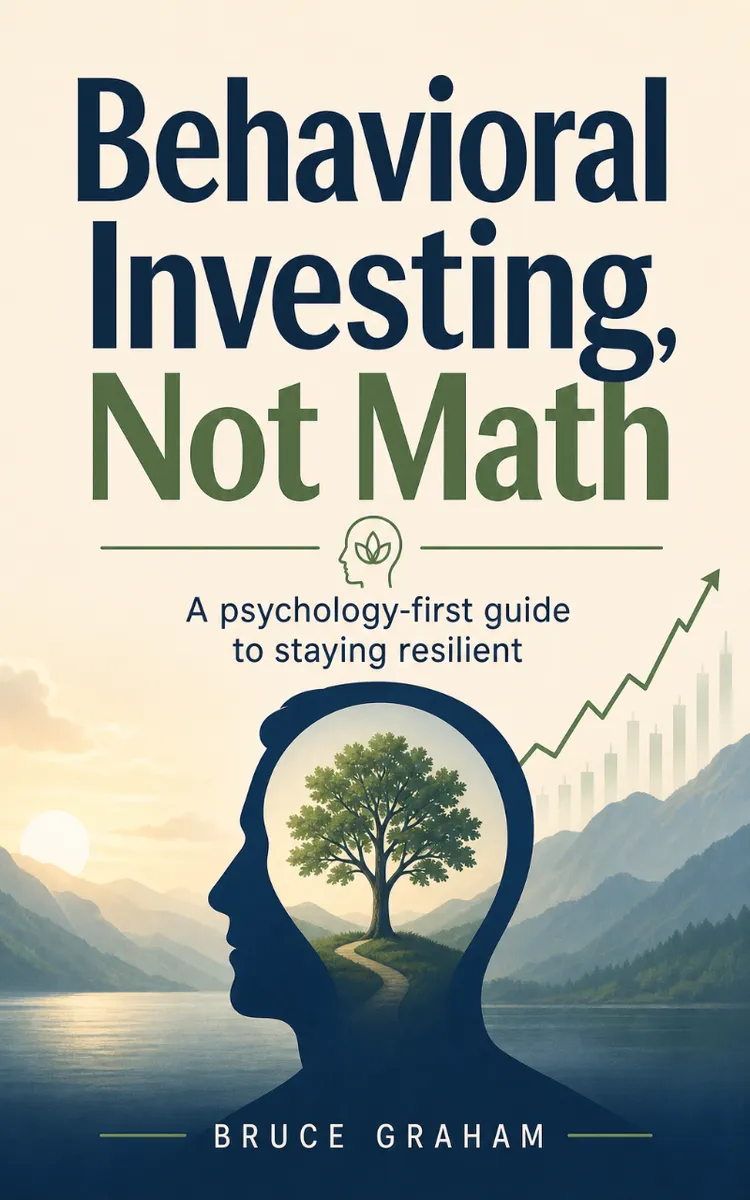
"Behavioral Investing, Not Math" is a finance book by Bruce Graham with 25 chapters and approximately 38,787 words. Investing psychology, behavior, and emotional mechanics.
This book was created using Inkfluence AI, an AI-powered book generation platform that helps authors write, design, and publish complete books. It was made with the AI Ebook Generator.
Frequently Asked Questions
What is "Behavioral Investing, Not Math" about?
Investing psychology, behavior, and emotional mechanics
How many chapters are in "Behavioral Investing, Not Math"?
The book contains 25 chapters and approximately 38,787 words. Topics covered include The Investing Ego You Carry, Your Brain Loves Stories, Regret: The Hidden Portfolio Manager, Loss Aversion and the Pain Budget, and more.
Who wrote "Behavioral Investing, Not Math"?
This book was written by Bruce Graham and created using Inkfluence AI, an AI book generation platform that helps authors write, design, and publish books.
How can I create a similar finance book?
You can create your own finance book using Inkfluence AI. Describe your idea, choose your style, and the AI writes the full book for you. It's free to start.
Write your own finance book with AI
Describe your idea and Inkfluence writes the whole thing. Free to start.
Start writingCreated with Inkfluence AI


