
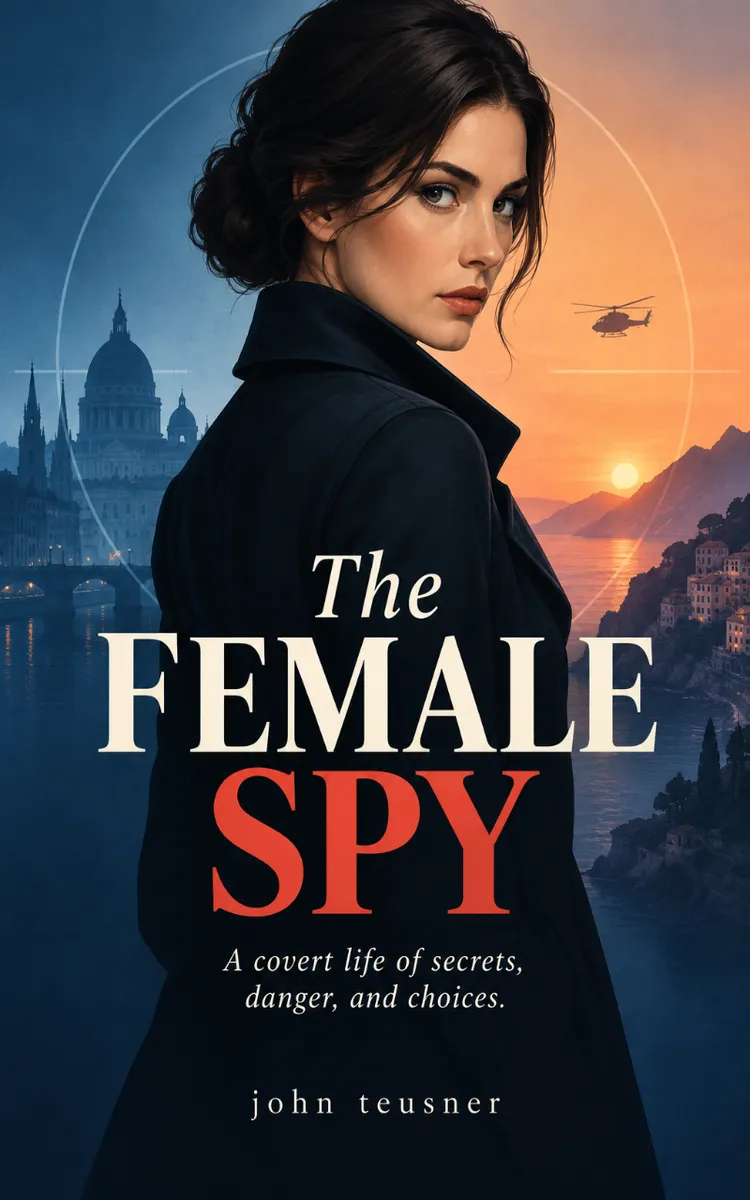
Read the first chapter
The whole of chapter one, free. About 9 min. Turn the pages with the arrows, your keyboard, or a swipe.
Chapter 1
The Safehouse That Isn’t Safe
The brass number 17 had been painted over so many times that the door looked bruised.
Mara Voss paused beneath the crooked awning and watched rain bead on the black lens of the streetlamp across the road. The foreign district pressed close around her: shuttered textile shops, balconies strung with dripping laundry, scooters ticking as their engines cooled. Somewhere behind the walls, a radio played a trumpet line that kept breaking under static.
She checked the address again.
17 Kestrel Lane. Third floor. Apartment 3B. The rented safehouse was supposed to be empty except for a kettle, a change of clothes, and a dead-drop compartment behind the kitchen tiles. Her handler would arrive at midnight.
Mara wanted ten quiet minutes inside it.
Ten minutes to confirm the place was usable, to find the exits, to make sure the city had not followed her from the station.
A tram shrieked around the corner. In its reflected windows, she saw the man across the street lower his newspaper without turning his head.
Mara climbed the steps.
The lock opened on the second key.
That was wrong.
The agency’s key had been cut yesterday in a shop three countries away, and the lock was meant to resist anything less than a deliberate hand. She eased the door inward. Warm air drifted over her wrist, carrying boiled coffee and the faint metallic tang of gun oil.
The apartment was occupied.
Mara did not enter. She let the door swing against its chain, then looked through the gap.
A narrow hall. Green wallpaper. A pair of men’s shoes beneath the radiator, wet at the soles. The sitting room beyond stood in darkness, though a thin bar of light showed beneath an interior door.
Someone had turned on a lamp.
She closed the door without a sound and stepped back onto the landing.
The stairwell smelled of damp plaster. Above her, a floorboard creaked.
Mara looked up.
A woman in a red cardigan leaned over the banister on the fourth floor. Her face was turned toward the street, but her hand rested on the rail, fingers still. Waiting.
Mara smiled at her as if they were neighbors.
“Good evening.”
The woman’s gaze dropped to Mara’s suitcase, then returned to her face.
“New tenant?”
“Visiting my aunt.”
“You have no aunt here.”
The woman said it in English.
Mara’s smile stayed in place. “Then she’ll be disappointed.”
She turned, descended two steps, and heard the apartment door behind her open.
Not the door at 3B. The building’s front door.
The man with the newspaper had crossed the street.
Mara moved down the stairs, keeping her pace even. The landing below was empty. A small window looked onto the alley, its glass clouded by rain. She stopped beside it and watched the reflection in the pane.
The man entered the lobby.
Another figure stood outside beneath the awning, smoking.
The woman in the red cardigan came down one flight behind Mara.
Three watchers. Perhaps more.
Mara touched the handle of her suitcase. The lining held a compact pistol, a forged passport, and a strip of surgical tape wrapped around a ceramic blade. None of them would help if she tried to force her way through the lobby. The building had only one street entrance. The alley window opened onto a drop of four meters, with a drainpipe too thin to trust.
Her handler was due in less than an hour.
If she left now, she would abandon the meeting. If she stayed, she might never reach it.
A door clicked open above.
The occupied apartment.
Mara went down another step, then stopped.
A voice floated from the hall.
“Ms. Voss?”
The man sounded young. Calm. He knew her name.
The woman behind her said, “You should answer.”
Mara turned. Red Cardigan had come close enough for Mara to see the pale crescent scar beneath her left eye.
“Who are you?” Mara asked.
“Someone trying to keep you alive.”
“Then you should have chosen a better building.”
The woman’s expression tightened. “Your handler is already inside.”
Mara felt the sentence land with the weight of a bullet.
The apartment door on the third floor opened wider. Light spilled across the stairwell. A man stepped into view, broad-shouldered, wearing a gray suit darkened by rain. He held no weapon that Mara could see.
That meant nothing.
“Mara,” he said. “Come upstairs.”
She recognized the voice. Not the handler’s, but close enough to belong to someone who had heard recordings of him.
Mara’s right hand slipped into her coat pocket and closed around the tram ticket she had kept from the station. The paper was damp and soft. Her mind worked through the building: lobby watched, street watched, apartment compromised, upper floor occupied. The window beside her had a loose latch.
She glanced at Red Cardigan.
The woman noticed. “Don’t.”
“Don’t what?”
“Make noise.”
Mara pulled the window open.
Cold rain struck her face. Below, the alley ran between the building and a row of garages. A stack of wooden crates sat beneath the window, perhaps two meters down. Beyond them, a narrow passage led toward the market street.
The gray-suited man moved onto the stairs.
“Mara, listen to me,” he said. “The address was burned before you crossed the border.”
“By whom?”
His eyes flicked toward the woman behind her.
That was answer enough.
Mara drove her shoulder into the window frame.
The latch tore free with a crack.
Red Cardigan lunged. Mara caught the woman’s wrist and twisted, using the rail for leverage. The woman hissed and struck with her free hand. Her knuckles clipped Mara’s cheek. Pain flashed white.
The gray-suited man reached for Mara.
Mara kicked the window wider and shoved Red Cardigan into him.
They collided on the stairs. Mara climbed onto the sill.
“Mara!” the man shouted.
She dropped.
Her boots hit the crates. Wood split beneath her weight. She rolled, struck the alley stones, and felt something tear along her left ribs. For a moment, rain hammered the hood of the nearest garage and the world narrowed to breath and pain.
Then the window above slammed shut.
Mara pushed herself upright.
A figure leaned over the sill. The gray-suited man. He aimed a pistol downward.
She ran.
The alley was slick with oil and rainwater. A bullet punched the crate behind her. Splinters cut her calf. She rounded the garage, flattened herself against the wall, and listened.
Footsteps above. A door opening. Someone shouting in the building.
Her suitcase lay back in the stairwell.
So did her pistol and passport.
Mara pressed a hand to her ribs. Her glove came away dark, though the wound felt shallow. She had arrived with a single objective and now possessed nothing but the clothes on her back.
A metal gate stood at the end of the passage. Locked.
She tested it once. Twice.
Behind her, footsteps entered the alley.
Mara looked left. A drainpipe ran up the garage wall, its lower bracket rusted. Above it, a window stood open on the second floor.
She grabbed the pipe.
It groaned.
“Stop!” someone called. “We can still talk.”
Mara pulled herself up. The pipe shifted under her weight. Her fingers slipped on the wet metal, but she caught the window ledge and hauled herself through.
She landed in a dark room filled with stacked chairs and folded tables. A restaurant, closed for the night. From the kitchen came the hum of refrigeration and the sharp scent of bleach.
The footsteps reached the alley below.
Mara crawled beneath a table and held still.
The window frame creaked. A hand appeared on the ledge.
She reached for the ceramic blade beneath her sleeve.
The hand withdrew.
“Search the market,” the gray-suited man ordered from below. “She has no money and no papers.”
Another voice answered, “What about the token?”
Mara’s fingers tightened around the blade.
The first man swore. “She doesn’t have it.”
“She was supposed to collect it.”
“She hasn’t met the contact.”
A pause.
Then the woman in the red cardigan said, “Perhaps she met him before she reached the building.”
Mara waited until their footsteps faded toward the street.
The restaurant door opened somewhere below. A bell gave a single tired chime. She slid out from under the table and found the back stairs.
The kitchen was empty. A row of knives gleamed beneath the fluorescent lights. She crossed to the rear door, lifted the latch, and stepped into another alley.
A blue sign glowed at the far end: Varga Clinic, open all night.
Mara had seen it on the city map. It was not part of the safehouse plan, but it was the only place nearby with a chance of shelter.
She reached the clinic’s side entrance and knocked three times.
A slot opened.
An old man looked out. “We’re closed.”
“I need a doctor.”
“We’re closed.”
Mara pressed her palm against her ribs. Blood seeped between her fingers.
The old man looked at it, then at her face. “Name?”
“Voss.”
His eyes changed.
Not surprise. Recognition.
He unlocked the door.
Mara entered, and he locked it behind her.
The clinic’s back room was narrow and bright, crowded with cabinets and plastic-wrapped instruments. The old man pointed to an examination table.
“Sit.”
“I need a phone.”
“You need stitches.”
“I need a phone.”
He stared at her. “The people outside?”
“Not yet. Soon.”
He crossed to a cabinet and removed a black metal case. Beneath it, tucked behind gauze and bottles of disinfectant, lay a small silver token.
Mara reached for it.
The old man caught her wrist.
“Your contact said you would ask for the medicine,” he said.
“I don’t have time for passwords.”
“Then you don’t have the token.”
A siren wailed somewhere beyond the clinic. It rose, fell, and vanished beneath the rain.
Mara looked at the token. Its surface was etched with a pattern of tiny intersecting lines, almost invisible beneath the fluorescent glare.
“What medicine?” she asked.
“Something for a woman who has been poisoned.”
“Then give me the token.”
His grip tightened. “The medicine.”
“Antidote.”
The old man released her.
Mara took the token. It was warm, as if someone had been holding it recently.
A faint vibration pulsed against her palm.
She froze.
The old man saw her expression. “What is it?”
Mara turned the token over. A pinprick of green light blinked beneath the etched surface.
Once.
Twice.
A third time.
“Tracking beacon,” she said.
The clinic door rattled.
The old man’s face emptied of color. “They followed you?”
“They followed this.”
She wrapped the token in a strip of gauze and shoved it into the inner seam of her coat.
The old man moved toward a rear cabinet. “There is another exit.”
“Where?”
“Through the treatment rooms. It opens into the laundry court.”
The front door rattled again, harder.
A voice called from outside. “Clinic staff! Open up!”
Mara drew the ceramic blade.
The old man stared at it. “You said you needed a phone.”
“I changed my mind.”
She crossed the room as the lock began to splinter. The clinic’s corridor smelled of antiseptic and old linen. Behind her, the old man pulled a lever disguised as a fire extinguisher bracket. A panel slid open at the end of the hall.
Mara stepped through.
“Who betrayed the address?” he asked.
She looked back.
He stood beneath the harsh clinic light, one hand still on the lever, the other pressed to his chest.
“I don’t know,” she said.
The front door gave way.
Mara pulled the panel shut and ran into the laundry court.
A narrow passage led toward the market. Rain poured through the gap between buildings, washing blood from her sleeve. At the far end, a tram clattered past, windows bright with strangers who knew nothing about her.
Mara slipped into the crowd behind it.
The token vibrated again beneath her coat.
This time, the green light shone through the fabric.
Across the street, a man in a gray suit stepped from the clinic doorway and raised his head.
Mara turned toward the market, moving faster.
The safehouse was gone. The handler was compromised. Her papers and weapon were still in the building she had entered believing it would protect her.
But the contact’s token was in her possession.
And somewhere inside it, someone had already marked her for pursuit.
End of chapter one. 7 more chapters in the full book.
Swipe or use the arrows to turn the page


What's inside: 8 chapters
- 1. The Safehouse That Isn’t Safe
- 2. Choosing the Face to Wear
- 3. The Harbor Checkpoints Lie
- 4. The Ledger Name That Doesn’t Exist
- 5. The Roof Signal That Triggers Fire
- 6. Mara Breaks Her Own Rules
- 7. The Station Platform Exchange
- 8. Proof in Nadia’s Hands
About this book
"The Female Spy" is a fiction book by john teusner with 8 chapters and approximately 18,026 words. A female spy navigating espionage missions and betrayals.
This book was created using Inkfluence AI, an AI-powered book generation platform that helps authors write, design, and publish complete books. It was made with the AI Novel Writer.
Frequently Asked Questions
What is "The Female Spy" about?
A female spy navigating espionage missions and betrayals
How many chapters are in "The Female Spy"?
The book contains 8 chapters and approximately 18,026 words. Topics covered include The Safehouse That Isn’t Safe, Choosing the Face to Wear, The Harbor Checkpoints Lie, The Ledger Name That Doesn’t Exist, and more.
Who wrote "The Female Spy"?
This book was written by john teusner and created using Inkfluence AI, an AI book generation platform that helps authors write, design, and publish books.
How can I create a similar fiction book?
You can create your own fiction book using Inkfluence AI. Describe your idea, choose your style, and the AI writes the full book for you. It's free to start.
Write your own fiction book with AI
Describe your idea and Inkfluence writes the whole thing. Free to start.
Start writingCreated with Inkfluence AI


