
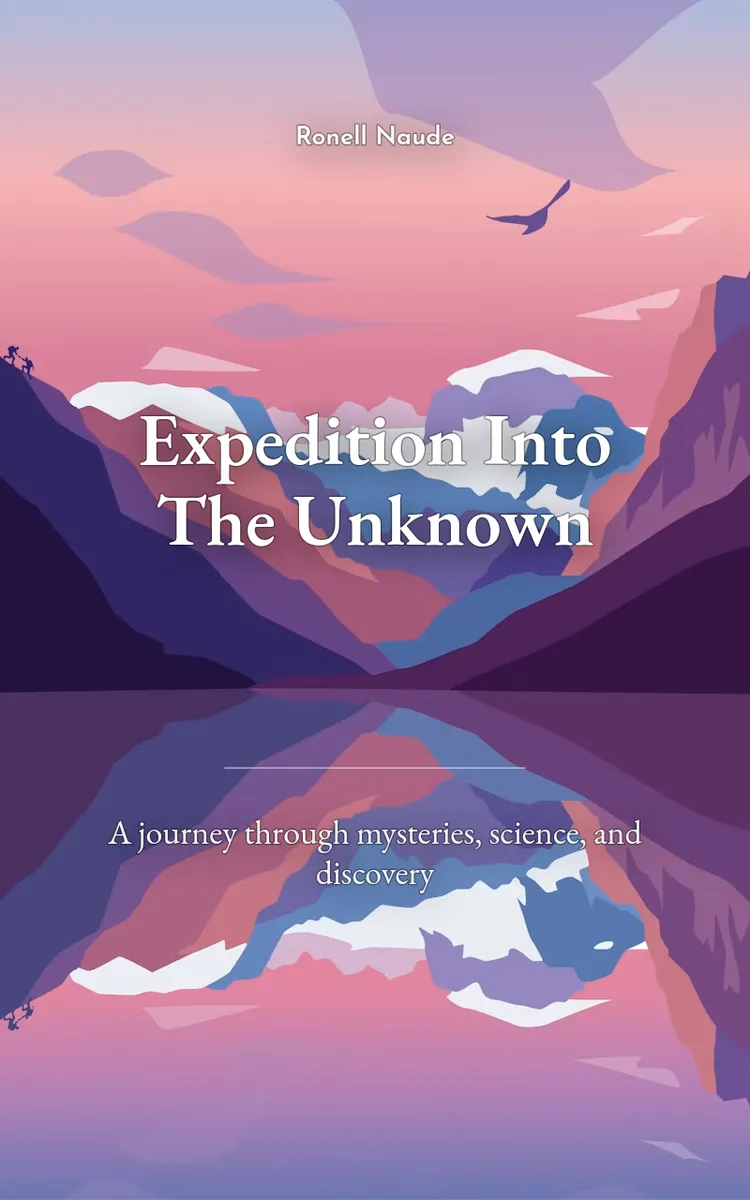
Read the first chapter
The whole of chapter one, free. About 10 min. Turn the pages with the arrows, your keyboard, or a swipe.
Chapter 1
The Compass That Points Elsewhere
The last red pin on Mara Ellison’s map trembled in its brass groove as the wind moved through the ravine. It was only a paper marker, but it marked the edge of the forbidden survey zone - and beyond it, the ridge they had crossed two weeks of bad weather to reach.
“Still moving,” Tomas said.
Mara tightened the strap of her pack and looked down at the compass in her palm. Its needle drifted west, paused, then swung north again. The marked ridge lay southeast.
“We’re not waiting for it to settle,” she said. “The ridge is three miles from here. If we reach it before dark, we can establish the first station.”
Tomas glanced at the ravine walls. They rose close on either side, gray stone streaked with black mineral bands. A few stubborn shrubs clung to cracks above them, their roots exposed like fingers. “The map says this cut runs straight through.”
“The map says a lot of things.”
Behind them, Ilya shifted the tripod case from one shoulder to the other. Metal knocked softly against metal inside. “Including that this area was surveyed and closed for safety reasons.”
“Surveyed from the rim,” Mara said. “Not from the ground.”
She stepped forward.
The ravine narrowed at once. Their boots scraped loose shale, and each stone that fell ahead of them clicked down the slope in a long, diminishing chain. The sound made the passage seem deeper than it was. Mara kept one hand on the compass and the other near the folded map in her coat.
At the edge of the survey zone, the old boundary posts stood half buried in scree. Their paint had faded to a color between yellow and bone. One leaned against the rock wall. Another had been split cleanly down the middle, though no axe marks showed in the wood.
Ilya stopped beside it. “There’s no reason to go past this.”
“There is,” Mara said.
“Your ridge?”
“Our ridge.”
He gave a short laugh without humor. “That distinction will comfort us if the ground opens.”
Mara looked toward the narrow throat of the ravine. Sunlight touched its upper rim but could not reach the floor. Cold pooled below, pressing through the seams of her gloves. Somewhere ahead, water dripped with patient regularity.
She lifted the compass.
The needle pointed southeast.
For the first time that morning, it held steady.
“See?” she said. “It works.”
Tomas adjusted the scarf around his neck. “That sounded like you were trying to convince the compass.”
Mara ignored him and crossed the boundary.
The others followed.
For the first half mile, the instrument guided them cleanly. The ravine floor bent around slabs of fallen stone, but the compass kept its direction. Mara checked the map whenever the walls opened enough to show the sky. The ridge should have appeared above the eastern shoulder before noon.
Instead, the passage turned sharply north.
Mara stopped.
Tomas nearly walked into her. “What is it?”
She held out the compass.
The needle pointed north, unwavering.
“That’s not the ridge,” Ilya said.
“I know.”
A gust came down the ravine, dragging dust over their boots. Mara unfolded the map against her knee. The contour lines showed a bend, but not one this severe. The old surveyors had drawn the ravine as a shallow channel leading southeast. Their route should have continued toward the ridge.
“Maybe the map is wrong,” Tomas said.
“It isn’t.”
“You just said maps say a lot of things.”
“Not this one.”
The paper was stiff from years of storage, its edges darkened by handling. Mara had copied the ridge coordinates herself from the survey archive. She knew every crease. The map did not show a northern branch.
Yet ahead of them, between two walls of stone, a passage opened into darkness.
Ilya peered into it. “Could be a washout.”
“Then we inspect it and return.”
Mara took three steps north.
The compass needle remained fixed.
Behind her, Tomas swore under his breath. “That’s the wrong way.”
“I can see that.”
“Then why are we going?”
Because the needle had never failed her. Not in the salt flats, where iron dust had made every instrument unreliable. Not on the northern ice shelf, where magnetic storms bent the readings by whole degrees. This compass had belonged to her mother, and its needle had always settled toward true north with a stubborn, almost personal precision.
Now it was pointing into a passage that did not exist on the map.
Mara closed the map.
“Because something is making it choose.”
No one answered.
They moved north.
The passage tightened until Mara could brush both walls with her hands. The stone was wet and cold beneath her gloves. A thread of water ran along the floor, black beneath the thin skin of ice. Their packs scraped against the rock. When Tomas breathed, the sound came back from somewhere ahead, altered and hollow.
After twenty minutes, the ravine widened into a pocket of pale gravel.
Mara checked the compass.
The needle swung east.
She stared at it.
Tomas leaned close. “What now?”
“It changed.”
“Perhaps it’s finally ashamed.”
Mara rotated the compass in her palm. The needle swung with her, then snapped east again. She took two steps in that direction. It followed. She turned west. It resisted, shuddering, then dragged itself back toward the dark cleft between the stones.
Ilya set down the tripod case. “There’s metal in the rock.”
“Enough to pull it?”
“Maybe.”
“Then why only the needle?”
He looked at the buckles on his pack, the steel tips of his poles, the brass clasps on the equipment case. Nothing moved.
Mara crouched and pressed the compass against the gravel. The needle remained east. She lifted it above her head. East. Held it near the rock wall. East.
Tomas watched her face. “We can mark this place and go back.”
The ridge was still southeast. The sun had climbed past noon. Every minute spent testing the compass was a minute taken from their daylight.
Mara looked at the map, then at the passage ahead.
“Back to where?”
The question settled among them.
They had entered the northern branch. The way behind them was narrow but clear. The way ahead descended into a darker cut where the water vanished under stone.
Ilya rubbed his hands together. “We’re losing time.”
“I know.”
“And if the compass is wrong - ”
“It has never been wrong.”
“That isn’t the same as being right now.”
Mara closed the lid of the compass. The needle continued to twitch beneath the glass.
She had the sudden impression that it was not pointing toward something. It was pulling away from something behind them.
“Give me the cord,” she said.
Tomas frowned. “Why?”
“Just give it to me.”
He pulled a length of orange survey cord from his pack. Mara tied it around the compass case and lowered it into the passage ahead. The instrument swung at the end of the cord, turning slowly until the needle faced east.
She walked.
The compass led them through a crack in the rock barely wide enough for a person. Mara went first, turning sideways, feeling the stone scrape her coat. The cold deepened as they descended. Water dripped onto her neck. Behind her, Tomas muttered as his pack caught on an outcrop.
“Keep moving,” she said.
“I’m trying to keep my ribs.”
The crack opened suddenly.
Mara stumbled onto a ledge overlooking a lower section of the ravine. The drop was no more than ten feet, but the floor below was crowded with broken stone. The water emerged from beneath the ledge and ran toward a cleft on the eastern wall.
The compass pointed straight at it.
“There,” Mara said.
Tomas climbed down first, testing each foothold. Ilya followed with the tripod case. Mara lowered herself last, boots skidding on damp rock. Her knee struck the ground hard enough to numb her leg.
The compass cord jerked.
She froze.
The instrument had swung behind her.
Not east.
West.
Toward the passage they had just left.
Mara pulled it close. The needle spun once, twice, then stopped.
West.
Tomas looked up from the base of the ledge. “Tell me that’s not what I think it is.”
“It’s pointing back.”
“Good. We can leave.”
Mara raised her eyes to the ledge. The crack above was already difficult to see. “No.”
He stared at her. “No?”
“We came down because it pointed east.”
“And now it points west.”
“Which means the direction changed.”
“Or the compass is broken.”
Mara felt the weight of the instrument in her hand. The case was cold, but beneath the glass the needle trembled as if caught in a current.
A low sound passed through the ravine.
Not wind. Not water.
The stone beneath her boots gave a faint, granular shiver.
Ilya looked toward the cleft. “Did you feel that?”
Another tremor moved through the ground. Pebbles rolled from the ledge and struck the water below. The ravine answered with a deep, distant knock.
Tomas climbed to his feet. “We’re going back.”
Mara should have agreed. The marked ridge was still within reach if they returned quickly, found the main channel, and cut southeast. But the compass had brought them here for a reason - or had been made to appear as if it had.
She looked at the dark cleft.
The water disappeared beneath it, but the current was too strong for such a narrow stream. Something beneath the rock was drawing it down.
“Five minutes,” she said.
Tomas shook his head. “No.”
“Five minutes to inspect the cleft.”
“That’s not the route.”
“No. It’s the reason the route changed.”
Ilya’s gaze moved between them. “Mara.”
She hated the warning in his voice. It was the same tone he had used when her mother’s compass first appeared in the expedition crate, wrapped in oilcloth and labeled with a date no one could explain.
Mara stepped toward the cleft.
The compass needle swung again.
This time it pointed downward.
A sharp crack split the air.
The ledge above them shed a sheet of stone. Mara threw herself against the wall as fragments struck the water and exploded into spray. Tomas grabbed Ilya by the collar and dragged him beneath the overhang. Dust filled the ravine, gritty against Mara’s teeth. For several seconds, there was nothing but falling rock and the hard rattle of loose equipment.
When the noise stopped, the passage behind them was blocked.
A slab had collapsed across the base of the ledge, sealing the narrow route beneath tons of stone.
Tomas stared at it. “Five minutes,” he said bitterly. “You got your five minutes.”
Mara forced herself upright. Her knee burned. The compass hung from its cord, swinging in the dusty air.
The needle pointed through the cleft.
She wiped grit from the glass.
“Then we go forward.”
“You can’t be serious.”
“We can’t climb that.”
“We can wait for the others to find us.”
“They’re on the other side of the boundary. They don’t know where we are.”
“And if we follow that thing?”
Mara looked at the black water vanishing under the rock. “Then we find out what it wants.”
Tomas stepped close enough that his shoulder brushed hers. His voice dropped. “That isn’t navigation.”
“No,” she said. “It isn’t.”
The admission frightened her more than the blocked passage.
They moved along the lower ravine, following the compass through a channel where the walls leaned together overhead. The light thinned to a blue-gray smear. Mara tied orange cord to every third stone, though the markers seemed absurdly bright against the dark.
Then, beneath a shelf of rock, she saw paint.
A fragment of red marked the stone at knee height. Mara crouched and brushed away mud with her glove. Beneath it was a survey symbol: a broken triangle crossed by a single line.
A trail marker.
“Here,” she said.
Tomas knelt beside her. “This is from the old survey.”
“Not on the map.”
The marker continued around the corner, but only for two feet before vanishing beneath a collapse. Someone had once come this way. Someone had marked the route and then stopped.
Mara pulled out the map. The ridge line was close now - closer than it should have been. If the marker belonged to the original survey crew, the ravine might lead directly beneath the ridge.
She opened the compass.
The needle snapped north.
Not southeast. Not east. North again, toward a narrow gap where the rock walls met.
Tomas let out a slow breath. “The ridge is there.”
“I know.”
“The marker says this way.”
“I know.”
“Then follow the marker.”
Mara looked from the painted triangle to the compass. The needle quivered once, then locked into place with a tiny metallic click.
The gap ahead was too narrow for the equipment case. Beyond it, something breathed - not loudly, not like an animal, but in a long measured draw that pulled the loose dust across the stones.
Ilya lifted the tripod case. “We can’t take this through.”
Mara reached for the case and unfastened its straps.
Tomas caught her wrist. “If we leave it, we lose the station.”
“If we stay, we lose the daylight.”
“And if we go in there?”
Mara looked at the compass. Its needle pointed north, away from the ridge, away from the marked trail, away from every line she had trusted to bring them here.
She pulled free and began stripping the case down to its smallest components.
“We follow,” she said.
The first piece of equipment disappeared into the gap.
Then Mara ducked beneath the stone and went after it, while behind her the painted trail marker faded into dust and the compass pulled them toward a direction no map had ever named.
End of chapter one. 14 more chapters and about 28,899 words in the full book.
Swipe or use the arrows to turn the page


What's inside: 15 chapters
- 1. The Compass That Points Elsewhere
- 2. The Campfire That Smells Like Rain
- 3. Footprints That Appear After Rain
- 4. The Bridge That Collapses Twice
- 5. Mara’s Promise to Bring Back Proof
- 6. The Map That Refuses to Stay Put
- 7. The Sealed Valley’s Living Echoes
- 8. The Humidity Key in the Log
- 9. The Climb That Costs Their Oxygen
- 10. The Signal That Calls the Wrong Thing
- 11. Mara Admits She Can’t Lead
- 12. The Dead Member’s Trail Goes Cold
- 13. Mara Breaks the Humidity Key
- 14. The Outside Sky Isn’t the End
- 15. Proof in the Wrong Direction
About this book
"Expedition Into The Unknown" is a fiction book by Ronell Naude with 15 chapters and approximately 28,899 words. Exploration of unknown places, phenomena, and mysteries.
This book was created using Inkfluence AI, an AI-powered book generation platform that helps authors write, design, and publish complete books. It was made with the AI Novel Writer.
Frequently Asked Questions
What is "Expedition Into The Unknown" about?
Exploration of unknown places, phenomena, and mysteries
How many chapters are in "Expedition Into The Unknown"?
The book contains 15 chapters and approximately 28,899 words. Topics covered include The Compass That Points Elsewhere, The Campfire That Smells Like Rain, Footprints That Appear After Rain, The Bridge That Collapses Twice, and more.
Who wrote "Expedition Into The Unknown"?
This book was written by Ronell Naude and created using Inkfluence AI, an AI book generation platform that helps authors write, design, and publish books.
How can I create a similar fiction book?
You can create your own fiction book using Inkfluence AI. Describe your idea, choose your style, and the AI writes the full book for you. It's free to start.
Write your own fiction book with AI
Describe your idea and Inkfluence writes the whole thing. Free to start.
Start writingCreated with Inkfluence AI


