
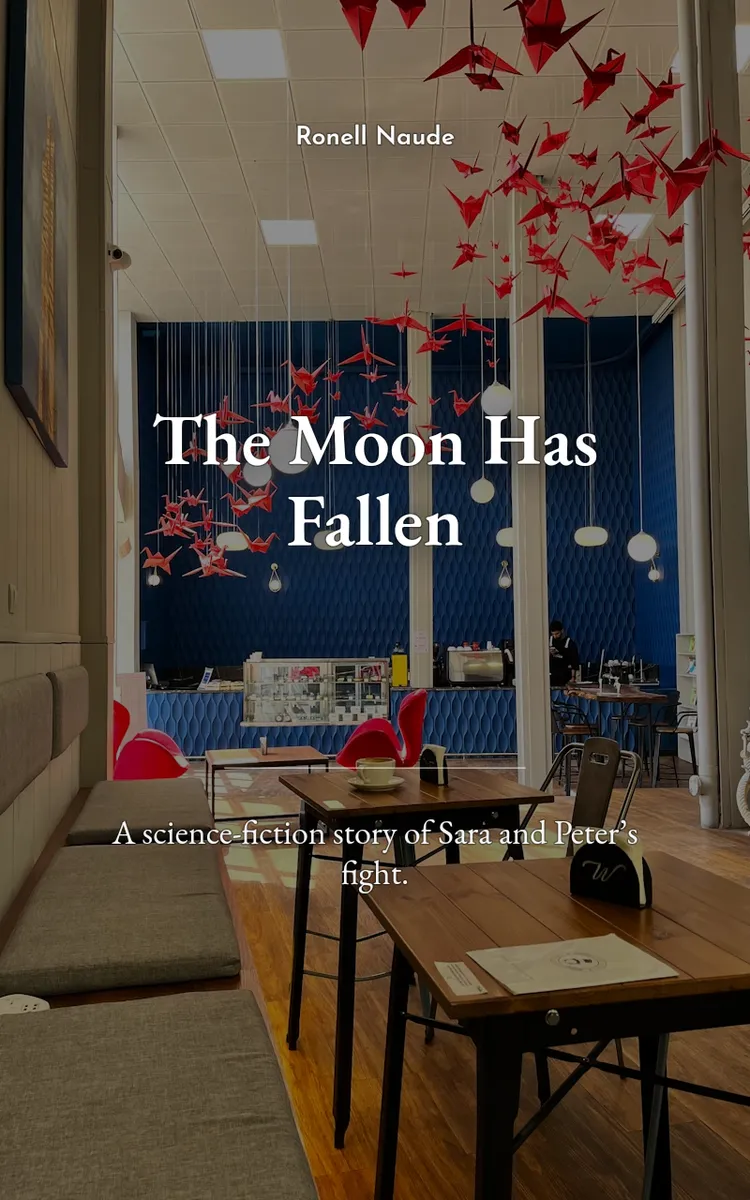
Read the first chapter
The whole of chapter one, free. About 9 min. Turn the pages with the arrows, your keyboard, or a swipe.
Chapter 1
The Sky Goes Dark Over Luna
The maintenance ring’s outer windows flashed white, turning every bolt in Corridor C-19 into a hard little star.
Sara Kessler looked up from the coolant panel as the ring shuddered beneath her boots. The wrench slipped from her glove and struck the deck, rebounding once in the low gravity before the emergency sirens began.
“Luna Control, this is Ring Three,” she said, already reaching for her comm. “We’ve got a seismic event. Confirm status.”
Only static answered.
A second tremor rolled through the corridor. Light strips flickered overhead. Somewhere beyond the pressure doors, metal groaned with the long, tortured complaint of a structure being pulled apart.
Sara pushed away from the panel and caught the handrail. Through the narrow window at the corridor’s end, Luna filled half the sky.
It was no longer where it belonged.
The moon’s surface burned in a widening crescent of white and orange. Mountain ranges tore upward into space. Clouds of rock and dust streamed behind it as if the planet had hooked a chain through its core and was dragging it down.
Sara forgot to breathe.
The moon has fallen.
Her comm snapped alive with a burst of voices.
“ - ring losing attitude - ”
“ - doors won’t cycle - ”
“ - Peter, get off the maintenance spine, now!”
Sara seized the wall console. The display came up red, then broke into a grid of corrupted symbols. Every route map on the ring shifted at once, corridors blinking in and out as the navigation system lost its reference points.
“Peter,” she said. “Answer me.”
A sharp crack sounded over the channel. Then Peter’s voice, strained and distant.
“I’m here. I’m in the east service run. What happened?”
“Luna hit.”
Silence.
The words seemed too small for the sight beyond the glass.
“What do you mean, hit?” Peter asked.
“I mean it’s down there.” Sara glanced at the window. A plume of incandescent debris rose from the lunar horizon, expanding across the black. “The whole belt is going dark. Get to the crew habitat.”
“I’m trying. Bulkhead twelve is sealed.”
“Override it.”
“I would if the doors knew which side of the wall they were on.”
A violent jolt threw Sara into the console. Her shoulder struck metal. Pain flashed down her arm, and the comm slipped from her hand. She caught it before it spun away.
The corridor lights died.
For one breath, there was only the blue glow of Luna’s ruin and the ticking of cooling machinery. Then red emergency lamps stuttered on, one after another, leaving long gaps of darkness between them.
Sara keyed the crew channel. “Everyone, report. Sound off.”
Voices answered through static.
“Habitat secure - no, wait, pressure alarm - ”
“Cargo spine trapped. We’ve got three people here.”
“Medical bay’s locked.”
“Where’s the gravity?”
The ring lurched again. Sara’s boots lifted from the deck. She slammed against the handrail and pulled herself forward, using the cable conduit as a guide.
“Stop talking over each other,” she said. “Seal masks on. Stay together. I’m getting to emergency comms.”
Peter cut in. “Sara, the habitat is on the far side of the ring.”
“I know.”
“The main corridor is gone.”
“I know that too.”
A deep impact rolled through the structure. Dust puffed from a ceiling seam. The red lamps went black, then returned with half their number.
Sara checked the nearest access panel. The route to emergency comms had been rerouted through the central maintenance hub. That hub was six corridors away, beyond three automatic locks and a section of ring now spinning without attitude control.
Her crew had no way to call for rescue. No way to know which doors would open, which compartments still held pressure, or whether the ring would remain in orbit after the next wave struck.
She pulled the emergency key from her belt.
“I’m moving,” she said. “Peter, find the others and bring them toward Junction Four.”
“Junction Four is marked outside the safe zone.”
“The safe zone just lost its map.”
“That’s not an answer.”
“It’s the only one I have.”
She shoved through the first pressure door. It opened halfway, groaning against a twisted frame. On the other side, the corridor had become a maze of floating equipment. A tool cabinet had torn loose and wedged across the passage. Cables drifted from the ceiling, sparking against the walls.
Sara pushed herself through a gap barely wide enough for her shoulders. Her suit scraped the metal. The air tasted of hot insulation through the filter, and somewhere nearby a coolant line hissed with a steady, furious whisper.
“Peter, report.”
“Moving. I’ve got six with me.”
“Only six?”
“Others are on the cargo side. I can’t reach them.”
“Keep the six alive.”
“Always your gentlest order.”
His voice steadied her. Peter had a talent for making fear sound like an inconvenience. Sara pictured him gripping the handrails, jaw clenched, guiding frightened crew through the dark. She wanted to tell him she was coming back.
The ring bucked before she could speak.
A section of wall split open ahead. Air tore through the gap, dragging loose panels and a coil of wire toward the breach. Sara hooked one arm around a support strut and grabbed the nearest emergency shutter with the other. The shutter controls blinked without power.
“Come on,” she muttered.
The pressure warning began to pulse in her helmet. Her gloves slipped on the cold metal. Beyond the breach, stars streamed past in a crooked arc, and fragments of Luna spun through the distance like sparks from a struck furnace.
She drew the manual release lever.
Nothing happened.
Sara braced both boots against the wall and pulled again. The lever shifted a centimeter, then locked.
“Peter,” she said. “I need power at C-22.”
“Power’s down everywhere.”
“Then find me some.”
“That’s your plan?”
“It’s the plan that keeps us from becoming vacuum.”
A burst of static swallowed his reply.
The warning in her helmet turned amber. Forty seconds until the corridor lost pressure.
Sara unlatched the battery from her suit and jammed its connector into the shutter’s maintenance socket. The battery indicator dropped instantly. The shutter shivered.
“Thirty seconds,” the suit announced.
“Noted.”
She pulled the lever a third time. The shutter slammed across the breach, crushing the loose wire and sealing the corridor with a sound like a gunshot. Air rushed back into her suit. The pressure warning faded.
Her battery showed eleven percent.
“C-22 sealed,” she said.
Peter’s voice returned, rough with interference. “Junction Four just moved.”
“Junctions don’t move.”
“This one did. Or the corridor did. I’m looking at a wall where the route should be.”
Sara reached the next hatch and forced it open. Beyond lay the central maintenance run, a narrow passage wrapped around the ring’s interior spine. The normal white strips were dead. A single green line glowed along the floor, then vanished, reappearing several meters away on the ceiling.
Navigation was scrambling itself.
She clipped her tether to the guide rail and pushed off. The corridor rolled around her. For a moment she was moving sideways through a tunnel of darkness, with Luna’s reflected fire flickering across the walls. Loose screws struck her visor. Her shoulder throbbed where she had hit the console.
“Peter, can you see the green guide line?”
“Negative. I see three of them.”
“Take the one that leads inward.”
“They all lead inward.”
Sara stopped herself against a junction brace. Three corridors opened ahead, each marked with a different emergency symbol. The symbols pulsed, changed, and rearranged.
She pulled the printed maintenance schematic from the pocket at her hip. Paper was old-fashioned, but it did not lose its mind when the ring’s computers panicked. She held it beneath the red lamp and traced the routes with one gloved finger.
The emergency comms lay beyond the central spine. The shortest path crossed the reactor service corridor, where the ring’s power couplings ran beneath armored decking. If the reactor had survived, she could bring one circuit online manually.
If it had not, the crew would have minutes.
“I’m taking the reactor route,” she said.
Peter exhaled sharply. “That corridor was damaged during the last impact.”
“So was everything else.”
“Wait for me.”
“I can’t.”
“You said we stay together.”
“I said keep the crew alive. There’s a difference.”
“Not to me.”
The words landed harder than the tremors.
Sara closed her eyes for half a second. Peter was not supposed to sound afraid. Not with her. They had spent two years learning how to trust each other across failing systems and bad odds, but neither of them had learned how to say what that trust cost.
“I’ll open the comms,” she said. “Then I’ll come back.”
“You’d better.”
She pushed into the reactor service corridor.
Heat pressed through the walls. The air was thick with the metallic tang of scorched wiring. Every few meters, a panel had blown outward, exposing bundles of cables and glowing circuit boards. The deck tilted sharply, forcing Sara to crawl along the handrail.
At the corridor’s end, the reactor access door stood open.
Inside, the emergency power cabinet flickered with a weak amber light.
Sara pulled herself into the compartment. The cabinet’s manual controls were intact, but the primary bus had burned out. She opened the lower panel and found three auxiliary routes, all disconnected by the impact.
One route fed life support.
One fed navigation.
One fed emergency communications.
She had enough charge in her suit battery to bridge only one.
Peter came over the comm again. “Sara, we’re at the junction. The habitat door is cycling.”
“Can you get it open?”
“It opens for two seconds, then locks.”
“How many crew?”
“Eight now. Two injured.”
Sara stared at the three dead routes.
Life support would keep the habitat breathable. Navigation might stabilize the ring. Communications could call the belt, if anything out there still listened.
A tremor shook dust from the cabinet ceiling.
“Peter,” she said, “get everyone through on the next cycle.”
“And you?”
“I’m going to power the comms.”
“That won’t help us if the habitat seals.”
“It will if you move.”
“Sara - ”
“Move!”
She tore the battery cable from her suit and stripped the insulation with the edge of her wrench. The exposed wire sparked against the emergency bus. She flinched, then jammed it into the communications feed.
The cabinet screamed.
Across the compartment, dead panels burst into light. A low vibration passed through the ring as the auxiliary circuit woke. The emergency comms indicator turned green.
At the same moment, every door on the ring unlocked.
Peter shouted over the channel. “They’re open! We’re through!”
Sara sagged against the cabinet, relief lasting less than a second.
Then the reactor alarm began.
The auxiliary route had drawn power from a system that was never meant to carry the load. Heat climbed through the compartment. The cabinet display flashed a countdown.
Four minutes until automatic isolation.
“Sara,” Peter said, his voice suddenly clear. “We’re inside the habitat. The pressure doors are sealing.”
“Good.”
“Your signal is fading.”
“I’m at the central comms.”
“Don’t stay there.”
“I have to route the transmission.”
A new sound entered the channel beneath his voice: a faint, repeating pulse. Not static. Not an alarm. Something deliberate.
Sara turned toward the comms console.
The signal was coming from inside the ring.
She left the reactor compartment and followed the green emergency lights through the newly unlocked corridors. The ring spun unevenly around her. Behind the walls, pumps hammered and metal shifted. Every few seconds, the comm pulse returned, stronger than before.
At last she reached the central maintenance corridor.
Partial power glowed along the floor, illuminating a service hatch at the far end. The access panel beside it was open. Someone had already bypassed the lock.
Sara raised her wrench and advanced.
The hatch console flashed once.
ACCESS KEY PRESENT.
A second line appeared beneath it.
ACCESS KEY CONTESTED.
The lock began to cycle.
From the other side of the hatch came a scrape of metal against metal, followed by a voice she did not recognize.
“Step away from the door.”
Sara tightened her grip on the wrench. Behind her, Peter called her name through the comm, but the signal broke apart into static.
The hatch unlocked halfway.
Something on the other side pulled back.
Sara reached for the manual override as the corridor lights went dark again.
End of chapter one. 14 more chapters and about 28,913 words in the full book.
Swipe or use the arrows to turn the page


What's inside: 15 chapters
- 1. The Sky Goes Dark Over Luna
- 2. Peter Finds a Live Beacon
- 3. Sara Decodes the Intruder’s Route
- 4. The Vault Door Refuses Her
- 5. Sara Chooses to Trust Peter
- 6. Peter Escapes the Relay Trap
- 7. Sara Hunts the Missing Beacon Module
- 8. The Scrapyard Broadcast Names the Target
- 9. Sara Refuses Caldwell Varron’s Offer
- 10. The Detonation Wipes Their Trail
- 11. Sara Loses Peter in the Smoke
- 12. Peter Finds the Vault Key in Code
- 13. The Moon-Fall Signal Opens Everything
- 14. Sara Trades Survival for Truth
- 15. A New Orbit, a New Promise
About this book
"The Moon Has Fallen" is a fiction book by Ronell Naude with 15 chapters and approximately 28,913 words. Science-fiction novel about the moon falling and two protagonists.
This book was created using Inkfluence AI, an AI-powered book generation platform that helps authors write, design, and publish complete books. It was made with the AI Novel Writer.
Frequently Asked Questions
What is "The Moon Has Fallen" about?
Science-fiction novel about the moon falling and two protagonists
How many chapters are in "The Moon Has Fallen"?
The book contains 15 chapters and approximately 28,913 words. Topics covered include The Sky Goes Dark Over Luna, Peter Finds a Live Beacon, Sara Decodes the Intruder’s Route, The Vault Door Refuses Her, and more.
Who wrote "The Moon Has Fallen"?
This book was written by Ronell Naude and created using Inkfluence AI, an AI book generation platform that helps authors write, design, and publish books.
How can I create a similar fiction book?
You can create your own fiction book using Inkfluence AI. Describe your idea, choose your style, and the AI writes the full book for you. It's free to start.
Write your own fiction book with AI
Describe your idea and Inkfluence writes the whole thing. Free to start.
Start writingCreated with Inkfluence AI


