
Read the first chapter
The whole of chapter one, free. About 10 min. Turn the pages with the arrows, your keyboard, or a swipe.
Chapter 1
The Map That Lied
The map’s paper had been stitched with fishing line, three crooked loops holding together the corner where the old town used to be.
Mara tightened the last knot with her teeth and glanced toward the rail yard. Evening light slid between the broken signal towers, turning the rusted tracks the color of dried blood. Her supply pouch lay open beside her knee. Two water tabs. Half a strip of dried beans. A flare with its cap missing.
The coast was marked in blue ink beyond the western ridges.
If the map told the truth, she could reach it in four days.
If it lied, she would die somewhere between the rails and the sea.
She folded the map along its original creases and tucked it beneath her jacket. The paper was warm from her hands. For a moment, she pressed her palm against it, as if the coast might pulse through the fibers.
Then a loose rail clanged in the distance.
Mara went still.
The sound came from the eastern throat of the yard, where the tracks vanished beneath a collapsed pedestrian bridge. Not wind. Not settling metal. Something had stepped on the rail.
She slid her knife free.
The yard stretched around her in layers of wreckage: freight cars tipped onto their sides, weeds pushing through cracked concrete, cables hanging from dead towers. Beyond it, the old town crouched beneath a haze of ash, its rooftops broken open to the sky. No movement showed between the buildings.
Another clang.
Closer.
Mara lowered herself behind the shell of a signal box. Its metal wall pressed cold against her shoulder. She watched the gap between two derailed cars.
A pale shape moved there.
She gripped the knife until the handle bit her palm. A dog emerged, ribs showing beneath matted fur. It sniffed the ballast, then lifted its head toward her.
“Go on,” she whispered.
The dog’s ears flattened.
A pebble clicked behind her.
Mara turned and threw herself sideways as a bolt punched through the signal box wall. It struck the rusted panel where her head had been and spun away with a bright metallic shriek.
She hit the ground hard. Dust filled her mouth. Across the yard, three figures rose from behind the freight cars.
“Map girl!” one of them called. “Don’t make us dig for it.”
Mara rolled behind a concrete footing as another bolt snapped against the rail. The dog fled, claws skittering over stone.
They knew about the map.
Her hand went to the inside of her jacket. The stitched paper pressed against her ribs.
“Who sent you?” she shouted.
A man laughed. “You already know.”
She did not. That was the worst part.
Mara had found the map that morning inside the dead stationmaster’s office, beneath a drawer swollen shut by years of rain. The coast had been marked in a careful blue hand, along with a route through the hills and three landmarks. The first was a water tower shaped like a tuning fork. From there, the line led west.
She had trusted it because she needed something to trust.
A bolt struck the concrete above her. Chips stung her cheek.
The supply pouch lay six feet away in the open. Her water tabs were inside. So was the flare. Leaving it meant losing the only supplies that might get her past the hills.
The men began moving around the wreckage.
Mara pulled a broken length of cable from the ground and tossed it toward the far side of the yard. It clattered against a boxcar.
“There!” someone shouted.
Boots pounded away from her.
She lunged for the pouch.
A hand caught the back of her jacket.
Mara drove her elbow into the attacker’s throat. He gagged, but his grip held. She twisted, slammed her forehead into his nose, and felt cartilage give beneath the impact. He released her with a wet curse.
She snatched the pouch and ran.
The rail yard opened ahead in a maze of tilted cars and collapsed platforms. Mara vaulted a sleeper, slipped on loose gravel, and caught herself against a wheel rim. The metal was hot despite the fading sun.
“Cut her off!”
She heard feet behind her. More than three. Maybe four.
A narrow passage led between two freight cars. She entered without slowing. The gap tightened around her shoulders, the air sharp with rust and old oil. At the far end, daylight flashed.
Then a man stepped into it.
He carried a length of pipe and wore a cracked respirator hanging beneath his chin. His eyes fixed on Mara’s jacket.
“Hand it over,” he said.
Mara stopped.
Behind her, boots scraped closer.
The man lifted the pipe. “The map.”
“You can read?”
His mouth tightened. “I can follow lines.”
“Then follow mine.”
She kicked the rail beneath him.
The old track shifted with a groan. One of the freight cars leaned harder, its wheels grinding against the sleepers. The man stumbled. Mara drove her shoulder into his chest and forced past him as the car lurched.
Metal screamed behind her.
She burst into the open just as the freight car slid from its supports. It crashed into the passage, crushing the man beneath a storm of splintered wood and rust. The impact shook the yard. Dust rolled across the tracks.
Mara did not stop to see whether he lived.
She ran toward the western edge, where the map promised a drainage culvert beneath the old highway. Her lungs burned. The pouch slapped against her hip. Behind her, voices rose through the dust.
The culvert appeared as a black mouth under a slab of fallen roadway.
Mara dropped to her knees and crawled inside.
The concrete scraped her palms. Water trickled beneath her, cold enough to numb her fingers. She dragged herself forward until the voices outside faded into muffled shouts.
Only then did she stop.
Her breath came in harsh, shallow pulls. She listened.
Nothing but dripping water and the distant ticking of cooling metal.
Mara sat back against the culvert wall and pulled out the map. The paper had torn where the attacker’s hand had caught her jacket. A dark smear of blood crossed the blue route.
She unfolded it beneath the weak light from the entrance.
The first landmark was less than a mile ahead: the tuning-fork water tower.
Mara knew that tower.
Everyone in the old town knew it. Two narrow tanks rose above the western warehouses, joined by a high pipe. The structure had survived the fires and the winter storms. Its shadow marked the edge of the safe routes.
Safe, if the map was right.
She wiped blood from the paper with her sleeve. The landmark’s symbol had been drawn in blue ink, precise and delicate. Beneath it, someone had written a single word.
LISTEN.
Mara frowned.
The word had not been there when she found the map.
She ran her thumb over it. The ink was dry, but newer than the rest. The letters had been added by a narrow-tipped pen, each stroke pressed deep into the fibers.
A sound drifted through the culvert.
Three notes.
Low. High. Low.
Mara froze.
The same pattern came again from somewhere beyond the western exit.
A signal.
She folded the map and crawled toward the light. The sun had dropped behind the broken town, leaving the sky bruised purple. The water tower stood ahead, exactly where the map said it would.
Two tanks. One connecting pipe.
A tuning fork against the dark.
Mara stayed low and studied the ground. The route to the tower crossed an open service road littered with burned vehicles. No movement. No birds. Even the wind seemed to avoid the place.
She touched the radio clipped to her belt. Dead weight. The generator back at the station had given her only a few minutes of charge before choking out, but the radio had caught a voice in the static.
Mara Kincaid.
It had spoken her name.
She had assumed the transmission was an echo from some surviving relay. Now she wondered whether the voice had been waiting for her to find the map.
Another three-note signal sounded from the tower.
Low. High. Low.
Mara stepped out of the culvert.
The first half of the road was empty. She crossed quickly, keeping behind the burned cars. Their doors hung open, interiors packed with gray ash. Halfway to the tower, she saw a strip of red cloth tied to a bent signpost.
The map showed no signpost.
She stopped.
The cloth fluttered once.
A rifle cracked.
The burned car beside her erupted in sparks. Mara dropped behind its engine block as bullets punched through the hood. The metal rang against her teeth.
“Wrong way,” a voice called from the tower.
Not one of the men from the rail yard. This voice was calm, almost bored.
Mara pressed her cheek to the gritty pavement and looked toward the water tower. Figures occupied the catwalk between the tanks. Four of them. Maybe five. Their weapons pointed down.
A trap.
The landmark had not led her toward safety. It had led her into a killing ground.
She reached beneath her jacket and pulled out the map. The blue route ran straight through the service road to the tower. There was no alternate path marked.
“Who are you?” she called.
The calm voice answered from above. “You know where you’re going, Mara.”
Her stomach tightened.
“You’ve been following me.”
“We’ve been waiting.”
“For what?”
“For you to stop pretending the coast is yours alone.”
A bullet struck the pavement near her hand.
Mara looked behind her. The culvert entrance lay thirty yards away, partly hidden by the road’s broken edge. The people at the tower had chosen their position well. They could see every approach except the drainage channel.
But the rail-yard hunters were coming from behind.
She heard them before she saw them: boots crunching over the service road, voices spreading wide to surround the burned cars.
The tower group had driven her here. The others had been part of it, whether they knew it or not.
Mara folded the map and shoved it into her waistband.
The calm voice called down again. “Give us the paper. We’ll let you walk.”
“Why?”
“Because we want you to keep walking.”
The words landed harder than the gunfire.
Mara glanced at the tower. The people above were not trying to kill her. They were herding her. Every shot had pushed her toward the open road, toward the landmark, toward this exact patch of cover.
Someone had drawn the route for her long before she found it.
She pulled the flare from her pouch.
Its cap was already missing. The red cylinder was slick with sweat.
Mara struck it against the broken edge of the engine block.
For one breath, nothing happened.
Then red fire roared in her hand.
The tower figures shouted. Mara hurled the flare beneath the nearest burned vehicle and ran for the culvert.
Flame caught the spilled fuel beneath the car. Fire raced along the road in a bright, snarling line. Men cursed and stumbled backward. One fired blindly; the shot tore through Mara’s sleeve.
She hit the culvert entrance, slid into the dark, and crawled as smoke poured after her. Heat chased her along the concrete. She dragged herself through the narrow channel, scraping her knees raw, until the passage opened beneath the far side of the highway.
Mara emerged in a ditch choked with dead reeds.
The tower rose behind her, its tanks glowing red through the smoke. Figures moved along the catwalk, reduced to black cutouts against the fire.
She checked her arm. The bullet had grazed her, leaving a hot line from elbow to wrist. The flare was gone. One water tab had burst inside the pouch, dissolving into useless powder.
She had escaped.
The map was still with her.
Mara pulled it out again. Firelight trembled over the blue route. The ink seemed to shift beneath her gaze, the line from the rail yard to the tower suddenly less like a path than a finger pointing.
Toward her.
She turned the map over.
At the bottom edge, beneath the old survey markings, a second line of writing showed through the paper. She held it near the flames.
Not a place name. Not a direction.
A message.
SHE WILL TAKE THE WESTERN ROAD.
Mara stared until the words blurred.
The writer knew her destination. Knew which road she would choose. Knew the first landmark she would trust.
Beyond the ditch, the western road disappeared into the dark hills. Somewhere past them lay the coast and the end of the world, if the coast still existed at all.
Mara folded the map without looking at the route.
Then she stepped away from the road and into the reeds, choosing the rough ground where no blue line had been drawn. Behind her, the water tower burned like a signal, and from its height came the three-note call again.
Low. High. Low.
This time, Mara did not answer.
End of chapter one. 14 more chapters and about 29,460 words in the full book.
Swipe or use the arrows to turn the page


What's inside: 15 chapters
- 1. The Map That Lied
- 2. Stealing the Generator’s Breath
- 3. Following the Echo Trail
- 4. The Bridge That Wouldn’t Hold
- 5. Choosing Between Water and Fire
- 6. Jory Sable’s Bargain Terms
- 7. The Saltwind Warning
- 8. The Archive of Last Days
- 9. Elowen Varr’s Offer of Mercy
- 10. The Countdown Broadcast Fails
- 11. Buried in the Tides
- 12. Reconstructing the Last Route
- 13. The Relay’s Choice
- 14. A World That Listens Back
- 15. Walking Into the New Silence
About this book
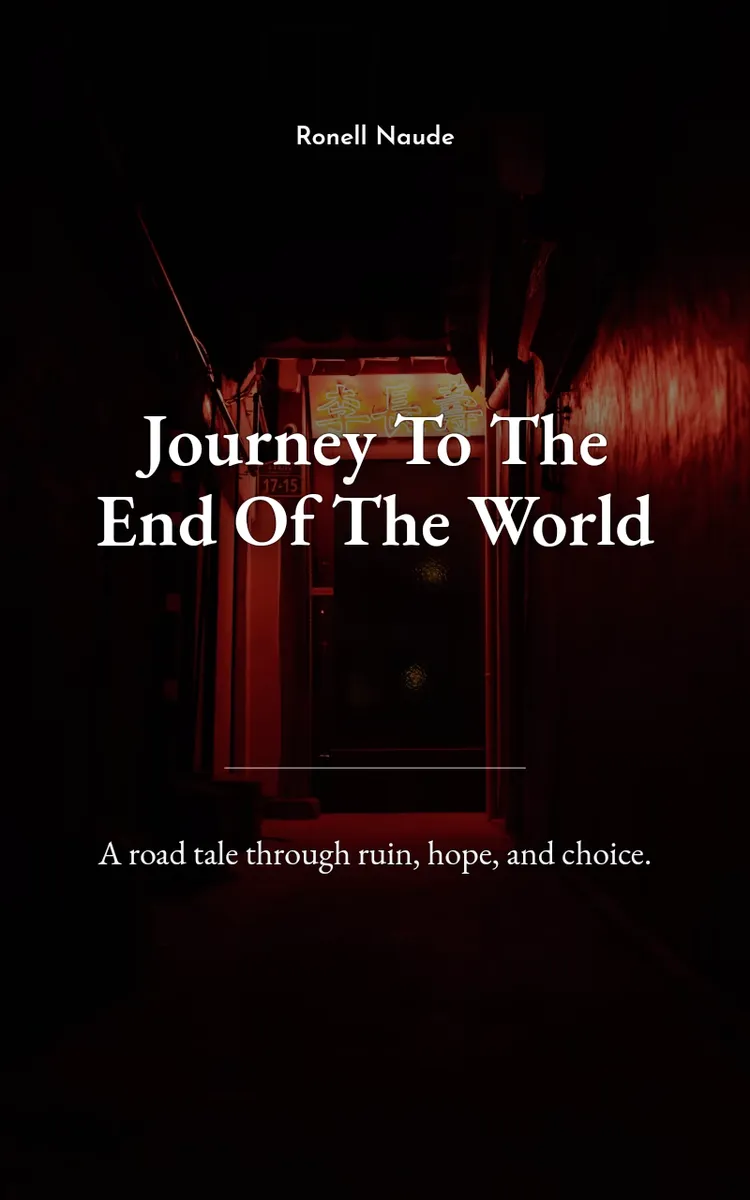
"Journey To The End Of The World" is a fiction book by Ronell Naude with 15 chapters and approximately 29,460 words. A post-apocalyptic journey toward the world's final days.
This book was created using Inkfluence AI, an AI-powered book generation platform that helps authors write, design, and publish complete books. It was made with the AI Novel Writer.
Frequently Asked Questions
What is "Journey To The End Of The World" about?
A post-apocalyptic journey toward the world's final days
How many chapters are in "Journey To The End Of The World"?
The book contains 15 chapters and approximately 29,460 words. Topics covered include The Map That Lied, Stealing the Generator’s Breath, Following the Echo Trail, The Bridge That Wouldn’t Hold, and more.
Who wrote "Journey To The End Of The World"?
This book was written by Ronell Naude and created using Inkfluence AI, an AI book generation platform that helps authors write, design, and publish books.
How can I create a similar fiction book?
You can create your own fiction book using Inkfluence AI. Describe your idea, choose your style, and the AI writes the full book for you. It's free to start.
Write your own fiction book with AI
Describe your idea and Inkfluence writes the whole thing. Free to start.
Start writingCreated with Inkfluence AI


