
Read the first chapter
The whole of chapter one, free. About 7 min. Turn the pages with the arrows, your keyboard, or a swipe.
Chapter 1
Rewriting Your Habit Identity
The Sentence That Runs Your Routine
What do you say to yourself the moment a new routine becomes inconvenient?
Maybe it’s 6:15 a.m., your alarm has already been ignored twice, and your running shoes are beside the bed. You tell yourself, “I can’t get up this early.” At lunch, you open the food you packed, notice the takeaway menu on your phone, and think, “I can’t stick with this.” After work, the gym bag sits in the car while you drive straight home. The familiar line arrives again: “I’m just not disciplined.”
The words sound like observations, but they often work like instructions. “I can’t” closes the door before you’ve tested the handle. It turns a difficult moment into proof about who you are. Then the routine feels unnatural because you’re asking yourself to act against an identity you’ve already rehearsed. Do you recognise this pattern in yourself?
The Identity You Practise Without Choosing
What if “I can’t” isn’t describing your ability, but protecting an identity you’ve practised?
That question changes the work. You may not be fighting laziness, weak willpower, or a permanent lack of discipline. You may be defending a familiar description: I’m someone who never sticks to routines. I’m not a morning person. I always fall off after a week. Each repetition makes the description feel more believable, even when it began with one rough day.
The answer isn’t to pretend you’re already perfect. That usually feels false, and false statements don’t survive contact with a busy Tuesday. The useful shift is smaller: choose an identity that makes the next action reasonable. Replace “I can’t exercise consistently” with “I’m becoming someone who keeps promises to my body.” Replace “I can’t plan meals” with “I’m someone who prepares one useful meal before the week gets chaotic.”
Consider the difference between these two mornings. Before the shift, you wake late and say, “I can’t train today because I’ve already ruined the schedule.” The missed workout becomes evidence. After the shift, you wake late and say, “I’m someone who keeps the routine alive, even if today’s version is shorter.” You do twelve minutes of movement before showering. The workout is smaller, but the identity receives a vote. That vote matters because durable routines grow from repeated evidence, not dramatic declarations.
The Identity Switch Ladder gives you a practical way to build that evidence. Start at the bottom with a believable action, then climb through repetition: notice the old label, name the chosen identity, prove it with a small action, and repeat the proof until the routine feels like yours. You don’t need to feel like the new person first. You act in a small way, then let the action teach you who you’re becoming.
How “I Can’t” Becomes a Habit
Here’s the chain to watch in real time:
1. When you meet a trigger - a late alarm, a stressful customer, an empty fridge, or a missed day - you notice the routine will require effort. 2. You feel discomfort, doubt, embarrassment, or the urge to avoid another failed attempt. 3. So you say, “I can’t,” “I’m not that kind of person,” or “I always mess this up.” 4. Which leads to avoidance, followed by short-term relief and long-term evidence for the identity you want to outgrow.
That chain is powerful because the relief arrives quickly. Skipping the workout removes pressure. Ordering food removes planning. Leaving the paperwork until tomorrow removes the unpleasant feeling for a few hours. Your brain learns that “I can’t” is a fast exit.
Now run the alternative chain:
1. When you meet the same trigger, pause before accepting the old label. 2. You feel the discomfort, but name it accurately: “This is resistance, not inability.” 3. So you say, “I’m someone who keeps the next promise small,” and choose the smallest useful version of the routine. 4. Which leads to one completed action, a little more trust in yourself, and stronger evidence for the identity you’ve chosen.
The alternative doesn’t remove difficulty. It changes what difficulty means. A missed day no longer proves you’re inconsistent; it becomes a prompt to return. A shortened routine no longer counts as failure; it becomes a way to protect continuity. Your goal is not to win every moment. Your goal is to stop letting one uncomfortable moment write your identity.
You become believable to yourself by keeping small promises when “I can’t” shows up.
Rate the Identity You’re Rehearsing
Use a notebook or your phone’s notes app. Answer quickly, without trying to sound impressive. Honest numbers are more useful than flattering ones.
1. From 1 to 10, how strongly do you believe the statement “I can’t stick to routines”? A low score suggests the old identity is losing its grip. A high score doesn’t mean you’re doomed; it shows where your first identity switch needs attention.
2. Yes or no: When you miss one planned action, do you usually abandon the whole routine? “Yes” reveals that you treat consistency as perfection. “No” suggests you already have some ability to return, which you can strengthen deliberately.
3. From 1 to 10, how believable is your chosen identity - for example, “I’m someone who follows through on small promises”? A low score means the identity may be too grand or too disconnected from current evidence. A higher score gives you a useful starting point, but it still needs daily proof.
4. Yes or no: Can you name one action from the last seven days that supports the person you want to become? “Yes” gives you evidence to build on. “No” means your next step should be extremely small - small enough to complete today, not someday.
Read your answers together. High belief in “I can’t” plus low belief in the chosen identity means you shouldn’t force a dramatic transformation. Begin with a two-minute proof. If you believe the new identity but have no recent evidence, your words are ahead of your routine. If you have evidence but still feel like an imposter, keep repeating the action; identity often catches up after behaviour has become familiar.
The Two-Minute Identity Switch
Start one identity-building routine today
1. Catch the old sentence. For the next seven days, set a reminder for the moment your routine usually breaks - 6:30 a.m. for exercise, 12:30 p.m. for lunch choices, or 8:00 p.m. for preparing tomorrow. When “I can’t” appears, write the exact sentence in your phone. Don’t argue with it yet. Expected difficulty: Easy.
2. Choose a believable replacement and act for two minutes. Write: “I’m someone who ______.” Keep it tied to behaviour: “I’m someone who starts before I feel ready,” or “I’m someone who prepares one thing that helps tomorrow.” Then complete a two-minute version immediately. Put on the training shoes, chop one vegetable, open the budget, or clear one section of the workbench. Expected difficulty: Medium.
3. Record the proof before bed. Write one line: “Today I proved I’m someone who ____ by ____.” If you missed the planned time, complete the smallest version before sleep. The point is not to create a perfect record. It’s to teach yourself that returning is part of the identity. Expected difficulty: Medium.
You’ll know it’s working when...
• You notice “I can’t” before it turns into an automatic decision. - You begin choosing a smaller version instead of abandoning the routine. - You can name several recent actions that support your chosen identity.
Keep the action small enough that excuses sound slightly ridiculous. Two minutes may not transform your fitness, finances, or workload today. It can transform the sentence you use when the old pattern appears. That sentence is the doorway.
Choose Who Gets the Next Vote
Your identity is built from the evidence you repeat. It isn’t fixed by your worst habit, your busiest week, or the number of times you’ve started over.
The key insights to carry forward are:
• “I can’t” often acts as an exit, not a final truth about your ability. - A chosen identity becomes durable when it is tied to a small, visible action. - Missing a routine doesn’t cancel the identity; returning protects it. - The Identity Switch Ladder moves you from noticing the old label to proving a new one repeatedly.
Today, don’t ask whether you feel disciplined enough to become different. Ask which identity you want your next two minutes to support. Then make that choice visible through action. Once you can see yourself as someone who returns, begins, and keeps small promises, what routine will you be ready to make easier in the next step?
End of chapter one. 7 more chapters and about 12,162 words in the full book.
Swipe or use the arrows to turn the page
What's inside: 8 chapters
- 1. Rewriting Your Habit Identity
- 2. Defusing Beliefs That Sabotage
- 3. Designing Triggers With If-Then Prompts
- 4. Building Tiny Routines That Stick
- 5. Replacing Bad Loops With Substitution
- 6. Communicating Boundaries Without Guilt
- 7. Recovering Fast After Habit Slips
- 8. Stacking Habits Toward Purpose
About this book
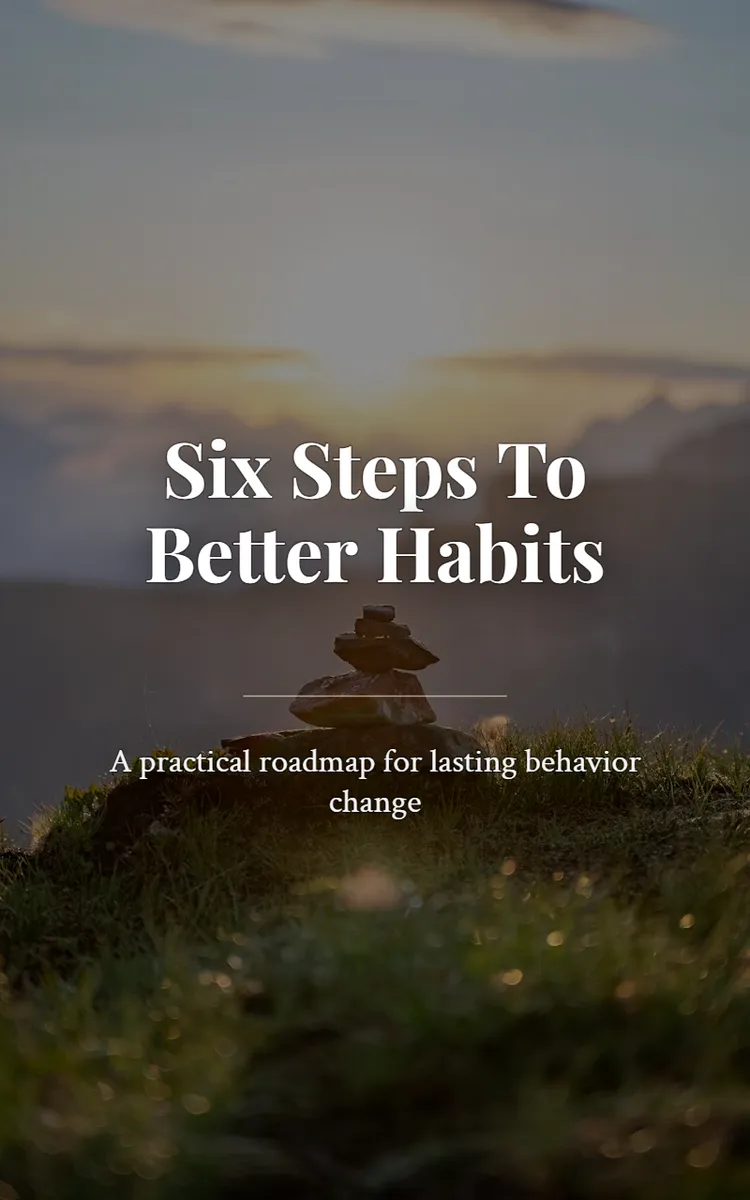
"Six Steps To Better Habits" is a self-help book by Anonymous with 8 chapters and approximately 12,162 words. Breaking bad behaviors and building good habits.
This book was created using Inkfluence AI, an AI-powered book generation platform that helps authors write, design, and publish complete books. It was made with the AI Self-Help Book Writer.
Frequently Asked Questions
What is "Six Steps To Better Habits" about?
Breaking bad behaviors and building good habits
How many chapters are in "Six Steps To Better Habits"?
The book contains 8 chapters and approximately 12,162 words. Topics covered include Rewriting Your Habit Identity, Defusing Beliefs That Sabotage, Designing Triggers With If-Then Prompts, Building Tiny Routines That Stick, and more.
Who wrote "Six Steps To Better Habits"?
This book was written by Anonymous and created using Inkfluence AI, an AI book generation platform that helps authors write, design, and publish books.
How can I create a similar self-help book?
You can create your own self-help book using Inkfluence AI. Describe your idea, choose your style, and the AI writes the full book for you. It's free to start.
Write your own self-help book with AI
Describe your idea and Inkfluence writes the whole thing. Free to start.
Start writingCreated with Inkfluence AI


