

Read the first chapter
The whole of chapter one, free. About 9 min. Turn the pages with the arrows, your keyboard, or a swipe.
Chapter 1
First Orders in the Dust
Dust filled Elias Mercer’s mouth before anyone gave him an order. It lay over the staging area in a thin brown skin, coating the canvas trucks, the rifle slings, and the faces of men who had already learned not to waste movement. Elias had arrived that morning with a pack cutting into his shoulders and the uncertain belief that obedience would be enough to keep him safe.
He was nineteen, though the number felt borrowed. At home, nineteen had meant unfinished plans and a mother who still looked at him as if he might change his mind. Here, near the forward line, it meant a uniform, a weapon, and a place in a column that was already preparing to move.
“Fall in,” someone called.
Elias looked toward the voice, then toward the men around him. For a moment, none of them seemed to belong to the same world. Boots scraped over hard ground. Metal struck metal. Engines coughed and settled into a rough vibration that traveled through the soles of his feet. He tightened his grip on his rifle and stepped into the nearest line.
A corporal glanced at him. “You Mercer?”
“Yes.”
“Then stand where you’re told.”
Elias nodded. “Yes, Corporal.”
The words came easily. His body did not. His hands were damp inside his gloves, and the strap beneath his collar had begun to rub the skin raw. He kept his face still because the others did. That was the first rule he understood: fear could be present, but it could not be allowed to take up space.
The staging area had no clear edge. It spread between low earthworks, supply crates, parked vehicles, and stretches of open ground where the dust moved in small, restless sheets. Men crossed through it carrying ammunition, water, tools, messages. There was no single direction to watch. Every sound seemed to come from somewhere else.
Elias tried to memorize the landmarks. A bent sign near a stack of fuel cans. A torn strip of canvas tied to a post. A shallow ditch filled with gray water. He told himself that if he could recognize those things, he would not be lost. The thought comforted him for less than a minute.
The column began moving.
At first, following orders seemed simple. Keep pace. Keep the rifle close. Do not fall behind. Elias repeated the instructions to himself as the unit left the staging area and entered a road worn into the dust. The men in front of him raised small clouds with every step. Grit settled on his tongue. Sweat gathered beneath his helmet and ran along his temples, carrying dirt with it.
“Close it up,” the corporal shouted.
Elias shortened his stride and moved nearer to the man ahead. The pack pulled backward against his shoulders. His boots felt too heavy, as if the ground had begun to hold them.
The road narrowed between broken walls and abandoned structures. Their surfaces were the color of old bone, with holes where windows had been and doors hanging open into darkness. Elias looked at each opening without meaning to. He knew he was supposed to keep his attention forward, but the empty rooms seemed to watch him.
Nothing happened.
That became its own kind of pressure.
He waited for the sound that would explain why everyone moved so carefully. He waited for a command, a visible threat, some clear boundary between danger and ordinary movement. Instead, there was only the scrape of boots, the clatter of equipment, and the distant concussion of guns beyond the forward line. The sound came low and irregular, like heavy doors being shut somewhere far away.
His breathing changed.
He noticed it and tried to correct it. In through the nose. Out through the mouth. The breath caught before it reached his chest. His fingers tightened around the rifle until the joints ached.
Not here, he told himself.
The thought had no authority. It was only a sentence inside a mind that had stopped trusting itself.
The man ahead turned his head slightly. “You all right?”
“Yes.”
“You look pale.”
“I said I’m all right.”
The man faced forward again. He did not answer. Elias felt ashamed of the sharpness in his voice, then ashamed that shame was taking attention away from the road. Everything inside him competed for control. Fear. Pride. The need to appear useful. The wish to be somewhere that had walls he understood.
At a bend in the road, the unit halted. The men lowered their packs or leaned against their rifles. Elias remained standing until his knees began to tremble.
“Water,” someone said.
He reached for his canteen. The cap slipped from his fingers and struck a stone. The small sound seemed louder than the engines.
The corporal looked over. “Mercer.”
Elias picked up the cap. “Yes, Corporal.”
“Keep your hands steady.”
“Yes.”
The corporal moved on.
Elias drank. The water was warm and tasted faintly of metal, but it cooled the back of his throat. He held the canteen against his mouth longer than necessary, listening to the men breathe around him. No one spoke about being afraid. No one needed to. Their silence had weight.
When the order came to move again, Elias rose with the others. The first stretch had already taken something from him. His shoulders hurt. His feet burned. More than that, the small confidence he had brought with him had been worn down by the unfamiliar ground. He had believed discipline would create a barrier between him and panic. He was beginning to understand that discipline did not remove fear. It only gave fear a shape that could be carried.
The road opened onto a wider field where the dust blew freely. There was no cover, only low ridges and the dark cuts of trenches farther ahead. The forward line was closer now. Elias could feel it before he saw it, not as a single place but as a pressure in the air. The men around him moved with greater attention. Their conversations stopped.
A vehicle passed at the edge of the column, throwing dust across them. Elias turned his face away too late. The grit struck his eyes and filled his nose. He stumbled, catching himself against the shoulder of the man beside him.
“Watch it,” the man said.
“Sorry.”
“Don’t apologize. Keep moving.”
Elias wiped his eyes with the back of his glove. The world blurred, then returned in pieces: a boot, a rifle barrel, the pale line of the ridge, the corporal’s raised hand.
He moved.
That was the victory available to him. Not courage. Not calm. Movement.
For the next hour, he followed the column through ground that seemed designed to erase direction. The trail divided and rejoined. Men disappeared briefly behind embankments and emerged farther along. Orders traveled unevenly, changing as they passed from one voice to another.
“Left side.”
“No, the other left.”
“Hold the line.”
“Keep going.”
Elias listened for the corporal, but the voices blended together. He kept the man ahead in sight and used him as his reference. Whenever the distance widened, panic rose. Whenever it closed, his relief was immediate and embarrassing.
At one point he nearly stepped into a shallow depression hidden beneath dust. His ankle twisted. Pain shot up his leg, and he caught himself before falling. The rifle struck his ribs.
The corporal stopped. “Injured?”
“No.”
“Then get back in line.”
Elias did. His ankle throbbed with each step, but the pain gave him something definite to attend to. He preferred it. A hurt foot made sense. It had a place and a cause. The panic had neither.
By late afternoon, the unit reached the edge of the forward position. The trenches were not the dark, ordered lines Elias had imagined. They were uneven cuts through the earth, crowded with sandbags, boards, broken tools, and men crouched beneath the low cover. Smoke hung near the ground. The smell of dust had mixed with fuel, sweat, and something sharp he did not identify.
The corporal pointed toward a narrow section of trench. “You’re with the third squad.”
Elias looked at him. “I thought I was assigned to transport.”
“You were. That changed.”
“Why?”
The corporal’s expression remained flat. “Because the line needs bodies.”
The words settled more heavily than the pack.
Elias climbed down into the trench. The earth pressed close on both sides. He had spent the day trying to remain functional, and now the place demanded more than movement. It demanded that he accept where he was.
A soldier sitting against the wall looked up at him. “Mercer?”
“Yes.”
“Take that position.”
Elias followed the gesture. It was a narrow space beside a sandbagged corner, close enough to the open ground that he could see the dust moving beyond the trench.
“Here?”
“That’s what I said.”
Elias lowered himself into the position. His injured ankle protested. He set the rifle across his knees and tried to make his breathing quiet.
For a few minutes, nothing required him to act. That was worse than the marching. During movement, each step had interrupted his thoughts. In the trench, the thoughts returned in full.
He wondered whether anyone had noticed how close he had come to losing control. He wondered whether the corporal had seen his shaking hands. He wondered how long a person could pretend to be ready before the pretending became dangerous.
A runner came along the trench, bent low beneath the edge of the earthworks.
“Mercer?”
Elias looked up.
“Here.”
“You’re on the detail.”
“What detail?”
The runner glanced toward the open ground. “Signal post. After dark.”
Elias felt the blood leave his face again. “I just got here.”
“So did half the line.”
“I’m not trained for it.”
“You’ll be shown.”
The runner started away.
Elias caught himself before calling him back. The request rose in his throat, then disappeared beneath the old answer he had been using all day.
Yes.
He had followed the column. He had stayed upright. He had reached the forward line without falling apart in front of the men. That was something. It was not enough, but it was real.
The soldier beside him watched his face. “First day?”
Elias nodded.
“Then keep your eyes open.”
“Is the post exposed?”
The soldier looked toward the ridge. “Everything is exposed.”
Elias lowered his gaze to his rifle. Dust had worked into the grooves along the stock. His hands were still unsteady, though less than before. He placed them carefully, one over the other, and waited for the next order.
Looking back, I now understand that the march was not difficult because it was long. It was difficult because it stripped away every comfort I had mistaken for preparation. I had thought arriving meant beginning. Instead, arriving meant discovering that the war had already begun without waiting for me to understand it.
I learned that obedience could carry a person a long way, but it could not tell him what waited at the end of the road. I had followed orders and stayed functional. I had earned my place in the line, or at least failed to lose it. That was the partial victory.
But the victory had a cost. By nightfall, my role was no longer uncertain. I was not passing through the forward position. I belonged to it now, and the first duty assigned to me would take me beyond the cover of the trench, toward a signal post exposed to everything I had spent the day trying not to imagine.
I kept my rifle across my knees and listened to the earthworks settle around me. The dust had followed me into the trench. It covered my sleeves, my boots, and the skin beneath my collar. I could not brush it away without disturbing the rifle.
So I left it there and waited.
End of chapter one. 20 more chapters in the full book.
Swipe or use the arrows to turn the page
What's inside: 21 chapters
- 1. First Orders in the Dust
- 2. Crossing the Bridge Under Fire
- 3. Counting Seconds to Survive
- 4. The Night Patrol That Fails
- 5. Refusing the Medics’ Sedative
- 6. The Ammunition Truck Reversal
- 7. Following the Missing Radio Call
- 8. Running the Flooded Sector
- 9. Writing Letters He Never Sends
- 10. The Court-Martial Room of Silence
- 11. The Map That Doesn’t Match Reality
- 12. The Order to Hold the Line
- 13. Admitting He Can’t Sleep
- 14. The Flare Signal That Betrays Them
- 15. Questioning the Man Who Smiles
- 16. The Vomit of Fear in the Dark
- 17. Crawling to the Listening Post
- 18. The Counterattack That Almost Works
- 19. Surviving the Morning After
- 20. Trading Confession for a Transfer
- 21. Finding One Answer in the Noise
About this book
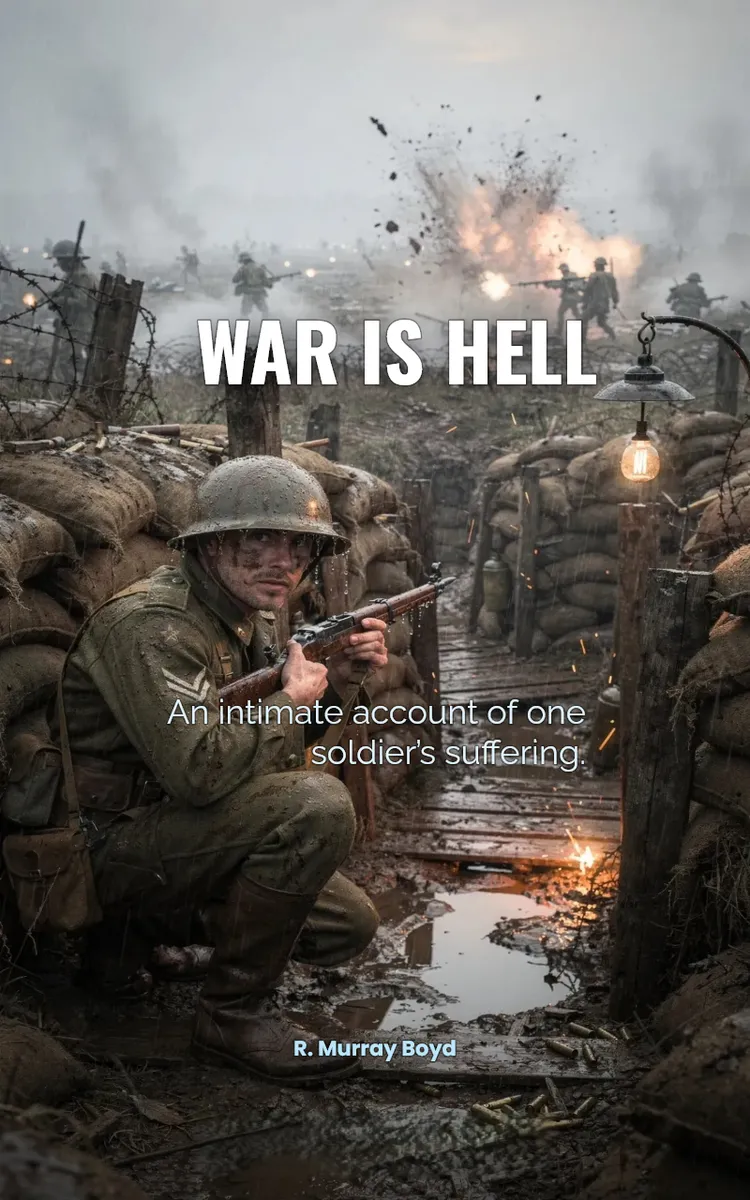
"War Is Hell" is a biography book by R. Murray Boyd with 21 chapters and approximately 42,589 words. A soldier’s life told through internal dialogue and pain.
This book was created using Inkfluence AI, an AI-powered book generation platform that helps authors write, design, and publish complete books. It was made with the AI Biography Writer.
Frequently Asked Questions
What is "War Is Hell" about?
A soldier’s life told through internal dialogue and pain
How many chapters are in "War Is Hell"?
The book contains 21 chapters and approximately 42,589 words. Topics covered include First Orders in the Dust, Crossing the Bridge Under Fire, Counting Seconds to Survive, The Night Patrol That Fails, and more.
Who wrote "War Is Hell"?
This book was written by R. Murray Boyd and created using Inkfluence AI, an AI book generation platform that helps authors write, design, and publish books.
How can I create a similar biography book?
You can create your own biography book using Inkfluence AI. Describe your idea, choose your style, and the AI writes the full book for you. It's free to start.
Write your own biography book with AI
Describe your idea and Inkfluence writes the whole thing. Free to start.
Start writingCreated with Inkfluence AI


