
Read the first chapter
The whole of chapter one, free. About 8 min. Turn the pages with the arrows, your keyboard, or a swipe.
Chapter 1
Before Words, I Watched the Room
The living room changed before anyone admitted that anything had changed.
I was a child, sitting on the carpet at night with the television murmuring beside me, while voices moved behind a closed door. I could not make out the words. I heard the rise and fall of them instead - the clipped sounds, the pauses that lasted too long, the sudden quiet that felt heavier than speech. The room smelled faintly of dust and warm fabric. The television cast pale light across the furniture, then pulled it away again.
I watched the door.
I did not yet have language for emotional tension. I did not know that a household could have weather. I only knew that some nights felt safe enough to breathe in, and other nights made my body tighten before anything visible happened. The air seemed different. People walked differently. A voice could enter a room and change its temperature.
I wanted to understand why.
That was the goal I carried without knowing it was a goal. I watched faces, hands, shoulders, the way someone set down a cup or closed a cabinet. I listened for what came before the change. I searched for rules. If I could find the pattern, perhaps I could know what was coming. If I knew what was coming, perhaps I could keep myself out of its path.
The voices behind the door rose and then disappeared. I looked toward the hallway. The carpet pressed rough against my legs. Somewhere in the house, a pipe clicked as it cooled. I remember feeling that even the ordinary sounds had become part of the message.
Someone noticed me watching.
“What are you looking at?” an adult asked.
“Nothing,” I said.
The answer came quickly because it was safer than the truth. I did not know how to say that I was trying to understand the room. I did not know how to explain that the silence beyond the door felt dangerous even though nobody had touched me or threatened me in that moment. I only knew that my attention had been discovered.
“You’re overreacting,” I was told.
The words landed before I understood them. Overreacting meant that the feeling belonged to me, not to the room. It meant I had made too much of something other people could apparently ignore. I looked back at the television, though I was no longer watching it.
The voices began again behind the door.
I listened harder.
Looking back, I understand that memory is not a perfect recording. It is reconstruction. It changes with time, emotion, repetition, and everything that happens afterward. Some parts of childhood remain clear, while others exist more like damaged photographs. Some memories have sharp edges. Others are foggy around the borders. Sometimes I remember the feeling of something more strongly than I remember exactly what happened.
What survived for me was the pattern.
I remember feeling different. I remember being sensitive to things other people seemed able to ignore. I noticed moods. I noticed tension. I noticed when something did not feel right even when nobody was saying anything. I did not have sophisticated words for any of this. I was a kid. Kids are not supposed to sit around wondering whether the emotional atmosphere of a room has changed by three degrees.
Apparently, I did not get that memo.
The living room became the place where I practiced. I watched from the edge of conversations and from the floor near the furniture. I studied expressions when people thought I was occupied. I listened to voices through walls and doors. I noticed contradictions: affection followed by cruelty, promises followed by actions that did not match them, adults making decisions that affected children and then behaving as though the consequences belonged to somebody else.
I wondered why someone could say they loved you and then hurt you.
I wondered why adults could deny what a child could feel in her own body.
Sometimes I tried to ask.
“Why is everyone upset?”
Nobody gave me an answer that matched what I was sensing.
“People aren’t upset.”
“I can tell.”
“No, you can’t.”
The exchange was small, but it taught me something larger than the words themselves. Observation could be treated as accusation. Noticing could make people defensive. If I pointed toward the tension, I might become the problem instead of the tension being addressed.
So I learned to keep more of it inside.
I did not stop watching. I watched more carefully.
There was a cost to that. The harder I tried to decode the room, the less present I felt inside it. I could be sitting with other people and still be positioned somewhere else in my mind, measuring tone, tracking movement, waiting for the next change. My attention became a kind of shelter, but it was also a place where I could not rest.
At the time, I believed the problem was that I had not watched closely enough. If I missed one expression or misunderstood one silence, the consequences might be my fault. I thought safety depended on perfect attention. I did not know that no child could monitor an entire household well enough to make uncertainty disappear.
I only knew that uncertainty frightened me.
The room gave me details, but not explanations. A chair scraped against the floor. A door closed more firmly than necessary. Footsteps crossed the hallway and stopped. The television continued speaking to nobody. I collected each sound as though it might complete the picture.
When I looked at people, I was not trying to judge them. I was trying to locate myself in relation to them. Was it safe to speak? Was it safe to move? Was it safe to ask for something? Was the quiet ordinary, or was it the kind of quiet that came before someone’s mood turned?
No one taught me these questions. They grew in me.
That was the beginning of a lifelong habit. I thought I was simply trying to understand the world. Maybe that is what observation is before you give it a fancy name. It is survival with a notebook, even when the notebook is only a child’s memory and the writing is done through attention.
I began to believe that other people knew something I did not. They seemed able to sit in a room without studying it. They could accept a silence as silence. They could hear a voice change and continue eating, watching television, or walking past. I wondered what was wrong with me that I could not do the same.
The more I noticed, the more alone I felt with what I noticed.
I remember trying to make my face look ordinary. I kept my body still. I avoided looking toward the closed door too often because I had already been seen watching. But not looking did not make the feeling disappear. It only forced me to gather information indirectly, through sound and movement and the pressure that seemed to settle over the room.
I wanted an explanation. What I received instead was dismissal.
“You’re too sensitive.”
“You’re making something out of nothing.”
“Stop worrying.”
Those words did not calm me. They made me question my own senses. If the room felt dangerous to me but ordinary to everyone else, perhaps I was the danger. Perhaps my attention was creating the tension. Perhaps I was defective in some way I could not name.
That confusion followed me beyond childhood. It became part of how I understood my own mind. Before I had words for schizophrenia, before I could describe frightening or confusing perceptions, I had already learned to doubt the evidence of my experience. I had learned that speaking about what I sensed could make people laugh, dismiss me, fear me, or try to explain me away.
So I became quieter.
Quiet did not mean unaware. It meant I moved my questions inward. I watched people’s faces, their voices, their reactions, their contradictions. I stored details other people seemed to discard. I looked for the point where kindness became impatience, where patience became anger, where normal conversation became something else.
Sometimes I was right about a change. Sometimes I was wrong. I could not tell the difference reliably, and that uncertainty became its own form of suffering. My mind felt too tuned in, but I had no way to adjust it. There was no dial marked less. There was only the room, the people in it, and my effort to read what they would not say.
The childhood living room taught me that attention could protect me from surprise, but it could not protect me from being misunderstood. I got what I had been seeking in one sense: I became skilled at detecting shifts. I could feel when a mood had changed. I could recognize the small signs that preceded a larger rupture in the emotional atmosphere.
But the skill carried a new cost. The more closely I watched, the more exposed I became. My attention made me visible, and my visibility made people question me. When I tried to explain what I saw, I was treated as though the problem was my reaction. When I stayed silent, I carried the tension alone.
Looking back, I now understand that I was not simply a difficult or overly sensitive child. I was a child trying to build a map of a world that kept changing without warning. I did not have the words for hypervigilance, perception, trauma, or mental health. I had only the living room, the closed door, the muffled voices, and the feeling in my body that something had shifted.
That feeling became one of the first languages I knew.
Years later, when my mind began producing experiences I could not explain, I would recognize the same desperate need to decode what was happening. I would search for patterns because patterns had once seemed like the closest thing to safety. The system would eventually give me its own language, its own labels, and its own answer: sedation. But long before anyone tried to quiet my mind, I had already been told that my attention was too much.
That night, I kept watching the door.
I watched until the room seemed to watch me back - not because it had changed into something unreal, but because I had become so alert to every detail that I could no longer separate the room from my fear of it. I wanted to understand why people’s moods changed without explanation. Instead, I learned that asking could make me look unreasonable, and noticing could make me seem dangerous.
I did not stop looking.
I only stopped expecting anyone to believe what I saw.
End of chapter one. 4 more chapters in the full book.
Swipe or use the arrows to turn the page

What's inside: 5 chapters
- 1. Before Words, I Watched the Room
- 2. The First Time My Thoughts Split
- 3. Hunting Answers in Clinic Hallways
- 4. When “Sedation” Became the Plan
- 5. Motherhood and the Return of Observation
About this book
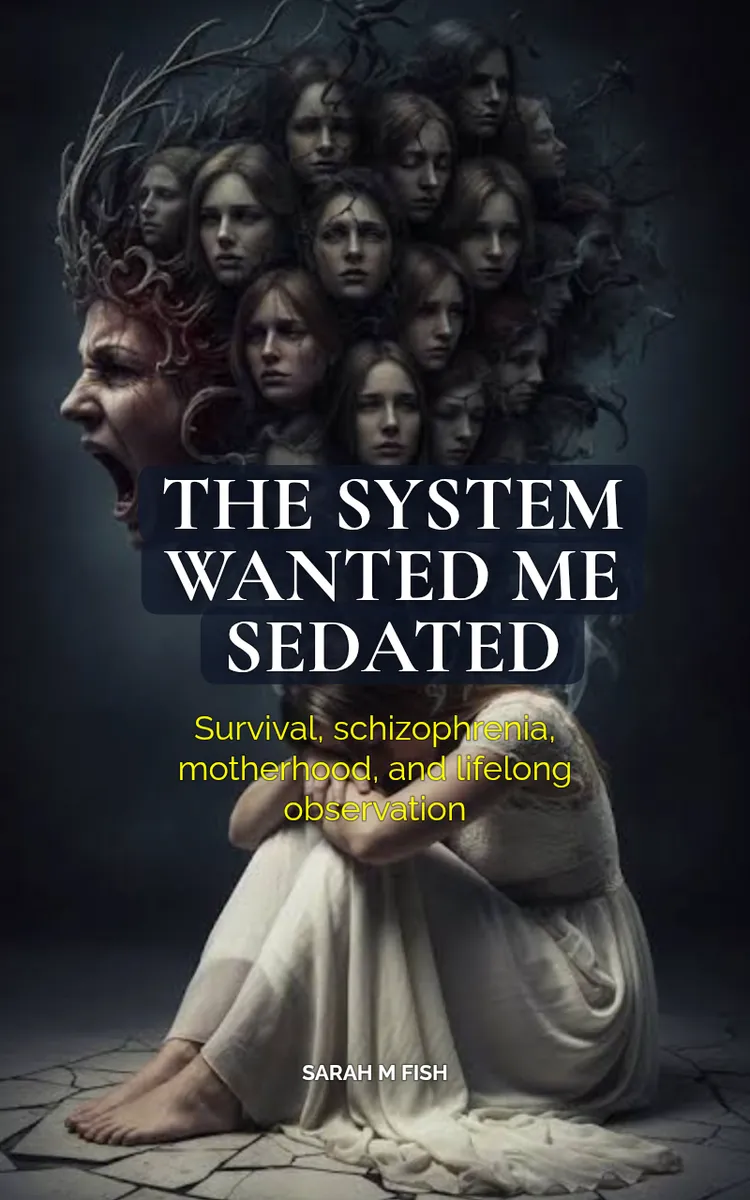
"The System Wanted Me Sedated" is a biography book by Sarah M Fish with 5 chapters and approximately 8,898 words. A personal memoir about schizophrenia, motherhood, and survival.
This book was created using Inkfluence AI, an AI-powered book generation platform that helps authors write, design, and publish complete books. It was made with the AI Biography Writer.
Frequently Asked Questions
What is "The System Wanted Me Sedated" about?
A personal memoir about schizophrenia, motherhood, and survival
How many chapters are in "The System Wanted Me Sedated"?
The book contains 5 chapters and approximately 8,898 words. Topics covered include Before Words, I Watched the Room, The First Time My Thoughts Split, Hunting Answers in Clinic Hallways, When “Sedation” Became the Plan, and more.
Who wrote "The System Wanted Me Sedated"?
This book was written by Sarah M Fish and created using Inkfluence AI, an AI book generation platform that helps authors write, design, and publish books.
How can I create a similar biography book?
You can create your own biography book using Inkfluence AI. Describe your idea, choose your style, and the AI writes the full book for you. It's free to start.
Write your own biography book with AI
Describe your idea and Inkfluence writes the whole thing. Free to start.
Start writingCreated with Inkfluence AI


