
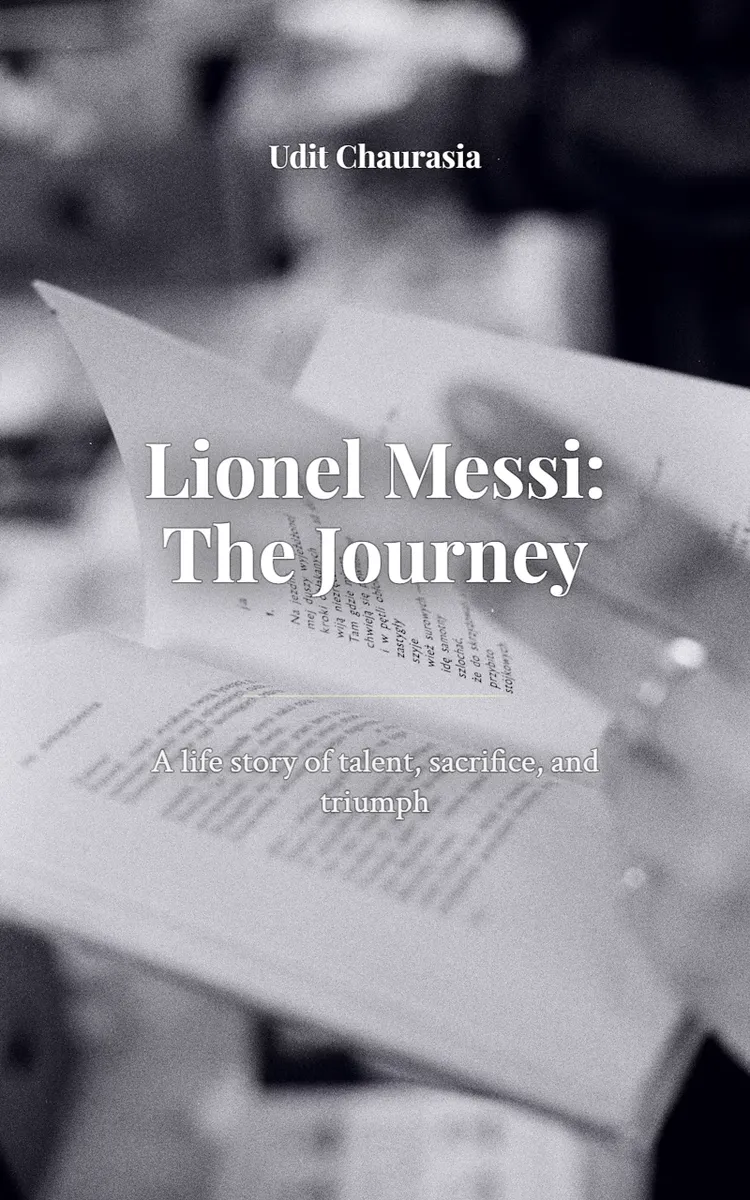
Read the first chapter
The whole of chapter one, free. About 7 min. Turn the pages with the arrows, your keyboard, or a swipe.
Chapter 1
Rosario Street Football Beginnings
The ball skipped off the broken pavement and struck Lionel Messi’s ankle before he could trap it. Dust lifted around his shoes. A bicycle bell rang somewhere beyond the fence, and from a nearby kitchen came the smell of frying onions. Lionel recovered the ball with one touch, slipped between two older boys, and sent it toward the makeshift goal marked by a pair of stones.
The pitch was hardly a pitch at all. It was a patch of uneven ground in Rosario, bordered by walls, parked cars, and streets that demanded attention from anyone who wanted to play. The surface punished careless steps. A loose stone could turn a run into a fall; a passing car could interrupt an attack. Yet for Lionel, who was still a child, the cramped space offered something more important than comfort. It offered the chance to play.
He had already learned that a game did not wait for ideal conditions. There were no smooth lines, no quiet stands, and no guarantee that the match would continue until the final goal. Players arrived when they could, argued over teams, and made room for one another only when they had to. Lionel’s goal was simple: stay on the ball, prove himself, and keep playing.
“Give it here,” one of the boys called.
Lionel looked up, saw the narrow lane between two defenders, and pushed the ball through it instead. He was small enough to disappear briefly among the older players. Then he emerged on the other side, close to the stones that served as the goal. A foot came across his path. Lionel adjusted his stride and struck the ball before the challenge could reach him.
It was not a powerful shot. It did not need to be. The ball rolled between the stones.
The game carried on, but the goal changed the way the others watched him. In street football, approval was rarely announced. It appeared in the next pass, in the decision to mark someone closely, in the way a player stopped treating you as a child who happened to be nearby. Lionel noticed those changes. He understood that talent had to be demonstrated again and again because the pitch belonged to whoever could hold it.
Rosario gave him plenty of chances to learn that lesson. The city’s streets were familiar to him, but they were not gentle. The neighborhoods were busy and close together, with hard surfaces underfoot and little space left unused. A local game could form beside a wall or on a small patch where the ground had been cleared. The ball might be scuffed, the goals might be improvised, and the teams might change from one afternoon to the next.
Lionel adapted without making a display of it. He kept the ball close. He moved before the challenge arrived. When a larger player leaned into him, Lionel did not try to win through strength. He used a turn, a change of direction, or the narrowest opening. His size became part of the way he played, even before he had words for what that meant.
Sometimes the obstacle was not an opponent. It was the pitch itself. A cracked surface sent the ball in an unexpected direction. A patch of dirt slowed a pass. The boundary could be a curb, a wall, or an understanding that the next street marked the edge of play. Lionel had to read all of it at once: the ball, the players, the ground, and the movement around them.
That kind of football left little room for hesitation. If he stopped to question whether a pass was possible, the chance disappeared. If he waited for a clearer path, someone else took it. The game taught him to trust what he saw and to act quickly.
He did not always succeed. There were matches when a heavier player knocked him away from the ball, when a mistake led directly to a goal, or when a disagreement ended the game before anyone had settled the score. Lionel felt those failures sharply. He wanted to remain on the field, and he wanted the others to understand that he belonged there. But the street offered no formal explanation for losing. The next game began, and he had to find a way back into it.
“Again,” he would say when the ball went out or the teams were reshuffled.
The word carried more than impatience. It carried his refusal to let one error decide what he could do. He returned to the same spaces, faced many of the same difficulties, and gradually became more certain of his own solutions. The ball seemed to stay nearer to him. His turns became quicker. His passes arrived where a teammate was moving rather than where he had been.
At home, football remained part of the family’s everyday life, but the path ahead was not clear. Lionel could play wherever a game appeared, yet street football did not provide a stable route into a club. There were no dependable schedules, no assured coaching, and no promise that a good performance would be noticed by someone who could help him progress. He had the desire to go further, but desire alone could not create a place to train.
That uncertainty followed him back from the streets. Dust clung to his socks. His shoes carried the marks of the ground. He replayed moments from the game in his mind, thinking about the pass he had missed or the turn that had worked. The matches ended, but they continued inside him as questions: Could he do it against better players? Could he keep improving? Could football become more than something he chased from one improvised pitch to another?
The first meaningful change came through repetition. Lionel’s performances were no longer isolated flashes known only to the players beside him. People began to recognize what he could do. His ability to control the ball in crowded spaces, to evade stronger opponents, and to make decisions quickly gave his street games a wider reach. Attention did not arrive as a dramatic announcement. It moved through the ordinary network of local football, passed from one person to another.
A boy who had seen Lionel play mentioned him to someone connected with organized youth football. The details of that introduction mattered less than what it represented. For the first time, the game he loved on the streets began to connect with a structured setting beyond them.
Lionel still had to prove himself. A new pitch would not automatically respect what he had done on the old one. Organized football brought its own demands: regular training, stronger competition, expectations from coaches, and the need to fit into a system. The freedom of the street had taught him to improvise, but a youth setup would ask him to listen, repeat, and compete within a team.
That prospect carried excitement and unease. Lionel wanted the opportunity, yet entering organized football meant that football could no longer be treated only as an afternoon game. It would require time, travel, equipment, and commitment from more than the player himself. His family would have to help make the opportunity possible.
Before that future became clear, Lionel continued to play wherever he could. The streets remained his first classroom. Their tight spaces trained his feet and sharpened his awareness. Their interruptions taught him to remain ready. Their roughness forced him to find ways around obstacles rather than waiting for the surroundings to improve.
Looking back, the importance of those games was not limited to the goals Lionel scored. They gave him an early understanding of pressure. A player could be talented and still lose the ball. A clever move could fail because the ground was uneven. A chance could appear only once. To continue, he had to respond without allowing one mistake to define him.
He also learned that football was a language of trust. A teammate had to believe Lionel would find a way through a crowded space. Lionel had to believe a pass would be returned. Even on a rough neighborhood pitch, the game depended on movement and connection. His individual skill drew attention, but it became more valuable when it helped the team move forward.
The bridge to organized football began with that balance. Lionel was not leaving behind the instincts formed in Rosario’s streets; he was carrying them toward a more demanding environment. The close control, quick changes of direction, and calm decisions that had helped him survive crowded games would soon be tested against players who trained regularly and competed for their own places.
The opportunity was real, but it did not arrive without a cost. Training required support, and support required time and money. The family’s ability to keep Lionel involved would become part of the challenge. His performances had opened a door, yet stepping through it meant asking more of the people who stood behind him.
For Lionel, the immediate result was both encouraging and unsettling. He had earned attention from a local youth setup, moving closer to the organized football he had imagined while chasing games through Rosario. But the next stage would not depend on his feet alone. The road from the uneven streets to a club pitch had begun, and his family would have to determine how far they could follow him.
End of chapter one. 4 more chapters in the full book.
Swipe or use the arrows to turn the page
What's inside: 5 chapters
- 1. Rosario Street Football Beginnings
- 2. Joining Newell’s Old Boys Academy
- 3. The Growth Hormone Treatment Decision
- 4. Barcelona Offer and Move to Catalonia
- 5. Breaking Through to the First Team
About this book
"Lionel Messi: The Journey" is a biography book by Udit Chaurasia with 5 chapters and approximately 9,051 words. The life and career of soccer star Lionel Messi.
This book was created using Inkfluence AI, an AI-powered book generation platform that helps authors write, design, and publish complete books. It was made with the AI Biography Writer.
Frequently Asked Questions
What is "Lionel Messi: The Journey" about?
The life and career of soccer star Lionel Messi
How many chapters are in "Lionel Messi: The Journey"?
The book contains 5 chapters and approximately 9,051 words. Topics covered include Rosario Street Football Beginnings, Joining Newell’s Old Boys Academy, The Growth Hormone Treatment Decision, Barcelona Offer and Move to Catalonia, and more.
Who wrote "Lionel Messi: The Journey"?
This book was written by Udit Chaurasia and created using Inkfluence AI, an AI book generation platform that helps authors write, design, and publish books.
How can I create a similar biography book?
You can create your own biography book using Inkfluence AI. Describe your idea, choose your style, and the AI writes the full book for you. It's free to start.
Write your own biography book with AI
Describe your idea and Inkfluence writes the whole thing. Free to start.
Start writingCreated with Inkfluence AI


