
Read the first chapter
The whole of chapter one, free. About 8 min. Turn the pages with the arrows, your keyboard, or a swipe.
Chapter 1
Ballito Inbox and Missed Calls
The fan in my rented room in Ballito clicked from one speed to the next, pushing warm air across the desk and doing nothing to loosen the silence.
My phone lay beside the laptop, screen facing upward. I had charged it fully, turned the volume up, and checked that I had not accidentally switched it to silent. The laptop was open to my inbox. I refreshed the page, watched the small circle turn, and waited for Ang’s name to appear.
It did not.
I was younger then, though not young enough to excuse how completely I had handed my attention to another person. I had already made Ang’s future part of my daily routine. Her studies. Her plans. The modelling opportunity we had been trying to move forward. The photographs that had been requested. The meetings and follow-up calls that depended on her answering.
I told myself I was being useful. In that room, with the salt-heavy air coming through the window and the sound of traffic rising and fading outside, usefulness became difficult to separate from waiting.
I refreshed the inbox again.
There were messages from people who did not know me well enough to understand why I was reading their names with disappointment. They had written about Ang’s photographs, her availability, the next conversation. Their messages were practical and hopeful. They belonged to a future that still seemed possible to them.
I opened each one, read it carefully, and searched for something I could answer without admitting that I could no longer reach her.
My phone had become a second inbox. I checked the missed calls, then the recent calls, then Ang’s number. I had called more than once. I had sent messages. I had waited for the ordinary relief of seeing the screen light up with her name.
Nothing came.
The room made every small sound noticeable. The fan. The laptop’s faint hum. A car passing on the road. The scrape of my thumb against the phone case. When the phone vibrated, my body reacted before my mind could correct it. I looked down quickly.
It was not Ang.
I placed the phone back beside the laptop and tried to return to the email in front of me. The words blurred, not because they were difficult, but because I had begun reading them through fear. The sender wanted to know whether Ang was still interested. The opportunity was waiting for confirmation. They needed photographs and a response.
I understood their question. What I did not know how to explain was that I had been answering for someone who was no longer answering me.
At first, I treated the silence as a delay. People became busy. Phones were lost. Life interrupted plans. I found reasons because reasons allowed me to keep moving. I could tell the modelling contact that I was checking. I could say I would come back with an answer. I could tell myself that Ang would respond once she had time.
That was how I kept the future alive. I gave it another hour, then another day.
The room in Ballito became the place where I tried to hold everything together. I sat at the desk with my elbows near the laptop and my phone close enough to grab. I made coffee that cooled before I finished it. I left the curtains partly open, and the afternoon light moved across the wall while I remained in the same chair. Outside, people continued with their errands. Inside, I watched an empty inbox as though patience could summon a message.
I wanted to help Ang finish her studies. I wanted her to have choices beyond the place that had shaped her. The modelling opportunity felt connected to that hope, even when I knew it was only one opportunity and not a guarantee of anything. I attached meaning to every request for photographs, every suggested meeting, every follow-up. Each step seemed to prove that the future I imagined was becoming real.
When Ang did not answer, I did not immediately question the future. I questioned my timing, my messages, my approach. I wondered whether I had said something wrong. I wondered whether she was overwhelmed. I wondered whether she needed me to be more patient.
I did not yet wonder whether she wanted me to stop.
Another email arrived.
The notification appeared in the corner of the screen, small and ordinary. I opened it immediately. The modelling contact was following up again. The message was polite, but the repetition gave it a weight the earlier emails had not carried. They needed to know where Ang was. They needed confirmation that she remained available.
For a moment, I stared at the question without moving.
Where is Ang?
It was the question I had been avoiding, now placed plainly in an email from someone who expected an answer. I had no honest answer to give. I knew where I was. I knew the room, the desk, the phone, the open laptop. I knew the distance between my calls and Ang’s silence. I did not know where she was, or what had happened to the future I had been helping arrange.
I began typing anyway.
I wrote that I was trying to reach her. I deleted it because it sounded uncertain. I wrote that I would confirm shortly. I deleted that too because I had already said it in different forms. I wanted to protect Ang from being judged as unreliable. I also wanted to protect the opportunity from disappearing while I waited.
The cursor blinked at the end of the message.
I thought of her studies and the way I had spoken about helping her complete them. I thought of the photographs that had not been sent, the meetings that had not happened, and the people who had made room for her before they had ever met her properly. I had believed that if I worked hard enough, answered quickly enough, and kept every connection alive, I could carry her toward a life she deserved.
In that moment, the work became painful to look at.
I sent a short reply saying I was still trying to confirm Ang’s availability and would respond again as soon as I could. Then I closed the laptop, though I did not move away from the desk.
The quiet returned immediately.
I picked up my phone and called Ang again. The call rang without being answered. I listened until it ended, then looked at the blank screen. There was no anger in me. There was fear, and beneath the fear, a stubborn belief that one more attempt might change the shape of the day.
I sent another message.
I cannot remember the exact words now. I remember the feeling of choosing them carefully, as though a gentle enough sentence could cross the distance between us. I remember checking the message after it was sent, searching for a mistake. I remember waiting for the small indication that it had been received.
The phone offered no comfort.
The modelling contact replied later, after the light had faded from the room. I opened the message with the same urgency I had brought to every notification. They had tried to reach Ang too. There had been no response. They needed to know whether she was still available, but they could not keep the opportunity open without confirmation.
I read the message twice.
The opportunity was still there in some form. That was the part I had wanted. I had been trying to preserve it, and now I had a reason to send one more email. But the cost was no longer hidden. Other people were also waiting for Ang. Her silence was not only affecting me. It was closing doors around a future I had treated as though it belonged to both of us.
I opened the laptop again.
The room smelled faintly of cooled coffee and dust warmed by the afternoon. My fingers rested on the keyboard. I wanted to write something confident. I wanted to say that Ang was interested, that she would respond, that the photographs and meeting could be arranged. I wanted to buy more time without admitting that I had already spent too much of it.
Instead, I wrote that I was making one final attempt to confirm her availability. I said I would follow up as soon as I had a response. The words felt desperate because they were desperate. I was no longer simply passing along information. I was asking the future to wait for someone who had disappeared from my reach.
Before sending it, I called Ang once more.
The call rang into the same silence.
I sent the email.
For several seconds, I kept my hand on the mouse. The message sat in the sent folder, neat and complete, carrying a promise I could not guarantee. Then another reply arrived from the modelling contact.
They still had not been able to reach her.
I leaned back in the chair and looked around the room. Nothing had changed. The fan continued its uneven clicking. The road outside carried on. My phone remained silent beside the laptop.
But something in me had shifted. I could no longer pretend that I was only waiting for a convenient reply. I had been trying to keep Ang’s future moving while she was absent from it, and every attempt tied me more tightly to the silence.
Looking back, I understand that I was not only helping. I was holding on. I had mistaken persistence for love and responsibility for closeness. I believed that if I continued sending messages, answering contacts, and protecting her opportunities, I could remain connected to her even without her participation.
I now understand that a future cannot be built by one person alone, no matter how sincere the effort is.
That night in Ballito, I left the inbox open. I did not refresh it again for a while. The modelling opportunity had not vanished completely, but it no longer felt like proof that everything could still be repaired. It had become a question I could not answer on Ang’s behalf.
I had sent one more follow-up.
And once again, the reply led me back to the same place: her silence, and my inability to cross it.
End of chapter one. 4 more chapters in the full book.
Swipe or use the arrows to turn the page
What's inside: 5 chapters
- 1. Ballito Inbox and Missed Calls
- 2. Choosing Her Studies Over His
- 3. Tracing “Where Is Ang?” Leads
- 4. The Photo Shoot That Never Happens
- 5. Learning Love Isn’t Ownership
About this book
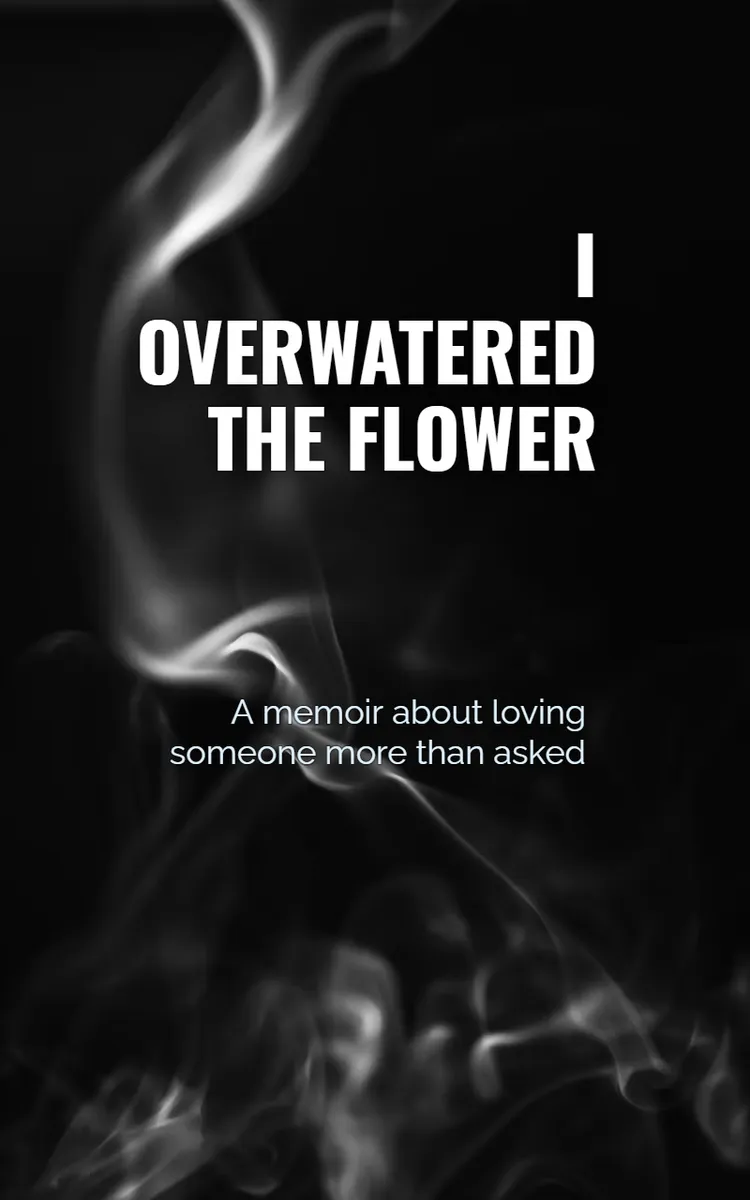
"I Overwatered The Flower" is a biography book by Anonymous with 5 chapters and approximately 9,069 words. A personal memoir about heartbreak, attachment, and learning boundaries.
This book was created using Inkfluence AI, an AI-powered book generation platform that helps authors write, design, and publish complete books. It was made with the AI Biography Writer.
Frequently Asked Questions
What is "I Overwatered The Flower" about?
A personal memoir about heartbreak, attachment, and learning boundaries
How many chapters are in "I Overwatered The Flower"?
The book contains 5 chapters and approximately 9,069 words. Topics covered include Ballito Inbox and Missed Calls, Choosing Her Studies Over His, Tracing “Where Is Ang?” Leads, The Photo Shoot That Never Happens, and more.
Who wrote "I Overwatered The Flower"?
This book was written by Anonymous and created using Inkfluence AI, an AI book generation platform that helps authors write, design, and publish books.
How can I create a similar biography book?
You can create your own biography book using Inkfluence AI. Describe your idea, choose your style, and the AI writes the full book for you. It's free to start.
Write your own biography book with AI
Describe your idea and Inkfluence writes the whole thing. Free to start.
Start writingCreated with Inkfluence AI


