
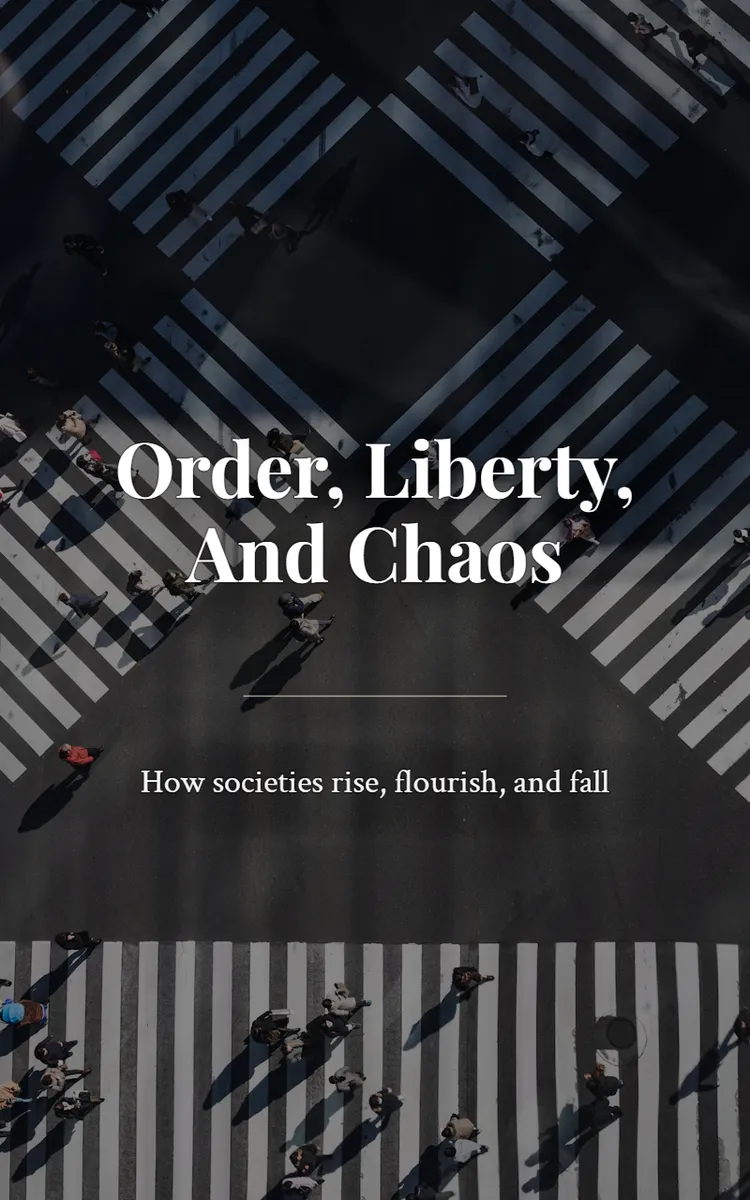
Read the first chapter
The whole of chapter one, free. About 9 min. Turn the pages with the arrows, your keyboard, or a swipe.
Chapter 1
Why Strangers Obey the Queue
The Queue Begins Before Anyone Arrives
At London’s Heathrow Airport, passengers sometimes form an orderly line before a check-in desk opens. There may be no rope, no employee directing traffic, and no written instruction beyond a small sign. Still, strangers arrange themselves, leave space, and wait their turn. The line exists before the institution that needs it.
That ordinary scene contains a difficult fact about human society: cooperation often depends less on personal trust than on a shared expectation about what everyone else will do. A queue turns a collection of unrelated people into a temporary community. Its members may never exchange names, and they may have no reason to meet again, yet they accept a common rule because the rule is visible, familiar, and usually observed.
The same pattern appears in roads, markets, courtrooms, libraries, and apartment buildings. Some rules are enforced by cameras, fines, or officials. Others survive mainly because people expect strangers to respect them. Together they form what might be called The Invisible Queue Principle: when people recognize a shared order, they coordinate even without direct supervision.
How much of civilization rests on rules that nobody is formally watching?
The Small Invention of Taking Turns
A queue is a modest technology for solving a serious problem. When several people want the same scarce resource, physical strength, social rank, or speed could decide who receives it. Taking turns replaces those contests with sequence. The first person waits less; the last person waits more; in return, everyone receives a rule that can be understood at a glance.
The principle is ancient, although its modern form developed alongside dense urban life. In a small village, people could often settle priority through personal knowledge. Everyone knew whose harvest had failed, who had arrived first, or which family held local authority. Cities made that knowledge unreliable. Crowds brought together strangers who lacked a shared history, so visible procedures became more important than personal familiarity.
Markets were among the earliest places where anonymous cooperation became unavoidable. A buyer and seller did not need to trust each other as friends. They needed to recognize weights, measures, prices, and customary behavior. The Code of Hammurabi, carved in Babylon around the eighteenth century BCE, addressed commercial disputes, wages, property, and responsibility. It did not create trust in the modern emotional sense. It created expectations that could be consulted when trust was absent.
Public order often begins with such external signs. A marked crossing tells drivers where pedestrians may pass. A numbered ticket tells customers that service follows an order. A courtroom layout places judge, witness, lawyers, and public in recognizable positions. The objects are simple, but their meaning is shared. They allow people to act without negotiating every interaction from the beginning.
The queue also demonstrates the difference between obedience and agreement. A person may dislike waiting and still accept the line. The rule does not require affection, only recognition. That distinction matters because large societies cannot depend on everyone wanting the same thing. They depend on people accepting enough common limits to pursue different things without constant collision.
Why Strangers Follow Rules
The human mind is unusually sensitive to violations of shared order. In experiments involving economic games, people have repeatedly shown a willingness to sacrifice some of their own resources to punish unfair behavior, even when punishment brings them no material reward. The important point is not that every person behaves generously. It is that people monitor what others receive and whether the process appears legitimate.
A queue makes fairness visible. Everyone can see who arrived first, who is waiting, and who has moved ahead. A person who cuts in line does more than gain a place; the act changes the meaning of the line for everyone behind them. If cutting becomes common, waiting no longer guarantees priority. The queue collapses because its members stop believing that the rule applies equally.
This is why enforcement is not always necessary at the start. People carry expectations from one setting to another. They have learned that certain actions - joining the rear, yielding at a crosswalk, lowering one’s voice in a library - are normal. The rule operates through what sociologists call a social norm, but the phrase need not make the phenomenon sound abstract. A social norm is simply a shared answer to the question, “What do people like us do here?”
Children learn this answer through correction, imitation, and observation. Adults continue learning it whenever they enter an unfamiliar place. At a Japanese railway platform, passengers commonly form marked lines beside the doors and wait for exiting riders before boarding. In many Western cities, passengers may gather less precisely, but the same basic expectation remains: those already inside should be allowed out before newcomers enter. The details vary; the underlying coordination does not.
A surprising single sentence captures the power of these arrangements: people often obey a rule because they believe strangers will obey it too.
That belief can be fragile. When people see others ignore a rule without consequence, they revise their estimate of what is normal. One driver blocking a pedestrian crossing can make the next driver more likely to do the same. One passenger pushing ahead can provoke either resistance or imitation. Order is therefore not a permanent possession. It is a public performance repeated by many people, each watching the others for evidence that the performance still holds.
The Invisible Queue Principle
The counterintuitive finding is that anonymity does not always weaken cooperation; sometimes it makes shared rules more important and more visible. In a crowd, personal reputation disappears, but the surrounding structure remains. A stranger cannot rely on being known as fair, so the queue, ticket, lane, or signal carries part of the burden.
This changes how order is understood. Cooperation is not produced only by close relationships or strong authorities. It can emerge from small public signals that tell unrelated people how to fit their actions together. The rule becomes a temporary substitute for personal knowledge.
Air traffic control offers a precise example. Pilots and controllers may never meet, and many decisions occur between people separated by hundreds or thousands of miles. Yet standardized phraseology, assigned altitudes, runway procedures, and read-backs allow them to coordinate through speech and instruments. The system is not based on assuming that every participant is wise or trustworthy. It is based on reducing ambiguity.
Road traffic works similarly, though with less formal language. A red light is not a command issued anew to each driver. It is a public agreement that movement will pause in one direction while another direction proceeds. The light does not know whether anyone is watching. Its usefulness depends on the fact that drivers act as though everyone can see it.
Rules become especially powerful when they are legible. A painted line is easier to follow than an unwritten dispute over where a line should be. A numbered ticket is easier to defend than a claim that someone “looks next.” Legibility does not eliminate conflict, but it gives conflict a common surface. People can argue about whether a rule is fair while still understanding what the rule says.
The danger appears when rules lose that shared meaning. A queue may remain physically intact while becoming socially hollow if certain people are regularly allowed to pass ahead. A traffic signal may continue to change while drivers treat it as optional. Institutions often weaken in this quiet way: not through one dramatic refusal, but through many small exceptions that teach observers that order is negotiable.
The Market in the Square
The Agora of Athens offers an early and vivid setting for anonymous coordination. From the sixth century BCE onward, the Agora served as a marketplace, civic center, and public meeting place. Farmers, craftsmen, sailors, politicians, and visitors crossed paths there. They did not share equal wealth or status, and they did not belong to one intimate community. Yet the space worked because its activities were organized by recognizable customs, measures, officials, and physical boundaries.
A buyer could approach a stall without knowing the seller’s family. A citizen could attend a public gathering without personally knowing every other participant. Coins helped make exchange portable; standard measures helped make quantities comparable; public architecture made certain activities visible. These arrangements did not remove deception or conflict. Ancient Athens had plenty of both. They made repeated interaction possible despite them.
The Agora shows why shared rules are more than restrictions. They also create opportunities. A market needs limits against theft and fraud, but it also needs enough freedom for strangers to bargain, travel, and exchange. A public meeting needs rules about speaking and voting, but those rules allow disagreement to become something other than physical struggle. Order gives liberty a setting in which it can operate.
The same logic appears in a modern supermarket. Customers usually do not know one another, the cashier, or the manager personally. They place goods on a belt, wait in a line, pay with a recognized medium, and leave with an expectation that the transaction is complete. The store’s shelves and checkout lanes are physical arrangements, but they are also social instructions. They tell hundreds of people how to move through a shared space without constant explanation.
Such systems are easy to overlook because they feel natural. Their success makes them nearly invisible. We notice the queue when someone cuts it, the traffic rule when someone ignores it, and the public institution when its procedures fail. Most of the time, order appears not as an achievement but as the background of ordinary life.
When the Watcher Is Absent
The strongest test of a shared rule comes when supervision disappears. A locked door, an unstaffed honesty box, or an empty intersection reveals whether people follow instructions only under immediate pressure or whether the rule has entered their understanding of the place.
The honesty box used in some rural farm stands is a simple example. Produce is left outside, prices are displayed, and customers place payment in a container without a cashier present. The arrangement depends on more than the fear of being caught. It depends on a local expectation that taking goods without paying is a violation of the relationship between place and visitor, even when the owner is elsewhere.
No such system is perfect. Some people exploit it. But its existence demonstrates that surveillance is not the only source of compliance. People often behave according to roles they recognize: customer, pedestrian, passenger, neighbor, voter. Those roles carry rules, and the rules remain active even when no authority is visible.
This is where the queue becomes a useful image for civilization. A line is not merely a set of bodies arranged from front to back. It is a promise that position will mean something. When strangers maintain that promise, they create a small zone of order inside a world full of competing desires. When they abandon it, the problem is not only delay. It is the loss of a common expectation about how public life works.
The human achievement lies in the fact that the promise can be renewed by people who have never met and may disagree about nearly everything else. A society does not become orderly because its members are identical. It becomes orderly when difference can pass through shared forms.
Civilization is often pictured as grand architecture, written law, or powerful government. Yet its daily foundation may be humbler: a person joining the rear of a line, a driver stopping at an empty crossing, a customer paying into an unattended box. These acts are small enough to escape notice, but together they reveal a remarkable capacity. Strangers can coordinate without friendship, and communities can persist without constant supervision.
The queue does not eliminate liberty; it gives liberty a boundary in which other people can also move. Nor does it defeat chaos forever. Every line depends on continued recognition, and every public rule can be tested by indifference, resentment, or opportunism. The mystery is not why humans sometimes obey. It is how often a crowd, with no shared leader and no personal bond, quietly chooses order - and keeps choosing it while nobody watches.
End of chapter one. 36 more chapters and about 61,918 words in the full book.
Swipe or use the arrows to turn the page
What's inside: 37 chapters
- 1. Why Strangers Obey the Queue
- 2. The First Rule Was a Boundary
- 3. When Grain Invented Government
- 4. The City as a Promise
- 5. Writing Made Power Portable
- 6. The Tax That Built Trust
- 7. Roads Carry More Than Armies
- 8. The Law Must Bind the King
- 9. Why Empires Need Local Brokers
- 10. Ritual Turns Rule Into Meaning
- 11. The Market Needs a Referee
- 12. Liberty Begins in the Gaps
- 13. The Printing Press Unseals Debate
- 14. Cities Teach People to Bargain
- 15. The Petition That Became a Right
- 16. Science Needs Room to Disagree
- 17. The Workshop Outruns the Palace
- 18. When Citizenship Gets Wider
- 19. The Press Can Free and Inflame
- 20. Rights Need Everyday Guardians
- 21. The Strong State’s Hidden Gift
- 22. Prosperity Can Loosen the Bonds
- 23. The Frontier Tests Every Rule
- 24. Inequality Makes Order Brittle
- 25. The Army Becomes a Political Class
- 26. Civil War Starts in the Story
- 27. Emergency Powers Rarely Stay Temporary
- 28. When Elites Stop Sharing
- 29. The Currency of Trust Runs Out
- 30. Climate Stress Finds Weak Seams
- 31. Migration Rewrites the Social Contract
- 32. The Capital Cannot Hear the Provinces
- 33. Corruption Makes Rules Feel Fake
- 34. The Collapse That Wasn’t Sudden
- 35. After Order, Neighbors Become Infrastructure
- 36. Rebuilding Requires More Than Walls
- 37. Civilization Is a Daily Verb
About this book
"Order, Liberty, And Chaos" is a self-help book by Anonymous with 37 chapters and approximately 61,918 words. The forces of order, liberty, and chaos in the rise and decline of civilizations.
This book was created using Inkfluence AI, an AI-powered book generation platform that helps authors write, design, and publish complete books. It was made with the AI Self-Help Book Writer.
Frequently Asked Questions
What is "Order, Liberty, And Chaos" about?
The forces of order, liberty, and chaos in the rise and decline of civilizations
How many chapters are in "Order, Liberty, And Chaos"?
The book contains 37 chapters and approximately 61,918 words. Topics covered include Why Strangers Obey the Queue, The First Rule Was a Boundary, When Grain Invented Government, The City as a Promise, and more.
Who wrote "Order, Liberty, And Chaos"?
This book was written by Anonymous and created using Inkfluence AI, an AI book generation platform that helps authors write, design, and publish books.
How can I create a similar self-help book?
You can create your own self-help book using Inkfluence AI. Describe your idea, choose your style, and the AI writes the full book for you. It's free to start.
Write your own self-help book with AI
Describe your idea and Inkfluence writes the whole thing. Free to start.
Start writingCreated with Inkfluence AI


