
Read the first chapter
The whole of chapter one, free. About 9 min. Turn the pages with the arrows, your keyboard, or a swipe.
Chapter 1
Stop Paying for BBB Leads
Why the BBB Badge Can Bring the Wrong Customer
Darren, a 39-year-old remodeling contractor, once kept a Better Business Bureau badge on his website because it looked responsible. The badge cost him about $70 a month. It did not bring a steady stream of profitable remodeling jobs. What it did bring were calls from people who wanted to investigate him, compare his price with four other contractors, or complain before he had even seen the project.
That pattern is the real problem with pay-to-play accreditation. “Pay-to-play” means you pay a recurring fee to belong, display a badge, or receive preferred treatment from a directory. The badge may look like proof of quality, but it is not the same as qualified demand: a customer who has a real need, can afford the work, and is calling because they want your company.
The Rent-vs-Own Audit gives you a clean way to see what is happening. Rank your attention in this order:
1. Count the revenue and qualified calls produced by each paid directory. 2. Compare those results with the complaints, price shoppers, and time wasted. 3. Move money from badges and shared lead pools into assets you control, such as your website, customer reviews, and direct follow-up.
You are not trying to prove that every BBB, Yelp, Angi, or HomeAdvisor contact is bad. You are checking whether the fee earns its place in your budget. After nearly a decade in remodeling, roofing, and automotive businesses, I found that these platforms often sell access to attention, not ownership of customer relationships. Once the payment stops, the attention usually stops too.
The Rent-vs-Own Audit: Find Out What You Are Actually Buying
Use the Rent-vs-Own Audit when a directory asks for a monthly membership, accreditation fee, advertising payment, or charge for shared leads. It is especially useful when the platform promises exposure but cannot show how many calls became profitable jobs for businesses like yours.
The strategy is simple: separate rented attention from owned demand before renewing another payment. Rented attention belongs to the platform. The platform controls the listing, the customer’s contact details, the ranking, and often the ability to show your competitors beside you. Owned demand reaches your business directly through your website, your business phone number, your reviews on a search service you control, referrals, and follow-up with past customers.
To run the audit successfully, you need:
• A list of every paid directory, badge, advertising package, or lead service. - The total monthly cost, including setup fees and charges for individual leads. - A record of every contact from each source for the last 90 days. - The customer’s requested job, estimated value, whether they could afford it, and whether they hired you. - The number of complaints, cancellations, no-shows, and price-only inquiries. - A separate record for direct calls, referrals, and searches that lead to your own website.
Do not judge a source by its star rating, badge, or number of messages. Judge it by qualified revenue after costs. A platform can send 30 contacts and still be a poor source if 25 are shopping only for the lowest price and the remaining five never answer. A direct referral can send three contacts and be far more valuable if two become $15,000 projects.
Darren’s audit showed why this distinction matters. His BBB accreditation, a Yelp advertising package, and a shared lead service were costing roughly $1,000 each month. The platforms reported views, profile visits, and lead counts. Darren needed a different answer: how many profitable jobs came from each source? Once he matched contacts to estimates and closed jobs, the badge looked impressive only until the numbers were written down.
Run the Audit in 14 Days, Then Make One Clear Decision
Assign one person to own the audit. If you are the owner and answer the phone, that person is you. If an office manager takes calls, that person records the source and outcome, while you approve the final decision. Do not leave this to memory. Memory tends to remember the one exciting call and forget the hours spent chasing people who never intended to hire you.
1. List every paid source on day one. Spend 30 minutes writing down the BBB, Yelp, Angi, HomeAdvisor, local directories, trade badges, and any advertising package that charges you for visibility or contacts. Record the monthly fee, contract end date, cancellation terms, and any per-contact charge. Your checkpoint is a complete list with no unexplained marketing payment in your bank statement.
2. Create one contact record for every inquiry from the last 90 days. Spend two to three hours reviewing call logs, email, text messages, and platform messages. For each contact, record the source, date, job type, location, estimated project value, whether an estimate was scheduled, whether an estimate was given, and the final result. Mark the contact as “won,” “lost,” “not qualified,” “no response,” or “unknown.” Your checkpoint is at least 90 percent of recent inquiries assigned to a source and outcome.
3. Separate complaints from buying signals. During the next seven days, have the person answering calls ask three plain questions: “What work do you need done?” “When do you want it started?” and “Have you set a budget range?” These questions are not meant to reject people. They show whether the person has a real project or is only collecting prices. Record complaints separately from estimates and jobs. Your checkpoint is a completed record for every new contact, including whether the caller mentioned a specific project.
4. Calculate the cost per qualified contact. Add the source’s monthly fee and contact charges. Divide that total by the number of contacts who had a real project, served area, reasonable timeline, and ability to discuss a budget. For example, $300 spent on a directory that produced six qualified contacts equals $50 per qualified contact. If it produced two, the cost is $150. Record the result after 14 days.
5. Calculate the cost per won job. Divide total source cost by the number of jobs actually sold from that source. If a $70 monthly BBB fee produced zero jobs in 90 days, the direct cost per won job cannot be treated as zero; it is $210 in paid cost with no attributed revenue. If a $900 shared lead package produced one $4,000 job but required 18 hours of calls, estimates, and follow-up, include that labor in your notes. The checkpoint is a source-by-source comparison, not a single blended marketing number.
6. Pause the weakest source for 30 days. Do not cancel every channel at once. Pause the source with the lowest qualified-contact rate or no verifiable won jobs, beginning with the badge or directory that provides the least evidence of revenue. Keep your own website, phone number, and review request process active. Record the date you paused payment and watch whether qualified inquiries change over the next 30 days.
7. Redirect the saved money to an owned result. Put the first month’s savings toward one specific task: five detailed customer reviews, updated project photos on your website, a service page for your most profitable job, or follow-up with past customers who may need additional work. Assign the task to a named person and set a due date. For Darren, the first replacement was not another directory. It was a simple project page showing before-and-after remodeling photos, the work performed, the service area, and a direct call button.
8. Review the numbers every Monday for 90 days. The owner checks spending and won jobs. The call handler checks source and qualification records. The person responsible for the website or review requests checks completed updates. Every Monday, compare direct inquiries and referrals with directory inquiries. Your checkpoint is three consecutive monthly reviews showing whether the paused source was actually worth restoring.
Watch Outs: Bad Tests Produce Bad Conclusions
• Don’t keep a badge because it looks trustworthy because appearance is not proof that it produces qualified demand. Ask how many paying customers came from it and verify the answer in your records.
• Don’t count profile views as leads because a view is not a phone call, an estimate, or a job. Track contacts that identify a real project and can be reached again.
• Don’t call every shared contact a customer because the same information may have been sold to five or six competitors. Record how many companies received the inquiry and expect a lower close rate than a direct referral.
• Don’t compare a directory’s cheap contact price with a job’s full value because one low-cost inquiry can consume hours without producing revenue. Include estimate time, driving time, follow-up, and cancellations in your notes.
• Don’t assume accreditation caused a customer to hire you because the customer may have found you through your website, a referral, or a previous review. Ask every new customer, “How did you first find us?” and record the answer before crediting the badge.
• Don’t cancel a source before saving your records because the platform may remove messages, reviews, or contact history after cancellation. Export what you are allowed to keep and save invoices, call records, and results first.
• Don’t replace a bad directory with another paid directory because changing the logo does not change the rented-lead model. Test one owned asset with the saved money and compare its results over the same 30-day period.
• Don’t blame the caller for being cautious because some customers are simply careful. The warning sign is not age or skepticism by itself. The warning sign is a repeated pattern of complaints, impossible price demands, no budget, and no commitment to a real project.
• Don’t let an outside marketer own the customer record because you lose the relationship when that person or platform disappears. Your business should keep the phone history, review requests, estimate outcomes, and customer contact details where you can access them.
The Numbers That Tell You Whether the Badge Earned Its Fee
The Rent-vs-Own Audit worked when you can answer five questions for each paid directory:
| Measure | How to calculate it | Starting target | |---|---|---:| | Qualified-contact rate | Qualified contacts divided by total contacts | At least 40% | | Estimate rate | Completed estimates divided by qualified contacts | At least 50% | | Close rate | Won jobs divided by completed estimates | At least 25% | | Cost per won job | Total source cost divided by won jobs | Below your allowed acquisition cost | | Complaint and price-shop rate | Complaints plus price-only inquiries divided by total contacts | Below 30% |
A qualified contact should have a real service need, live in your service area, fit the type of work you perform, and be willing to discuss timing and budget. Your allowed acquisition cost is the maximum amount you can spend to win one customer while still protecting profit. Set it from your average job profit, not from what a directory claims its leads are worth. If your average remodeling job produces $3,000 in gross profit, spending $1,500 to win one job may be possible, but spending $1,500 on a job that produces $800 is not.
Check contact records every Monday. Check source costs and won jobs at the end of each month. After 90 days, pause any paid directory that has produced no verifiable profitable job or has a qualified-contact rate below 20 percent. Restore it only if the provider can show a specific change and you agree to test it for another 30 days with a written spending limit.
Also measure what replaced the directory. Count direct phone calls, referral inquiries, website forms, and customers who mention a Google search leading to your business. Track how many came from a review, a project page, or a past customer. The goal is not to create a prettier report. The goal is to see more calls from people who chose your company before a platform placed you in a race against competitors.
Darren stopped treating accreditation as evidence of trust and started treating it as a cost that had to earn its keep. Within three months, he had a clearer view of which inquiries were worth pursuing, which fees were dead weight, and which customer reviews and project pages continued working after the payment stopped. That is the shift: stop paying to borrow someone else’s audience, and start building a business customers can find and trust without a badge standing between you and the relationship.
End of chapter one. 6 more chapters in the full book.
Swipe or use the arrows to turn the page

Meta Ads For Residential Contractors

Contract Dispute Playbook For Contractors

10 Copy-Paste AI Prompts
What's inside: 7 chapters
- 1. Stop Paying for BBB Leads
- 2. Build a Google-First Lead Engine
- 3. Review Generation Without Platform Games
- 4. Ad Spend That Doesn’t Get Buried
- 5. The Call-Handling Close Script
- 6. Referral Flywheel for Zero-Cost Leads
- 7. Marketer-Proof Your Growth Plan
About this book
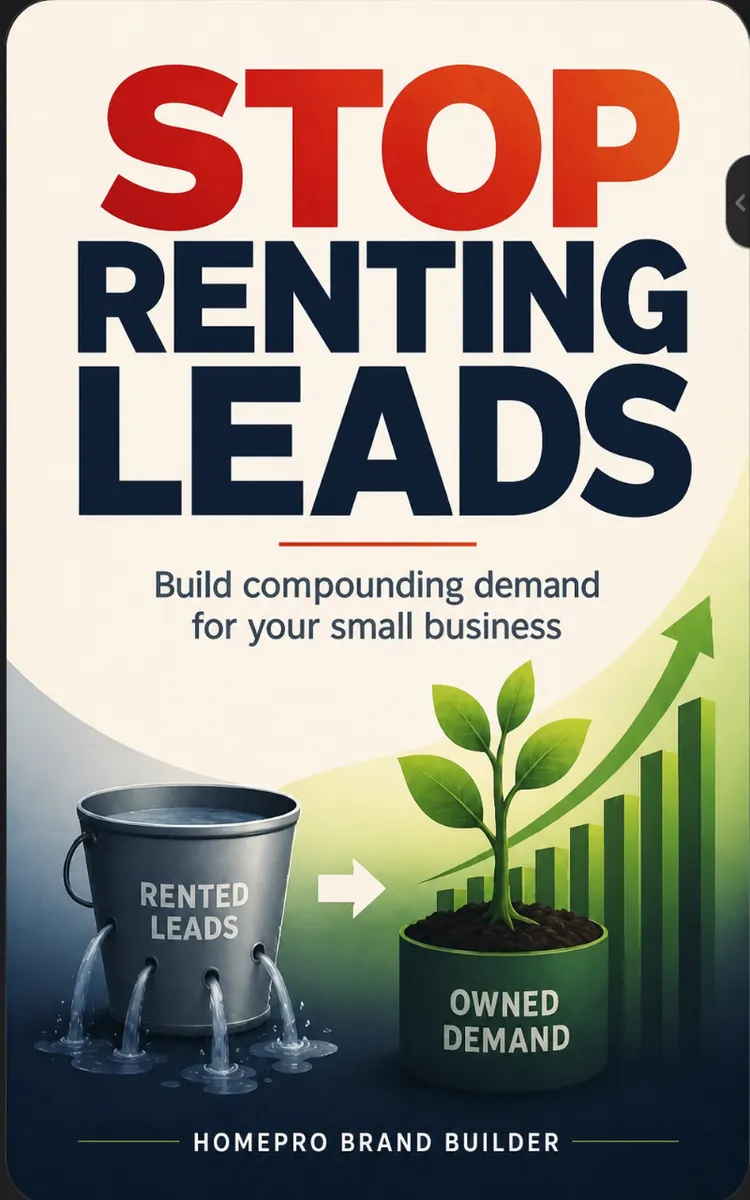
"Stop Renting Leads" is a marketing book by HomePro Brand Builder with 7 chapters and approximately 14,676 words. Avoid pay-to-play directories and build owned lead flow.
This book was created using Inkfluence AI, an AI-powered book generation platform that helps authors write, design, and publish complete books. It was made with the AI Ebook Creator.
Frequently Asked Questions
What is "Stop Renting Leads" about?
Avoid pay-to-play directories and build owned lead flow
How many chapters are in "Stop Renting Leads"?
The book contains 7 chapters and approximately 14,676 words. Topics covered include Stop Paying for BBB Leads, Build a Google-First Lead Engine, Review Generation Without Platform Games, Ad Spend That Doesn’t Get Buried, and more.
Who wrote "Stop Renting Leads"?
This book was written by HomePro Brand Builder and created using Inkfluence AI, an AI book generation platform that helps authors write, design, and publish books.
How can I create a similar marketing book?
You can create your own marketing book using Inkfluence AI. Describe your idea, choose your style, and the AI writes the full book for you. It's free to start.
Write your own marketing book with AI
Describe your idea and Inkfluence writes the whole thing. Free to start.
Start writingCreated with Inkfluence AI


