
Read the first chapter
The whole of chapter one, free. About 13 min. Turn the pages with the arrows, your keyboard, or a swipe.
Chapter 1
The Flood at Mercy Ford
The shoes of Caleb's horse struck the stones above the Mercy River, though the muddy river below had already swallowed half the wooden ranch crossing. Rain darkened the far hills to a bruised blue, and thunder rolled along the valley like wagons driven hard over a roof.
Caleb leaned forward in the saddle. On the opposite bank, two wagons stood seeking cover among the cottonwoods. A white cloth snapped from the lead wagon’s brake handle.
Then a child screamed.
“Hold on!” Caleb shouted, though the river tore his voice apart.
He pulled the reins and swung down before the horse had fully stopped. The animal tossed its head, eyes showing white. Caleb tied the reins to a cedar root and looked across the water.
The river had been a small shelf of pale stones that morning. Now brown water boiled over it, carrying branches, fence rails, and one whole section of somebody’s barn. The current struck the wagon wheels and shuddered them in their bones.
A man on the far bank waved both arms. “We can’t get out!”
Caleb stripped off his coat and rolled the sleeves of his shirt. His first thought was to reach the settlers before dark. His second was that the river had no intention of letting him.
A woman climbed down from the lead wagon, clutching a little girl against her hip. Behind her, two men wrestled at a rear wheel sunk nearly to its hub. A boy stood on the wagon tongue, staring at the water.
“Get the boy inside!” Caleb called. “Keep the horses turned uphill!”
The man nearest the wheel cupped his hands. “Who are you?”
“Caleb Mercer. Move!”
The man glanced at the river, then back at Caleb. “You got a boat?”
“No.”
“Then pray for one.”
Caleb looked toward the darkening sky. Somewhere beyond the rain, the ranch bell would be ringing for supper. He could picture the warm bunkhouse, the cook’s coffee, the dry boards beneath his boots. He had been riding toward the ranch with no plan beyond sleep and wages earned.
The child screamed again.
Caleb stepped into the river.
The cold seized him above the knees. Stones shifted beneath his boots, slick as grease. He planted his staff downstream and leaned into the current. Water slammed his thighs, then his waist. A log spun past close enough to scrape his hip.
“Caleb!” the man shouted. “Come back!”
Caleb drove the staff between two stones and held there until the river stopped trying to take his feet. “Get a rope!”
One of the settlers ran to the wagon and returned with a coil. He threw it. The rope fell short and vanished in the brown churn.
“Again!”
The second throw reached Caleb. He caught it against his chest, tied it around his waist, and looped the other end around his staff.
The man on the bank stared. “That won’t hold.”
“It only has to hold long enough.”
Caleb pushed on.
Each step demanded a choice. The water hid every stone. Twice his boots slipped, and once the current lifted him clean off the riverbed. The rope snapped tight. His shoulder wrenched, but the settlers hauled him toward the wagon.
When he reached the far bank, he fell against the wheel of the lead wagon, coughing river water. The woman crouched beside him.
“Are you hurt?”
“Not where it counts.” He looked at the child in her arms. “How many?”
“Seven,” she said. “My husband, my brother, our two boys, my daughter, and me.”
The husband came forward, a square-faced man with blood running from one temple. “Name’s Elias Voss. We left Missouri twelve days ago.”
“Where are you headed?”
“Mercy County. Heard there was work.”
Caleb glanced at the river. “You won’t reach it tonight.”
“We won’t reach anywhere if this wagon stays here.” Elias pointed at the rear wheel. “The axle’s cracked. We tried to pull it free, but the water’s climbing.”
A deeper roar rolled from upstream.
Caleb turned. The river had risen another handspan around the wagon. A cottonwood trunk struck the ford and broke apart, sending limbs spinning toward them.
“Cut the traces,” Caleb said. “Leave the wagon.”
Elias stiffened. “Everything we own is in there.”
“Everything you own is about to be downstream.”
The woman’s face tightened. “There’s flour. Blankets. My husband’s Bible.”
Caleb met her eyes. “Carry what you can. The rest belongs to the river now.”
Elias shook his head. “We can’t walk across that.”
“You can’t stay here.”
For a moment, no one moved. Rain began striking the wagon canvas in hard, flat blows. The little girl buried her face in her mother’s shoulder.
Caleb seized the lead rope and climbed onto the wagon tongue. “Tie yourselves together. One rope around the waist. Keep the children in the middle. We go uphill, then cross where the bank narrows.”
Elias grabbed his arm. “You’re not in charge of us.”
“No,” Caleb said. “The river is.”
Another log hit the wagon. The whole frame lurched. A horse screamed and reared against its harness.
That broke the stillness.
Elias drew his knife and cut the traces. His brother freed the second horse. The animals stumbled onto higher ground while the family gathered blankets, sacks, and a small wooden box.
Caleb took the girl from her mother. She clung to his neck with surprising strength.
“What’s your name?” he asked.
“Ruth.”
“Hold tight, Ruth.”
“I don’t want to go in the water.”
“Neither do I.”
That earned him a frightened glance.
“But we’re going anyway.”
They moved along the bank, roped together. Caleb went first, driving his staff into the mud. Behind him came Elias, then the woman with Ruth’s brothers pressed close around her. Elias’s brother brought up the rear, carrying the wooden box beneath his shirt.
The bank narrowed at a bend where the river had eaten away the earth. Beyond it, the only path to safety crossed a flooded channel no wider than a wagon road. The water surged over the trail, waist-deep at the center.
Caleb studied it. Upstream, the current struck a fallen tree and divided. Downstream, the bank dropped sharply into the main river.
“We cross here,” he said.
Elias looked at the churning water. “That’s your plan?”
“It’s the only ground left.”
Caleb tied the rope around a sturdy cottonwood and stepped into the channel. The water hit him hard enough to turn his shoulders. He lowered himself, found the first stone, and shouted, “One at a time!”
Elias followed with Ruth’s mother. She carried the wooden box against her chest. Water rose to her ribs.
“The box!” Caleb called. “Let it go!”
She shook her head. “It’s his Word.”
Caleb saw the old Bible’s black cover beneath her arm.
“Then hold it high.”
The current drove into them. Elias reached for his wife, but his boot slid. He went down with a cry, pulling her after him. The rope snapped tight around Caleb’s waist.
“Let go of me!” Elias shouted.
“Not a chance.”
Caleb wrapped one arm around Ruth and seized Elias’s coat with the other. The river dragged at all three. His staff tore free and shot downstream.
For one terrible second, Caleb’s feet left the bottom.
He thought of the empty sky above the flood, of the God his mother had spoken of when Caleb was a boy, saying that no man stood beyond mercy’s reach. The thought did not quiet the river. It gave him something to brace against.
He drove his knee into the submerged stones and hauled Elias upright.
“Stand!” Caleb roared.
Elias found his footing. His wife clung to him, the Bible still lifted above the water.
“Move!” Caleb said. “Move now!”
They staggered toward the far bank. Ruth’s brothers crawled the final few feet through the mud. Caleb shoved Ruth into her mother’s arms, then pulled Elias clear as the rope around his waist cut deep.
Behind them, the lead wagon groaned.
Caleb turned.
The bank beneath the wagon collapsed. The front wheels dropped into the river, and the wagon tipped forward. Canvas tore loose. Barrels and bedrolls spilled into the flood. Elias’s brother lunged toward it.
“Leave it!” Caleb shouted.
“My tools!”
The man took one step.
Caleb caught him by the collar and dragged him back. A moment later, the wagon rolled onto its side and vanished beneath the brown water.
The settlers stood in the rain, staring at the place where their home had been.
Ruth began to cry. Her mother pressed the Bible to her chest. Elias lowered his head, water running from his beard.
Caleb’s legs shook beneath him. He bent, hands on his knees, and drew a breath that burned all the way down.
Elias came near. “You saved us.”
Caleb looked at the river. “Not yet.”
A bell clanged from the trees downstream.
Caleb straightened. Through the rain he saw the old wagon bridge at the lower bend, its timbers black against the swollen water. It was the last crossing for miles. If it held, they could reach the settlement beyond the ridge. If it failed, the settlers would be trapped on the wrong side of Mercy Ford.
“Take the children uphill,” Caleb said. “There’s a rise beyond those cottonwoods.”
Elias frowned. “What about you?”
“I’m checking the bridge.”
“You’ve done enough.”
Caleb looked at the family huddled around the woman and the Bible. He had ridden to Mercy Ford alone, intending to pass through before the storm made the road impassable. Now seven faces watched him as if his next step belonged to them.
“I’ll meet you on the rise,” he said.
He ran.
The path to the bridge had become a ribbon of mud. Rain stung his eyes. Behind him, Elias shouted for the others to follow. Caleb reached the bridge just as the river struck its first support.
The timbers shuddered. One chain snapped with a report like a rifle shot.
Caleb stopped at the near end. The bridge swayed over the flood, boards lifting and dropping beneath the water. On the far side, the road climbed toward safety. On this side, the settlers gathered beneath the trees, their bundles held close.
“Caleb!” Elias called. “Can we cross?”
Caleb looked at the bridge, then at the river running beneath it.
“Stay back!”
He stepped onto the first board.
The bridge groaned under his weight. Water burst through the gaps, cold and forceful around his boots. He moved one careful step at a time, testing each plank before trusting it.
Halfway across, a support beam broke loose upstream and slammed into the bridge. The deck bucked. Caleb dropped to his hands as the river opened below him.
“Caleb!” Ruth screamed.
He gripped a wet rope and pulled himself forward. The bridge swung sideways, throwing him against the railing. Pain flashed through his ribs. He held on until the timbers settled.
Then he crawled.
The far bank came closer. Caleb reached for the last post and hauled himself onto solid ground. He turned and shouted, “Come!”
Elias crossed first, roped to his wife. The bridge dipped beneath them. Ruth’s brothers followed, pale and silent. The woman came next, clutching the Bible under her coat.
A crack split the storm.
The bridge dropped at its center.
Elias threw himself forward. Caleb seized his wrist and pulled. The woman screamed as the rope between them went taut. One of the boys slid backward, but his brother caught him by the belt.
“Keep coming!” Caleb shouted.
They reached the far bank in a tangle of arms and soaked clothing.
Ruth was the last. She stood on the near side, frozen, the flood roaring behind her.
“Caleb!” her mother cried.
He went back to the edge.
“Ruth, look at me.”
The girl’s lips trembled. “I can’t.”
“Yes, you can. Step where I step.”
The bridge sagged another foot.
Caleb held out his hand. “Come on.”
Ruth took it.
The instant her weight touched the first board, the center span tore free. Caleb lunged, caught her around the waist, and swung her against his chest as the bridge collapsed behind them.
Timbers crashed into the river. The chain whipped through the rain. The whole wagon bridge folded and vanished, leaving only broken posts and a widening field of foam.
Caleb landed hard on the far bank with Ruth beneath him. For a moment neither moved.
Then Ruth lifted her head. “Did we make it?”
Caleb looked back at Mercy Ford. The crossing was gone. The river filled the valley from bank to bank, carrying wagons, timber, and every road they had come by.
He set Ruth on her feet.
“Yes,” he said. “But we’re not going anywhere tonight.”
Elias stared at the destroyed bridge. “There’s no other crossing.”
“Not for miles.”
The settlers gathered around Caleb beneath the dripping cottonwoods. Their possessions lay in muddy bundles at their feet. The storm pressed them together, strangers with nowhere else to stand.
Elias opened his mouth, perhaps to ask what came next. Before he could speak, his wife stepped beside Caleb and placed the rescued Bible in his hands.
“You carried her,” she said. “Carry this awhile.”
Caleb looked down at the worn cover. Water dripped from its pages onto his knuckles.
Across the river, the last light faded over the road he had meant to follow alone.
He closed his fingers around the Bible.
“All right,” he said. “We’ll make camp.”
Rain settled into a slow drum. The cottonwoods whispered above them like men exchanging news they could not keep. Caleb set the Bible against his thigh and looked at the faces turned toward him - wet, hollow-eyed, stubborn as boot leather. The children huddled under a patched blanket, eyes bright with cold and fear. Elias’s jaw worked; his brother leaned on a bent shovel, mud clinging to the handle. The woman smoothed Ruth’s hair with hands that trembled.
“We’ll make shelter,” Caleb said. “Not much farther up, there’s a cedar draw. We can set a lean-to and get a fire going. Keep the wet wood for kindling, and bundle what’s dry inside the blankets.” He heard his voice as if from a distance, the authority of action more useful than the certainty of words.
Elias studied the ruined crossing and then Caleb. “You don’t have to do this. We’ll figure it - ”
“You don’t have to,” Caleb answered, “but you’re not the ones wading into the river.” He pushed to his feet. Rain slit his lashes. The Bible was warm against his ribs, as if the book itself refused to be chilled.
They moved without talk, each performing a job they had not planned. Elias and his brother shouldered what remained of their tools and scoured the cottonwood litter for straight poles. The woman gathered blankets and wrapped the children. Caleb and the younger boys hollowed a shelter of boughs against a fallen limb, angling it toward the windbreak of the hill. The air tasted of iron and wet earth; the rope of the wagon bridge still hummed faintly in the river as it vanished downstream.
When the lean-to stood, Caleb rubbed his palms together and struck flint against steel. A tiny spark caught. Smoke curled, stung their eyes, and then a small, stubborn flame took. They fed it with sodden bark until it glowed. The first comfort came in heat. The children leaned forward as if to drink it.
Ruth crawled to Caleb’s side and touched the Bible, fingers damp and clumsy. “My mama said it kept us safe,” she whispered.
Caleb tucked the book beneath his coat. “We’ll keep it safe.” He met Elias’s wife’s eyes. She nodded once, an agreement without words, and returned to stirring a pot fashioned from a dented tin.
Night folded over them with a white-throated wind. From across the river, somewhere beyond the broken bridge, a bell tolled - slow, lonely - and the sound came like an answer to the day’s violence. Caleb listened until the note faded into rain. He thought of the ranch he had left, of supper cooking in a warm room, and of how different a man felt when he had other people depending on him.
When the children finally quieted and sleep began to draw their breath into even lines, Elias crouched beside Caleb, hands wrapped around a cup of hot, thin broth. “You could go on,” he said, not unkindly. “Find work, keep your wages.”
Caleb looked at the Bible, then at the small family sheltering under the cedar. Mercy was a place beyond the river now, but mercy had found them in the storm. He wiped his mouth with the back of his hand and set the cup down.
“I’m staying,” he said. “Till you’re on the road again.” He thought of Harlan Vale and the ledger he had not yet seen, of Dry Creek and the wells turning sour somewhere ahead, and the way the world tilted on the edge of choices. For now, the decision was simple and true: hold the line until morning, when the road would be measured anew.
Above them, thunder rolled once more and then softened, as if hearing the promise and stepping back.
End of chapter one. 4 more chapters in the full book.
Swipe or use the arrows to turn the page
What's inside: 5 chapters
- 1. The Flood at Mercy Ford
- 2. A Promise at the Chapel
- 3. The Pass That Took Their Horses
- 4. The Ledger Beneath the Floor
- 5. The Night the Wells Ran Dry
About this book
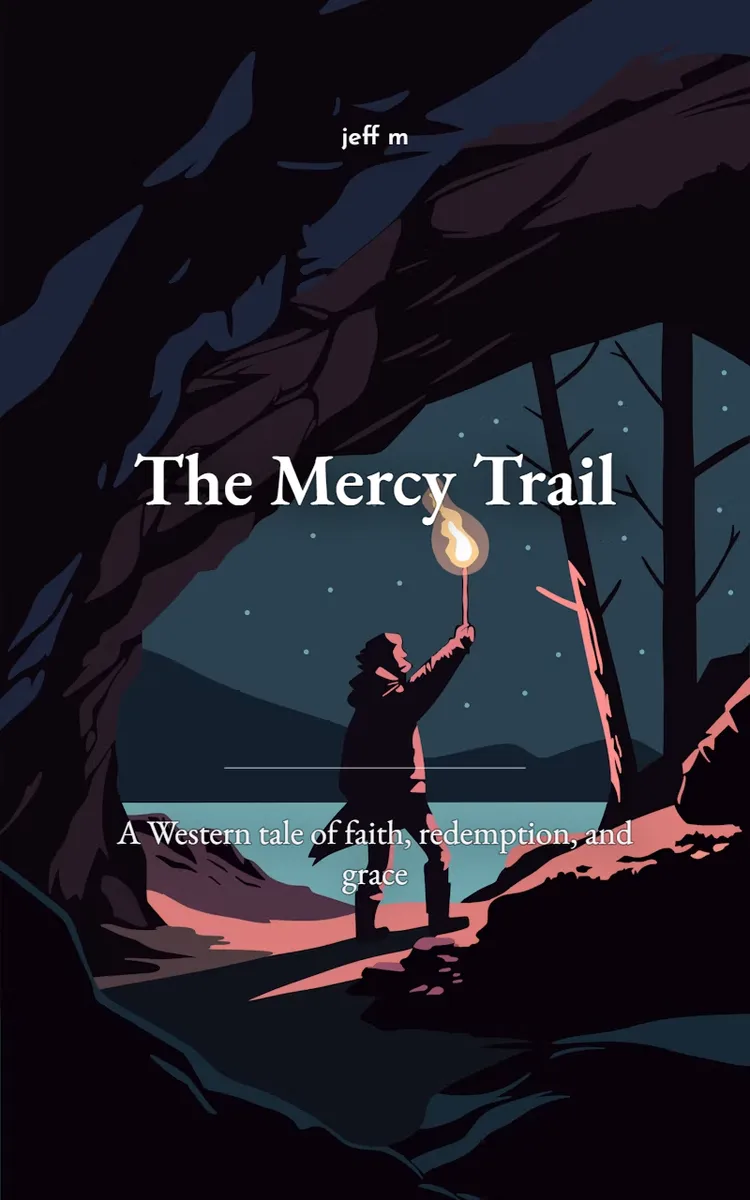
"The Mercy Trail" is a fiction book by jeff m with 5 chapters and approximately 10,991 words. God’s love for humanity expressed through a Western story.
This book was created using Inkfluence AI, an AI-powered book generation platform that helps authors write, design, and publish complete books. It was made with the AI Novel Writer.
Frequently Asked Questions
What is "The Mercy Trail" about?
God’s love for humanity expressed through a Western story
How many chapters are in "The Mercy Trail"?
The book contains 5 chapters and approximately 10,991 words. Topics covered include The Flood at Mercy Ford, A Promise at the Chapel, The Pass That Took Their Horses, The Ledger Beneath the Floor, and more.
Who wrote "The Mercy Trail"?
This book was written by jeff m and created using Inkfluence AI, an AI book generation platform that helps authors write, design, and publish books.
How can I create a similar fiction book?
You can create your own fiction book using Inkfluence AI. Describe your idea, choose your style, and the AI writes the full book for you. It's free to start.
Write your own fiction book with AI
Describe your idea and Inkfluence writes the whole thing. Free to start.
Start writingCreated with Inkfluence AI


