
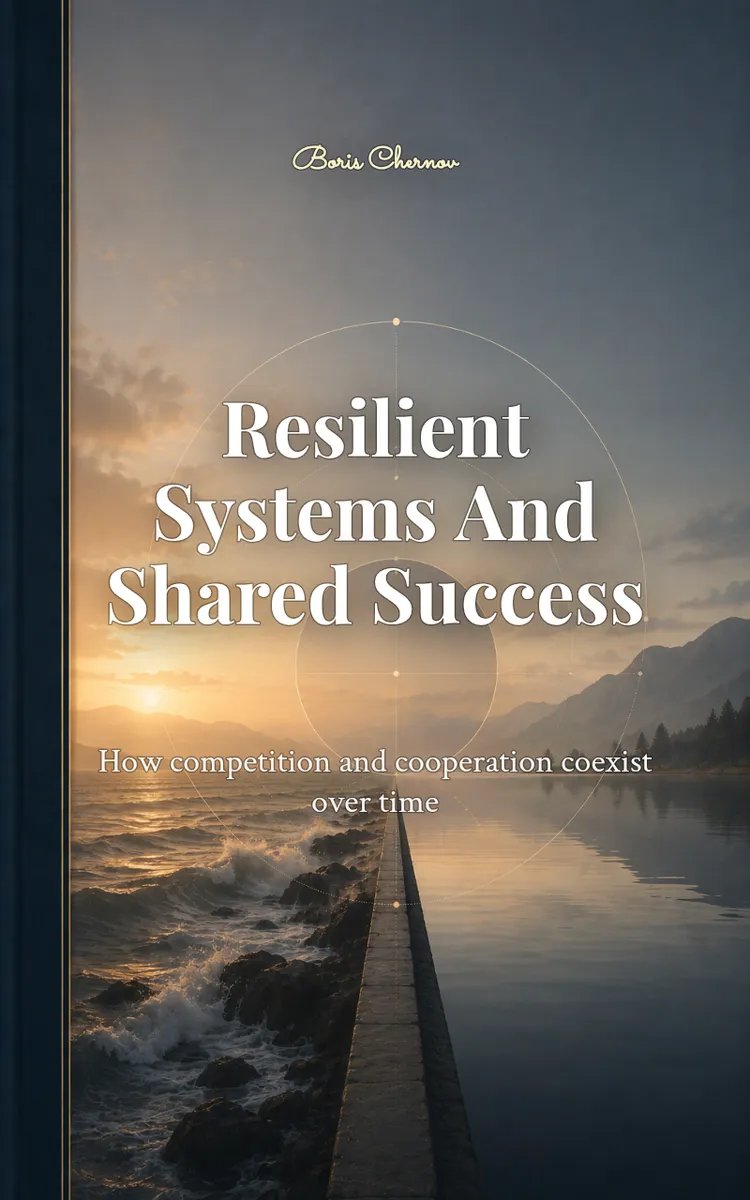
Resilient Systems And Shared Success
Created with Inkfluence AI
Popular science exploration of competition, cooperation, and system resilience
Table of Contents
- 1. The Friendly Rival on Game Night
- 2. When Everyone Tries to Win
- 3. The Rules Are the Real Player
- 4. Nature’s Scoreboards Don’t Exist
- 5. Open-Source: Compete by Sharing
- 6. Competition Finds Options; Cooperation Keeps
- 7. Your Memory Has the Evidence
- 8. Stop Asking Which Wins
Preview: The Friendly Rival on Game Night
A short excerpt from “The Friendly Rival on Game Night”. The full book contains 8 chapters and 12,870 words.
The Scoreboard Between Friends
The most useful rivalry in a team may be the one that ends with everyone laughing at the same mistake. On a school esports night, a player can compete fiercely for the highest score while depending completely on the people trying to beat her.
That tension is familiar far beyond games. Friends race each other during practice, musicians compare difficult passages, and colleagues quietly notice who solved a problem first. Competition can sharpen attention and effort. Yet if every point becomes a judgment of worth, the same contest begins to damage trust.
Nia, a sixteen-year-old high-school esports captain, knows this difference from the inside. Her team’s game-night routine contains a small puzzle: players challenge one another repeatedly, but the challenge works only because they expect to remain teammates afterward. The score matters, though not by itself.
What allows a contest to increase effort without turning cooperation into a casualty?
The Game-Night Loop
On a typical school esports evening, the visible action is competition: teams choose characters, read maps, manage limited resources, and try to outplay an opponent before the clock runs out. Less visible is the work between matches. Players review recordings, point out missed opportunities, adjust roles, and return to the next game with a slightly different understanding of what happened.
Nia’s role as captain is not simply to call tactics. She also helps keep the rivalry inside a useful boundary. A teammate may challenge another player’s decision, but the criticism must remain connected to the match. “That route exposed us” can improve the next round. “You always ruin the defense” turns a decision into an identity, and identity is much harder to revise.
This repeating pattern is the Game-Night Loop: a contest creates information, teammates examine that information together, and the next contest tests what they have learned. The loop depends on both separation and return. Players need enough rivalry to reveal differences in skill or judgment, and enough trust to bring those differences back into the group.
The pattern has older roots than electronic games. Athletic clubs, debating societies, orchestras, and scientific teams have long used comparison as a way to improve performance. A violin section may listen to another section and adjust its timing. Runners compare splits. Researchers test one explanation against another. The comparison is not the whole activity; it is a source of feedback within a continuing relationship.
A scoreboard, in this setting, is less like a verdict than a measuring instrument. It records an outcome, but it does not explain the outcome. That explanation comes from the conversation afterward.
Why Rivalry Needs a Return Path
Human beings do not respond to competition in only one way. A contest can focus attention because the result is clear and immediate. It can also make people conceal information, avoid risks, or blame others when the cost of losing feels too high. The same structure that produces effort can produce defensiveness.
Trust changes the meaning of the score. When teammates believe that a poor result will be examined rather than used as ammunition, they are more likely to admit what they missed. That admission gives the group better information. A player who hides a mistake protects a reputation for one evening but removes part of the evidence needed for improvement.
This is one reason repeated contests differ from one-time contests. In a single encounter, winning may dominate every other concern. In a series of encounters, today’s opponent may be tomorrow’s partner, coach, or source of advice. The future relationship places a limit on how much damage a person can afford to cause for a short-term advantage.
School esports makes this visible because teams often practice against themselves. Nia’s players might divide into two sides, compete intensely for twenty minutes, then exchange observations about map control or timing. The winning side has information the losing side needs. The losing side may have exposed weaknesses the winners had not noticed. Each side becomes, briefly, both rival and teacher.
A similar arrangement appears in open-source software. Contributors may propose different solutions to the same technical problem, and their ideas are compared publicly through review. The code is judged, but the people must continue working together. A harsh review can discourage participation; a careful one can make the shared project stronger. The contest takes place inside a structure that preserves the possibility of another contribution.
The important feature is not friendliness in the soft sense. Teammates do not need to agree about every decision. They need a reliable way to disagree without making future cooperation impossible.
The Unexpected Advantage of a Close Rival
...
About this book
"Resilient Systems And Shared Success" is a curiosity book by Boris Chernov with 8 chapters and approximately 12,870 words. Popular science exploration of competition, cooperation, and system resilience.
This book was created using Inkfluence AI, an AI-powered book generation platform that helps authors write, design, and publish complete books.
Frequently Asked Questions
What is "Resilient Systems And Shared Success" about?
Popular science exploration of competition, cooperation, and system resilience
How many chapters are in "Resilient Systems And Shared Success"?
The book contains 8 chapters and approximately 12,870 words. Topics covered include The Friendly Rival on Game Night, When Everyone Tries to Win, The Rules Are the Real Player, Nature’s Scoreboards Don’t Exist, and more.
Who wrote "Resilient Systems And Shared Success"?
This book was written by Boris Chernov and created using Inkfluence AI, an AI book generation platform that helps authors write, design, and publish books.
Write your own curiosity book with AI
Describe your idea and Inkfluence writes the whole thing. Free to start.
Start writingCreated with Inkfluence AI


