
Read the first chapter
The whole of chapter one, free. About 7 min. Turn the pages with the arrows, your keyboard, or a swipe.
Chapter 1
Where Did That Puddle Go?
Rain had left a shiny puddle across the sidewalk, and Emma crouched beside it before the last drops had stopped dripping from the porch roof.
The puddle looked like a little piece of sky. It held the pale blue clouds, the green leaves of the maple tree, and one upside-down picture of Emma’s yellow rain boots.
“Stay right there,” Emma whispered.
She hurried inside for a piece of chalk. When she came back, she drew a wide circle around the puddle. The chalk squeaked against the sidewalk. Then she placed a small twig at the puddle’s edge.
“This will help me watch you,” she said.
The air smelled fresh and wet. Drops tapped softly from the roof. Farther down the street, a car rolled through a damp patch with a gentle swish.
Emma sat on the front step and watched.
At first, nothing seemed to happen. The puddle rested inside its chalk circle, bright and smooth. Emma counted three red cars, two blue bicycles, and one squirrel that darted beneath a bush.
Then she leaned forward.
The twig no longer touched the water.
Emma blinked. “That’s strange.”
She moved the twig back to the edge. The water had pulled away from it. Not much, but enough to leave a dark, wet line on the sidewalk.
Emma looked up and down the street. No one was carrying a bucket. No one was sweeping. There was no drain near the puddle.
“Where did that water go?”
Her little brother, Austin, opened the front door behind her. He carried a towel around his shoulders like a cape.
“What are you looking at?” he asked.
“A disappearing puddle.”
Austin stepped onto the porch. “Maybe it rolled away.”
“It can’t roll,” Emma said. “It’s flat.”
“Maybe the sidewalk drank it.”
Emma pressed one finger to the dry part of the sidewalk. It felt warm and rough. Then she touched the wet part. It was cool and smooth.
“Sidewalks don’t have mouths,” she said.
Austin peered at the chalk circle. “Maybe the water is hiding under the chalk.”
Emma shook her head. She wanted to know the answer, but she did not want to guess too quickly. She had seen the puddle. She had marked it. Now she needed to watch carefully.
She found a small plastic cup in the kitchen and filled it with water from the sink. Back outside, she set the cup beside the puddle.
“If the sidewalk is drinking,” she told Austin, “the cup should stay full.”
Austin nodded with great seriousness. “And if the puddle rolls away, we’ll see it.”
Emma placed a second twig beside the water in the cup. Then she sat on the step again.
A warm breeze brushed her cheeks. The sun came out from behind a cloud and spread a bright patch across the sidewalk. The puddle glittered. Tiny drops shone like beads.
Emma watched the sunlit patch. She watched the cup. She watched the twig.
Nothing happened.
Austin grew tired and began making quiet drumbeats on his knees. Emma tried not to look away. She counted to twenty, then to forty. When she glanced at the puddle again, the water had shrunk farther inside the chalk circle.
“The sidewalk is drinking faster!” Austin cried.
Emma frowned. “But the cup is still full.”
She bent close to the puddle. The water had a thin edge now. In the middle, the sidewalk showed through in a wide gray shape.
“Maybe the water is soaking into the sidewalk,” Emma said.
She took a dry leaf and laid it on the wet part. The leaf darkened at once. Emma lifted it and touched the place beneath. The sidewalk was damp, but not deep. She pressed the leaf to the dry part. It stayed light brown.
“Some water may soak into tiny spaces,” she said. “But that can’t be all of it. The puddle is getting smaller even where the sidewalk looks dry.”
Austin pointed at the cup. “The cup is not smaller.”
Emma looked at the two bits of water. The cup had a smooth bottom and tall sides. The puddle spread wide and thin across the warm sidewalk.
She moved the cup into the sun. Then she put it in the shade beneath the porch step.
“Now we can compare them,” she said.
Austin tilted his head. “Compare means look at two things to see how they are different.”
“Exactly.”
They waited a little longer. The sun warmed Emma’s arms. The wet sidewalk began to lose its shine. A sparrow chirped from the maple tree. Somewhere nearby, a lawn sprinkler clicked and ticked.
Emma checked the puddle again.
Only a small patch of water remained.
She traced the chalk circle with her finger. “It was this big.”
Austin placed both hands around the tiny patch without touching it. “Now it is this big.”
Emma felt a pinch of disappointment. She had hoped to catch the water doing something. She had watched every spot she could see, but the water had not marched away, slipped beneath the sidewalk, or climbed into the cup.
“It disappeared while we were looking right at it,” she said.
Austin’s eyes widened. “Maybe it is invisible.”
Emma looked at him. “Water can be invisible?”
“Air is invisible.”
“That doesn’t mean water is.”
Austin thought for a moment. “Could water become air?”
Emma did not know. She looked at the last shining patch. The sun warmed her face, but the water felt cool when she touched it with one fingertip.
Then the warm breeze passed over the sidewalk.
The shining patch grew smaller.
Emma pulled her hand back. “Wait.”
She crouched lower. The water did not move like a stream. It did not slide toward a crack. It simply became less and less, as if tiny pieces were lifting away.
“Maybe the sun warms the water,” she said slowly. “Then the water changes into something that goes into the air.”
Austin lifted his face to the breeze. “Can we see it?”
Emma waved her hand through the space above the puddle. There was nothing to catch. No blue mist. No little drops. Only warm air moving over her fingers.
“I can’t see anything,” she said.
“Maybe it went too fast.”
“Maybe.”
Emma wanted proof. She fetched a ruler from her room and hurried back outside. The puddle was almost gone. She placed the ruler beside it, careful not to touch the water.
“Look,” she said. “It is smaller than the end of the ruler.”
Austin leaned close. “It is still there.”
Emma smiled. “Yes. So it has not vanished all at once.”
They watched in silence. A tiny drop trembled at the edge. The breeze moved over it. The drop grew flatter, thinner, and then disappeared.
Emma stared at the empty sidewalk.
The dark, wet mark remained for a while. Soon that faded too. The chalk circle surrounded nothing but warm gray concrete.
“Where did that puddle go?” Austin asked again, but this time his voice sounded curious instead of puzzled.
Emma looked at the cup. The water inside was still there. The cup in the shade was still full too.
“The puddle changed into invisible water in the air,” she said. “I think that is called evaporation.”
Austin tried the word carefully. “E-vap-o-ra-tion.”
“Evaporation,” Emma repeated. “It means liquid water changes into water vapor and mixes with the air.”
Austin waved his towel-cape above the empty circle. “Can we scoop the water back?”
Emma laughed softly. “Not with a towel. It is spread through the air now.”
She stood and brushed chalk dust from her knees. The sidewalk no longer smelled wet. It smelled warm, like sun-baked stone. Emma felt a little amazed. The water had been right in front of her, and now it was somewhere she could not point to.
She picked up the twig and set it beside the cup. “We still have water to watch.”
Austin carried the cup carefully to the porch. Emma followed. Together, they checked the water level. The cup in the sun had a tiny ring of water around its inside wall. The cup in the shade looked just the same as before.
Emma touched the sunlit cup. It felt warm.
“Maybe the warm air helped some water leave this cup too,” she said.
“But we can’t see it,” Austin replied.
Emma nodded. “That is the tricky part.”
She looked back at the chalk circle. The puddle was gone, but the question stayed with her. She had seen water shrink. She had seen a drop disappear. She had felt the warm breeze. Still, the air looked empty.
Emma lifted the cup and carried it beneath the porch. “Tomorrow, we can watch the cups again.”
Austin carried the twigs. “And maybe use two cups.”
“One in the sun and one in the shade.”
“So we can compare.”
“So we can compare,” Emma agreed.
They placed the cups safely on the porch rail, where they would not be kicked or tipped. Emma drew a small sun on a scrap of paper and set it beside the sunny cup. Then she drew a tree beside the shady one.
The porch roof dripped once more. Plink.
Emma glanced at the empty circle on the sidewalk. The puddle had not been stolen or swept away. It had changed, little by little, into water vapor that she could not see.
She still could not prove where every invisible bit had gone. But she had a good guess, and tomorrow there would be more clues.
Emma smiled at the quiet sidewalk and the two waiting cups.
Water can disappear from sight without disappearing from the world.
End of chapter one. 4 more chapters in the full book.
Swipe or use the arrows to turn the page
What's inside: 5 chapters
- 1. Where Did That Puddle Go?
- 2. Making Water Disappear in a Cup
- 3. Following Water as Water Vapor
- 4. The Steam Cloud Over the Pot
- 5. Where the Water Comes Back
About this book
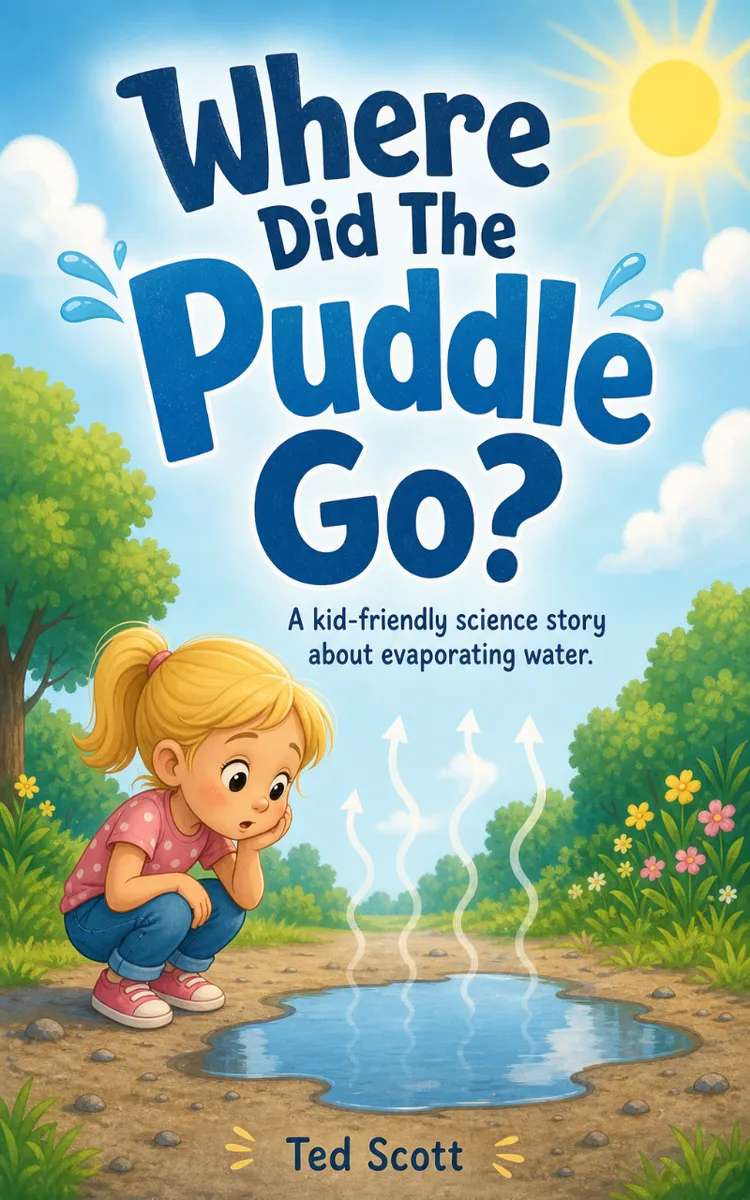
"Where Did The Puddle Go?" is a children's book by Ted Scott with 5 chapters and approximately 7,903 words. Children’s introductory science story about evaporation.
This book was created using Inkfluence AI, an AI-powered book generation platform that helps authors write, design, and publish complete books. It was made with the AI Children's Book Creator.
Frequently Asked Questions
What is "Where Did The Puddle Go?" about?
Children’s introductory science story about evaporation
How many chapters are in "Where Did The Puddle Go?"?
The book contains 5 chapters and approximately 7,903 words. Topics covered include Where Did That Puddle Go?, Making Water Disappear in a Cup, Following Water as Water Vapor, The Steam Cloud Over the Pot, and more.
Who wrote "Where Did The Puddle Go?"?
This book was written by Ted Scott and created using Inkfluence AI, an AI book generation platform that helps authors write, design, and publish books.
How can I create a similar children's book?
You can create your own children's book using Inkfluence AI. Describe your idea, choose your style, and the AI writes the full book for you. It's free to start.
Write your own children's book with AI
Describe your idea and Inkfluence writes the whole thing. Free to start.
Start writingCreated with Inkfluence AI


