
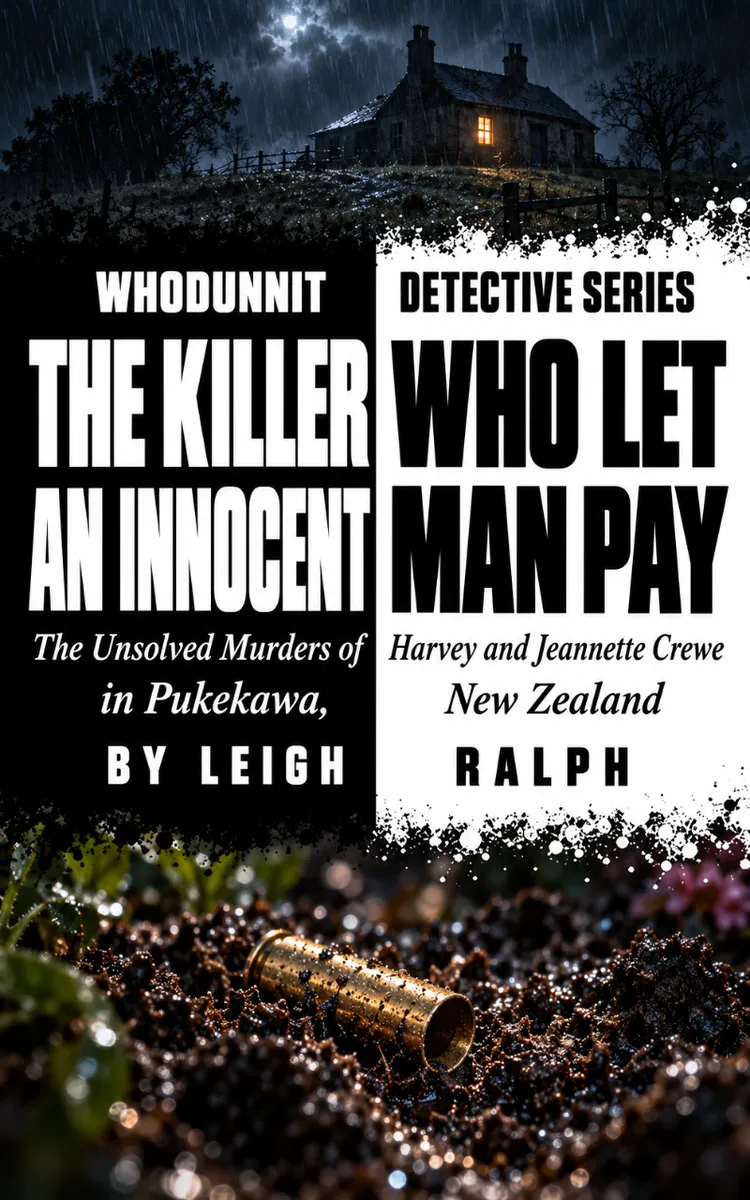

Read the first chapter
The whole of chapter one, free. About 4 min. Turn the pages with the arrows, your keyboard, or a swipe.
Chapter 1
A Quiet Corner of the Waikato
In 1970, Pukekawa was the kind of place where everybody knew everybody.
It sat on rolling green farmland in the Lower Waikato, about an hour's drive south of Auckland, with the wide brown Waikato River winding past below. A few hundred people lived in the district. There was a school, a hall, a store and a garage, and farm after farm of sheep and cattle stretching off across the hills. Families had worked the same land for generations. Children grew up together, went to the same little school, married into each other's families and stayed.
It was quiet, prosperous and safe. Nobody locked their doors.
The Demler girls
Jeannette Lenore Demler was born on 6 February 1940. Her parents, Len and Maisie Demler, farmed in Pukekawa. Len had taken over a farm there in 1937, and Maisie came from the Chennells family, who owned the farm next door. Two years after Jeannette, a second daughter, Heather, was born.
When the girls were still small, aged just ten and eight, an uncle on their mother's side died and left his farm to the two of them. It would be held for them until they were old enough to take it over. So from childhood, Jeannette knew that one day part of that land would be hers.
She went to the local primary school, Pukekawa School, along with the other farm kids of the district. One of them was a local boy two years older than her, from a big farming family down the road. His name was Arthur Allan Thomas.
Remember that name. We'll come back to him later in this book.
Jeannette was bright and capable. She went up to Auckland to finish her secondary schooling and then trained as a teacher. In the early 1960s, like so many young Kiwis, she headed overseas for a spell before coming home to work. She taught first at Maramarua, not far from home, and then moved down to Whanganui.
It was there that she met Harvey Crewe.
Harvey
David Harvey Crewe, always known as Harvey, was born on 20 October 1941. He came from a well-known farming family in Pahiatua, in the north of the Wairarapa, and he had grown up around sheep, cattle and hard work. Like Jeannette, he was steady and sensible. People who knew him described him as quiet and reserved, a man who got on with the job and didn't say much about it.
Jeannette was almost two years older than Harvey, and by all accounts they suited each other well. They were both country people at heart, and both had their futures tied up in the land.
On 18 June 1966, Harvey and Jeannette were married at St George's Church in Epsom, Auckland. In their wedding photographs they look exactly like what they were: a nice, ordinary young couple, smiling and ready to start their life together.
The farm
After the wedding, the newlyweds moved back to Pukekawa to take over the farm Jeannette's uncle had left her and her sister. Heather agreed to sell her half to Harvey, so the young couple owned the whole property between them.
It was a sheep and cattle farm of about 360 acres, right next door to the Demler farm where Jeannette had grown up and where her parents still lived. Harvey threw himself into it. Jeannette's father later said his son-in-law was a quiet man who managed the farm well.
The farmhouse itself was nothing grand: a modest single-storey home with a living room, a kitchen, bedrooms and a sunroom, where they would later put the baby's cot.
In December 1968, their daughter Rochelle was born.
A good, quiet life
From the outside, Harvey and Jeannette Crewe had everything a young farming couple could want. They had their own land, a healthy baby girl, and family right next door. They worked hard, kept to themselves and were well thought of. They weren't party people. Their evenings were spent at home, Harvey in his armchair by the fire, Jeannette on the couch with her knitting, Rochelle asleep in her cot.
It's hard, reading about them now, not to think of how ordinary it all was. Plenty of us grew up in houses just like theirs, in districts just like Pukekawa.
On 18 June 1970, Harvey and Jeannette would have celebrated their fourth wedding anniversary. They were killed the night before.
But that ordinary life wasn't quite as peaceful as it looked. Behind the farmhouse door, there was money, family tension and a growing sense of fear. In the years before the murders, strange things had started happening on the Crewe farm, and Jeannette had become frightened to be in the house on her own.
End of chapter one. 11 more chapters in the full book.
Swipe or use the arrows to turn the page

THE KILLER WHO TURNED CABIN 28 INTO A SLAUGHTERHOUSE

THE KILLER WHO WORE A WHITE MASK

Color My Little Pooch
What's inside: 12 chapters
- 1. A Quiet Corner of the Waikato
- 2. Warning Signs
- 3. The Last Night
- 4. A Terrible Bloody Mess
- 5. Five Days Alone
- 6. The River Gives Them Up
- 7. The Man Who Once Loved Jeannette
- 8. Exhibit 350
- 9. Guilty, Twice
- 10. The Fight for Arthur
- 11. The Royal Commission
- 12. Still No Justice
About this book
"THE KILLER WHO LET AN INNOCENT MAN PAY" is a general book by Leigh Ralph with 12 chapters and approximately 11,906 words. It covers key insights and practical takeaways on the topic.
This book was created using Inkfluence AI, an AI-powered book generation platform that helps authors write, design, and publish complete books.
Frequently Asked Questions
What is "THE KILLER WHO LET AN INNOCENT MAN PAY" about?
"THE KILLER WHO LET AN INNOCENT MAN PAY" is a general book by Leigh Ralph covering key insights and practical takeaways on the topic.
How many chapters are in "THE KILLER WHO LET AN INNOCENT MAN PAY"?
The book contains 12 chapters and approximately 11,906 words. Topics covered include A Quiet Corner of the Waikato, Warning Signs, The Last Night, A Terrible Bloody Mess, and more.
Who wrote "THE KILLER WHO LET AN INNOCENT MAN PAY"?
This book was written by Leigh Ralph and created using Inkfluence AI, an AI book generation platform that helps authors write, design, and publish books.
Write your own book with AI
Describe your idea and Inkfluence writes the whole thing. Free to start.
Start writingCreated with Inkfluence AI


