
Read the first chapter
The whole of chapter one, free. About 8 min. Turn the pages with the arrows, your keyboard, or a swipe.
Chapter 1
Customer Interviews for Market Fit
Start With Conversations, Not Promotion
A handmade soap seller spent $600 on social media promotion before learning that her best customers were not mainly looking for “natural soap.” They wanted fragrance-free products that would not irritate sensitive skin. A few focused conversations would have revealed that difference before the money was spent.
That is the purpose of the Five-Conversation Discovery Loop: speak with a small number of likely buyers, record the exact problems they describe, adjust your offer, and test whether the problem is important enough for people to act. Rank your work in this order: first, speak with people who recently faced the problem; second, look for repeated words and situations; third, test a revised offer; fourth, decide whether promotion is worth funding.
You will need a clear product idea, five people who resemble possible buyers, a short interview script, a note-taking system, and a simple research worksheet. You do not need a large survey, paid research software, or a polished brand. At this stage, useful evidence comes from specific experiences, not compliments.
The Five-Conversation Discovery Loop
Use this strategy when you have an idea but cannot confidently explain who needs it, why they need it, or what would make them pay. It is also useful when people visit your store but do not buy, or when social media posts receive attention without sales.
The loop has five parts:
1. Find recent problem owners. Speak with people who have personally faced the problem in the last six months. 2. Ask about the past, not imagined purchases. Learn what they did, what it cost, and what disappointed them. 3. Record repeated problems and buying language. Do not replace their words with your preferred marketing terms. 4. Show a specific offer after listening. Ask for a reaction to a product, price, format, or result. 5. Run a small demand test. Invite a real action, such as joining a waitlist, booking a trial, or placing a refundable deposit.
A good conversation is not a sales pitch. Ask, “Tell me about the last time you bought a gift for a new parent,” rather than, “Would you buy my gift box?” The first question asks for evidence. The second often produces polite encouragement.
Prepare these items before contacting anyone:
• A one-sentence description of the problem you are investigating. - A list of 10 to 15 possible interviewees from personal contacts, community groups, past buyers, or relevant online discussions. - A 20-minute interview script with six to eight questions. - A spreadsheet or notebook with columns for person, situation, exact words, current solution, cost, frustration, and next action. - A draft offer that can change after the conversations. - A consent request if you plan to record audio. Never record secretly.
The research worksheet below keeps the discussion focused:
| Question | Notes to capture | |---|---| | What happened most recently? | Date, situation, urgency | | What did you try? | Product, service, workaround | | What did it cost? | Money, time, inconvenience | | What was disappointing? | Exact complaint or missing result | | What would a better result look like? | Desired outcome | | What would make you act now? | Trigger, deadline, confidence | | What should we test? | Offer, price, message, next action |
Run Five Conversations and Test the Pattern
Set aside about seven days. Each conversation should take 20 minutes, followed by 10 minutes for notes. Complete the steps in order.
1. Write the research question. Spend 20 minutes finishing this sentence: “I need to learn whether [specific type of buyer] struggles with [specific problem] enough to seek a different solution.” A weak question is “Do people like my products?” A stronger question is “Do home bakers who sell at weekend markets struggle to transport decorated cakes safely?” Your checkpoint is one question narrow enough to investigate with five people.
2. Recruit five suitable people. Spend two days sending 10 to 15 personal invitations. Ask for a short conversation about their recent experience, not a review of your product. Offer a modest thank-you, such as a $10 store credit, if appropriate and affordable. Aim to schedule at least five interviews; if only two respond, recruit more rather than treating two opinions as a pattern. Record the person’s connection to the problem before the call.
3. Ask for a recent example. During each 20-minute conversation, begin with: “When was the last time this happened?” Follow with, “What did you do next?” and “What was hardest about it?” Ask one question at a time and allow silence. Your checkpoint is at least one dated or clearly described real event from every interview. If someone speaks only about what they might do, mark the answer as an opinion, not proof.
4. Capture exact language immediately. Within 10 minutes of each call, write down three direct phrases, the current solution, and the strongest frustration. For example, “I keep buying candles that smell good in the shop but disappear in my living room” is more useful than “Customer wants stronger candles.” After five interviews, highlight repeated phrases. A possible pattern requires at least three people describing a similar situation without being led by you.
5. Score the problem before changing the product. Rate each interview from zero to two on four measures: recent experience, clear frustration, money or time already spent, and willingness to try a next step. A score of eight is the maximum. Five interviews scoring six or higher, with at least three people describing the same costly problem, is a reasonable signal to test an offer. Lower scores mean you should narrow the audience or investigate a different problem.
6. Present one specific offer. In a second message or the final five minutes, describe the proposed result, format, and price. For example: “I am testing a fragrance-free soap set with three small bars for people whose skin reacts to scented products. It will cost $24 and ship next Friday.” Ask, “What would stop you from trying this?” Do not ask whether they like the idea. Your checkpoint is at least three people identifying a concrete concern and at least one taking a real next step.
7. Run a small demand test. Create a simple page, form, or product listing using the language that appeared in the interviews. Invite the five interviewees and 20 to 30 similar people to respond over seven days. Offer one action: join a waitlist, request a sample, book a trial, or place a refundable deposit. Track visits, responses, and completed actions in a table. A deposit or completed booking is stronger evidence than a “sounds great” message.
Keep ownership clear. You own the research question, notes, offer change, and final decision. Each interviewee owns only their answers and any decision to continue. If a friend helps recruit people, give them a target, such as 10 invitations by Wednesday, and ask them to report the number contacted and the number scheduled.
Don't Mistake Courtesy for Demand
• Don't ask, “Would you buy this?” because people often encourage a friendly seller without intending to spend money. Ask about the last time they faced the problem, then request a real next step. - Don't interview only friends because they may protect your feelings or share your assumptions. Include recent buyers, members of relevant groups, or people who already pay for an alternative. - Don't explain your product before hearing the problem because your description can steer the answers. Spend the first 15 minutes listening. - Don't treat every complaint as a market because a problem may be annoying but not important enough to solve. Record what people already spend in money, time, or effort. - Don't change several things at once because you will not know what caused a response. Test one audience, one promise, one offer, and one main action. - Don't count followers as buyers because attention does not show willingness to pay. Track sign-ups, bookings, deposits, or completed purchases. - Don't stop after one enthusiastic conversation because one person is an exception until a pattern appears. Require at least three similar accounts before rewriting your main message. - Don't record calls without permission because trust matters more than perfect notes. Ask first, explain how the recording will be used, and delete it if permission is refused. - Don't spend on promotion before the test because paid traffic can hide a weak offer behind rising costs. First confirm that a clear group recognizes the problem and takes action.
Know Whether the Research Worked
The goal is not to prove that everyone wants your product. The goal is to decide whether one clearly defined group has a repeated problem worth testing.
Review the worksheet after every interview and again at the end of the week. Mark a pattern only when at least three of five people describe a similar situation, use related language, and have already tried something. Mark the problem as urgent when at least three people report a deadline, repeated expense, lost time, or meaningful inconvenience.
Use this scorecard:
| Checkpoint | Target | What it tells you | |---|---:|---| | Interviews completed | 5 in 7 days | You have enough early conversations to compare answers | | Recent, relevant experiences | 4 of 5 people | You spoke with likely buyers, not casual observers | | Repeated problem | 3 of 5 people | A possible shared need exists | | Clear cost or frustration | 3 of 5 people | The problem may matter enough to solve | | Offer next steps | 2 of 5 people | The proposed solution deserves a small test | | Waitlist, booking, deposit, or purchase | At least 10% of test visitors | People acted, not merely praised the idea |
The final target is not a guaranteed sales rate; it is a decision. Continue to a small promotion test when the pattern and action targets are met. Revise the audience or offer when people describe the problem but reject the proposed solution. Stop or investigate a different problem when fewer than three people recognize the issue and nobody takes a next step.
Write the decision in one sentence: “We will test [offer] with [specific buyer] because [repeated problem], using [next action], and review results on [date].” That sentence gives your next work an owner, a deadline, and a measurable checkpoint.
Five honest conversations can prevent weeks of attractive posts aimed at the wrong people. Listen for the problem people already spend effort to solve, then ask them to take one small real-world step. That is how a guess becomes a market worth pursuing.
End of chapter one. 4 more chapters and about 9,348 words in the full book.
Swipe or use the arrows to turn the page
What's inside: 5 chapters
- 1. Customer Interviews for Market Fit
- 2. Organic Discovery Through Social Content
- 3. Content That Earns Buyer Attention
- 4. Product Pages That Convert Visitors
- 5. Post-Purchase Retention and Referrals
About this book
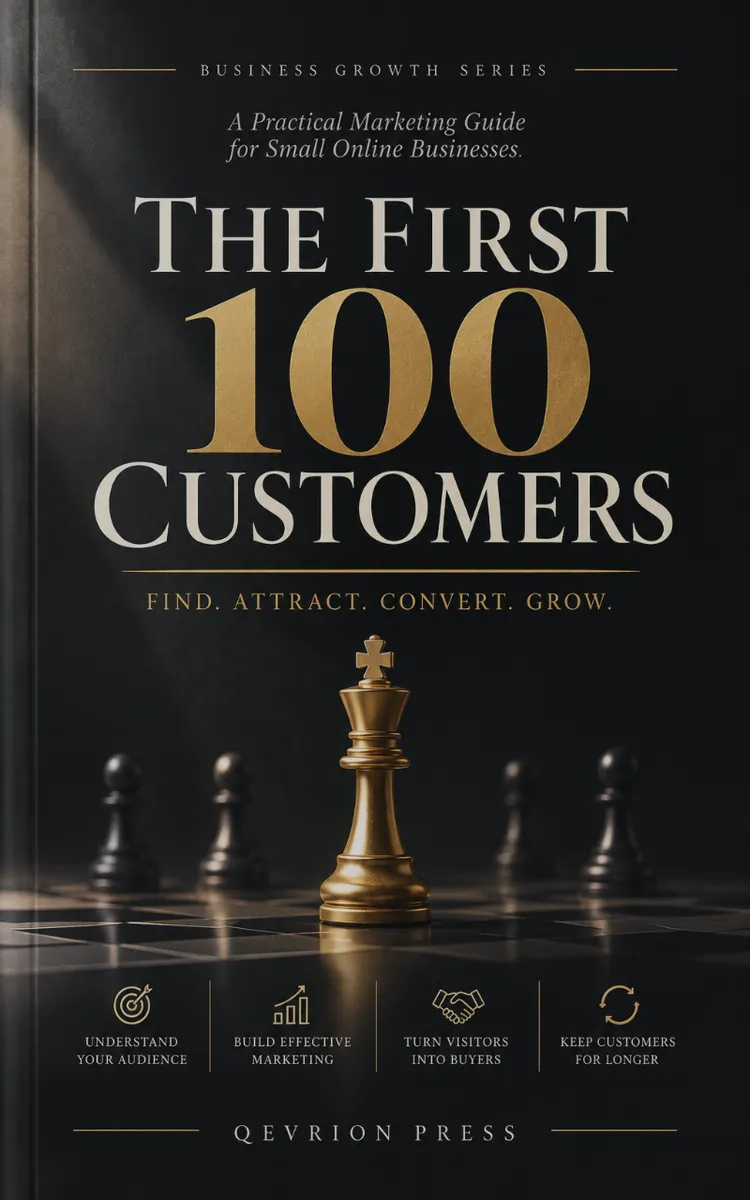
"The First 100 Customers" is a marketing book by Zahwan N with 5 chapters and approximately 9,348 words. Practical customer research, acquisition, conversion, and retention for small online businesses.
This book was created using Inkfluence AI, an AI-powered book generation platform that helps authors write, design, and publish complete books. It was made with the AI Ebook Creator.
Frequently Asked Questions
What is "The First 100 Customers" about?
Practical customer research, acquisition, conversion, and retention for small online businesses
How many chapters are in "The First 100 Customers"?
The book contains 5 chapters and approximately 9,348 words. Topics covered include Customer Interviews for Market Fit, Organic Discovery Through Social Content, Content That Earns Buyer Attention, Product Pages That Convert Visitors, and more.
Who wrote "The First 100 Customers"?
This book was written by Zahwan N and created using Inkfluence AI, an AI book generation platform that helps authors write, design, and publish books.
How can I create a similar marketing book?
You can create your own marketing book using Inkfluence AI. Describe your idea, choose your style, and the AI writes the full book for you. It's free to start.
Write your own marketing book with AI
Describe your idea and Inkfluence writes the whole thing. Free to start.
Start writingCreated with Inkfluence AI


