

Read the first chapter
The whole of chapter one, free. About 7 min. Turn the pages with the arrows, your keyboard, or a swipe.
Chapter 1
Rewriting Your ADHD Trader Identity
Picture This: The trade that felt exciting… until it didn’t
Last Tuesday, Tanya (34, ER nurse and swing trader) watched the chart like it was a live patient. The setup was “almost there,” the news was hot, and the move had that spark in it - the kind that makes your body lean forward. She felt it immediately: This is it. Don’t overthink it.
So she did what her brain always tried to do when it wanted momentum. She entered fast, sized a little bigger than planned, and told herself she’d “manage it once it’s moving.” Two hours later, the move stalled. Then it reversed. Then she started checking it every five minutes like her attention could physically force the price to behave. By bedtime, her confidence was bruised and her plan felt like a joke.
Here’s the tension: Tanya didn’t lack skill. She had execution energy. She just didn’t have an identity that told her what that energy was for - and what it wasn’t allowed to do.
What if the real problem isn’t your ADHD traits in trading… but the story you’re using to justify them?
---
The Mindset Shift: Turn “impulsive” into “edge-seeking”
Old Belief: If I’m ADHD, I’m naturally impulsive - so my best trades come from quick instincts, and my worst trades come from losing control. New Reality: If I’m ADHD, I’m naturally identity-driven in the moment - so I need a trading identity that channels novelty and urgency into disciplined, edge-seeking execution.
This shift matters because it changes what you’re trying to fix. Most people try to “control impulses” like they’re a bad habit. But impulsivity isn’t random chaos - it’s your brain reaching for stimulation, certainty, and progress. In trading, that can become a superpower… or a self-sabotage loop, depending on what your identity tells you you’re doing when you feel that spark.
Tanya realized her “fast entry” wasn’t bravery. It was a demand for emotional relief. The moment she felt uncertainty (the setup wasn’t perfect), her ADHD brain reached for novelty and action to reduce that uncomfortable gap. The chart didn’t need her panic. It needed her process.
Concrete example: Tanya rewound her last 20 trades and noticed a pattern. The trades she entered fastest were rarely the ones that matched her best entries. They were the ones where she felt the strongest urge to be “right now.” When she reframed her behavior as edge-seeking instead of impulse-following, she stopped asking, “Why do I do this?” and started asking, “What am I trying to get from this feeling?”
That’s the difference between fighting yourself and training yourself.
Signs this pattern is running your life 1. You feel most confident right before you break your own rules - because the adrenaline feels like “knowing.” 2. You keep rewriting your plan mid-trade (“I’ll adjust the stop later,” “I’ll size smaller next time,” “this time is different”). 3. You chase the momentum of your mood, not the momentum of the chart (you don’t notice until you’re already in). 4. You treat novelty like proof - if it feels interesting, you assume it’s high-quality.
Edge-seeking isn’t slower - it’s clearer.
---
Going Deeper: Why ADHD energy needs an identity with a job
Here’s what’s really going on under the hood. Your ADHD traits aren’t trying to ruin your trading. They’re trying to help you move. They generate urgency, quick pattern grabs, and the hunger to act before life gets boring. That can be brilliant for scanning, spotting themes, and staying engaged when other traders go numb.
But without an identity that gives those traits a job, your brain chooses the easiest job available: act now to feel safe. Trading then becomes emotional maintenance. You’re not just entering a trade - you’re managing the internal weather.
For Tanya, the “job” her identity was giving her looked like this: - When the setup was imperfect, she felt tension. - When tension showed up, she needed immediate relief. - Entering fast gave her relief (even if it cost her later).
So the fix wasn’t “be less impulsive.” The fix was: build an ADHD-positive identity that says, My urgency is data. My novelty is fuel. My action must come after the edge is confirmed.
That’s why the Identity-to-Execution Loop matters in this chapter’s theme. You don’t just want better entries - you want a better self. When your identity is “I only execute when the edge is present,” your ADHD energy stops being the boss and starts being the assistant.
Try this mental reframe during your next session: when you feel the urge to click, don’t ask, “Should I do it?” Ask, “What is my brain asking for right now - certainty, excitement, control, or relief?” Then give it the correct answer through your process, not through the trade.
Tanya started doing a tiny thing: before she placed any order, she wrote one sentence in her log: “I’m entering because the edge is confirmed, not because I’m anxious.” It wasn’t poetic. It was practical. It forced her identity to step forward and tell her what her action meant.
And once that sentence became familiar, her impulsivity didn’t disappear - it got redirected.
---
Reflection & Self-Assessment: Name the identity you’re trading with
If you want to change your results, you have to stop negotiating with the version of you that shows up at the exact wrong time. Reflection isn’t journaling for journaling’s sake. It’s how you catch the identity that’s currently driving the wheel.
Here are questions that will actually surface what’s going on. Answer them honestly, even if the truth makes you cringe a little.
1. When I break my rules, what am I getting emotionally in the next 30 seconds? Think relief, excitement, certainty, revenge, “I can’t miss this.” A real answer might sound like: “I feel relief because I stop feeling unsure.”
2. What identity am I acting like when I enter early - “decisive trader,” “hunter,” “risk-taker,” or “I trust my gut”? Be specific. If you say “I’m just confident,” dig deeper. Confidence doesn’t usually behave like a shortcut.
3. What part of my process feels boring or slow - and what am I afraid will happen if I follow it? Example: “If I wait for confirmation, I might miss the move,” or “I’ll feel powerless to affect the outcome.”
4. In my best trades, what was my internal tone? Not the chart. Your tone. Calm? Focused? Slightly curious? If your “best” tone is calm, that tells you what identity to reinforce.
5. What would “edge-seeking” feel like in my body? Give it a physical description. Maybe your shoulders drop, your breathing slows, or your mind stops sprinting.
Your answers don’t judge you. They map your current identity. And once you can name it, you can rewrite it.
---
Growth Challenge: The Identity-to-Execution Loop Drill (7 days)
You don’t need a new personality. You need a repeatable moment where your identity catches up to your execution.
Challenge Title: Edge-Confirmed Before Click (7 days)
• Set a timer for 90 minutes during your next trading session (pick your usual high-focus block). - Before every entry, write the same three lines in your journal (30 seconds max): - Edge check: What specific condition is confirmed? (exactly what you look for) - Urge label: What am I feeling right now? (urge, anxiety, boredom, excitement) - Identity statement: “I enter because the edge is confirmed, not because I need relief.” - Track your “click speed.” Write down the time from “edge check complete” to “order placed.” - After the trade, rate the identity match (0-10). Not performance - identity alignment. - End each day with one sentence: “Today my ADHD energy was used for ___.”
Expected difficulty rating: Medium (because it interrupts your autopilot)
You’ll know it’s working when… - You start noticing the urge before you act, not after. - Your entries begin to feel less like a gamble and more like a decision you can explain. - Your journal shows fewer “mid-trade rule edits” because you’re less emotionally hijacked at entry. - Even when a trade goes wrong, your identity score stays steadier than your emotions.
This drill builds the bridge between “I feel like clicking” and “I execute what I actually believe.”
---
Key Takeaway: You’re not rewriting your ADHD - you’re rewriting what it means
Tanya didn’t become a different person. She became a different trader identity. When she stopped treating impulsivity like a flaw and started treating urgency as a signal that she needed edge confirmation, her confidence came from consistency, not adrenaline. The spark was still there. The difference was that it finally had a job.
Your ADHD traits don’t need to be suppressed - they need an identity that turns urgency into edge-seeking.
• You can’t out-discipline a feeling; you can identity-train it. - “Fast” isn’t the goal - “edge-confirmed” is the goal. - Journaling works best when it names the identity and the urge, not when it just records emotions. - When your body wants relief, your process needs to provide it.
Next, we’ll take this identity and give it teeth - so your execution gets tighter even on the days your brain wants to sprint.
End of chapter one. 4 more chapters in the full book.
Swipe or use the arrows to turn the page


What's inside: 5 chapters
- 1. Rewriting Your ADHD Trader Identity
- 2. Converting Hyperfocus Into Repeatable Setups
- 3. Designing Dopamine-Smart Risk Rules
- 4. Building Anti-Distraction Trading Boundaries
- 5. Recovering Fast With the Reset Ritual
About this book
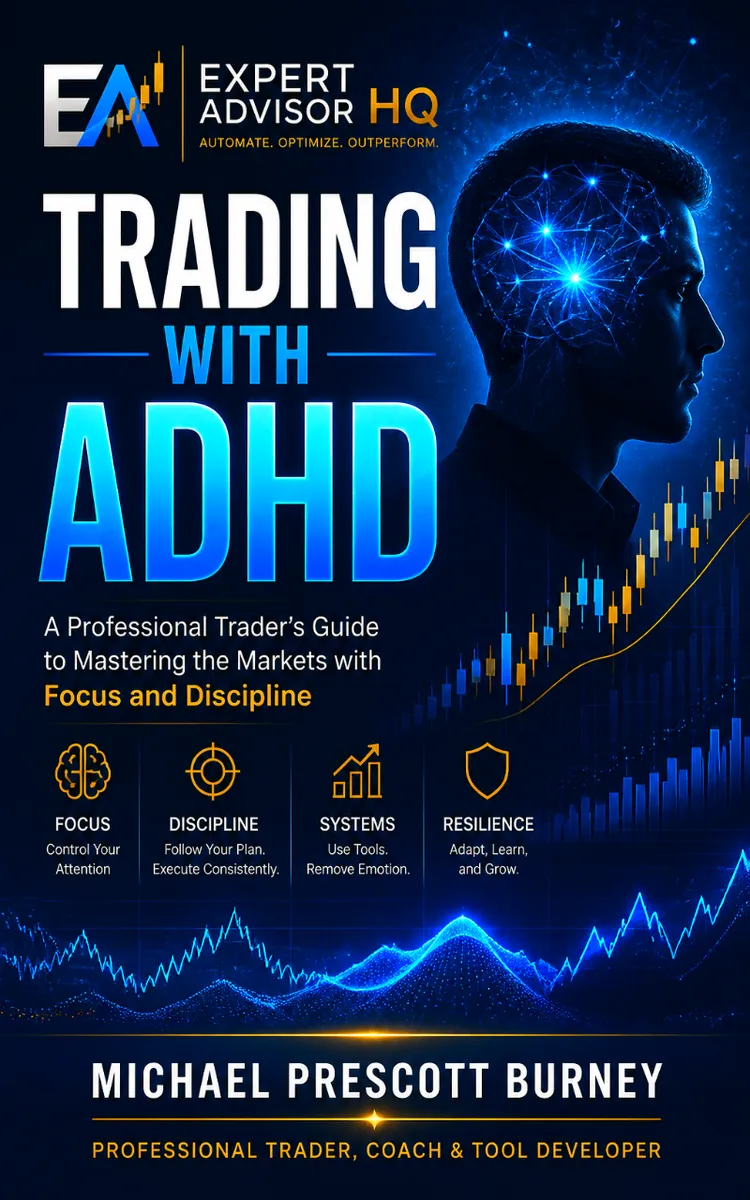
"Trading With ADHD" is a self-help book by Michael Burney with 5 chapters and approximately 8,380 words. Using ADHD traits to improve trading performance.
This book was created using Inkfluence AI, an AI-powered book generation platform that helps authors write, design, and publish complete books. It was made with the AI Self-Help Book Writer.
Frequently Asked Questions
What is "Trading With ADHD" about?
Using ADHD traits to improve trading performance
How many chapters are in "Trading With ADHD"?
The book contains 5 chapters and approximately 8,380 words. Topics covered include Rewriting Your ADHD Trader Identity, Converting Hyperfocus Into Repeatable Setups, Designing Dopamine-Smart Risk Rules, Building Anti-Distraction Trading Boundaries, and more.
Who wrote "Trading With ADHD"?
This book was written by Michael Burney and created using Inkfluence AI, an AI book generation platform that helps authors write, design, and publish books.
How can I create a similar self-help book?
You can create your own self-help book using Inkfluence AI. Describe your idea, choose your style, and the AI writes the full book for you. It's free to start.
Write your own self-help book with AI
Describe your idea and Inkfluence writes the whole thing. Free to start.
Start writingCreated with Inkfluence AI


