
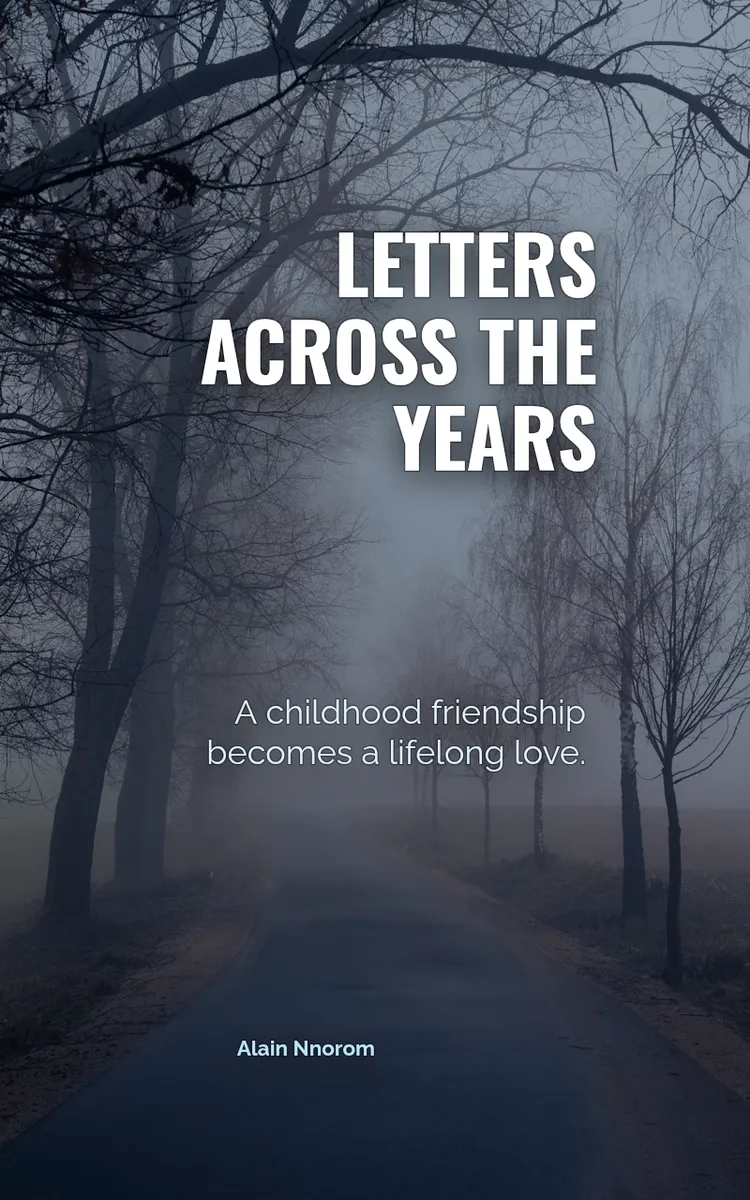
Read the first chapter
The whole of chapter one, free. About 10 min. Turn the pages with the arrows, your keyboard, or a swipe.
Chapter 1
The Day Letters Became Lifelines
Daniel pressed his palm against the cold window and watched Ethan’s house disappear behind the rain.
It had been there at the end of their street for as long as Daniel could remember: white porch, crooked blue shutters, a basketball hoop leaning toward the road. Now the view outside belonged to someone else. Their rented room smelled of cardboard, dust, and the sharp soap his mother had used on the floor. Boxes crowded the walls, their labels written in his father’s hurried block letters.
BEDROOM.
BOOKS.
MISCELLANEOUS.
Nothing said Ethan.
Daniel lifted his hand from the glass. A pale print remained where his fingers had been.
“Daniel?” his mother called from the hallway. “Can you bring the lamp into the sitting room?”
“In a minute.”
He had said that three times already.
On the desk beneath the window, he had placed the only things he refused to let the movers touch: a red plastic compass, two smooth stones from the creek, and the photograph Ethan had taken of them the summer before. In it, Ethan was squinting into the sun, one hand raised to shield his eyes. Daniel stood beside him with a crooked grin and a smear of blackberry juice on his chin.
Ethan had laughed when he took the picture.
“Don’t move,” he’d said.
“You’re the one who keeps moving.”
“I’m taking a picture, not chasing you.”
“You chase me every day.”
“That’s because you cheat.”
Daniel had been eleven then. Old enough to know Ethan was lying and young enough to believe the chase might never end.
Now the photograph lay half-covered by dust.
Daniel pulled a sheet of paper from the top drawer. His father had brought the stationery from the new office, thick and cream-colored, with a faint blue line near the edge. It looked too formal for what Daniel needed. He wanted something that could carry the sound of Ethan’s laugh, the smell of wet grass, the little pause Ethan always made before saying something he thought might hurt.
He sat on the edge of the bed and held the pen above the page.
Dear Ethan,
He stopped.
The words seemed to shrink under his hand.
Outside, a truck groaned down the unfamiliar street. Somewhere below, a cupboard slammed. His father called to his mother about the missing coffee tin, and she answered from another room. Their voices traveled strangely through the rented house, as if the walls had not yet decided whether to keep them.
Daniel wrote again.
Dear Ethan,
We got here.
He stared at the sentence. It sounded like a postcard from a stranger.
He crossed it out.
Dear Ethan,
I hate this place.
That was closer, but not fair. The town had done nothing to him. The room was small, but the window faced a row of elms, and the landlord had left a jar of peppermints in the kitchen. His father had promised there would be a school nearby. His mother had already found a bakery she liked.
It was Daniel who hated the distance.
He turned the paper over and started fresh.
Dear Ethan,
I keep looking toward your house even though it isn’t there.
His throat tightened. He lowered the pen and listened to the rain ticking against the glass.
At home, Ethan would have been in the room by now, leaning against Daniel’s desk while pretending not to be interested in whatever Daniel was doing. He would have stolen the pen, read the unfinished sentence, and said, “That’s dramatic.”
Daniel would have reached for it.
Ethan would have held it out of reach.
Then they would have forgotten what they were arguing about.
Daniel bent over the page.
Dear Ethan,
I keep looking toward your house even though it isn’t there. I know that sounds foolish, but everything here feels like it was put down yesterday and could be taken away tomorrow.
He paused, then added, I miss you.
The words were plain. They frightened him more than the others.
He almost tore the page in half.
His father appeared in the doorway with a cardboard box balanced against one hip. “You hiding in here?”
“No.”
His father glanced at the paper. “Writing to Ethan?”
Daniel covered it with his arm. “Maybe.”
“That’s good.” He set the box down. “You boys can keep in touch.”
“Can we?”
His father’s expression changed, though only slightly. “Of course you can.”
“You said we’d visit.”
“We will. Once things settle.”
“When?”
“Daniel.”
“When will things settle?”
His father rubbed the back of his neck. He had been doing that since the job offer came, whenever Daniel asked a question with no convenient answer. “I don’t know yet. The new position is demanding. We have to get the house sorted, and your mother needs time to find work.”
Daniel looked down at the covered letter. “Ethan’s father said the same thing.”
“Then he understands.”
“That doesn’t help.”
“No,” his father said quietly. “It probably doesn’t.”
For a moment, neither of them moved. Rain slid down the window in crooked streams, breaking the streetlights into trembling gold.
His father picked up the box again. “You can write. Just don’t expect letters to make everything exactly the way it was.”
Daniel looked at him. “Why not?”
His father’s mouth tightened. “Because nothing stays exactly the way it was.”
Then he left.
The sentence remained in the room after him.
Daniel uncovered the page. His handwriting had grown darker where the pen had pressed too hard.
He wanted to argue with his father. He wanted to prove that something could stay. The creek, the tree house, the secret path behind the grocery store - those things had belonged to them because they had named them. Their friendship had survived scraped knees, schoolyard fights, and the summer Ethan’s family went away for three weeks.
But distance was not three weeks.
Distance was a new street, a new school, a new boy who might know how to make Ethan laugh.
Daniel forced himself to continue.
Tell me everything. What does your room look like? Have you found a place to ride your bike? Did you bring the blue mug you always use? I’m going to write every Sunday. You have to write back, even if you only have one thing to say.
He smiled despite himself.
Especially if you only have one thing to say.
He added a final line.
Don’t let me become someone you used to know.
The room went very still.
Daniel read the sentence twice, then folded the paper before he could change it.
The next morning, his mother drove him to the post office. The town smelled of wet pavement and pine trees. Daniel held the envelope on his lap, keeping his thumb over Ethan’s address as if the ink might run away.
His mother glanced at it while they waited at a red light. “You wrote a lot.”
“Not really.”
“It’s four pages.”
“He’ll write four pages back.”
She smiled, but her eyes stayed on the road. “I’m sure he will.”
Daniel heard the doubt beneath her kindness.
At the post office, the line curved past shelves of postcards. Most showed beaches, mountains, or bright city streets. Nothing looked like the town Daniel had left. He stood with the envelope pressed against his chest while an old woman in front of him counted coins into her palm.
His mother touched his shoulder. “You could call him.”
“We don’t have a phone in his room.”
“Then call his house.”
“What would I say?”
“Hello?”
Daniel frowned.
She laughed softly. “You don’t have to solve the whole distance in one letter.”
“I’m not trying to solve it.”
“What are you trying to do?”
He looked at the envelope. Ethan’s name filled the center in careful black letters.
“Make sure he knows I’m still here.”
His mother’s hand lingered on his shoulder. “Then you’ve done that.”
When Daniel reached the counter, the clerk weighed the envelope and placed a blue stamp in the corner.
“First letter?” the man asked.
Daniel nodded.
“Special one, then.”
Daniel didn’t answer. The clerk slid the envelope back toward him.
It felt heavier now.
He carried it outside and stood before the red mailbox. Rain had stopped, but the metal was cold and damp beneath his fingers. For a second, he imagined opening the flap and finding the letter still inside, safe from the miles.
Then he pushed it through.
The envelope dropped with a soft, final sound.
Daniel kept his hand on the mailbox.
That evening, he unpacked his books. The new room slowly became less borrowed. He placed the compass on the desk, the stones beside it, and Ethan’s photograph against the wall. At dinner, his father talked about the new office. His mother asked whether Daniel wanted curtains for the window.
He said yes, though he could not imagine any fabric making the view familiar.
A week passed.
Then another.
Daniel wrote every Sunday. Sometimes he filled four pages. Sometimes he managed only one.
The first letter was about the neighborhood: the bakery with cinnamon rolls that burned at the edges, the elm tree outside his window, the boy at school who had tried to trade him a pocketknife for his lunch.
The second was about his father’s new office and the way his mother kept rearranging the furniture.
The third said, I saw a dog today that looked like the one we pretended to own.
He did not write that he had started turning toward Ethan’s street whenever he heard a bicycle bell.
He did not write that he had dreamed Ethan was sitting beside him and woken with his hand stretched across the empty bed.
On the fourth Sunday, Daniel came home from school to find an envelope beneath the front door.
His name was written across it in Ethan’s uneven handwriting.
Daniel dropped his books.
He picked up the letter so quickly that the paper bent between his fingers. The envelope smelled faintly of cedar and the dusty closet where Ethan’s family kept their mail. Daniel pressed it to his face before he could stop himself.
His mother looked up from the kitchen. “Is that from him?”
Daniel nodded.
“Well?”
“I haven’t opened it.”
“Perhaps you should.”
He carried it upstairs, shut the door, and sat by the window. The sky had turned pink over the elms. He slid one finger beneath the flap.
Daniel,
You’re wrong about the dog. It looked nothing like ours. Ours had one ear that stood up and one that gave up.
Daniel laughed, and the sound broke halfway through.
Ethan told him about his new school, where the teachers gave too much homework and the boys played soccer in a field full of stones. He had found a creek, though it was shallow and crowded with reeds. He had not found a good place to ride his bike.
Then, near the bottom, Ethan wrote:
I got your letter on Thursday. I read it twice before I answered. My dad says we might move again in the spring because his company is opening another office. He says nothing is certain yet, so don’t tell my mother I told you.
Daniel’s smile faded.
He read the lines again.
Another move.
His fingers tightened around the paper.
Ethan continued:
I’m going to keep writing anyway. Sundays, like you said. If we both keep doing it, then maybe we won’t lose track of each other. I don’t want to become someone you used to know either.
Below that, in smaller writing, he had added:
You still owe me a rematch at the creek.
Daniel placed the letter in his lap. Outside, a bicycle passed along the sidewalk, its tires whispering over damp leaves. For one sharp second, he imagined Ethan turning into the yard, calling his name.
The sound vanished.
Daniel pulled a fresh sheet of paper from the drawer. He dipped his pen, then stopped.
He had wanted a promise. Ethan had given him one.
But now the promise had a crack running through it: another possible move, another town, another address Daniel might have to memorize.
He began to write.
Dear Ethan,
I’m glad you wrote back. I’m glad you’re still there.
He looked toward the photograph on the desk. Ethan’s face was bright with sunlight, untouched by distance or time.
Daniel continued.
If your father moves again, you have to tell me. Don’t decide for me that it will be too hard. Don’t disappear because you think I’ll forget.
He hesitated, then added the truth that had been waiting beneath every letter.
I’m scared that one day we’ll have too many new places between us.
The words sat on the page, helpless and honest.
Daniel folded the letter and placed it beside Ethan’s first reply. He did not seal it yet. Tomorrow, he would add more. He would tell Ethan about the bakery and the crooked elm and the fact that he had finally found the courage to sit with someone at lunch.
For tonight, he held the two letters together and listened to the unfamiliar house settle around him.
The distance had not erased Ethan.
Not yet.
But it had begun asking what they were willing to do to remain known to each other.
End of chapter one. 7 more chapters in the full book.
Swipe or use the arrows to turn the page


What's inside: 8 chapters
- 1. The Day Letters Became Lifelines
- 2. Daniel Learns to Want Quietly
- 3. Ethan’s Map of Dreams
- 4. The Question Behind Every Postmark
- 5. The Train Ticket That Changes Everything
- 6. When Friendship Feels Like a Lie
- 7. A Confession Under Streetlamps
- 8. Letters Turn Into a Shared Home
About this book
"Letters Across The Years" is a romance book by Alain Nnorom with 8 chapters and approximately 16,977 words. Childhood best friends separated by moves, reunited, and marry..
This book was created using Inkfluence AI, an AI-powered book generation platform that helps authors write, design, and publish complete books. It was made with the AI Romance Novel Writer.
Frequently Asked Questions
What is "Letters Across The Years" about?
Childhood best friends separated by moves, reunited, and marry.
How many chapters are in "Letters Across The Years"?
The book contains 8 chapters and approximately 16,977 words. Topics covered include The Day Letters Became Lifelines, Daniel Learns to Want Quietly, Ethan’s Map of Dreams, The Question Behind Every Postmark, and more.
Who wrote "Letters Across The Years"?
This book was written by Alain Nnorom and created using Inkfluence AI, an AI book generation platform that helps authors write, design, and publish books.
How can I create a similar romance book?
You can create your own romance book using Inkfluence AI. Describe your idea, choose your style, and the AI writes the full book for you. It's free to start.
Write your own romance book with AI
Describe your idea and Inkfluence writes the whole thing. Free to start.
Start writingCreated with Inkfluence AI


