
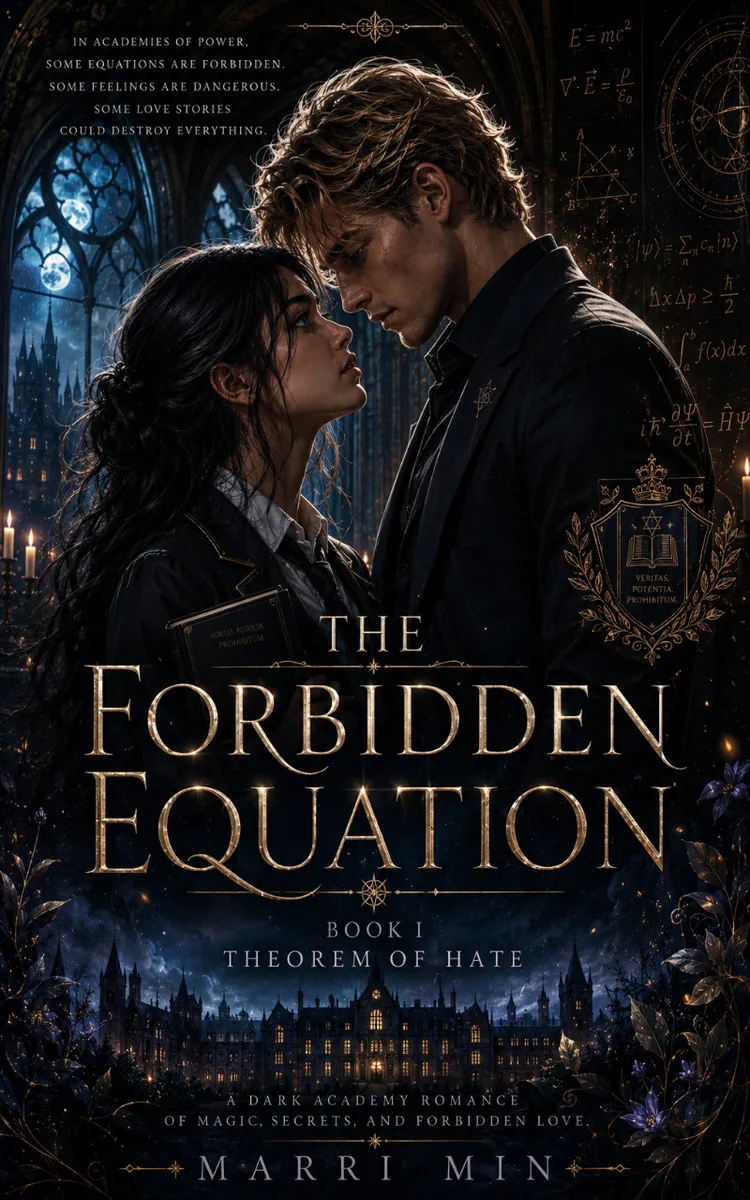
Read the first chapter
The whole of chapter one, free. About 18 min. Turn the pages with the arrows, your keyboard, or a swipe.
Chapter 1
The Secret Map of the Academy and a Clue
The smell hit her before the door even opened: iron and old paper, sweet at the edge like a wound that had been sewed shut for too long. You want to be where something secret is kept; you want to be the person who unties the last stitch. Amelia’s fingers tightened on the brittle fragment of map until the edges bit into her palm.
“Don’t be careless,” Leonard said, but his voice had given up on scolding and landed somewhere softer, like the underside of a reprimand. He held the journal in one flat hand, the way someone holds a sleeping thing that could wake and bite. “If the ward notices you, answer exactly what it asks and no more.”
That immediate desire - his steadiness, his nearness - pulled at her with a sharpness she recognized but had not named yet. She wanted to press closer to him, to let that steadiness be an anchor for the anxiety coiling in her. She wanted to ask him if he’d left the map fragment on purpose, if he’d meant for their fingers to brush earlier in the corridor. Instead she kept her questions folded up like contraband and let the cold of the passage fill the silence between them.
The archive’s cut stone swallowed sound. Lanterns hung at even intervals, their glass crystal-clear, but the light didn’t warm; it glazed surfaces and sharpened the edges of things - the curve of Leonard’s jaw, the crease where Amelia’s sleeve had a smear of dust. There was magnetism in the way he leaned over the journal, thumb careful on a page, the small unclenching of his shoulders whenever he read something that validated a suspicion. It made her want him to look at her the way he looked at text that mattered. She could see the attraction in miniature gestures: the way his fingers brushed the spine of the journal as if to steady it, the small hitch in his breath when a phrase proved more dangerous than expected. It was not only physical; it was a soft longing folded into a habit of guarding - an invitation and a fence in the same movement.
“You said there’s a sector called forbidden,” Amelia murmured, the words scraping the stone. “The fragment matches that seal. Why are we walking like thieves if you’re allowed in?”
Leonard didn’t look up. “I’m not allowed in all of it.” His voice had a rhythm that kept things half-closed, like a book not yet opened. “Rules are porous. People are not. You’ve seen how the wards answer; they ask in their own language.”
She moved closer to the shelf, letting paper-edge and dust-scent contain her. Under her palm the map fragment was thin as a fingernail and twice as stubborn. Ink darkened when she tilted it: an angular half of a sigil, the other half missing, as if someone had bitten it off and swallowed the rest. The map promised a seam, a joining place where paper became architecture. Amelia pressed the fragment to her heart and felt foolishly, urgently protective of it. If there was an actual door to something that was not meant for most eyes, she wanted to be the one who pushed it ajar.
“You’re hiding things,” she said. The accusation was blunt, not cruel, and there was a tremor of something like hunger threaded through it. She wanted more from him than secrecy - clarity, companionship in the risk.
He closed the journal with a sound that was almost a permission. “I’m choosing what you can carry and what I need to keep tethered.” His fingers curled around the book’s worn leather with possessive ease. “Not because I don’t trust you, Amelia, but because the archive evaluates differently when it knows you.”
That answer landed like a pebble thrown into deep water - small on the surface, widening under it. Attraction, now, drank distrust; the fact that he sheltered her competence and also restricted it made her chest ache in ways that were not solely indignation. The rhythm of their exchange - the clipped instructions, the soft retorts, the way he let a syllable linger - built pressure. She could feel the electricity along the small of her arm where he’d brushed against her in the hall earlier, a jolt that turned into a question she hadn’t yet learned to ask aloud.
A dry scrape came from deeper in the vault, low and disapproving like someone closing a ledger they did not wish to be read. The lantern light didn’t flicker. It sharpened, instead, as if the air itself had decided to focus. Leonard’s jaw stiffened. “They’re checking for anomalies.”
“You talk about the archive as if it were a person,” Amelia said. The map warmed in her grasp as if the paper itself had blood. “Is it a mechanism? A spell? A thing with an attitude?”
“Things here are a little of both.” He met her eyes then - briefly, and raw with something she could name: worry not for himself but for the breach between what he knew and what she might do. “It learns by pattern, and it judges by repetition. If you trigger a syllable it’s been waiting to hear, the response is… practical.”
Practical. The word wrenched her mouth. It made the stakes feel clinical, like a ledger entry where consequences were tallied in neat columns. She hated that answer. She hated, too, how the corner of Leonard’s mouth pulled down when he said it, like a man closing off a memory.
Amelia leaned closer to a shelf and ran her fingertips along a plaque with warped letters half-smudged with black wax. The ledger-dust tickled her nose; she tasted rust, like old pennies. Beneath the smear were traces of a phrase - edges of letters that might match the sigil on her fragment. Her heart climbed into her throat with the speed of a door half-open.
“Don’t,” Leonard said. His hand hovered near hers, but a gap remained. He didn’t reach. The prohibition felt personal, layered over a dozen spoken and unspoken limits. “Not here. Not without the other half.”
“Why?” Amelia kept the map pressed to the plaque anyway, because the heel of her palm needed the contact, needed to feel the answer. The faint imprint on the plaque seemed to stir where her map touched it. The map’s ink flared a thin gray as if recognizing kin.
The lights around them drew inward, a sensation like a held breath. Somewhere in the stacks something shifted: not a document sliding, but a shape of intent rearranging itself. Leonard’s eyes darkened. “Because it corresponds,” he said quietly. “And correspondences are binding.”
She needed to know what that binding looked like. She needed to know whether being bound meant being trapped or being chosen. “Is it dangerous?”
His fingers flexed around the journal until the knuckles blanched. “It’s selective.” He let the word hang out between them. “And it asks for proof.”
Proof. The map was a kind of proof, Amelia realized, but a partial one - like the first line of an answer without the finishing clause. She smelled something else then: cold stone warmed by breath, a metallic tang like the memory of a coin in a closed fist. In the lined paper of the registration folder she’d rifled through earlier, there had been a blank slip, insignificant and creased as a promise. She had saved it because it had felt like a question left unanswered on purpose. Now, under lantern light, the slip held a faint watermark, and when she tilted it, the other half of the sigil revealed itself like a ghost.
Leonard’s breath caught as if he’d inhaled smoke. “You had that,” he said. The words were close to accusation and much closer to relief. It was as if some danger had rearranged into possibility in his chest.
“You said don’t touch things that looked out of place,” she reminded him, soft as an apology and edged with mischief. She pressed the slip to the map. The two halves fit together with the reluctant inevitability of a hinge catching. For a second nothing happened, and then the stone under their boots chimed, a low note that shivered up through the soles and into the bones.
The archive answered, not with words, but with architecture. A seam in the nearest wall gleamed where mortar had been scraped away by time. A slit widened like a pupil at night, offering a sliver of black that smelled of folded paper and moon glass. The seam revealed a niche - a place barely big enough for one hand to enter, and yet it hummed with meaning.
“You brought this on yourself,” Leonard said, not unkindly. His hand hovered, wanting to steady her, to pull the paper back and hold the discovery for himself. He was the anchor, and yet she’d wedged herself between his tether and the thing he’d been guarding.
“Isn’t that what you wanted?” Amelia said. It wasn’t accusation, exactly. It was the echo of a dare. A thing a person says when they want someone to choose them, consequences and all.
There was another sound then - a whisper like a leaf against stone, and the seam contracted slightly. Tiny fissures traced from the slit outward, their veins lighting up with thin script that had been sealed in at the quarry. Symbols etched into the surrounding stone glowed faintly: letters someone had tried to smudge out, edges of sentences erased by citizens who feared the knowledge the archive would demand. It was beautiful in a way that made her chest ache: violent erasure turned into its own secret.
Leonard looked at the glowing cracks and his face shifted. What had been worry turned into a more complicated weariness - an understanding of boundaries he did not want to cross and the knowledge that he might be called to help her anyway. “It takes something,” he said. “Not the map. Not paper. A sort of proof that you meant it. That you were willing to put your claim where it leaves a mark.”
“You mean a price.” Her voice was a small, steady thing. She was not a child; she had been handling forbidden maps and hushed hints for months. The idea of paying in some literal way - blood, memory, name - simmered beneath the skin like a bruise. “What is it?”
He looked away, and for a second his profile was the map of a thing wounded and mended. “Not… not always the same.” His fingers found the edge of the journal and tightened until the leather groaned. “Sometimes it takes a step back in your life. Sometimes it takes the right to speak a thing aloud. Sometimes it takes a promise you can’t take back.”
Promises. Amelia felt her chest contract with the weight of the idea. Promises were dangerous: they made you stay; they made you vulnerable; they anchored you in a place the archive could measure. The thought of binding herself to some condition she could not later undo sparked an unexpected and bitter fear. “Then what if I walk away?” she asked. “If I leave now, does it forget?”
Leonard’s hand brushed hers - light, almost symbolic. “It remembers patterns.” The touch was enough to destabilize her, enough to make the world tilt toward what-ifs and almosts. “Once you’ve engaged it, it keeps the echo. It won’t give you easy because you’ve already listened.”
A cold breath rose from the slit then, dry and thin as a paper’s edge. The niche within the wall emitted a faint thread of light, like the trailing glow of a comet’s tail. It showed not an object but a path: a mapped line curling inward, a direction that suggested descent rather than arrival. The archive was offering them a clue, not a prize. It required interpretation, commitment, and the exactness of two halves meeting.
“You can hand it over,” Leonard said, his voice near a whisper. “Let me carry the answer for you.”
“You won’t,” Amelia replied, and the decision uncoiled in her chest with both terror and clarity. “You brought me here because you thought you could control the risk. But the map is mine now.” Her fingers closed around the joined symbols. The paper warmed, and the warmth spread into her palm like a promise and a warning together.
He reached for the slip, then stopped. For the first time she could see that his resistance to her was not cruelty but calculation: he feared the ledger the archive would write if he acted from protectiveness rather than consent. “If you insist,” he said finally, “you understand the cost.”
Amelia met his gaze. They were both children of the Academy - both of them trained to read contracts and to feel the teeth beneath ink. She had learned the art of negotiation: give up a little to keep more, hide your edges until you know the opponent, hold your breath until the other person does too. But there was more than bargaining here. There was the intimate, stupid truth that she wanted to see what was hidden, that she wanted him to stand with her while they did.
“I want you with me,” she confessed, faster than she intended. The words spilled, honest and dangerous. “Not as my guard. As my partner.”
The warmth in his eyes was immediate and exactly what she expected and wasn’t expecting: there was relief, yes, like a door half-closed finding a hand to latch it, but also a flash of something tender that made her breath hitch with a softness that was almost laughter. “You’ve been taking risks on your own for a while,” he said. “It would be foolish of me not to notice.”
A beat of quiet. The archive thrummed again, now patient, like a beast that’s been fed but is waiting for an answer. Amelia felt the map press against her ribs as if it had become part of her heartbeat. This was the vulnerable truth: she hadn’t wanted to ask him to come purely for his competence. She wanted to share the tremor of discovery, the way the whole world could narrow to the width of a seam when you and someone else understood the same glimpse.
“I’m afraid,” she admitted, because the map gave courage like a drug. “Not of what’s in there - of what being the one who opens it will change about me. About us.”
His hand covered hers, all the way this time, fingers lacing, anchoring. The contact was electric in its mundanity - no grand gesture, just the fact of skin and warmth and intention. “Then we decide the terms,” he said. “Not the archive. Not some old scrawl of rules. We choose what you will risk and what you keep.”
The intimacy of that promise - of being asked to deliberate rather than commanded - was a tender ferocity. Amelia could taste the metallic tang of the archive and something sweeter: the possibility of partnership that acknowledged fear and still chose action. For a second she could imagine the rest of their lives reduced to this: shared notes in margins, the map cornered between two hands that knew how to bargain and also how to soothe.
The slit breathed again, as if in response to their exchange. Light flared millimeter by millimeter, revealing a fragile talisman tucked inside the niche: a thin shard of something that looked like paper but held a sheen like oil on water. It might be the clue they needed. It might also be the thing that demanded payment.
Leonard’s lips were a narrow line, working through a dozen unsaid regulations. “If you take that,” he said, “you will owe the archive an answer. It collects returns.”
“You’ll help me pay it,” she said, half confident, half begging.
He held her gaze until she felt uncomfortably exposed, then inclined his head like someone agreeing to sign a pact. “We’ll do the math together.”
There was a small shift in the archive, almost like amusement. The fissures dimmed. The slit contracted again, offering no more but denying nothing either. The talisman sat there, patient as an animal behind glass. The decision hung between them: a choice to push farther into secrecy and consequence, or to step back and carry what they had like contraband.
Amelia’s thumb brushed the talisman’s edge without taking it. The contact was faintly electric; a shiver ran up her wrist and pooled warm behind her breastbone. She swallowed and felt Leonard’s hand tighten, not to restrain but to stand with her. The map’s ink seemed to pulse once, as if acknowledging their pact.
She could walk away. She could leave the slip and the map and the ineffable ache of wanting something forbidden to rot in the archive’s dark. She could hand the journal back and accept the simplicity of not knowing. But the knowledge that the archive had already marked her - had counted her steps, had sampled her attention - made retreat dishonest. The seam had been touched; echoes had been made.
“Okay,” she said at last. Her voice didn’t tremble. It didn’t have to. “We take it together.”
Leonard’s exhale was soft and raw with relief. He moved then, not in ownership but in partnership, and in that motion he reached for the talisman as if pulling the next beat of a duet into being. Amelia’s fingers left the map to meet his around the shard; their skin met and stayed. The warmth of his palm spread into hers, and a tumble of sensations - fear, excitement, the gravity of being chosen - unraveled and reknotted into something with direction.
The archive answered by contracting the slit just enough to allow Leonard’s hand to withdraw with the talisman between his fingers. It did not offer further softness. It did not promise they’d be spared. It only let them hold what it had judged they might deserve.
As they stood in the glow of the lanterns, the manuscript of the vault pressed close like a crowd of breathing pages, and Leonard turned the shard over once in his fingers. It refracted the light into a handwriting of its own: lines of faint script that were not words but coordinates. Amelia felt the whole of her chest tilt toward him with an ache that wanted both confession and comfort.
“You understand there will be consequences,” he said quietly, the practical syllabus of danger resuming its place between the warmth of his palm and her heat. “Not all of them pleasant. The archive doesn’t forgive curiosities.”
She nodded, because she had thought that trade through in a thousand permutations on nights when she should have been sleeping. To open a thing and not be altered by it was a fantasy. She felt the truth settle into her like a small stone.
“What I don’t want,” she added - because there was a fear she hadn’t been willing to name - “is for this to make us strangers. If we trade parts of ourselves as payment, I’d rather they be parts we agreed to give.”
His fingers tightened the barest degree. “Agreed,” he said. “We measure what we owe, not the ledger.”
The talisman hummed in his fist like an insect trapped in amber. It sang of deeper chambers and rituals that worked without words, of signs that answered to touch. They had pulled a thread and unearthed a loop; now a new question stretched taut between them: how far were they willing to unravel, together?
Amelia pressed her palm to the map again, sensing the map’s familiar resistance. She thought of the half-erased plaque, the smeared letters that tried to hide truth, and the way the archive had made its demands not in punishments but in choices. The decision ahead had weight, yes. But it also had proximity - of breath shared, of hands finding shape in the dark.
Leonard slipped the talisman back into the fold of the journal and closed the cover. The veneer of control returned to his face, tempered by something softer. “We take stock,” he said. “We plan the price. We do not blunder forward.”
“You sound like you’re lecturing a class,” she teased, because she needed the warmth of humor to steady the rawness under their skin.
“Someone has to,” he said, and his smile was small and private, aimed at her only. “We’ve got a clue. We’ve got each other. That’s more than we had when you found the map.”
She let herself lean into him, the contact casual and not casual, as if they could carry the world between their shoulders. The archive’s light made their shadows stretch long and joined on the stone. They were not safe. They were not close to answers. But the knowledge that they would measure the cost together was a fragile, luminous thing.
A distant lock clicked - the archive’s reminder that even partial truths loosened bolts elsewhere. Amelia lifted the map to the light and watched the sigil, whole now in the way that matters: two halves, joined, a single promise. She didn’t feel triumphant. She felt like someone who had been given a knife without having learned yet how to stitch up the wounds it might cause.
Leonard’s hand found hers again, this time with no hesitation. “When?” he asked, practical as ever.
“Soon,” she whispered. “Not tonight. We need - ” She stopped because the command of the archive wanted patience, and so did the tenderness between them. They both understood that the next step would be a negotiation with a mechanism that kept records and with each other, and that neither could be ignored.
He nodded, and in the way he nodded there was a promise that balanced fear and heat and something like love, though they had not named it. Amelia folded the fragment and tucked it back into her sleeve, the map’s edge biting softly as a reminder.
They left the forbidden slit sealed to a hair’s breadth, the talisman swallowed by the journal, and the archive settled back into its endless breathing. Outside the stacks the world was a different temperature; the corridor’s air felt ordinary, almost trivial, like someone had smoothed a crease that would reappear in the wash. But the seam between them had shifted. They had crossed something small but irrevocable together.
As they walked back through the lantern-lit corridor, Leonard’s hand brushed the back of Amelia’s wrist in an unpremeditated, sweet theft. Her pulse kicked in, not the cliched thunder but the precise staccato of a lock opening and needing to be turned. She met his eyes and found, in their half-smile, a new question.
“We’ve got a map, a clue, and a promise,” he said, softer than he had been in the vault. “What’s the first thing you want to risk, Amelia?”
She looked at him, at the space his arm made between them, at the thin line of courage she’d felt when she’d pressed the paper to stone. The answer sat on her tongue like a secret she would keep only if he promised to keep it too.
“I want you,” she said, and the confession was both a bargaining chip and a reckoning. “With me. Every step.”
Leonard’s fingers found hers and squeezed - not possessively, but in agreement. “Then we start with honesty.”
The archive had taught them a rule: ask the right way, and a door shows you a slice of its truth. Ask the wrong way, and the ledger opens against you. They stepped into the corridor’s hum, neither safe nor finished, carrying a shard that gleamed like a question and a map folded close to a heart that was, for all its cunning, still learning how to trust.
Outside, the Academy moved on, indifferent and reassuring. Inside, a private cartography was already forming between two people who had nothing left to offer the world but each other’s hands.
They’d started well enough. The rest, Amelia thought, would be messy and exact. And she had a feeling - dangerous and warm - that whatever price came, you’ve got this if you choose who pays with you.
End of chapter one. 30 more chapters in the full book.
Swipe or use the arrows to turn the page
What's inside: 31 chapters
- 1. The Secret Map of the Academy and a Clue
- 2. The Threshold of the Academy and Leonardo
- 3. Friends who change her choice
- 4. Testing the Formula: Broken Seal
- 5. The Hate Theorem: Its Own Contract
- 6. Signed boundary
- 7. The Boundary and the Consequences of Signing
- 8. Steps in the Archive
- 9. Night Threads of the Archive
- 10. Thin Line of Print
- 11. Signed Boundary
- 12. Thread after signature
- 13. Mastic is needed
- 14. Late marks
- 15. The Thin Line of Print
- 16. Signed Thread of Truth
- 17. Signed by the Boundary of Night
- 18. Thread After Signature
- 19. Signed by Tisha in the Morning
- 20. The Boundary and the Consequences of the Signature
- 21. A thread that didn’t break
- 22. Signed Thread of the Night
- 23. Thin Line of the Seal
- 24. Signed Thread of Truth
- 25. The Boundary and the Consequence of the Night
- 26. Signed Night Station
- 27. Thread After Signature
- 28. Thin Line of Truth
- 29. Signed by Tisha in the morning
- 30. Signed Thread of Truth
- 31. Signed Thread Endings
About this book
"Chaos Formula" is a romance book by Marri Min with 31 chapters and approximately 42,256 words. An Adventure Story of the Heroine in an Academy with Secrets.
This book was created using Inkfluence AI, an AI-powered book generation platform that helps authors write, design, and publish complete books. It was made with the AI Romance Novel Writer.
Frequently Asked Questions
What is "Chaos Formula" about?
An Adventure Story of the Heroine in an Academy with Secrets
How many chapters are in "Chaos Formula"?
The book contains 31 chapters and approximately 42,256 words. Topics covered include The Secret Map of the Academy and a Clue, The Threshold of the Academy and Leonardo, Friends who change her choice, Testing the Formula: Broken Seal, and more.
Who wrote "Chaos Formula"?
This book was written by Marri Min and created using Inkfluence AI, an AI book generation platform that helps authors write, design, and publish books.
How can I create a similar romance book?
You can create your own romance book using Inkfluence AI. Describe your idea, choose your style, and the AI writes the full book for you. It's free to start.
Write your own romance book with AI
Describe your idea and Inkfluence writes the whole thing. Free to start.
Start writingCreated with Inkfluence AI


