
Read the first chapter
The whole of chapter one, free. About 9 min. Turn the pages with the arrows, your keyboard, or a swipe.
Chapter 1
Leaving Nigeria After Government Promises
The engine shuddered as the vehicle joined the line of traffic outside the European transit center. Chinedu Okafor pressed his forehead against the cold window and watched unfamiliar signs slide past in a language he could not read. After hours of travel, his body felt stiff, his mouth tasted of stale water, and the small bag between his feet seemed heavier than it had when he left Nigeria.
He was twenty-four, carrying good grades, a folder of school certificates, and the promises he had heard from government officials and representatives who spoke confidently about opportunity. They had described a future in which educated young Nigerians would find work, contribute their skills, and build stable lives. Chinedu had believed them because he had done his part. He had studied, passed his examinations, and waited for the reward that was supposed to follow effort.
Now the vehicle moved through roads bordered by concrete barriers and unfamiliar buildings. The future he had imagined was somewhere beyond the glass, but he could not yet see its entrance.
At the transit center, people moved in several directions at once. Suitcases bumped against ankles. Wheels rattled over the tiled floor. Announcements came through loudspeakers, first in one language and then another, none of which Chinedu understood clearly. The air smelled of coffee, wet clothing, and disinfectant. He held his folder beneath his arm and followed the crowd toward a row of counters.
A uniformed official pointed toward a line.
“Documents,” the official said.
Chinedu opened the folder carefully. His certificates were arranged in plastic sleeves, their edges worn from the journey. He placed them on the counter along with the other papers he had been told to carry.
The official glanced at them and then at Chinedu.
“Address?”
Chinedu gave the address he had written down before leaving. It belonged to a contact whose name had been passed to him by someone who knew someone already in Europe. The address had sounded certain when he wrote it, but now it seemed fragile, like a bridge made from paper.
The official typed something into a computer, frowned, and asked another question. Chinedu answered as best he could. The official pointed him toward another counter.
At the next desk, he repeated the information. Then he was sent to a waiting area. A different person checked his papers and asked him to fill out a form. The form contained boxes and instructions that he struggled to understand. He looked around for someone who might explain it, but everyone seemed occupied with their own luggage, their own documents, their own urgency.
A man standing nearby noticed his hesitation.
“Where are you going?” the man asked in English.
Chinedu named the city.
“Do you have someone there?”
“I have a contact,” Chinedu replied.
The man gave a short nod. “Call him.”
Chinedu took out his phone. The battery had fallen low during the journey. He dialed the number once, then again. Each call ended without an answer. He tried sending a message, but the network connection failed.
The man looked at the phone and then back at him. “You need to be careful.”
Chinedu thanked him, though the warning did not tell him what to do.
He moved through the center for nearly an hour, directed from one place to another. His folder was inspected repeatedly, but no one seemed interested in what his certificates represented. The grades that had carried weight in Nigeria became ordinary sheets of paper here. They could prove that he had studied. They could not prove that he was permitted to work, that an institution recognized his education, or that anyone had a reason to open a door for him.
By the time he reached the exit, the light outside had weakened. Cold air entered through the automatic doors and passed through his thin clothing. He stopped beneath the awning and searched for the address again.
The street beyond the center was crowded but strangely isolating. People hurried past without looking at him. Buses released clouds of exhaust. Rainwater gathered along the pavement, reflecting signs that meant nothing to him. He carried his bag in one hand and his folder under the other arm, trying to appear as though he knew where he was going.
He found a public telephone near a shop and used the last of his coins to call the contact. This time, someone answered.
“Who is this?” a tired voice asked.
Chinedu gave his name and explained that he had arrived.
There was silence.
“You should have called before,” the voice said.
“I tried.”
Another silence followed. Then the man gave him directions to a street farther away and said he could not stay for long.
Chinedu followed the instructions, checking the address against shop signs and street numbers. More than once, he walked past the same corner. The cold settled into his fingers. His shoes had become damp, and the strap of his bag cut into his shoulder.
When he finally reached the building, the entrance was closed. He knocked several times. A light came on in an upper window, but no one opened the door.
He called again.
“You are too late,” the contact said.
“I have nowhere else to go.”
“I told you I could not keep you here.”
“You said you would help me find a place.”
“I said I would try.”
The call ended before Chinedu could answer. He stood beneath the building’s narrow entrance, listening to rain tap against the metal railing. His papers remained dry inside the folder, but the rest of him was becoming wet and cold.
He walked back toward the transit center because it was the only place he recognized. The streets had changed in the dark. During the day, the movement of people had made the city seem organized. At night, the same streets felt divided into spaces he did not understand. Groups stood outside shops and stations. Some watched him openly. Others turned away when he approached.
He asked two people where he might find a cheap room. One ignored him. The other shook his head and continued walking.
Near a row of closed shops, a man approached and asked whether Chinedu needed work. The offer came quickly: cleaning, carrying goods, perhaps helping in a warehouse. The man named a place and a payment that sounded possible. Chinedu listened carefully, trying to understand the directions.
“Do you have papers?” the man asked.
Chinedu showed him the documents in his folder.
The man looked at the certificates and laughed softly. “Not those papers.”
Chinedu understood then that his education was not the only kind of proof required. The man wanted an identification document, a work permit, something connected to the system that controlled employment. Chinedu had arrived with evidence of ability, but not with access.
“I can work,” Chinedu said.
“Everyone says that.”
The man walked away.
Chinedu remained beside the closed shop, holding the folder against his chest. The conversation had lasted only a few minutes, but it changed the weight of everything he carried. At home, his grades had been a source of confidence. They had helped him believe that discipline would lead to recognition. Here, they could not secure a bed, a meal, or a conversation that lasted longer than a few moments.
Near midnight, he returned to the transit center. Security guards moved people away from certain entrances, but a waiting area near the outer hall remained open. Chinedu found a bench beside a vending machine and sat with his bag between his feet. The machine hummed beside him. Every time the doors opened, cold air entered and lifted the loose papers in his folder.
He did not sleep properly. He rested his head against the wall and closed his eyes, but announcements and footsteps kept pulling him back. A child cried somewhere across the hall. A cleaner pushed a cart over the floor. The smell of strong coffee drifted from a machine, reminding him that he had eaten very little.
In the morning, a cleaner pointed him toward a community office a few streets away. Chinedu thanked her and followed the directions. The office was in a plain building above a row of small businesses. He waited outside until someone opened the door.
Inside, a woman examined his documents and asked him questions about his accommodation, his finances, and his legal status. Chinedu answered honestly. She made several phone calls and wrote down two addresses.
“This place may have a bed for a few nights,” she said, giving him a paper. “And this agency sometimes has temporary work.”
Chinedu held the paper with both hands. For the first time since arriving, he felt that the day had offered him a path rather than another closed door.
The shelter was crowded. The room contained several beds, each separated by a small space. A man showed Chinedu where he could leave his bag. The mattress was thin, and the blanket smelled faintly of soap, but it was warmer than the bench at the transit center. Chinedu placed his folder beneath his pillow and lay down without removing his shoes.
That afternoon, he went to the employment agency. The office was busy, and people waited along the walls with forms in their hands. When his turn came, the clerk reviewed the paper from the community office and then asked for identification and proof of authorization to work.
Chinedu produced what he had.
The clerk shook her head. “These are school certificates.”
“They show what I can do.”
“I understand,” she said, though her expression suggested that understanding was not enough. “We need the other documents.”
“Can I begin while I arrange them?”
“No. The employer will not accept it.”
Chinedu asked whether there was another kind of work available. The clerk searched her computer and wrote down a number. When he called it, no one answered. He tried again later. The number led to a disconnected line.
The second lead came from a man at the shelter who knew of construction work. Chinedu walked across the city to meet the contact, following directions that took him through narrow streets and under a railway bridge. When he arrived, the address belonged to an empty lot. He waited until the sky turned gray, then returned to the shelter with sore feet and no explanation.
That evening, the shelter worker told him that his place could not be guaranteed beyond the next few nights. More people had arrived, and the beds were needed.
Chinedu nodded. He did not argue. The temporary shelter had given him rest, but not security. The work leads had given him possibilities, but not employment. Each small gain carried its own limit.
Looking back, I now understand that my arrival was not the beginning I had imagined. I had crossed into Europe expecting my education to speak for me. Instead, I learned that qualifications needed a system willing to recognize them, and that a person could be capable yet remain invisible without the right documents, contacts, and legal access.
The government promises I had trusted had prepared me to hope, but not to navigate this place. My grades had not failed me. The path built around them had never been waiting for me.
That night, I folded my certificates again and placed them inside the folder. They were still mine. They still represented years of effort. But I no longer treated them as protection. I began to understand that survival would demand more than proof of what I had achieved. It would demand patience, caution, and the willingness to begin below the level at which I had once believed I belonged.
In the morning, I would leave the shelter before my time ended and search again. For the moment, I lay awake among strangers, listening to the pipes knock inside the walls, while the future I had crossed an ocean to find narrowed into one immediate need: a safe place to stand and work that would last longer than a promise.
End of chapter one. 7 more chapters in the full book.
Swipe or use the arrows to turn the page


What's inside: 8 chapters
- 1. Leaving Nigeria After Government Promises
- 2. Using Good Grades to Find Real Work
- 3. Crossing the City to Avoid Deportation
- 4. Following Leads Through a Closed Office
- 5. Choosing Street Hustles Without Losing Dignity
- 6. The Night Chinedu Breaks Inside
- 7. Turning a Small Trade Into a Business
- 8. Success Built on Proof, Not Promises
About this book
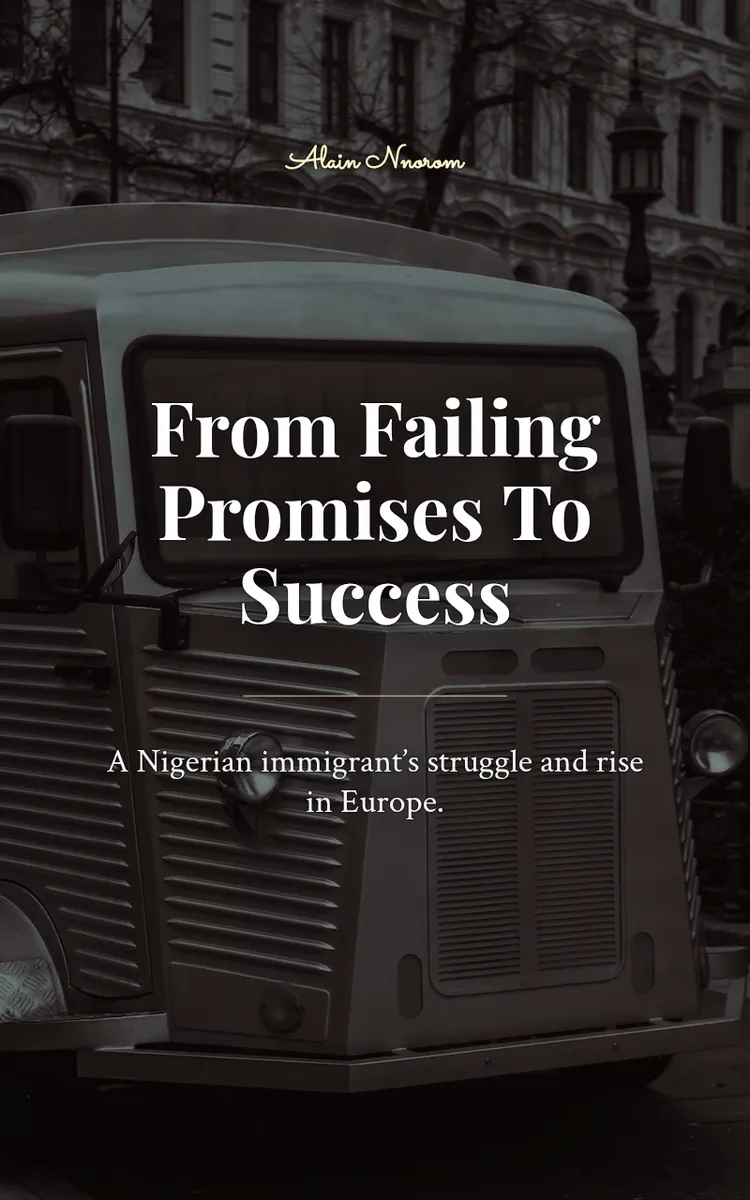
"From Failing Promises To Success" is a biography book by Alain Nnorom with 8 chapters and approximately 19,891 words. Nigerian migration to Europe, street struggles, and eventual success.
This book was created using Inkfluence AI, an AI-powered book generation platform that helps authors write, design, and publish complete books. It was made with the AI Biography Writer.
Frequently Asked Questions
What is "From Failing Promises To Success" about?
Nigerian migration to Europe, street struggles, and eventual success
How many chapters are in "From Failing Promises To Success"?
The book contains 8 chapters and approximately 19,891 words. Topics covered include Leaving Nigeria After Government Promises, Using Good Grades to Find Real Work, Crossing the City to Avoid Deportation, Following Leads Through a Closed Office, and more.
Who wrote "From Failing Promises To Success"?
This book was written by Alain Nnorom and created using Inkfluence AI, an AI book generation platform that helps authors write, design, and publish books.
How can I create a similar biography book?
You can create your own biography book using Inkfluence AI. Describe your idea, choose your style, and the AI writes the full book for you. It's free to start.
Write your own biography book with AI
Describe your idea and Inkfluence writes the whole thing. Free to start.
Start writingCreated with Inkfluence AI


