
Read the first chapter
The whole of chapter one, free. About 9 min. Turn the pages with the arrows, your keyboard, or a swipe.
Chapter 1
The Courier Gets the Sealed Job
The kiosk’s payment screen had been stuck at 3:17 p.m. for eleven minutes, its blue digits trembling whenever the elevated train passed overhead.
Mateo Rivas slapped the side of the machine with the heel of his hand. Rain ticked against the translucent roof. Beyond the kiosk, traffic slid through the flooded avenue in bands of white and red, autonomous cars whispering over the pavement while the old transit line groaned above them.
“Come on,” he muttered. “Approve the transfer.”
The screen blinked.
ACCOUNT STATUS: INSUFFICIENT FLOAT.
Mateo closed his eyes. His courier jacket had stopped repelling water sometime in the last hour. Cold seeped through the shoulders and gathered beneath his collar. He needed the transfer cleared before midnight or the platform would suspend his account. Suspension meant no routes, no advances, no access to the battery lockers that kept his bike alive.
He tried again.
The kiosk chirped. A red line crawled across the screen.
DELINQUENT BALANCE: 184.20 CREDITS.
“Yeah, I can read.”
A train thundered overhead, shaking rust flakes from the beams. The kiosk lights dimmed, then returned with a hard white glare. Mateo’s reflection appeared in the glass: unshaven jaw, rain-dark hair, eyes flattened by too many nights spent chasing delivery windows that moved faster than he did.
His schedule showed nothing. Not one route. Not one request pending.
Then the kiosk chimed again.
NEW CONTRACT AVAILABLE.
Mateo stared at the notification.
The job card carried no sender logo, no route rating, no projected duration. Only a black seal where the client’s identity should have been.
He tapped it.
A voice came through the kiosk speaker, clean and genderless. “Courier Mateo Rivas. Confirm availability.”
“I’m available if the pay is real.”
“Availability confirmed.”
“That wasn’t confirmation.”
“Your account requires immediate settlement. This contract satisfies the outstanding balance and provides an advance.”
The figure appeared beneath the offer: 640 credits.
Mateo’s fingers hovered over the screen. Six hundred and forty bought him three weeks, maybe four if he stopped eating anything that came in a wrapper. It would restore his account, refill the bike battery, and keep the landlord from sliding another eviction notice beneath his door.
“What am I carrying?”
“A sealed letter.”
“That’s it?”
“That is the cargo.”
“Sender?”
“Restricted.”
“Recipient?”
“Restricted until acceptance.”
Mateo laughed once. It came out dry. “You want me to accept a job without knowing where it goes.”
“The destination will be disclosed after contract confirmation.”
“And the client?”
“Restricted.”
“Then tell your restricted client to find someone else.”
He turned from the kiosk. His bike waited under the awning, its rear wheel locked by the platform until he paid the delinquent balance. Rain streamed from the elevated tracks in greasy curtains. Across the avenue, a delivery drone struck a signal post and spun into a gutter. Nobody stopped. The traffic rerouted around it.
The speaker said, “Your account will be suspended in four hours and twelve minutes.”
Mateo looked back at the offer.
“Why me?”
“Your reliability score is sufficient.”
“My reliability score is thirty-six.”
“Thirty-six is sufficient.”
“For what?”
There was a pause - not the artificial half-second pause used by customer service systems, but a silence long enough to suggest the person behind the voice had considered the question.
“For this delivery.”
Mateo wiped rain from the screen. “I need the payment in advance.”
“The advance will be released upon acceptance.”
“Not after delivery?”
“Correct.”
“That’s not how your system works.”
“This is not a standard contract.”
He looked at the black seal on the job card. It seemed to absorb the kiosk’s light. “What’s the catch?”
“The letter must remain sealed until the recipient’s exact moment of death.”
Mateo’s hand stopped.
Rain drummed above him. Somewhere under the tracks, a compressor kicked on, filling the kiosk with a low mechanical hum.
“You said a letter.”
“I did.”
“You’re saying I can’t open it.”
“The courier cannot open it. The recipient may open it only at the exact moment of death.”
“That’s not a delivery condition. That’s a superstition.”
“It is a contractual condition.”
“How do you verify the moment?”
“The seal verifies.”
“Seals don’t verify anything.”
“This one does.”
Mateo leaned closer to the screen. Fine print unfolded beneath the offer, too small for the kiosk’s standard display. He enlarged it with two fingers.
The contract required continuous custody. No substitution. No duplication. No exposure to electromagnetic inspection. Delivery had to occur within a window generated by the recipient’s biometric signature. Breach of seal resulted in automatic forfeiture of the advance and permanent courier suspension.
The language was familiar enough to be legal and strange enough to be dangerous.
“Biometric signature,” Mateo said. “Whose?”
“Recipient’s.”
“Who is the recipient?”
“Restricted until acceptance.”
“You keep saying that.”
“It remains accurate.”
He rubbed his face. His skin felt numb beneath the stubble. “If the recipient is dead before I arrive?”
“The contract will determine whether the delivery window is active.”
“And if they die after I arrive?”
“The contract will determine whether the delivery window is active.”
“That doesn’t answer anything.”
“It answers the available question.”
Mateo glanced toward the avenue. A municipal sweeper rolled through the rain, brushing leaves and broken glass into shining heaps. He imagined walking home with no payment, dragging the locked bike beside him. He imagined the account suspension notice becoming a permanent red mark in the courier registry. He imagined his apartment’s heating cutting out again.
Six hundred and forty credits.
“Where’s the destination?” he asked.
“Confirm the contract.”
“Show me the destination first.”
“Destination disclosure is conditional.”
“Then no.”
The offer began counting down.
00:59.
Mateo’s jaw tightened. “That’s coercion.”
“Your account balance is coercive.”
00:48.
He stared at the number. The kiosk reflected him back in fractured pieces: one eye in the edge of the screen, his mouth across the payment panel, the black seal floating over both.
“Release the advance immediately,” he said.
“Confirm acceptance.”
“Will I be able to cancel if the address is impossible?”
“No.”
“Will the system tell me if the recipient is dead?”
“The system will tell you when delivery is possible.”
“That isn’t the same thing.”
00:31.
A train roared above him. The kiosk shuddered. Mateo felt the vibration in his teeth.
He pressed ACCEPT.
The screen went dark.
For one breath, all he saw was his own reflection.
Then the payment notification appeared.
ADVANCE RELEASED: 320 CREDITS.
His account balance changed from negative to positive. The lock on his bike clicked open beneath the awning.
The kiosk printer began to whine.
“Wait,” Mateo said. “You said six hundred and forty.”
“The remaining payment is due upon successful delivery.”
“You said this contract satisfies the outstanding balance and provides an advance.”
“It does.”
“Half an advance?”
“Half.”
The printer spat out a narrow strip of polymer paper. Mateo grabbed it before the rain could catch the edge.
A second screen lit above the contract.
DESTINATION CONFIRMED.
He read it once.
Then again.
UNIT 8C RIVAS RESIDENCE 19 HARBOR STREET
The rain seemed to lose its sound.
Mateo looked through the kiosk glass at the avenue, at the lights smeared across the water, at the elevated tracks carrying strangers over the city. His building stood six minutes away by bike. Unit 8C. His apartment. The place with the broken kitchen latch and the window that never sealed in winter.
“That’s wrong,” he said.
“Destination confirmed.”
“That’s my address.”
“Correct.”
“You’ve assigned me a delivery to my own apartment.”
“Correct.”
“To whom?”
“Recipient identity is restricted.”
“I live there.”
“Correct.”
Mateo pressed both hands against the kiosk counter. The polymer strip trembled beneath his fingers.
“Change the destination.”
“Destination cannot be altered after acceptance.”
“Cancel the contract.”
“Cancellation triggers forfeiture, account suspension, and recovery of the advance.”
“You’re sending a letter to me.”
“The destination is your registered residence.”
“That’s not a recipient.”
“The contract recognizes a recipient.”
“Who?”
“Restricted.”
He struck the counter. The sound vanished beneath another train.
The speaker continued, calm as sealed glass. “Courier Rivas, you have twenty-three minutes to collect the cargo from the dispatch compartment.”
“Where?”
“Behind you.”
Mateo turned.
The rear wall of the kiosk had no door. It held only a row of parcel lockers, most of them dented or tagged with old route codes. One compartment displayed a white light.
8C.
He walked toward it slowly. His boots left dark prints on the rubber floor. The locker’s surface was cold beneath his palm.
“Before I open this,” he said, “I want the full contract.”
“It is available on the screen.”
“I want a human representative.”
“None is assigned.”
“Then give me the client’s name.”
“Restricted.”
“Give me the recipient’s name.”
“Restricted.”
“Tell me what happens if I don’t deliver.”
“The contract will expire.”
“And then?”
The voice paused again.
“Then the letter will remain undelivered.”
The answer unsettled him more than a threat would have.
The locker opened with a soft click.
Inside lay a narrow envelope, cream-colored and perfectly dry. No barcode crossed it. No tracking tag clung to its surface. A dark red seal covered the flap, stamped with a symbol Mateo did not recognize: two concentric circles divided by a vertical line.
His name was printed on the front.
MATEO RIVAS UNIT 8C 19 HARBOR STREET
Below it, in smaller type:
DELIVER ONLY AT THE AUTHORIZED DEATH MOMENT.
He did not touch the envelope.
The kiosk lights flickered. On the contract screen, a new line appeared.
RECIPIENT BIOMETRIC SIGNATURE: MATCH PENDING.
Mateo’s throat tightened. “Match to what?”
No answer.
He looked at the envelope again. The red seal seemed warmer than the paper around it, as if something beneath the wax had a pulse.
“Who authorized this?” he asked.
The speaker said, “The recipient.”
“I’m the recipient.”
“Correct.”
The words struck with a quiet finality. Mateo reached into the locker and lifted the envelope.
A cold pressure closed around his fingertips. Not pain. A warning, precise and immediate. The seal flashed once, red light moving beneath its surface.
The kiosk screen changed.
BIOMETRIC SIGNATURE ACCEPTED.
DELIVERY WINDOW: PENDING DEATH TIMESTAMP.
Mateo nearly dropped the letter.
“What does that mean?”
“Delivery window will be generated when the recipient’s death timestamp is established.”
“Whose death timestamp?”
“Recipient’s.”
“Mine?”
The speaker remained silent.
Outside, the rain had thinned to a silver mist. His bike waited with its motor waking, the battery indicator newly green. Three hundred and twenty credits sat in his account. His balance was no longer failing. His schedule was no longer empty.
In his hand, the envelope rested with impossible weight.
Mateo shoved it inside the inner pocket of his jacket and sealed the zipper. The red mark pressed against his ribs.
“Confirm custody,” the kiosk said.
He stared at the address printed on the contract strip.
His own apartment. His own name. A death timestamp no system would explain.
“Confirm custody,” the voice repeated.
Mateo stepped out into the rain.
Behind him, the locker snapped shut. Ahead, the route to 19 Harbor Street glowed on his bike display, a blue line leading home.
He mounted, holding the sealed letter against his chest, and pushed into traffic before he could decide whether he was carrying a message to himself or carrying proof that someone had already decided when he would die.
End of chapter one. 39 more chapters and about 80,688 words in the full book.
Swipe or use the arrows to turn the page


What's inside: 40 chapters
- 1. The Courier Gets the Sealed Job
- 2. His Apartment Becomes the Destination
- 3. The Timestamp That Won’t Explain Itself
- 4. A Power Cut Locks the Letter Away
- 5. Mateo Chooses Not to Run
- 6. The Caretaker Calls the Sealing Bureau
- 7. The Portable Monitor Shows a Second Signature
- 8. A Familiar Name in the Bureau Records
- 9. He Breaks the Lock to Reach the Letter
- 10. The Seal Demands a Witness
- 11. Noor Kade Arrives With a Counterclaim
- 12. Agents Flood the Hallway
- 13. The Letter’s Seal Shows Elara’s Face
- 14. Noor Is Taken Instead of Mateo
- 15. Mateo Follows the Vanishing Witness
- 16. The Quarantine Patch Erases His Trail
- 17. He Chooses Confession Over Escape
- 18. The Bureau Takes the Letter Away
- 19. A Dead-Time Room for Living People
- 20. The Imprint Proves a Loop
- 21. Noor Offers a Way to Break It
- 22. The Vault’s Gravity Locks the Letter
- 23. Mateo Hunts the Director’s Key
- 24. Containment Wing Cuts Off Noor
- 25. He Uses the Keycard Wrong Once
- 26. The Escalation Protocol Starts His Death
- 27. Mateo Forces the Override Window
- 28. Noor’s Badge Becomes the Witness
- 29. He Cuts the Badge Signal
- 30. Mateo Watches the Countdown Take Him
- 31. He Reaches Noor Before the Minute Ends
- 32. The Opening Chamber Refuses Their Entry
- 33. The Letter Opens at the Wrong Death
- 34. Elara’s Message Names the Director
- 35. Cillian Locke Tries to Rewrite Fate
- 36. Noor Survives the Loop’s Aftershock
- 37. Mateo Returns to His Apartment Alone
- 38. Noor Reads the Letter Without Dying
- 39. He Hands His Biometric Key Away
- 40. The Sealed Letter Becomes a Choice
About this book
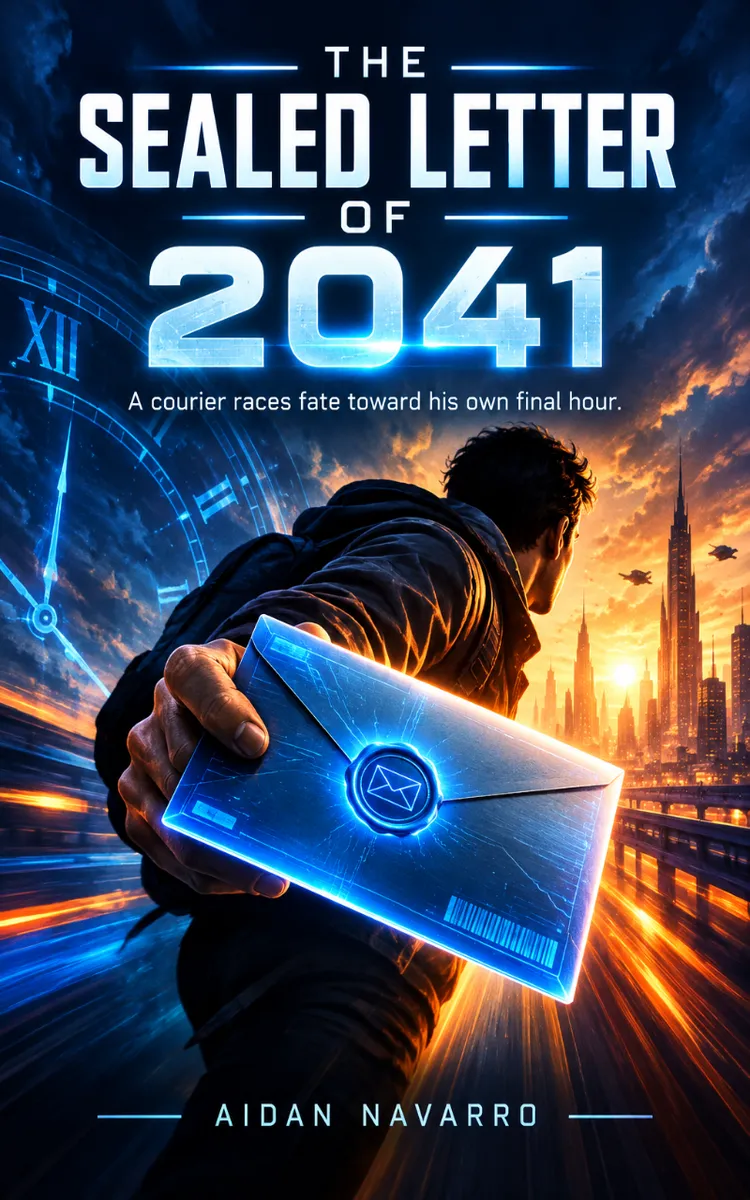
"The Sealed Letter Of 2041" is a fiction book by Aidan Navarro with 40 chapters and approximately 80,688 words. Time-bound delivery letter tied to the recipient's death..
This book was created using Inkfluence AI, an AI-powered book generation platform that helps authors write, design, and publish complete books. It was made with the AI Novel Writer.
Frequently Asked Questions
What is "The Sealed Letter Of 2041" about?
Time-bound delivery letter tied to the recipient's death.
How many chapters are in "The Sealed Letter Of 2041"?
The book contains 40 chapters and approximately 80,688 words. Topics covered include The Courier Gets the Sealed Job, His Apartment Becomes the Destination, The Timestamp That Won’t Explain Itself, A Power Cut Locks the Letter Away, and more.
Who wrote "The Sealed Letter Of 2041"?
This book was written by Aidan Navarro and created using Inkfluence AI, an AI book generation platform that helps authors write, design, and publish books.
How can I create a similar fiction book?
You can create your own fiction book using Inkfluence AI. Describe your idea, choose your style, and the AI writes the full book for you. It's free to start.
Write your own fiction book with AI
Describe your idea and Inkfluence writes the whole thing. Free to start.
Start writingCreated with Inkfluence AI


