

Read the first chapter
The whole of chapter one, free. About 6 min. Turn the pages with the arrows, your keyboard, or a swipe.
Chapter 1
Redefining Self-Esteem as Evidence
The Approval Loop You Keep Calling Confidence
Last Tuesday, you sent a message to a client and checked your phone before the screen had even gone dark. No reply. You reread your words, found a sentence that might sound too blunt, and started drafting a follow-up. Then you stopped yourself. You didn’t want to look needy, so you posted something online instead: polished, upbeat, and just vulnerable enough to invite praise.
A few likes arrived. Your shoulders dropped. For ten minutes, you felt steady. Then someone else posted a bigger win, a sharper opinion, a better-looking result. The feeling slipped away. You reached for another affirmation, another compliment, another sign that you were doing fine. By bedtime, you’d spent the day asking other people to hold up a version of you that you didn’t fully trust.
The pattern often looks productive from the outside. You make a plan, announce it, buy the notebook, repeat “I’m disciplined,” and wait for the confidence to appear. But when the real moment arrives - making the call, setting the boundary, finishing the task - you bargain with yourself. You want certainty before action. You want approval before commitment. Do you recognise this in yourself?
The Question Beneath “Do I Feel Confident?”
What if confidence isn’t something you need to feel before you act, but something you earn by giving yourself proof?
That question changes the job completely. Approval-seeking asks, “Do they think I’m capable?” Empty affirmations ask, “Can I make myself feel capable?” The Evidence Before Emotion Model asks something more useful: “What did I promise myself, and did I follow through?”
Self-esteem isn’t built through affirmations alone. Saying “I’m confident” while repeatedly breaking small promises creates an uncomfortable split. Your mouth says one thing. Your memory says another. Somewhere beneath the positive language, you know whether you showed up.
Consider a gym owner who says, “I’m going to get organised this week,” then spends every evening reacting to messages. Before the shift, he waits for motivation and posts a confident statement about his goals. After the shift, he chooses one five-minute promise: at 4:30 each afternoon, he reviews tomorrow’s bookings and writes down the first task. He keeps that promise for five days. Nothing dramatic happens. But on the sixth morning, he trusts himself a little more. Not because he feels transformed. Because his memory contains evidence.
That evidence matters when the day gets messy. The promise is small enough to keep and specific enough to prove. Confidence grows from the accumulated record: “I said I would do this. I did it. I can rely on myself.” Approval may still feel pleasant, but it no longer carries the whole weight of your self-worth.
How Approval-Seeking Becomes Self-Doubt
The loop is easier to change when you can see its machinery:
• When you feel uncertain about a decision, you look outside yourself for reassurance.
• You feel temporary relief when someone agrees, praises you, or responds positively.
• So you hand over the decision-making job again, checking reactions instead of checking your own standards.
• Which leads to weaker self-trust, because your brain records that you needed permission to move.
The alternative chain is quieter but stronger:
• When you feel uncertain about a decision, you choose one small commitment within your control.
• You feel discomfort while carrying it out, because action rarely arrives with a marching band.
• So you complete the commitment without waiting for applause.
• Which leads to earned self-trust, because your brain records that you can act without external permission.
Notice the difference. The goal isn’t to stop caring what people think. That would be unrealistic and, frankly, a strange way to live. The goal is to stop using their reactions as your main evidence.
A useful commitment might be sending the proposal by 10 a.m., taking a ten-minute walk after lunch, or telling a customer, “I can complete that by Friday, not tomorrow.” Each one gives you a clean result. Kept or not kept. No performance required.
Confidence is not a mood you wait for; it is a record you build.
Rate the Evidence You Already Have
Use these questions honestly. Don’t give yourself the score that sounds mature. Give yourself the score that matches your recent Tuesday.
• On a scale of 1-10, how often do you keep promises to yourself that take less than fifteen minutes?
A high score suggests your daily evidence is already supporting self-trust. A low score usually means your promises are too vague, too large, or too easy to postpone.
• Yes or no: Do you often announce a goal before you’ve completed the first small action?
“Yes” may reveal that public approval is replacing private follow-through. “No” suggests you’re protecting the action from unnecessary pressure and letting results speak first.
• On a scale of 1-10, how quickly does praise lose its effect?
A high number means approval may be giving you a short lift but not lasting security. A lower number can indicate that you’re beginning to value your own judgment more than the audience’s reaction.
• Yes or no: When you break a promise, do you repair it with a smaller promise, or simply make a new ambitious one?
“Smaller promise” shows practical self-respect. “New ambitious one” often reveals a cycle of guilt, overcorrection, and another broken commitment.
Here’s the interpretation guide: scores of 8-10 or mostly grounded “no” answers suggest you’re building a dependable evidence base. Scores from 5-7 point to a mixed record; choose fewer commitments and make them more precise. Scores below 5, or mostly “yes” answers to approval-seeking questions, don’t mean you’re hopeless. They mean your current system is asking for promises you don’t consistently keep. Start with one that takes five minutes.
The Five-Minute Evidence Challenge
Choose one promise small enough to keep and clear enough to measure.
• Name the promise today. Write one action on paper, not in a vague note on your phone. Use this format: “At [exact time], I will [visible action] for [short duration].” Example: “At 7:15 tonight, I will place tomorrow’s work clothes by the door.”
Timing: 3 minutes to choose and write it.
Difficulty: Easy.
• Keep it before seeking feedback. Complete the action tomorrow at the stated time. Don’t post about it, tell anyone, or wait until you feel ready. Put a checkmark beside it immediately afterward. If you miss the time, reschedule it once within the same day and reduce the task.
Timing: 5-15 minutes, depending on the promise.
Difficulty: Medium.
• Record the evidence, not the emotion. At the end of the day, write two lines: “I promised…” and “I did…” If you didn’t keep it, write what made the promise unrealistic and choose a smaller version for the next day.
Timing: 2 minutes for three days.
Difficulty: Medium.
You’ll know it’s working when:
• You check the promise before checking for someone else’s reaction.
• You feel a little less pressure to announce what you’re going to do.
• You recover from a missed commitment by adjusting it instead of attacking yourself.
Don’t make the challenge impressive. Impressive promises are often where self-trust goes to die. A promise like “I’ll rebuild my entire routine” gives you a grand statement and no dependable proof. A promise like “I’ll open the invoice at 9:00 and work for five minutes” gives you something your mind can verify.
The Proof You Carry Forward
Self-esteem becomes steadier when your private actions stop contradicting your public words.
• Affirmations can point toward a belief, but kept commitments give that belief weight.
• Approval feels good, yet it cannot become a reliable foundation for self-respect.
• The Evidence Before Emotion Model puts action first: promise, follow-through, record.
• Small commitments work because they create repeatable proof without demanding a personality transplant.
You don’t need to become fearless before trusting yourself. You need to become more accurate about what you promise, then more faithful about what you keep. Each completed commitment is a quiet vote for your reliability. Over time, those votes matter more than a compliment, a like, or a confident sentence repeated into the mirror.
The next question is unavoidable: once you can trust yourself with one small promise, what larger promise are you ready to make - and keep?
End of chapter one. 7 more chapters and about 11,600 words in the full book.
Swipe or use the arrows to turn the page


What's inside: 8 chapters
- 1. Redefining Self-Esteem as Evidence
- 2. Auditing Your Broken Promises
- 3. Choosing Commitments You Can Keep
- 4. Making Follow-Through Automatic
- 5. Setting Boundaries Without Self-Betrayal
- 6. Recovering After You Miss a Promise
- 7. Building Courage Through Repeated Proof
- 8. Living by Values You Can Practice
About this book
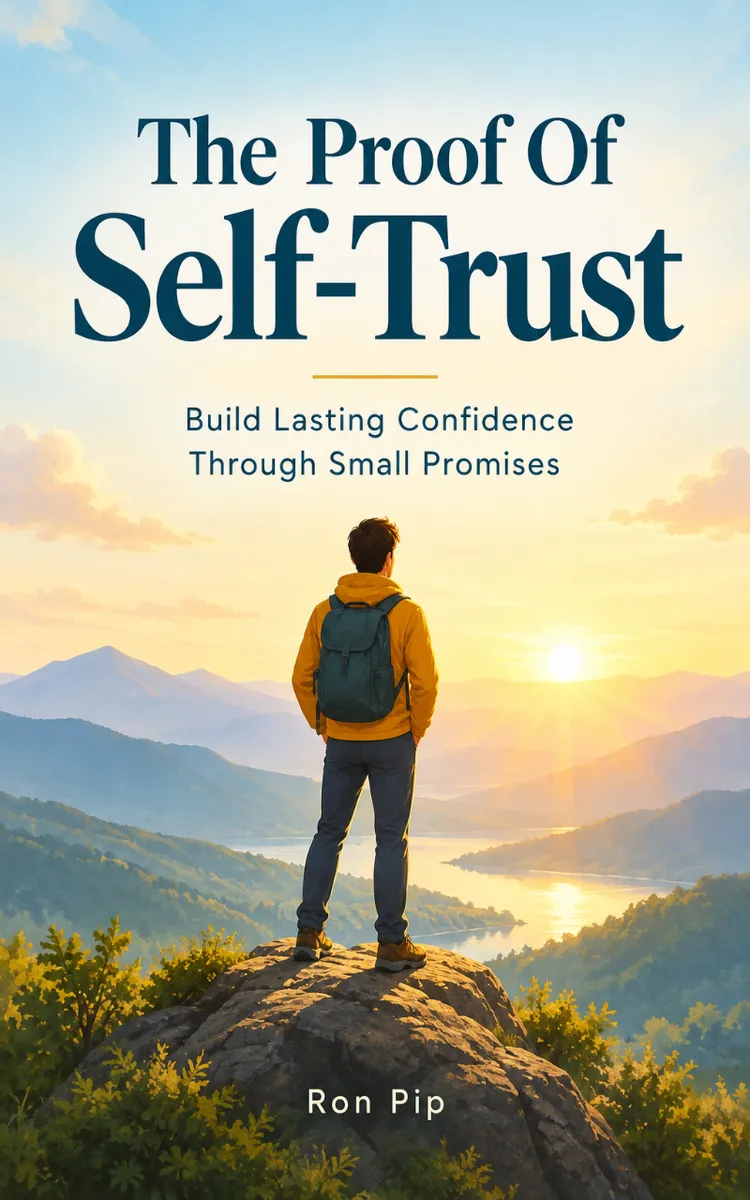
"The Proof Of Self-Trust" is a self-help book by Ron Pip with 8 chapters and approximately 11,600 words. Building self-esteem by keeping small commitments to yourself.
This book was created using Inkfluence AI, an AI-powered book generation platform that helps authors write, design, and publish complete books. It was made with the AI Self-Help Book Writer.
Frequently Asked Questions
What is "The Proof Of Self-Trust" about?
Building self-esteem by keeping small commitments to yourself
How many chapters are in "The Proof Of Self-Trust"?
The book contains 8 chapters and approximately 11,600 words. Topics covered include Redefining Self-Esteem as Evidence, Auditing Your Broken Promises, Choosing Commitments You Can Keep, Making Follow-Through Automatic, and more.
Who wrote "The Proof Of Self-Trust"?
This book was written by Ron Pip and created using Inkfluence AI, an AI book generation platform that helps authors write, design, and publish books.
How can I create a similar self-help book?
You can create your own self-help book using Inkfluence AI. Describe your idea, choose your style, and the AI writes the full book for you. It's free to start.
Write your own self-help book with AI
Describe your idea and Inkfluence writes the whole thing. Free to start.
Start writingCreated with Inkfluence AI


